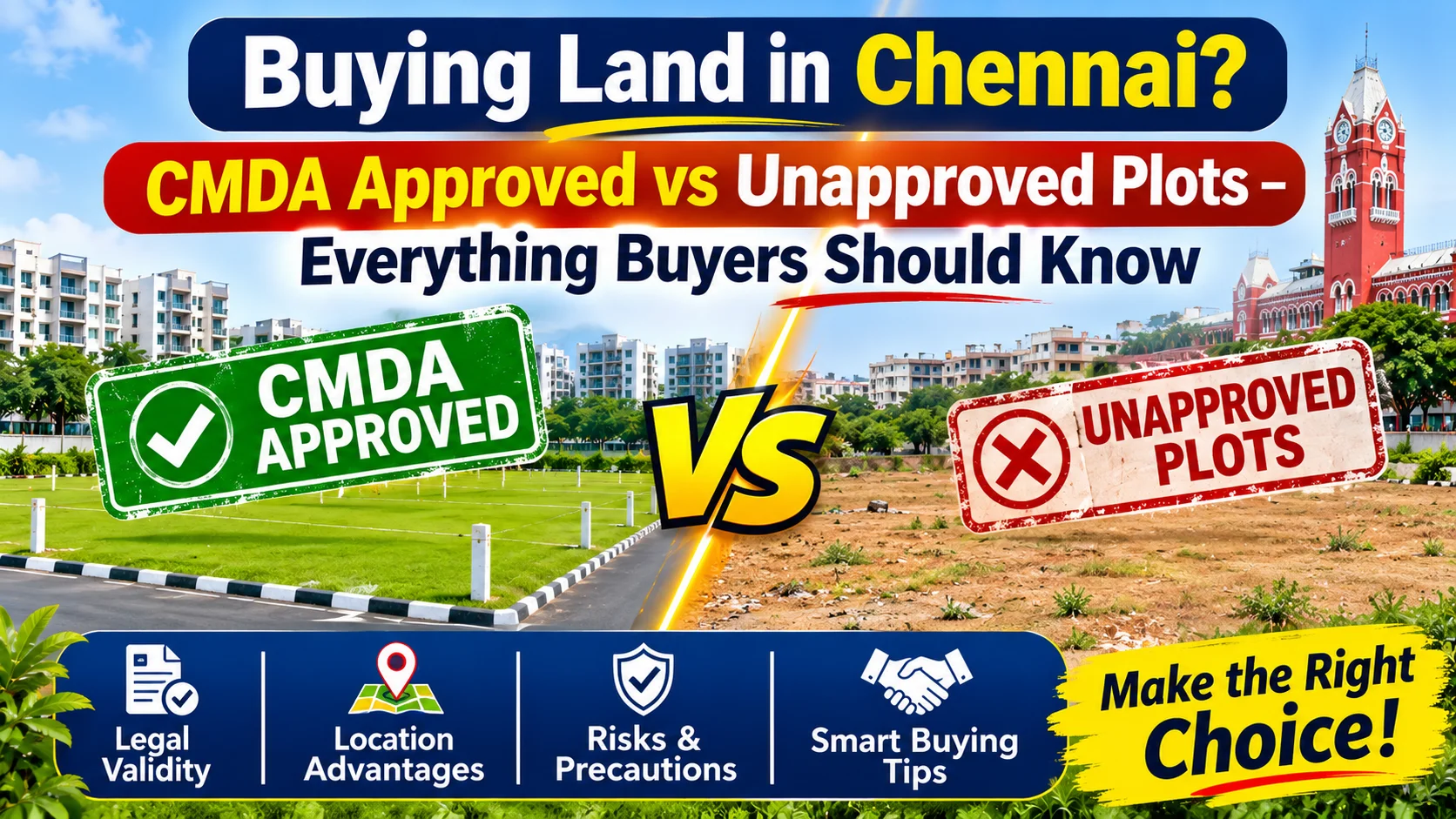
Purchasing a residential plot in Chennai is an important step towards owning a home and building long-term financial security. Unlike buying a ready-to-occupy apartment, purchasing land gives buyers the flexibility to construct a house according to their family requirements, preferred design, and budget. As Chennai continues to expand towards developing residential corridors, demand for individual plots has increased in several locations. Areas such as Tambaram, Medavakkam, Guduvanchery, Perungalathur, Poonamallee, Avadi, and Thirumazhisai attract buyers looking for residential land and future investment opportunities. However, finding the right location is only one part of purchasing land. The legal status and planning approval of the property are equally important. During a property search, buyers frequently encounter two types of listings: CMDA-approved plots and unapproved plots. Both may have attractive advertisements, clearly marked boundaries, and similar road access. Yet, their legal and planning status can be very different. An unapproved plot may initially appear more affordable, but it could create difficulties when applying for building permission, obtaining a bank loan, or selling the property later. On the other hand, purchasing an approved plot does not eliminate the need for ownership verification and other legal checks. In this detailed guide, we will explain how plot approvals work in Chennai, the difference between approved and unapproved layouts, the documents required for verification, possible legal complications, land prices, regularization procedures, and the precautions buyers should take before purchasing a residential plot.
1. Understanding CMDA Approval in Chennai
The Chennai Metropolitan Development Authority (CMDA) is the planning authority responsible for regulating and guiding planned development within the Chennai Metropolitan Planning Area. Its planning responsibilities include examining development proposals and regulating land use and layout development in accordance with applicable planning regulations. When a landowner or developer wants to convert a larger piece of land into smaller residential plots, the proposed layout may require planning permission from the competent authority. The approval process examines whether the proposed development satisfies the relevant planning requirements.
A properly approved residential layout generally contains important information such as
- Total land extent and survey numbers.
- Individual plot numbers and dimensions.
- Internal road alignment and road widths.
- Access to existing roads.
- Areas reserved for public purposes.
- Open-space reservations, where applicable.
- Other planning requirements and approval conditions.
For a buyer, these details are important because they help establish whether the specific plot being advertised is actually included in the sanctioned layout.
2. What Exactly Is a CMDA-Approved Residential Plot?
A CMDA-approved residential plot is a plot included in a layout that has received the necessary planning approval from CMDA or the legally competent authority under the applicable planning framework. Such approval indicates that the proposed layout has been examined against relevant planning requirements.
For example, consider a developer who purchases two acres of land and proposes to divide it into 40 residential plots.
Before marketing the plots as an approved residential development, the developer must obtain the required planning permission and comply with applicable layout conditions. Once the layout is approved, buyers can examine the sanctioned plan to verify their individual plot.
A buyer should check the following details:
- Plot number: The number mentioned in the sale documents should match the plot shown in the sanctioned layout.
- Survey number: The land survey and subdivision details should correspond with the approval records.
- Plot measurements: The width, length, and total area should match the actual property.
- Road access: The approved layout should clearly indicate the relevant access roads.
- Planning conditions: Any reservations, restrictions, or conditions affecting the plot should be examined.
One important point is that layout approval and building permission are not the same. Even after purchasing an approved plot, the owner must obtain the applicable building permission before constructing a house.
3. What Is an Unapproved Plot and Why Is It Sold at a Lower Price?
An unapproved plot generally refers to land divided or developed into plots without obtaining the required layout or subdivision planning permission from the competent authority. This situation can occur when agricultural or larger vacant land is divided into smaller portions and marketed as residential plots without completing the applicable planning procedures. Some buyers come across these properties through individual landowners, local brokers, or small property advertisements. The selling price may be considerably lower than the price of an approved plot in the same general area.
However, the lower price does not necessarily mean that the buyer is getting a better investment. For instance, a seller may offer a 1,000 sq. ft. plot at a discounted price and provide a registered sale deed. The buyer may feel that the purchase is safe because the property can be registered. But registration of a transaction, ownership rights, and planning approval are separate legal matters. A registered sale deed does not automatically establish that the land subdivision is approved for residential development. Similarly, a patta does not independently establish layout approval. Before purchasing such land, buyers must investigate whether the property is eligible for any applicable regularization scheme, whether its title is clear, and whether lawful residential construction is possible.
4. CMDA Approved vs Unapproved Plots: Which Is Better for Buyers?
The main difference between these two types of properties is their planning status and the level of uncertainty associated with their development.
| Important factor | CMDA-approved plot | Unapproved plot |
| Layout permission | Required approval obtained | Required approval not obtained |
| Approved drawing | Available for verification | May not be available |
| Plot identification | Can be checked against the sanctioned plan | May have layout discrepancies |
| Building permission | Considered subject to building regulations | May be restricted until legal compliance or registration |
| Registration | Subject to applicable registration requirements | May face registration restrictions |
| Bank financing | Generally easier to evaluate | Financing may be difficult. |
| Resale prospects | Generally more straightforward | Buyer confidence may be lower. |
| Planning risk | Lower when approval is geniune and applicable | Higher |
| Legal verification | Still necessary | Requires particularly careful investigation |
An approved plot is generally preferable for someone who wants to construct a house without taking unnecessary planning-related risks. Nevertheless, buyers should not treat approval as a substitute for checking ownership, encumbrances, survey boundaries, land classification, and environmental restrictions.
5. CMDA vs DTCP Approval: Understanding the Difference
Another common confusion among Chennai property buyers is the difference between CMDA approval and DTCP approval. Both are associated with planning regulation in Tamil Nadu, but their geographical jurisdictions differ.
CMDA – Chennai Metropolitan Development Authority: CMDA regulates planned development within the Chennai Metropolitan Planning Area. Buyers purchasing plots within this jurisdiction should verify the relevant planning permission with CMDA or the legally competent authority.
DTCP – Directorate of Town and Country Planning: DTCP oversees town and country planning functions in areas outside the Chennai Metropolitan Planning Area through the relevant planning authorities and regional offices.
CMDA vs. DTCP comparison
| Feature | CMDA | DTCP |
| Full name | Chennai Metropolitan Development Authority | Directorate of Town and Country Planning |
| Planning jurisdiction | Chennai Metropolitan Planning Area | Relevant areas outside CMDA jurisdiction |
| Main function | Metropolitan development planning | Regional and local planning |
| Approval verification | CMDA or competent authority | Relevant DTCP/LPA or competent authority |
| Property coverage | Depends on the notified metropolitan boundary | Depends on the applicable planning jurisdiction |
Which approval is required for your plot?
The answer depends on the exact location and planning jurisdiction of the land.
For example, a property advertised as being in the Chennai outskirts may fall within a different planning jurisdiction from another property nearby.
6. Why Should Buyers Prefer Approved Plots?
Purchasing a plot is not just about acquiring a piece of land. It is also about ensuring that the property can serve its intended purpose. A family purchasing land to construct a home may have several requirements, including a proper access road, residential land use, building permission, and access to basic infrastructure. Approved plots generally provide a clearer starting point for these requirements.
6.1 Greater clarity regarding planning status
The sanctioned layout plan provides a reference for understanding how the land has been divided and developed.
Buyers can check the location, dimensions, and position of their individual plot against the approved drawing.
6.2 Better preparation for house construction
A buyer purchasing land for an independent house should understand the applicable building regulations before finalizing the property.
For instance, someone planning a ground-plus-one house should check the permitted building use, setbacks, road width, height restrictions, and other relevant requirements.
An approved layout can help establish the planning status of the site, but separate building permission is still necessary.
6.3 More transparent property transactions
When the approval documents, title records, and survey details are consistent, buyers and their legal advisers can examine the property more systematically.
This can reduce uncertainty during the purchase process.
6.4 Better financing opportunities
Banks generally evaluate the legal status of land before offering plot loans or construction finance.
An approved layout with clear ownership records may make the property easier to evaluate. However, financing is never guaranteed and depends on the lender's eligibility and valuation requirements.
6.5 More confidence during resale
A future buyer may ask for the approved layout plan, sale deed, patta, EC, and other supporting documents.
Having a properly documented property can make the verification process more straightforward.
7. Documents Required Before Buying a Residential Plot in Chennai
Document verification is one of the most important parts of purchasing land. A buyer should not transfer money simply because a property agent or developer claims that the land has clear documents. Every document serves a different purpose. The following records should be examined before signing the sale agreement.
7.1 Parent Documents
Parent documents establish the historical ownership of the property. They help trace how the land passed from one owner to another. A property lawyer should examine the ownership chain and verify that the seller has the legal right to transfer the property.
The examination should include:
- Previous registered sale deeds.
- Partition or settlement deeds, where applicable.
- Inheritance and legal-heir documents, where applicable.
- Gift or release deeds, where applicable.
- Relevant court orders, if ownership was affected by litigation.
- Do not rely on a single recent sale deed when the property's ownership history requires further examination.
7.2 Sale Deed
The sale deed is the registered instrument recording the transfer of property ownership.
Before purchasing, confirm that the document contains the correct:
- Seller and buyer details.
- Survey and subdivision numbers.
- Plot number.
- Land extent.
- Four boundaries.
- Property description.
- Registration details.
- Relevant rights and easements.
The property description must match the plot being purchased on the ground.
7.3 Patta
Patta is a revenue record maintained by the Tamil Nadu Revenue Department. It contains information about the recorded landholder and relevant survey details. Buyers should verify the name, survey number, subdivision, extent and land classification. However, patta is not a replacement for a registered title investigation. It also does not establish CMDA approval.
7.4 Encumbrance Certificate (EC)
An EC is used to identify registered transactions and certain registered encumbrances affecting a property during the selected period. It is useful for checking whether there are registered mortgages, sale transactions or other recorded instruments. A buyer should request an EC covering the relevant ownership period rather than relying only on a recent short-duration certificate. An EC is not a complete guarantee that the property has no legal disputes or unregistered claims.
7.5 Approved Layout Plan
This is particularly important when purchasing a plot in a residential layout. The sanctioned drawing should be checked against the property documents and actual site.
Verify:
- Layout approval number.
- Approval date.
- Name of the authority.
- Survey numbers covered.
- Individual plot number.
- Plot measurements.
- Road alignment.
- Open-space reservations.
- Any special conditions affecting the property.
A marketing brochure or an approval reference printed on an advertisement is not a substitute for the complete sanctioned plan.
7.6 Field Measurement Book (FMB) Sketch
The FMB sketch helps establish the recorded measurements and boundaries of land in the revenue survey records. It can help buyers and surveyors compare the land description with the actual property. A licensed surveyor should inspect the site and identify potential encroachments or boundary discrepancies.
7.7 Land Classification and Zoning Records
Buyers must understand whether the proposed property use is permitted under the applicable planning regulations.
A land parcel may have an agricultural classification, residential zoning, industrial designation or other land-use restrictions.
The fact that nearby houses have been constructed does not automatically mean that the specific plot is legally suitable for residential construction.
7.8 Other Relevant Documents
Depending on the property, additional verification may include:
- Tax receipts.
- Property subdivision records.
- Legal access documents.
- Release deeds.
- Court orders.
- Acquisition notifications.
- Waterbody and drainage-related records.
- Applicable NOCs and statutory clearances.
The exact document requirement depends on the property's history and location.
8. How to Verify CMDA Approval Online Before Purchasing Land
Many buyers ask how they can independently check whether a plot is CMDA-approved.
The safest method is to obtain the approval details from the seller and verify them with the relevant authority.
Follow this process.
Step 1: Collect the plot information
Ask the seller for the complete property details, including the village name, survey number, subdivision number, plot number and layout name.
Step 2: Obtain the approval reference
Request the approval number, approval date and complete sanctioned layout drawing.
Step 3: Visit the official CMDA website
Visit the official website to find planning information and relevant approval-related services.
Visit the official CMDA website
Step 4: Check the layout regularisation portal where relevant
If the seller claims that an unapproved layout has been regularised, request the actual regularisation order and approved plan.
Visit the CMDA layout regularisation portal
Step 5: Match the survey and plot details
Check that the plot being offered is actually covered by the approval or regularisation order.
Step 6: Obtain confirmation from the competent authority
If there is any discrepancy, contact the relevant planning authority instead of relying on a broker's explanation.
Step 7: Complete independent legal verification
Ask a property lawyer to examine the title and supporting records before paying the final purchase amount.
9. Can Unapproved Plots Be Regularised in Tamil Nadu in 2026?
One of the most frequently asked questions among land buyers is whether an unapproved plot can be converted into an approved plot. Tamil Nadu introduced the Regularisation of Unapproved Layouts and Plots Rules, 2017, to address certain historical unapproved layouts and subdivisions. The scheme provides a framework under which eligible plots and layouts can be examined for regularisation, subject to the applicable requirements. However, buyers must understand that regularisation is not an automatic right.
What is the eligibility condition?
The original 2017 framework covered specified unapproved layouts where any or all plots had been sold and registered on or before 20 October 2016, and specified unapproved individual plots registered by that date. The applicable rules have subsequently been amended. A January 2026 amendment and a later July 2026 government announcement have changed aspects of the application process and timelines. The July announcement refers to an extension until 30 June 2027 for eligible layout applications under the stated conditions. Buyers should check the latest applicable government order before relying on any deadline.
How does the regularisation process work?
The general process involves two stages.
Stage 1: Layout-level examination
The competent planning authority examines the layout and considers its conformity with applicable requirements. An in-principle layout framework plan may be issued.
Stage 2: Individual plot-level examination
The concerned local body examines ownership, access and other requirements. Applicable regularisation and development charges must be paid before the final regularisation order and plan are issued, where approved.
What can make a plot ineligible?
Some properties may face restrictions because of their location or legal status.
Examples include:
- Government-owned land.
- Waterbodies and watercourses.
- Land reserved for public purposes.
- Properties affected by certain road alignments.
- Land with prohibited development restrictions.
- Plots without legally acceptable access.
- Other categories excluded by the applicable rules.
11. Which Chennai Locations Should You Consider for Buying Residential Plots?
Chennai has several residential corridors that attract individual homebuyers and land investors. The right location depends on the buyer's budget, intended construction timeline, workplace connectivity and long-term requirements.
- Tambaram
Tambaram is an established residential and commercial centre in South Chennai.
Its railway connectivity, educational institutions, healthcare facilities and road network make it a location worth considering for families.
Buyers should compare the different neighbourhoods around Tambaram rather than assuming that all plots have similar prices and facilities.
- Medavakkam
Medavakkam has developed into an important residential location due to its connectivity to Velachery, Pallikaranai, Sholinganallur and other parts of South Chennai.
Its access to employment corridors and residential facilities makes it relevant for buyers looking for land for future house construction.
- Guduvanchery
Guduvanchery is located along the GST Road corridor and has attracted residential development.
It is worth researching for buyers seeking residential plots with access to railway connectivity and developing neighbourhood infrastructure.
- Perungalathur
Perungalathur benefits from railway connectivity and access to important road networks.
The locality and surrounding areas offer different residential options, but buyers should carefully examine drainage, road access and site conditions.
- Poonamallee
Poonamallee is an important western Chennai growth corridor.
Its access to industrial, commercial and residential areas makes it a location worth evaluating for long-term residential land requirements.
- Avadi
Avadi is an established residential location with railway connectivity and access to various employment centres.
Buyers should check the exact locality, road width, water availability and planning jurisdiction before purchasing a plot.
- Thirumazhisai
Thirumazhisai is another developing residential location in the western Chennai region.
It may appeal to buyers exploring plots for future residential construction, subject to careful examination of location-specific development and planning conditions.
- Kelambakkam
Kelambakkam is situated along the Old Mahabalipuram Road growth corridor.
Its proximity to educational institutions and IT employment areas makes it a location that buyers may consider for residential land.
Important location advice: Never assume that all plots in a particular neighbourhood are approved. Approval must be verified for the exact survey number and layout.
12. What Is the Difference Between Buying Land for Investment and Buying Land for Building a House?
Not every buyer purchases land for the same reason. Some want to construct a house immediately, while others purchase plots as a long-term investment. Understanding your purpose before selecting a property can help you make a better decision.
Buying land to construct a house
If your intention is to build a home within the next few years, prioritise:
- Verified residential planning approval.
- Clear and marketable ownership title.
- Legally recognised road access.
- Applicable building permission eligibility.
- Water and electricity availability.
- Drainage and flood-risk assessment.
- Proximity to schools, hospitals and workplaces.
For a family planning a ground-floor or duplex house, checking the applicable building regulations before purchasing is particularly important.
Buying land as a long-term investment
If your intention is to hold the property for several years, consider:
- Future infrastructure development.
- Residential demand in the locality.
- Employment opportunities nearby.
- Road and transport connectivity.
- Current market transactions.
- Land-use restrictions.
- Legal approval and resale potential.
An investment should not depend entirely on the expectation that a government project or infrastructure development will increase land prices. The property's current legal status and market value should make sense independently.
13. What Should You Check During a Physical Plot Inspection?
A site visit is just as important as document verification. Sometimes, the documents may appear correct, but the actual property conditions may not suit the buyer's requirements.
1. Plot boundaries: Check whether the physical boundaries match the dimensions mentioned in the sale deed and approved layout.
2. Road width: Measure or independently verify the road width and check whether the access is legally recognised.
3. Surrounding development: Observe whether neighbouring properties are residential, commercial, agricultural or vacant.
4. Water availability: Ask neighbouring residents about groundwater conditions and existing water facilities.
5. Drainage facilities: Check whether rainwater flows away from the plot or accumulates during heavy rainfall.
6. Electricity access: Verify the availability of electricity infrastructure and the process for obtaining a connection.
7. Flood history: Speak with nearby residents and investigate previous waterlogging incidents.
8. Nearby facilities: Check the distance to schools, hospitals, markets, public transport and essential services.
9. Physical encroachments: Look for fencing disputes, unauthorised structures or occupation by third parties.
10. Surrounding land use: Investigate whether nearby developments or planning restrictions could affect your future construction.
A second site visit during or immediately after rainfall can also help buyers understand drainage conditions.
14. Plot Buying Process in Chennai: From Property Search to Registration
For first-time land buyers, understanding the purchase process can make the experience easier and reduce avoidable mistakes.
Here is a practical sequence to follow:
- Decide your budget and location
Identify your total budget, preferred neighbourhood and intended use of the land.
- Shortlist suitable plots
Compare plot sizes, location, road access and advertised prices.
- Check planning approval
Obtain the sanctioned layout plan and verify it with the competent authority.
- Complete legal verification
Examine parent documents, sale deeds, EC, patta and other relevant records through a property lawyer.
- Inspect the property
Visit the site, verify measurements and check physical conditions.
- Sign the sale agreement
Record the agreed price, payment schedule, property details and conditions for completing the sale.
- Arrange payment and registration
Complete the necessary payment formalities and register the sale deed at the appropriate Sub-Registrar Office.
- Complete post-registration formalities
Collect the registered documents and apply for relevant revenue-record updates, where applicable.
A buyer should not skip legal verification just because the seller is offering a limited-time discount or an attractive price.
15. How Can First-Time Buyers Avoid Property Fraud in Chennai?
Land transactions require careful attention because buyers may not be familiar with survey records, ownership documents and planning regulations.
Some warning signs deserve additional investigation.
- The seller refuses to provide the parent documents.
- The approval number cannot be independently verified.
- The survey number differs across documents.
- The seller offers an unusually low price without a reasonable explanation.
- Multiple people claim ownership of the same property.
- The road shown in the brochure is missing at the actual site.
- The seller promises guaranteed regularisation without official proof.
- The seller insists on receiving a large advance immediately.
- The property has unresolved boundary or ownership disputes.
Never sign blank documents or transfer a substantial amount without checking the seller's ownership and the property's legal status. For high-value transactions, independent advice from a property lawyer and licensed surveyor is a sensible precaution.
Conclusion
For most homebuyers planning to construct a residential property in Chennai, a genuinely approved plot with clear ownership documents is generally the more prudent choice. It provides a clearer planning framework, makes building permission evaluation more straightforward and can improve buyer confidence during future resale. Unapproved plots may appear attractive because of their lower advertised prices. However, their legal and planning status must be investigated carefully. Regularisation may be possible for certain eligible properties, but it should never be assumed. A plot should be evaluated based on more than its price or location. The buyer must understand the ownership history, planning approval, land classification, road access, physical condition and applicable construction regulations. Ultimately, a good land purchase is one where the buyer understands exactly what is being purchased, what can legally be done with the property and what responsibilities come with ownership. For anyone planning to buy land in Chennai, verify the documents first, inspect the property carefully and make the purchase only after completing independent legal checks.
Frequently Asked Questions
1. What is the difference between CMDA-approved and unapproved plots in Chennai?
A CMDA-approved plot forms part of a layout that has obtained the required planning approval from the competent authority. An unapproved plot belongs to a development that has not obtained the necessary planning permission. The difference can affect construction permission, registration eligibility, financing and resale.
2. Is it safe to buy an unapproved plot in Chennai?
Buying an unapproved plot involves additional legal and planning risks. Before purchasing, buyers should verify ownership, land classification, registration eligibility, road access and regularisation possibilities. It is generally preferable to select a properly approved plot.
3. Can I construct a house on an unapproved plot?
Construction permission may be refused for an unapproved plot or subdivision. The property must satisfy applicable planning requirements and obtain the necessary approval or regularisation, where legally permitted, before construction.
4. Does having patta mean the plot is CMDA-approved?
No. Patta is a revenue record that identifies the recorded landholder and land details. It does not automatically establish layout approval or permission for residential construction.
5. Can an unapproved plot be registered in Tamil Nadu?
Registration eligibility depends on the applicable registration laws, planning permissions and the property's circumstances. A registered transaction also does not automatically regularise an unapproved layout.