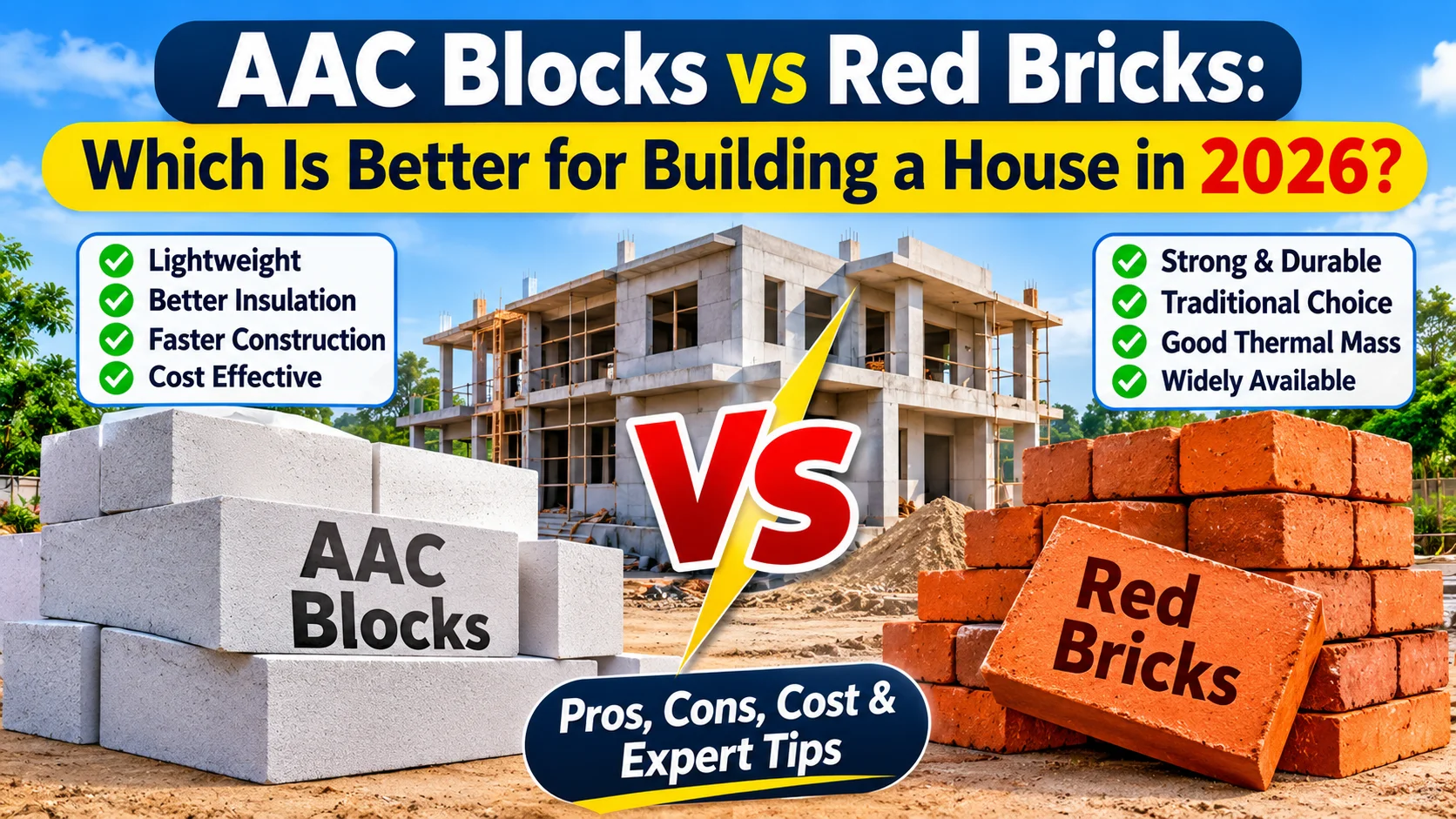
Choosing the right building material is one of the most important steps when planning a new house. The material used for wall construction affects the overall construction budget, building weight, indoor temperature, labor requirements, and long-term performance. In India, red bricks have been a traditional choice for residential construction for many years. However, AAC (autoclaved aerated concrete) blocks are becoming increasingly popular in modern homes, apartments, and independent residential buildings. One of the biggest questions homeowners ask is whether AAC blocks are actually cheaper than red bricks. Although AAC blocks may have a higher price per unit, they cover a larger wall area and generally require less jointing material. Red bricks may have a lower individual purchase price, but more units and mortar are needed to complete the same wall. This guide compares both materials in detail, including estimated 2026 prices, cost per square foot of wall, labor expenses, material requirements, construction performance, advantages, disadvantages, and suitability for Chennai homes.
1. What Are AAC Blocks?
AAC blocks are lightweight construction materials manufactured using cement, lime, silica-rich materials such as sand or fly ash, water, and a small quantity of aluminum powder. During manufacturing, the mixture expands and develops tiny air pockets. It is then hardened using high-pressure steam in an autoclave. This process produces lightweight blocks with relatively uniform dimensions.
Main characteristics of AAC blocks
- Lightweight compared with conventional red brick masonry.
- Larger dimensions, requiring fewer units per wall.
- Good thermal insulation.
- Uniform manufacturing dimensions.
- Easier cutting and shaping.
- Suitable for internal and external walls.
- Compatible with specialized thin-bed adhesives.
AAC blocks are widely used in modern RCC-framed residential buildings because they can reduce the weight of non-structural masonry walls.
2. What Are Red Bricks?
Red bricks are traditional building materials manufactured using natural clay. The clay is molded, dried, and fired in kilns to develop the required hardness and strength. They are widely used in Indian construction for external walls, internal partitions, and other masonry applications.
Main characteristics of red bricks
- Manufactured using natural clay.
- Available through many local suppliers.
- Familiar to traditional construction workers.
- Suitable for different masonry applications.
- Provide thermal mass.
- Available in different quality and strength classes.
The quality of red bricks depends on the raw material, firing temperature, manufacturing method, and supplier.
3. AAC Blocks vs. Red Bricks—Complete Comparison
| Comparison | AAC Blocks | Red Bricks |
| Raw Material | Cement, lime, sand/fly ash | Natural clay |
| Weight | Lightweight | Generally heavier |
| Dimensions | Larger units | Smaller units |
| Installation | Faster | Comparatively slower |
| Mortar | Thin-based adhesive commonly used | Cement mortar |
| Thermal insulation | Generally better | Depends on wall design |
| Sound installation | Depends on wall density and thickness | Depends on wall mass and thickness |
| Water absorption | Porous | Varies by quality |
| Cutting | Easier | More difficult |
| Structural dead load | Lower | Higher |
| Labor requirements | Often lower | Often higher |
| Purchase price per unit | Generally higher | Generally lower |
| Overall wall cost | Project-dependent | Project-dependent |
| Availability | Depends on supplier network | Widely available |
The important difference is that the cost and performance of a complete wall cannot be determined by comparing one AAC block with one red brick.
4. AAC Blocks vs Red Bricks Price Comparison in Chennai – 2026
Price is one of the biggest factors homeowners consider before starting construction. In Chennai, the price of AAC blocks and red bricks varies depending on the manufacturer, block thickness, brick quality, order quantity, transportation, and supplier. For a practical comparison, the following are indicative Chennai market prices from October to November 2026.
A. AAC block price list in Chennai
| AAC Block size | Approximate price per block |
| 4-inch (600*200*100 mm) | Rs 48-55 |
| 5-inch (600*200*125 mm) | Rs 60-65 |
| 6-inch (600*200*150 mm) | Rs 65-75 |
| 8-inch (600*200*200 mm) | Rs 85-95 |
These are indicative rates, not guaranteed quotations. One Chennai supplier lists 4-inch AAC blocks at Rs 48.85, 6-inch at Rs 69.85, and 8-inch at Rs 89.85. Another November price list gives Rs 49 for 4-inch and Rs 71 for 6-inch blocks. Transportation and tax treatment should be checked separately.
B. Red brick price list in Chennai
| Red brick category | Approximate price per brick |
| Country bricks | Rs 8-10 |
| Standard chamber bricks | Rs 10-12 |
| Selected higher-quality bricks | Rs 11-14 |
A Chennai supplier quoted approximately Rs 10.62 per chamber brick, including delivery, before GST, on 28 October 2026. Country bricks were quoted at approximately Rs 8.80 per brick. Actual prices depend on quality and order quantity.
C. Direct material price comparison
| Material | Approximate unit price |
| 4-inch AAC Block | Rs 49 |
| 6-inch AAC Block | Rs 70 |
| 8-inch AAC Block | Rs 90 |
| Country red brick | Rs 8.80 |
| Chamber red brick | Rs 10.62 |
At first glance, red bricks appear much cheaper because their individual purchase price is lower. However, one AAC block covers considerably more wall area than one red brick. This is why homeowners should compare the cost per square foot of wall rather than the cost per piece.
5. How Many AAC Blocks and Red Bricks Are Required for 100 Sq Ft of Wall?
This calculation helps homeowners understand the actual material requirement.
For the following illustration, we use:
- AAC block face size: 600 × 200 mm.
- Red brick approximate size: 9 × 4 × 3 inches.
- AAC wall thickness: 4 inches or 6 inches.
- Red brick wall thickness: approximately 4.5 inches or 9 inches.
- Standardized mortar joints for brickwork.
- No deduction for doors or windows.
External wall comparison
For an external wall, a common practical comparison is a 6-inch AAC wall against a 9-inch red brick wall, subject to the architect's design.
| Particulars | 6-inch AAC | 9-inch red brick |
| Wall area | 100 sq ft | 100 sq ft |
| Approximate units | 78 | 1,000 |
| Unit price | Rs 70 | Rs 10.62 |
| Material cost | Rs 5,460 | Rs 10,620 |
| Material cost per sq ft | Rs 54.60 | Rs 106.20 |
This comparison illustrates why a lower price per brick does not necessarily mean a lower wall-material cost.
Important: The wall thicknesses, thermal performance, strength, and finishing specifications must be checked before treating these as alternative designs.
7. Total Construction Cost: AAC Blocks vs. Red Bricks
Material price is only one part of the construction budget. A homeowner should also account for adhesive, cement, sand, labor, and plastering. The following figures are useful preliminary budgeting ranges for Chennai. They are not fixed contractor rates.
| Cost component per sq ft of wall | AAC Blocks | Red bricks |
| Main wall material | Rs 40-70 | Rs 55-110 |
| Jointing material | Rs 8-15 | Rs 15-25 |
| Masonry labor | Rs 20-35 | Rs 30-45 |
| Masonry subtotal | Rs 68-120 | Rs 100-180 |
The figures are broad planning allowances, not a verified quotation or a like-for-like rate card. The red brick range varies substantially with wall thickness and brick quality. Plastering, mesh, painting, transport, scaffolding, and GST may be additional. A Chennai construction comparison published in May 2026 estimates AAC masonry at Rs 145–Rs 170 per sq ft and red brick masonry at Rs 125–Rs 155 per sq ft, illustrating that AAC can carry a higher upfront installed cost in some projects. The precise inclusions should be confirmed before using these figures in a contractor comparison.
8. Construction Labor Cost—Which Material Requires More Labor?
Labor expenses can make a noticeable difference to the total wall construction budget.
AAC block masonry labor
AAC blocks are larger and lighter, which allows workers to cover more wall area with fewer units.
The work generally involves:
- Marking the wall layout.
- Preparing the surface.
- Applying suitable AAC adhesive.
- Positioning and aligning blocks.
- Checking vertical and horizontal levels.
- Cutting blocks around openings.
- Completing joints and finishing.
Because the units are larger, the masonry process can be faster when workers are trained in AAC installation.
Red brick masonry labor
Traditional brickwork involves placing individual bricks in rows using cement mortar.
The process includes:
- Preparing the foundation or supporting surface.
- Soaking bricks when required by the masonry method.
- Preparing cement-sand mortar.
- Arranging bricks in the correct bonding pattern.
- Maintaining uniform mortar joints.
- Checking wall alignment.
- Completing joints and surface preparation.
More individual units need to be positioned, which can increase the time required.
9. Plastering Cost – AAC Blocks vs. Red Bricks
Plastering is necessary to create a smooth surface before painting or applying other finishes. The plastering requirement can vary depending on the surface quality of the masonry.
Plastering AAC block walls
AAC blocks generally have more uniform dimensions and a relatively even surface. This can help achieve a consistent plaster finish. However, AAC block walls need compatible plastering materials and appropriate surface preparation. Mesh reinforcement may be required at specified junctions and locations to reduce cracking.
10. Strength Comparison – Which Material Is More Reliable?
Strength is not determined by appearance or weight alone. The compressive strength of AAC blocks depends on their density, grade, and manufacturing quality. Red brick strength depends on the clay, firing process, and classification.
For homeowners, the following checks are important:
| Strength-related factor | AAC Blocks | Red Bricks |
| Compressive strength | Depends on block grade | Depends on brick class |
| Weight | Lower | Higher |
| Wall stability | Depends on design and workmanship | Depends on design and workmanship |
| Heavy fixture support | Requires suitable anchors | Requires suitable anchors |
| Load-bearing application | Requires engineered approval | Requires engineered approval |
AAC blocks are commonly used as infill walls in RCC-framed buildings. Red bricks can also be used in framed buildings and in appropriately designed load-bearing masonry.
Remember: Neither material should be selected for a load-bearing application without checking the structural design.
11. Water Absorption, Rain Protection and Maintenance
Moisture protection is important for houses in Chennai because of seasonal rainfall and humidity.
AAC block walls
AAC blocks have a porous internal structure. They need suitable external plastering, waterproof coatings where required and proper protection from prolonged moisture exposure.
Red brick walls
Red bricks also absorb water. Poor-quality bricks may absorb excessive moisture and cause efflorescence or plaster-related problems.
How to prevent moisture problems
- Use tested and suitable building materials.
- Provide proper damp-proofing.
- Apply waterproofing in bathrooms and wet areas.
- Protect external walls against rainwater penetration.
- Ensure proper roof and balcony drainage.
- Repair plumbing leaks promptly.
- Avoid leaving exposed masonry without suitable protection.
Both materials can provide durable walls when moisture protection is correctly designed and executed.
12. Environmental Impact – Which Is Better for Sustainable Homes?
Sustainable construction is becoming an important consideration in residential development. AAC blocks can incorporate fly ash, depending on the manufacturer. Their lightweight properties and thermal insulation may also provide benefits throughout the building's lifecycle. However, cement production and autoclaving consume energy. Red bricks use natural clay, but traditional kiln firing can cause air pollution and greenhouse gas emissions. Clay extraction can also affect land resources.
A fair environmental comparison should consider:
- Raw material sourcing.
- Manufacturing energy.
- Transportation distance.
- Construction wastage.
- Building lifespan.
- Operational energy consumption.
Neither material should automatically be labelled completely eco-friendly. The manufacturer and production method matter.
13. Which Material Is Better for Different Types of Houses?
| Building type | Material worth considering | Main reason |
| Independent house | AAC or red brick | Depends on budget and design |
| Duplex house | AAC block | Lightweight wall construction |
| Multi-storey apartment | AAC block | Reduced masonry dead load |
| Budget residential project | Compare both | Local supply and installed cost |
| Luxury home | AAC Blocks | Thermal insulation and uniformity |
| Internal partiions | AAC Block | Larger units and easier installation |
| Exteral walls | Both | Depends on thickness and weather protection |
Depends on thickness and weather protection
14. Step-by-Step Guide to Selecting the Right Material
Before purchasing construction materials, follow these steps.
Step 1: Finalise the building plan
Identify the external walls, internal walls, partition walls and any walls requiring special acoustic or fire performance.
Step 2: Consult the structural engineer
Confirm which wall material, thickness and grade are suitable for the building design.
Step 3: Collect local supplier quotations
Get at least two or three quotations for both materials.
Step 4: Calculate the wall area
Use the architectural drawings to calculate the exact masonry area.
Step 5: Compare the complete cost
Include material, transportation, adhesive, mortar, labour, plastering and wastage.
Step 6: Verify product quality
Request test certificates and check the relevant Indian Standard.
Step 7: Check labour experience
Ensure the construction team understands the selected masonry system.
Step 8: Inspect the construction
Monitor wall alignment, joints, junction treatment and moisture protection during execution.
Conclusion
AAC blocks and red bricks both have important roles in Indian residential construction. However, the choice should depend on the requirements of the house rather than simply following traditional construction practices. AAC blocks are particularly useful for modern homes where lightweight construction, faster masonry work and thermal insulation are priorities. They are also a practical choice for non-load-bearing walls in RCC-framed apartment buildings. Red bricks remain a reliable option for homeowners who prefer traditional construction, have access to good-quality materials and want to work with familiar masonry techniques. For Chennai homeowners, AAC blocks are worth considering because of their thermal insulation and reduced masonry weight. However, proper waterproofing, installation and finishing are essential. Before finalising your decision, compare the price per square foot of completed wall, including material, adhesive or mortar, labour and plastering. The best construction material is not necessarily the cheapest one. It is the material that delivers the right combination of quality, safety, comfort and long-term value for your home.
Frequently Asked Questions
1. What is the price of AAC blocks in Chennai in 2026?
The indicative price of 4-inch AAC blocks is approximately Rs 48–Rs 55 per block, 6-inch blocks Rs 65–Rs 75 and 8-inch blocks Rs 85–Rs 95. Prices vary by brand, quantity and transportation.
2. What is the price of red bricks in Chennai in 2026?
Standard chamber red bricks generally cost around Rs 10–Rs 12 per piece, while country bricks may cost approximately Rs 8–Rs 10. Final prices depend on quality and delivery location.
3. Which is cheaper, AAC blocks or red bricks?
AAC blocks can offer a competitive wall construction cost because fewer units are required and thin-bed adhesive reduces jointing material. Red bricks may have a lower purchase price per unit. Compare the complete installed cost before deciding.
4. How many AAC blocks are required for 1,000 sq ft of wall?
Approximately 775 AAC blocks with a 600 × 200 mm face are required for 1,000 sq ft of wall, excluding wastage. Around 814 blocks can be budgeted with 5% additional quantity.
5. How many red bricks are required for 1,000 sq ft of wall?
Approximately 5,000 red bricks may be required for 1,000 sq ft of conventional 4.5-inch brick masonry. The actual requirement depends on brick dimensions and mortar joints.
6. Which material is better for Chennai's climate?
AAC blocks generally provide better thermal insulation and can help reduce heat transfer through external walls. Both materials require suitable waterproofing and finishing.
7. Are AAC blocks suitable for G+2 and G+3 buildings?
Yes. AAC blocks are commonly used for non-load-bearing walls in multi-storey RCC-framed buildings. The structural engineer must approve the wall specifications.
8. Do AAC blocks require special cement?
AAC blocks commonly use specially formulated thin-bed block adhesive rather than conventional thick cement-sand mortar for laying. Follow the manufacturer's recommendations.
9. Can red bricks be used for external walls?
Yes. Good-quality red bricks can be used for external walls with suitable wall thickness, plastering and weather protection.
10. Which material is faster to construct?
AAC blocks generally allow faster masonry construction because their dimensions are larger and fewer units are required to cover the same wall area.