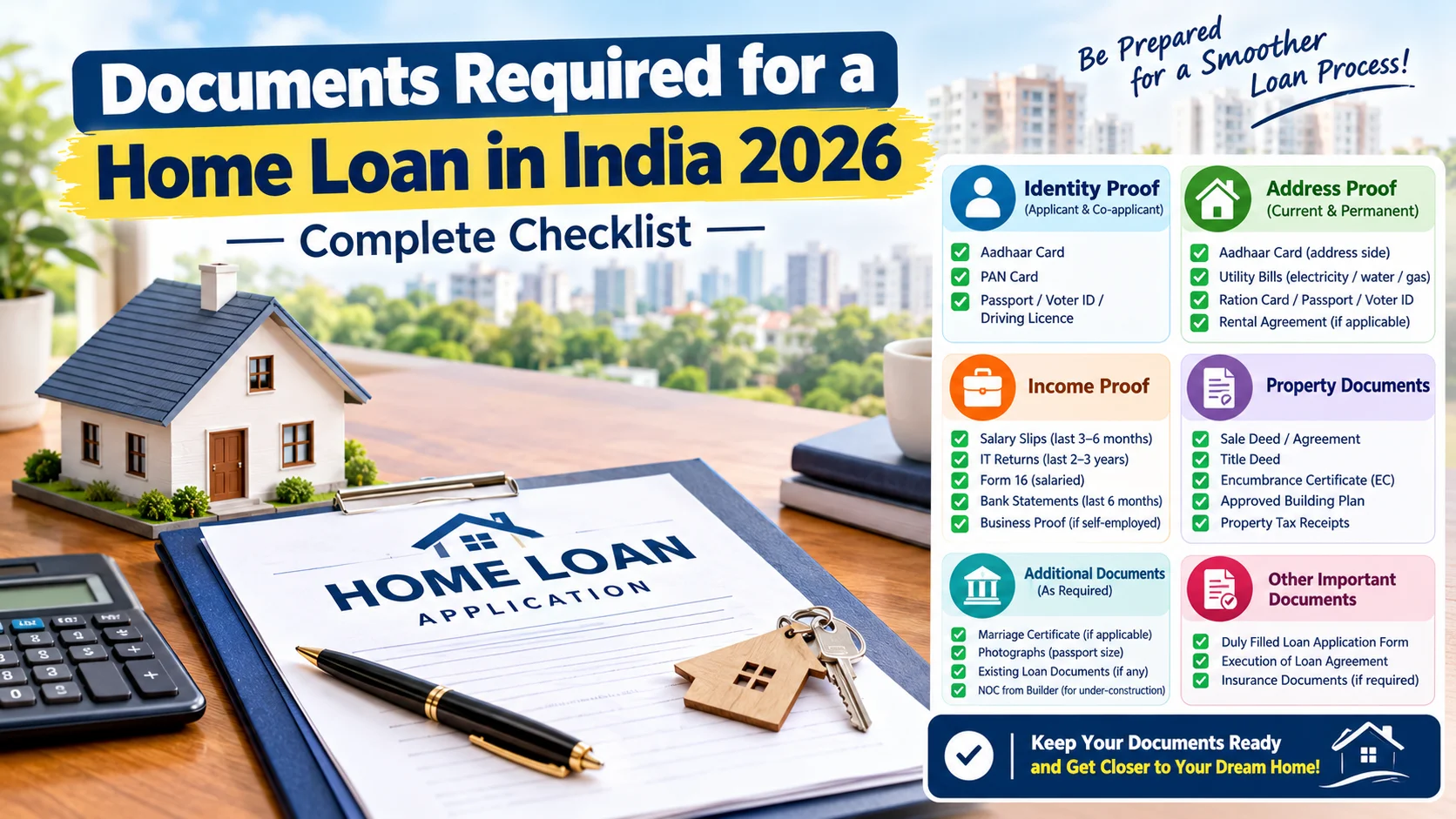
Buying a home is an important financial decision, and a home loan can help make property ownership more affordable. However, before approving a home loan, banks and housing finance companies verify the applicant’s identity, income, employment, repayment capacity, credit history, and property documents. Understanding the documents required for a home loan in India in 2026 can help you prepare your application properly, reduce unnecessary delays, and make the loan approval process easier. Whether you are a salaried employee, self-employed professional, business owner, or first-time homebuyer, this guide explains the essential documents you may need when applying for a home loan in India.
1. What Are the Documents Required for a Home Loan in India?
The documents required for a home loan generally fall into five categories:
- Identity proof and address proof
- Income proof and employment or business documents
- Bank statements and financial records
- Property-related documents
- Additional documents, depending on the applicant and property type
The exact requirements vary between lenders and depend on whether you are purchasing a ready-to-move apartment, an under-construction property, a resale flat, an independent house, or a plot with a construction loan.
2. Identity Proof Documents for a Home Loan
Banks need to verify the identity of the borrower before processing a home loan application.
Commonly accepted identity documents include:
- Aadhaar card, where accepted for the relevant verification purpose
- PAN card
- Passport
- Voter ID card
- Driving licence
Important: PAN is commonly required for financial and tax-related verification. The lender will specify which identity documents are mandatory for your application. Aadhaar should be provided in accordance with applicable requirements and the lender’s verification process. Ensure that your name and other personal details are consistent across the documents you submit. Differences in initials, spelling, or date of birth may require clarification or supporting proof.
Best Home Loan Service in Chennai
3. Address Proof Documents
Address proof helps the lender confirm your current residential address.
You may be asked to submit one or more of the following:
- Aadhaar card, where accepted
- Passport
- Voter ID
- Driving licence
- Recent utility bills, such as electricity or telephone bills
- Registered rent agreement, where accepted
- Bank statement or other officially accepted address proof
If your permanent address and current residential address differ, inform the lender in advance. The bank may request proof for both addresses. For applicants who have recently moved, keeping an updated address record can help avoid verification-related delays.
4. Income Proof Documents for Salaried Employees
Salaried individuals are generally required to provide documents showing their employment status, monthly income, and financial stability.
Essential documents for salaried applicants
1. Latest salary slips
Banks commonly request the latest three months of salary slips, although some lenders may require a different period. These documents help establish your monthly income, deductions, and employment details.
2. Bank statements
You may need to provide bank statements covering the previous three to six months, particularly for the account into which your salary is credited. The lender may request a longer period if necessary.
3. Form 16
Form 16 provides information about salary income and tax deducted at source. It may be requested for the latest financial year or additional years, depending on the lender.
4. Income Tax Returns
Some lenders may request income tax returns or other tax records to verify income, especially when the applicant has variable compensation or additional sources of income.
5. Employment proof
The lender may request an employee ID card, appointment letter, employment certificate, or other proof of current employment.
6. Proof of existing financial commitments
If you already have personal loans, vehicle loans, or other financial obligations, the lender may ask for details of your outstanding balances and monthly repayments.
Additional documents that may be required
- Latest increment letter or revised salary structure
- Details of bonuses and incentives
- Proof of additional income
- Explanation of unusual transactions in bank statements
Providing clear and consistent income records helps the lender assess whether you can comfortably repay the proposed home loan.
5. Income Proof Documents for Self-Employed Applicants
Self-employed professionals, business owners, consultants, and entrepreneurs may need to provide additional financial records because their income may fluctuate from month to month.
Essential documents for self-employed applicants
1. Income Tax Returns
Lenders commonly request income tax returns for the previous two to three financial years, depending on their policies and the applicant’s profile.
2. Financial statements
You may need to submit profit and loss statements, balance sheets, and income computation statements prepared or certified by a chartered accountant, where required.
3. Bank statements
Personal and business bank statements for the previous six to twelve months may be requested to understand cash flow and financial activity.
4. Business proof
Examples include:
- GST registration certificate, where applicable
- Udyam registration, where applicable
- Shop and establishment registration, where applicable
- Partnership deed
- Certificate of incorporation and company registration documents
- Business licence or professional registration, where applicable
5. Business continuity proof
Some lenders require evidence that the business or professional practice has been operating for a specified period.
6. GST returns
If the business is registered under GST, the lender may request GST returns or related filings to verify turnover and business activity.
7. Existing loan details
Details of business loans, overdrafts, credit facilities, and other liabilities may be required to calculate repayment capacity.
The documents needed will depend on the type of business, ownership structure, income pattern, and the lender's assessment criteria.
6. Bank Statements and Financial Documents
Bank statements help lenders understand how you manage your finances and whether your income is sufficient to cover the proposed monthly instalment.
Commonly requested financial documents include:
- Bank statements for the previous three to six months for salaried applicants
- Bank statements for the previous six to twelve months for self-employed applicants, where required
- Details of existing loans and EMIs
- Credit card outstanding information, where requested
- Proof of savings and available funds for the down payment
- Details of fixed deposits or other financial assets, if relevant to the application
These periods are indicative rather than universal. A lender may ask for more extensive records depending on the applicant's profile.
7. Property Documents Required for a Home Loan
Property documents are an essential part of the home loan process. Even if the borrower has a good income and credit history, the lender must verify the property's legal status, ownership, approvals, and value. The exact documents depend on the property type and applicable state regulations.
A. Documents for a ready-to-move apartment
For a ready-to-move flat, the lender may request:
- Registered sale deed or title documents
- Previous title deeds and link documents, where applicable
- Encumbrance Certificate (EC), for the relevant period
- Approved building plan
- Applicable planning or building permission
- Completion Certificate, where applicable
- Occupancy Certificate, where applicable
- Property tax receipts
- Possession letter or handover documents, where applicable
- Sale agreement
- Details of undivided share (UDS) in the land, where relevant
- Seller's identity and ownership documents
- Bank loan closure documents, if the property has an existing mortgage
The lender may also arrange a legal review and technical valuation before approving the loan.
B. Documents for an under-construction apartment
If you are purchasing an under-construction property, you may be asked to submit:
- Builder-buyer agreement or agreement for sale
- Allotment letter
- Builder's title documents
- Approved building plan
- Planning and construction approvals, as applicable
- RERA registration details, where registration is required
- Construction schedule or stage-wise payment demand
- Cost sheet issued by the builder
- Receipts for amounts already paid
- Details of the builder's project approvals
For properties in Tamil Nadu, buyers should verify the relevant approvals and registration details with the appropriate authorities, including TNRERA and the applicable planning or local body authority.
C. Documents for a resale property
For a resale flat or house, lenders may request:
- Existing registered sale deed
- Previous title documents
- Agreement to sell
- Encumbrance Certificate
- Property tax receipts
- Approved building plan and applicable completion or occupancy documents
- Seller's identity proof
- Proof of the seller's ownership
- Existing home loan outstanding statement, if applicable
- Loan closure letter and original document release details, where applicable
If the seller has an outstanding home loan, the buyer's lender may coordinate with the seller's bank to arrange the settlement and release of the original property documents.
D. Documents for a plot or house construction loan
For a plot purchase or construction loan, additional documents may be necessary:
- Registered plot sale deed or title deed
- Previous link documents
- Encumbrance Certificate
- Approved layout plan, where applicable
- Land-use or planning approval, where applicable
- Patta and other relevant land revenue records in Tamil Nadu, where applicable
- Building plan approval for the proposed construction
- Construction estimate prepared by an eligible professional
- Construction agreement, where applicable
- Stage-wise construction details
- Relevant local authority permissions
For a construction loan, the lender may release the sanctioned amount in stages after checking construction progress.
8. Documents Required for a Joint Home Loan
A joint home loan allows eligible applicants to apply together. Depending on the lender's policy, the co-applicant's income may be considered when determining eligibility.
Commonly required documents for each applicant include:
- Identity proof
- Address proof
- PAN and other tax-related documents, as applicable
- Income proof
- Bank statements
- Employment or business proof
- Existing loan details
- Photographs, where requested
- Relationship proof, if required by the lender
If the co-applicant is salaried, salary slips and employment records may be needed. If the co-applicant is self-employed, business and tax records may be requested. Important: A co-applicant does not automatically become a co-owner of the property. Ownership depends on the registered property documents and applicable legal arrangements. Some lenders also have specific rules about eligible co-applicants.
9. Documents Required for an NRI Home Loan
Non-Resident Indians (NRIs) may need to provide additional documents to verify their identity, overseas income, employment, and residential status.
These may include:
- Passport
- Valid visa or residence permit, where applicable
- Overseas address proof
- Employment contract or employer certificate
- Overseas salary slips
- Overseas bank statements
- Tax returns or income documents, where requested
- Indian bank account details, as applicable
- PAN and other Indian financial documents, where required
- Power of Attorney, if a representative is authorised to act on the applicant's behalf
The lender may require attestation, notarisation, or other authentication for overseas documents. The requirements vary by lender and country of residence. NRIs should confirm the latest document checklist with the selected bank or housing finance company before submitting their application.
10. Additional Documents That May Be Required
Depending on your circumstances, the lender may request additional documents.
If you have changed jobs recently
- Previous employment records
- Current appointment letter
- Latest salary slips
- Updated bank statements
If you have additional income
- Rental agreement and evidence of rental receipts
- Investment income statements
- Other income records accepted by the lender
If your name differs across documents
- Marriage certificate, where relevant
- Gazette notification or legally accepted name-change proof, where applicable
- Other supporting documents requested by the lender
If you are purchasing inherited or jointly owned property
- Relevant inheritance or succession documents
- Legal heir documents, where applicable
- Partition deed or release deed, where applicable
- Consent or other documents required from co-owners
The lender may seek additional legal advice where the property's ownership history requires clarification.
11. Complete Home Loan Documents Checklist for 2026
Use the following checklist to organise your documents before applying.
Personal documents
- PAN card
- Accepted identity proof
- Accepted address proof
- Recent photographs, if required
- Marriage certificate or name-change proof, if applicable
Income documents
- Latest salary slips, if salaried
- Form 16 and tax records, if requested
- Income Tax Returns, as applicable
- Bank statements for the required period
- Employment certificate or appointment letter, if required
- Business registration and financial statements, if self-employed
- GST returns, where applicable and requested
- Details of existing loans and EMIs
Property documents
- Sale agreement or agreement for sale
- Registered title deed or seller's title documents
- Previous link documents, where required
- Encumbrance Certificate
- Approved building plan and applicable permissions
- Property tax receipts, where applicable
- RERA details, where applicable
- Completion or Occupancy Certificate, where applicable
- Builder's payment demand or cost sheet, for new projects
- Construction estimate and plan approvals, for construction loans
- Seller's loan details, if the property is already mortgaged
Additional documents
- Co-applicant documents, if applicable
- NRI documents, if applicable
- Down payment proof, if requested
- Existing loan closure documents, if applicable
- Power of Attorney, where required
This checklist is a general guide. Your lender may request additional documents or may not require every item listed.
12. Step-by-Step Home Loan Documentation Process
Step 1: Check your home loan eligibility
Estimate your eligible loan amount based on income, existing EMIs, credit history, age, loan tenure, and the lender's eligibility criteria.
Step 2: Prepare your personal documents
Keep your PAN, identity proof, address proof, and other personal records ready. Check that the information matches across documents.
Step 3: Arrange your income proof
Collect salary slips, bank statements, tax records, or business financial documents according to your employment type.
Step 4: Collect the property documents
Request the relevant documents from the builder or seller. For resale properties, confirm that the ownership and property records are available for the lender's legal review.
Step 5: Submit the loan application
Complete the application form and submit the required documents through the lender's accepted online or offline process.
Step 6: Complete verification
The lender reviews your financial details, credit profile, employment or business information, and property documents. It may request clarification or additional records.
Step 7: Property valuation and legal review
The lender may arrange a technical valuation and legal verification to assess the property and its suitability as security for the loan.
Step 8: Receive the sanction and complete disbursement requirements
If approved, the lender issues a sanction letter describing the loan terms. Read it carefully and fulfil the remaining conditions before disbursement. For under-construction properties, disbursement may take place in stages according to the lender's policy and the project's progress.
13. Common Mistakes to Avoid When Submitting Home Loan Documents
Avoiding documentation errors can make the application process smoother.
- Submitting incomplete documents: Check whether every mandatory document and page has been included.
- Providing inconsistent information: Differences in names, addresses, income, or employment details can lead to further verification.
- Ignoring existing liabilities: Disclose current loans and other financial commitments accurately.
- Not checking property approvals: Do not assume that a property is legally ready for purchase merely because it is marketed as ready-to-move.
- Using unclear copies: Ensure that scanned documents and photocopies are readable. Keep the originals available for verification.
- Ignoring additional lender requests: Respond promptly if the bank asks for further proof or clarification.
- Paying before completing due diligence: Review the agreement, payment conditions, title documents, and relevant approvals before making substantial payments.
Conclusion
Preparing the right documents is an important step towards obtaining a home loan in India in 2026. Applicants should organise their identity proof, address proof, income records, bank statements, and property documents before applying. Salaried employees, self-employed individuals, NRIs, and joint applicants may have different documentation requirements. For homebuyers in Chennai and other parts of Tamil Nadu, property verification deserves particular attention. Reviewing the sale deed, Encumbrance Certificate, applicable approvals, and other relevant property records can help identify issues before completing the purchase. A well-prepared application can reduce avoidable delays and help you move towards purchasing your dream home with greater confidence.
Frequently Asked Questions
1. What documents are required for a home loan in India in 2026?
The common documents include PAN, accepted identity and address proof, income proof, bank statements, existing loan details, and property documents such as the sale agreement, title documents, and applicable approvals. Additional documents depend on the applicant and property type.
2. Is a PAN card mandatory for a home loan?
PAN is commonly required for home loan applications and financial verification. Confirm the specific requirements with your chosen lender.
3. Is Aadhaar mandatory for a home loan?
Aadhaar may be accepted for identity or address verification, subject to applicable requirements. Ask the lender which alternative documents it accepts and whether Aadhaar is needed for your application.
4. How many months of salary slips are required for a home loan?
Many lenders ask for the latest three months of salary slips. However, the requirement may vary based on the lender and the applicant's employment profile.
5. How many years of ITR are required for a home loan?
Self-employed applicants are often asked for two to three years of Income Tax Returns. Requirements for salaried applicants can differ depending on the lender and the income profile.
6. Can I get a home loan without Form 16?
Possibly. Some applicants may be able to submit alternative income documents, such as salary slips, bank statements, or tax records accepted by the lender. Approval depends on the lender's verification requirements.
7. What property documents are required for a home loan?
Common documents include the sale agreement, title deed, previous link documents where required, Encumbrance Certificate, approved building plan, and applicable completion or occupancy documents. The exact list depends on the property and location.
8. Are property documents required before applying for a home loan?
You can often begin an eligibility assessment or preliminary application before collecting every property document. However, the lender generally needs the relevant property documents for legal verification and final approval or disbursement.
9. Can I apply for a home loan with a low credit score?
You may be able to apply, but a lower credit score can reduce your chances of approval or affect the loan terms. Lenders consider several factors, including repayment history, income, existing liabilities, and their own credit policies.
10. What documents are required for a joint home loan?
Each applicant generally needs identity proof, address proof, income documents, bank statements, and details of existing liabilities. The lender may also ask for relationship proof or other supporting documents.