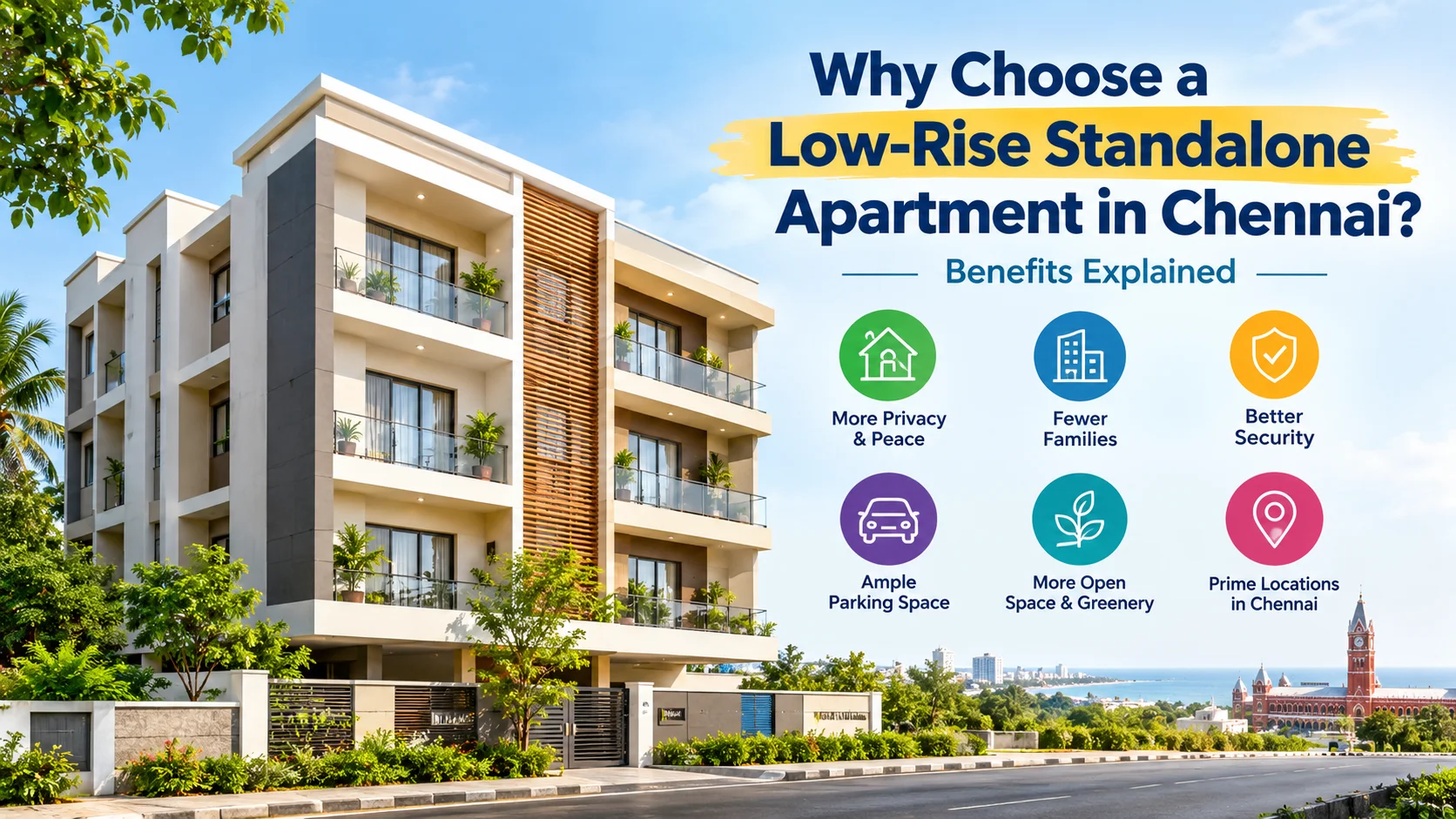
Buying a home is an important milestone, and choosing the right type of apartment can make a significant difference to your lifestyle, comfort, and long-term financial plans. In Chennai, homebuyers can choose from high-rise residential towers, gated communities, independent houses, and low-rise standalone apartments. Among these options, low-rise standalone apartments are worth considering for buyers who prefer a smaller residential community and practical living spaces. Low-rise standalone apartments generally have fewer floors and a limited number of residential units compared with large apartment complexes. They can be suitable for families looking for 2 BHK and 3 BHK homes, working professionals seeking convenient access to the city, and buyers who prioritize essential amenities over extensive recreational facilities. Chennai's residential market offers different types of standalone apartments across established and developing neighborhoods. However, the right property depends on several factors, including location, construction quality, apartment size, water supply, connectivity, legal approvals, and overall affordability.
What Is a Low-Rise Standalone Apartment?
A low-rise standalone apartment is a residential building with a relatively small number of floors and multiple residential units within an individual development. Unlike a large gated community, it is generally not part of a township containing multiple residential towers and extensive shared facilities. These buildings may offer 2 BHK, 3 BHK, and other apartment configurations depending on the available land, building design, and local planning regulations.
Common features include:
- A limited number of apartments and floors.
- Individual residential units with private kitchens and bathrooms.
- Shared facilities such as staircases, corridors, and parking areas.
- Essential amenities depending on the project's specifications.
- Access to nearby residential streets, shops, schools, and other local facilities.
- Shared maintenance responsibilities among apartment owners.
A standalone apartment is different from an independent house because the owners generally own their individual apartments and have rights over the common areas and undivided share of land according to the applicable documents. The exact definition of a low-rise building can vary according to planning regulations and local usage. Buyers should therefore verify the sanctioned building plan rather than relying only on a property's marketing description.
1. Privacy and a Smaller Residential Community
One of the main reasons buyers consider low-rise standalone apartments is the possibility of living in a smaller residential community. Large residential complexes can have hundreds of households sharing lifts, corridors, recreational facilities, and common spaces. In comparison, a low-rise standalone building may have fewer residents and less movement through shared areas.
This arrangement can offer several advantages:
- Fewer households sharing common corridors.
- A more compact residential environment.
- Potentially less congestion in shared spaces.
- Easier communication between residents about common maintenance.
- A residential atmosphere suited to buyers who prefer smaller communities.
However, privacy depends on the apartment's position, neighboring buildings, sound insulation, and the number of units on each floor. A low-rise building does not automatically guarantee a quieter home.
2. Suitable for Families and Everyday Living
Low-rise standalone apartments can provide practical living arrangements for different types of households. A 2 BHK apartment may be suitable for a couple, a small family, or a first-time homebuyer. A 3 BHK apartment can offer additional space for children, elderly parents, guests, or a home office. When choosing an apartment, examine the complete floor plan rather than focusing only on the number of bedrooms.
Important features include:
- A comfortable living and dining area.
- Well-ventilated bedrooms.
- A functional kitchen with sufficient storage.
- Adequate bathroom facilities.
- Utility space for washing and drying clothes.
- Natural light in the main living areas.
- Convenient access to the entrance and lift, where available.
A well-designed apartment can support comfortable daily living without requiring extensive common facilities.
3. Access to Established Residential Neighbourhoods
Location plays a major role in determining the convenience and value of a residential property. Many standalone apartment projects are located within existing neighborhoods where residents may have access to supermarkets, schools, hospitals, pharmacies, public transport, and other essential services. Homebuyers exploring Chennai can consider areas such as Velachery, Madipakkam, Ullagaram, Nanganallur, Porur, and Arumbakkam, depending on their budget and commuting needs. Before purchasing, check the actual distance between the apartment and important destinations. A property advertised as being near a major road or public transport facility may still require additional travel time because of traffic, road access, or the exact street location. Buyers should also examine road width, street lighting, drainage, water supply, and the availability of essential services in the immediate neighborhood.
4. Amenities for Comfortable Living
A low-rise standalone apartment may not have the extensive recreational facilities available in a large gated community. However, a building with well-planned essential amenities can provide a comfortable living experience.
Depending on the project, useful amenities may include:
- Lift facilities: Helpful for residents living on upper floors, families with children, and elderly people.
- Covered parking: Provides a designated space for vehicles, subject to the project's layout and documented allocation.
- CCTV surveillance: Can help monitor common entrances and shared areas.
- Power backup: Supports specified services during electricity interruptions. Buyers should confirm whether backup covers individual apartments or only common facilities.
- Rainwater harvesting: Supports rainwater collection and groundwater recharge when properly designed and maintained.
- Water storage and distribution: Reliable arrangements are important for everyday household requirements.
- Proper drainage and sewage systems: Help maintain hygiene and reduce the risk of waterlogging or drainage-related problems.
- Secure common areas: Well-lit entrances, maintained staircases, and appropriate safety arrangements contribute to a better residential environment.
Before making a purchase, obtain written confirmation of the facilities included in the apartment price.
5. Efficient Use of Space
Low-rise standalone projects may focus on functional apartment layouts rather than large recreational areas. For buyers who prioritize indoor space, this can be an important consideration. A practical floor plan may include a spacious living room, a separate dining space, well-planned bedrooms, kitchen storage, and a balcony or utility area where provided.
However, buyers should distinguish between carpet area, built-up area, and super built-up area. "Carpet area" refers broadly to the usable floor area within the apartment, subject to the applicable statutory definition. The built-up area includes the carpet area and certain additional areas such as walls. A super built-up area may also include a proportionate share of common areas, depending on the calculation method. Comparing carpet areas helps buyers understand how much usable space they are receiving for the quoted price.
6. Potentially Manageable Maintenance Costs
Some standalone apartments have fewer shared facilities to maintain than large residential complexes. This may reduce certain recurring expenses, but lower maintenance costs are not guaranteed. A standalone building still requires regular maintenance of common areas, water pumps, electrical systems, lifts, drainage, waterproofing, and other building components.
The cost can depend on:
- The age and condition of the building.
- The number of apartments sharing expenses.
- Whether security staff are employed.
- Lift servicing and equipment maintenance.
- Water supply and common electricity costs.
- The frequency of major repairs.
- The availability of a maintenance reserve fund.
Buyers should request details of the proposed monthly maintenance charge, any corpus fund, outstanding dues, and responsibility for major repairs. A transparent maintenance arrangement is particularly important when a building has a limited number of apartment owners.
7. Low-Rise Standalone Apartments vs. High-Rise Apartments
Both low-rise and high-rise apartments can be suitable for homebuyers. The better option depends on the buyer's priorities, budget, and preferred lifestyle.
| Feature | Low-rise standalone apartment | High-rise apartment |
| Building height | Relatively few floors | Many floors |
| Residential community | Often smaller | Often larger |
| Shared facilities | Usually focused on essential amenities | May include extensive recreational facilities |
| Privacy | Depends on layout and land occupancy | May include extensive recreational facilities |
| Maintenance | Depends on equipment and shared expenses | May include additional facility management expenses. |
| Open spaces | Depends on the plot and design | May include additional facility management expenses. |
| Location | Often within existing residential streets | Available in established and developing areas |
| Suitable buyers | Those preferring a compact residential setting | Those seeking a wider range of shared facilities |
A low-rise apartment may appeal to buyers who prefer a smaller community, while a high-rise development may be more suitable for those who want a clubhouse, swimming pool, sports facilities, or other shared amenities. Neither option is automatically more affordable, better constructed, or a stronger investment. These factors must be assessed for each individual property.
8. Price Guide for Low-Rise Standalone Apartments in Chennai
The cost of a low-rise standalone apartment varies according to location, land value, apartment size, construction quality, amenities and legal status. Properties in different neighbourhoods may have substantially different prices even when their sizes are similar. The same locality can also contain a wide range of property values depending on the street, building age, floor plan and included facilities. The following examples demonstrate how apartment size and assumed price per square foot affect the base purchase price. They are illustrative calculations, not verified current market quotations.
| Apartment Configuration | Areas | Rate | Base price |
| 2 BHK | 900 sq ft | Rs 8,000 | Rs 72 L |
| 2 BHK | 1,000 sq ft | Rs 9,000 | Rs 90 L |
| 3 BHK | 1,300 sq ft | Rs 9,000 | Rs 1.17 cr |
| 3 BHK | 1,500 sq ft | Rs 10,000 | Rs 1.50 cr |
The base price is calculated by multiplying the assumed area by the assumed rate. Actual quotations may use different area definitions and may exclude parking, registration, interiors and other charges.
Factors that influence apartment prices
- Location: Access to employment centres, public transport, schools, hospitals and established commercial areas can influence demand.
- Apartment size: Larger apartments generally have a higher total purchase price, although their price per square foot may differ.
- Construction quality: Materials, workmanship, fittings, structural design and finishing can affect the property's value.
- Undivided share of land: UDS is an important factor to review when comparing apartments, along with the legal documents and land ownership arrangements.
- Amenities: Lifts, covered parking, power backup, security systems and other facilities may affect the overall cost.
- Property status: A completed apartment can be inspected directly, while an under-construction property requires careful evaluation of approvals, construction progress and contractual commitments.
For an accurate comparison, collect quotations for similar apartments in the same neighbourhood and compare the total purchase cost rather than only the advertised price per square foot.
9. Additional Expenses When Buying an Apartment
The advertised price may not represent the complete amount required to purchase and occupy a home.
Potential additional expenses include:
- Stamp duty and registration charges.
- Legal verification fees.
- Home loan processing charges, where applicable.
- Parking charges, if separately payable and legally documented.
- Maintenance deposits and corpus contributions.
- Interior work, wardrobes and kitchen fittings.
- Electrical fixtures and appliances.
- Utility connection or transfer charges, where applicable.
- Repairs, relocation and moving expenses.
Ask the seller for an itemised quotation and calculate your complete acquisition budget before applying for a home loan.
10. Best Chennai Locations to Explore for Low-Rise Apartments
- Velachery
Velachery is worth exploring for buyers who want to compare residential apartments with access to shopping, employment centres and transport connections. Consider traffic conditions, parking availability and the distance to your regular destinations. - Madipakkam
Madipakkam offers residential options for buyers looking for homes within an established neighbourhood. Check the specific street's water supply, drainage, road access and connectivity to work and family requirements.
- Ullagaram and Nanganallur
These areas can be considered by buyers seeking residential surroundings with access to local facilities. Compare apartment layouts, building quality, parking arrangements and travel times to important destinations.
- Porur
Porur is another area to explore when comparing different apartment configurations and commuting requirements. Buyers should examine access to major roads, employment centres, schools and healthcare facilities.
- Arumbakkam
Arumbakkam may be suitable for buyers who want to assess properties with access to established urban facilities and city transport. Pay attention to the immediate street environment, traffic, noise and available parking. These locations are suggestions for a property search, not a ranking of investment performance. Current availability and prices should be verified through comparable listings and property visits.
11. Advantages of Low-Rise Standalone Apartments in Chennai
Low-rise standalone apartments are an attractive housing option for homebuyers who prefer practical living spaces, a smaller residential community and access to established neighbourhoods. In Chennai, these apartments can be suitable for families, working professionals, first-time buyers and people looking for a long-term home.
1. Greater Privacy and a Smaller Community
Low-rise standalone apartments generally accommodate fewer households than large residential towers. This can create a more private residential environment with less movement through shared corridors and common areas.
2. Comfortable Living for Families
These apartments often offer practical 2 BHK and 3 BHK configurations. Families can choose a layout that suits their needs, whether they require additional bedroom space, a home office or room for elderly parents.
3. Convenient Neighbourhood Access
Many standalone apartments are located in established residential areas, close to grocery stores, schools, hospitals, pharmacies and public transport. This can make everyday activities more convenient.
4. Essential Amenities for Daily Life
Depending on the project, facilities may include lifts, covered parking, CCTV surveillance, rainwater harvesting, power backup and secure common areas. Buyers can prioritise the amenities they actually need.
5. Practical Apartment Layouts
Well-designed low-rise apartments can provide functional living rooms, bedrooms, kitchens and utility spaces. Buyers should compare carpet area and room dimensions to understand how much usable space each property offers.
6. Potentially Lower Shared-Facility Expenses
Buildings with fewer common facilities may have fewer expenses associated with recreational amenities and facility management. However, maintenance is not always cheaper because lift servicing, security and major repairs must still be funded.
7. A More Personal Residential Environment
A smaller community may make it easier for residents to communicate about cleanliness, parking, maintenance and building repairs. The quality of community management depends on the residents and the maintenance arrangements.
8. Choices Across Different Residential Locations
Homebuyers can explore low-rise standalone apartments in Chennai neighbourhoods such as Velachery, Madipakkam, Ullagaram, Nanganallur, Porur and Arumbakkam. Each location has different price levels, connectivity options and local facilities.
9. Suitable for Long-Term Homeownership
A well-maintained apartment in a convenient location can serve as a long-term family home. Buyers should consider construction quality, water supply, legal approvals, maintenance costs and future household requirements before purchasing.
10. Potential Rental and Resale Opportunities
Apartments near employment centres, transport links, educational institutions and healthcare facilities may attract tenants and future buyers. Rental income and property appreciation are not guaranteed, so the local market and total purchase cost should be assessed carefully.
12. Disadvantages of Low-Rise Standalone Apartments
Low-rise standalone apartments offer several potential benefits, but buyers should also understand their limitations.
- Limited recreational facilities: Some buildings may not have a clubhouse, swimming pool, sports courts or large landscaped spaces.
- Shared repair expenses: Major repairs can become expensive when the cost is divided among a small number of owners.
- Parking limitations: Certain properties may have limited visitor parking or difficult vehicle access.
- Accessibility concerns: Buildings without lifts may be inconvenient for elderly residents and people with mobility needs.
- Neighbouring construction: Nearby buildings may affect privacy, sunlight, ventilation and noise levels.
- Water and drainage issues: Conditions can vary from one street to another, so inspect the site and surrounding area.
- Resale uncertainty: Future demand depends on location, maintenance, building condition, legal status and local market conditions.
Visiting the property at different times of the day can help buyers evaluate traffic, noise, sunlight and the general residential environment.
13. How to Choose the Right Low-Rise Standalone Apartment
Before finalising a property, follow these practical steps:
- Set a total budget that includes registration, interiors and other expenses.
- Select neighbourhoods based on your commuting needs and family requirements.
- Compare the carpet area, floor plans and room dimensions.
- Inspect ventilation, sunlight, water supply and drainage.
- Verify parking, lift facilities and power-backup specifications.
- Review title documents, building approvals, UDS and applicable RERA details.
- Understand the monthly maintenance charge and major-repair responsibilities.
- Compare the final price with similar apartments nearby.
- Arrange an independent legal review before proceeding.
- Read the sale agreement carefully and confirm all promised specifications in writing.
Following these steps can help buyers compare properties more confidently and avoid relying solely on advertisements or verbal assurances.
Conclusion
Low-rise standalone apartments can be a practical residential choice for buyers in Chennai who prioritise functional layouts, a smaller residential community and access to established neighbourhoods. They provide an alternative to large high-rise developments and may suit families searching for 2 BHK or 3 BHK homes with essential amenities. However, the right apartment depends on more than the building's height. Location, construction quality, usable area, water supply, maintenance arrangements, legal approvals and total purchase cost all play an important role. If you are searching for flats for sale in Chennai, compare properties in your preferred neighbourhood, inspect the actual apartment and verify its legal documentation. A carefully selected home can support your family's comfort today and your long-term housing goals.
Frequently Asked Questions
1. Why choose a low-rise standalone apartment in Chennai?
A low-rise standalone apartment may suit buyers who prefer a smaller residential community, practical layouts, essential amenities and access to established neighbourhoods.
2. Are low-rise standalone apartments suitable for first-time homebuyers?
Yes. A suitable 2 BHK or 3 BHK apartment may be an option for first-time buyers, provided the purchase price, loan eligibility, recurring expenses and legal documentation meet their requirements.
3. Are low-rise apartments cheaper than high-rise apartments?
Not always. Prices depend on location, land value, apartment size, construction quality and amenities. Compare the total purchase price and usable area of similar properties before deciding.
4. Which is better: a 2 BHK or a 3 BHK low-rise apartment?
A 2 BHK may suit smaller households or buyers with a limited budget. A 3 BHK offers additional space for children, guests, elderly parents or a home office. The right choice depends on your needs and financial capacity.
5. Do all low-rise standalone apartments have lifts?
No. Lift availability depends on the building's design and specifications. Buyers should confirm lift facilities and maintenance arrangements, especially when considering upper-floor apartments.
6. What amenities should I look for in a low-rise apartment?
Prioritise reliable water supply, proper drainage, ventilation, safe common areas and suitable parking. Lifts, CCTV, rainwater harvesting and power backup may also be useful, depending on the project.
7. Which areas in Chennai can I consider for standalone apartments?
You can explore Velachery, Madipakkam, Ullagaram, Nanganallur, Porur and Arumbakkam, among other areas. Compare location, price, commuting time and local infrastructure before choosing.
8. What is UDS in an apartment?
UDS stands for Undivided Share of Land. It represents an apartment owner's undivided interest in the underlying land, as recorded in the relevant legal documents.
9. Are low-rise standalone apartments a good investment?
They may be suitable for long-term investment when the location, purchase price, rental demand and ownership costs are favourable. Property appreciation and rental income are not guaranteed.
10. What legal documents should I check before buying an apartment?
Review the title and parent documents, Encumbrance Certificate, sanctioned building plan, applicable permissions, UDS, RERA status where required, completion-related documents and maintenance records. Seek independent legal advice.