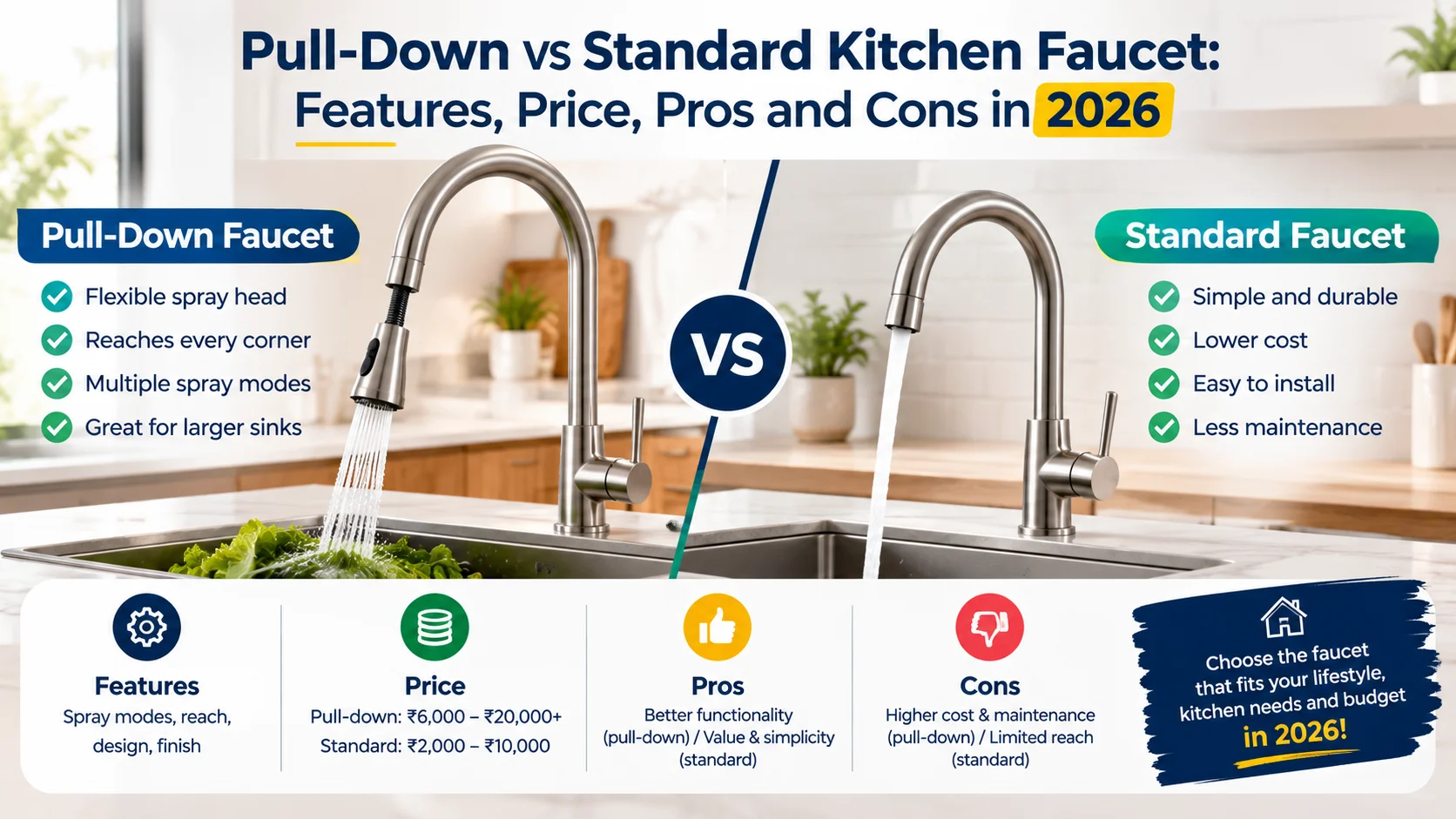
Choosing the right kitchen faucet is an important decision when designing a new kitchen or renovating an existing one. A kitchen faucet is used every day for washing vegetables, cleaning dishes, filling cooking vessels, and maintaining the sink area. The right design can improve convenience, complement the kitchen interior, and make everyday tasks easier. In 2026, pull-down kitchen faucets and standard kitchen faucets are popular options for different kitchen layouts and budgets. Pull-down faucets offer a flexible spray head for improved reach, while standard faucets provide a simple and practical solution for everyday use. In this guide, we will explore the differences between pull-down and standard kitchen faucets, including their features, estimated prices in India, advantages, disadvantages, installation requirements, and frequently asked questions.
What Is a Pull-Down Kitchen Faucet?
A pull-down kitchen faucet is a modern tap featuring an extendable spray head attached to a flexible hose. The spray head can be pulled downward into the sink, allowing users to direct water towards different areas of the basin. Most pull-down faucets have a tall, curved neck and a spray head with a release button or switch for changing the water-flow pattern. Depending on the model, users may be able to switch between an aerated stream and a spray mode. These faucets are commonly used in contemporary modular kitchens because they combine modern styling with practical functionality.
Features of a Pull-Down Kitchen Faucet
1. Flexible spray head: The spray head extends into the sink, making it easier to rinse dishes, vegetables, and large cooking vessels.
2. Multiple spray modes: Many models offer different water-flow settings for filling containers and rinsing away food residue.
3. Extended reach: The flexible hose helps users clean sink corners and reach areas that may be difficult to access with a fixed spout.
4. Modern design: Pull-down faucets are available in chrome, stainless-steel finishes, brushed metal, and other decorative options.
5. Convenient rinsing: Users can direct water where it is needed rather than moving every utensil beneath the tap.
6. Retractable mechanism: Many models use a counterweight or magnetic docking system to guide the spray head back into place.
- Where Is a Pull-Down Faucet Most Suitable?
Pull-down faucets are particularly suitable for:
- Modular kitchens with contemporary interiors.
- Homes with deep or large single-bowl sinks.
- Families that cook frequently and wash large vessels.
- Kitchens where convenient sink cleaning is a priority.
- Homeowners who prefer modern fixtures with additional functionality.
Before installation, check the available space beneath the sink to ensure that the flexible hose can move freely.
What Is a Standard Kitchen Faucet?
A standard kitchen faucet is a conventional tap that delivers water through a fixed spout. It is available in different designs, including straight spouts, curved spouts, single-lever taps, and two-handle models. Some standard faucets also feature swivel spouts or adjustable aerators, but they generally do not have an extendable spray head. Standard faucets are widely used in traditional kitchens, compact apartments, utility areas, rental homes, and budget-friendly kitchen renovations.
Features of a Standard Kitchen Faucet:
1. Simple construction: Basic models have fewer moving components than pull-down faucets.
2. Fixed spout: Water flows directly into the sink without requiring an extendable hose.
3. Multiple mounting options: Standard faucets are available in wall-mounted and countertop-mounted designs.
4. Budget-friendly pricing: Basic models are generally more affordable than feature-rich pull-down faucets.
5. Easy everyday operation: They are suitable for filling vessels, washing hands, and carrying out routine kitchen activities.
6. Traditional and modern styles: Standard faucets come in different shapes, finishes, and handle configurations.
- Where Is a Standard Faucet Most Suitable?
Standard faucets are a practical option for:
- Small kitchens with limited counter space.
- Homes with simple kitchen layouts.
- Rental properties and secondary kitchens.
- Homeowners working with a limited renovation budget.
- Households that do not require an extendable spray head.
A standard faucet can be a reliable long-term choice when it is made from quality materials and installed correctly.
Also Read: Most Popular Kitchen Cabinet Color for 2026
Pull-Down vs Standard Kitchen Faucet: Key Differences
The main difference between these faucets is their functionality. A pull-down faucet provides a flexible spray head, whereas a standard faucet generally supplies water through a fixed spout.
| Feature | Pull-Down Faucet | Standard Faucet |
| Design | Usually a tall faucet with an extendable head | Fixed spout in different designs |
| Water reach | The flexible hose extends into the sink. | Limited to the spout's reach |
| Spray settings | Often includes multiple modes | Usually a standard stream |
| Cleaning convenience | Easier to reach sink corners | May requires repositioning utensils |
| Large vessels | Convenient for rinsing from different angles | Depends on spout height and sink depth |
| Installation | Requires hose clearance beneath the sink | Often simpler, depending on the mounting type |
| Maintenance | Hoses and spray heads may need attention. | Usually fewer moving parts |
| Initial cost | Generally higher | Generally lower |
| Appearance | Suits many contemporary kitchens | Available in traditional and modern styles |
| Best suites for | Frequent cooking and flexibility | Everyday use and budget-conscious projects |
The quality of the faucet, cartridge, finish, and installation also affects performance. A good standard faucet may be more durable than a poorly manufactured pull-down model.
Pull-Down vs Standard Kitchen Faucet: Price in India in 2026
Kitchen faucet prices depend on the brand, material, finish, water-control mechanism, and additional features. Pull-down models typically cost more because they include a flexible hose and spray mechanism. The following figures are indicative budgeting estimates for India in 2026. They are not fixed market prices, and actual prices may vary by manufacturer and retailer.
| Kitchen Type | Price |
| Basic standard kitchen type | Rs 500-2000 |
| Branded standard faucet | Rs 2000-6000 |
| Premium standard faucet | Rs 3000-8000 |
| Mid-range pull-down faucet | Rs 8000-15000 |
| Premium pull-down faucet | Rs 15000-30000 or more |
Factors That Affect Kitchen Faucet Prices
- Material and construction: Faucets with durable metal bodies and quality internal components may cost more than basic models.
- Spray functionality: Pull-down faucets with multiple spray modes, pause functions, or magnetic docking may have higher prices.
- Brand and warranty: Established manufacturers may offer better access to replacement parts and service. Compare warranty coverage and exclusions before buying.
- Surface finish: Chrome, brushed metal, and matte finishes may have different prices and cleaning requirements.
- Installation expenses: Plumbing modifications, additional fittings, and countertop drilling may increase the overall project cost.
When comparing prices, consider the purchase price, installation charges, replacement parts, and expected maintenance rather than looking only at the initial cost.
Advantages of a Pull-Down Kitchen Faucet
1. Better Reach and Flexibility
The flexible hose allows users to direct water into different areas of the sink. It is particularly helpful when cleaning sink corners, rinsing vegetables, and washing utensils of different sizes.
2. Convenient for Large Indian Cooking Vessels
Pressure cookers, kadais, large pots, and other cooking vessels can be difficult to rinse beneath a fixed tap. A pull-down spray head provides greater flexibility when directing water into these containers.
3. Multiple Water-Flow Options
Many pull-down faucets provide both an aerated stream and a spray pattern. A stream can be useful for filling vessels, while a spray can help rinse dishes and remove food residue.
4. Contemporary Kitchen Appearance
Pull-down faucets often complement modern modular kitchens, granite countertops, quartz surfaces, and undermount sinks.
5. Easier Sink Cleaning
The extendable head makes it easier to rinse food particles towards the drain and clean areas around the edges of the basin.
6. Convenient Daily Operation
Users can bring the spray head closer to the item being washed, reducing the need to reposition large utensils repeatedly.
Disadvantages of a Pull-Down Kitchen Faucet
1. Higher Purchase Price
Pull-down faucets generally cost more than basic standard taps. The additional features may not be necessary for households that use the kitchen sink mainly for simple tasks.
2. More Components to Maintain
The flexible hose, spray head, docking system, and internal cartridge may require maintenance or replacement over time.
3. Requires Space Beneath the Sink
The hose and counterweight need room to move. Plumbing pipes, water filters, and stored cleaning products should not obstruct their movement.
4. Water Splashes in Some Sink Designs
A tall spout and powerful spray may cause splashing in shallow sinks or when water hits hard surfaces at an unsuitable angle. Choosing an appropriate spray setting and sink depth can help reduce this problem.
5. Potential Hose or Docking Issues
With extended use, a hose may become worn or a docking mechanism may lose its effectiveness. The likelihood of problems depends on construction quality and usage.
Advantages of a Standard Kitchen Faucet
1. Affordable Purchase Cost
Standard kitchen faucets are available in a wide range of prices, including economical options for rental properties and budget-conscious renovations.
2. Simple Design
Many standard faucets have fewer moving parts, making their operation and routine maintenance straightforward.
3. Suitable for Compact Kitchens
A conventional faucet can be a good choice when counter space is limited or the sink is relatively small.
4. Wide Range of Designs
Standard faucets are available in traditional, contemporary, wall-mounted, and deck-mounted styles, making them suitable for many kitchen interiors.
5. Easy Replacement
When the existing plumbing and mounting arrangement are compatible, replacing a standard faucet can be relatively straightforward.
6. Practical for Everyday Use
For washing hands, filling cooking vessels, and cleaning everyday utensils, a standard faucet may provide all the functionality a household needs.
Also Read: Modern Modular Kitchen Design Ideas in 2026
Disadvantages of a Standard Kitchen Faucet
1. Limited Reach
A fixed-spout faucet cannot usually reach all areas of the sink. Cleaning corners may require moving utensils or using a separate cleaning tool.
2. Fewer Spray Options
Basic models generally provide a standard water stream rather than multiple spray settings.
3. Less Convenient for Large Utensils
Rinsing large cooking vessels may require repositioning them beneath the tap, depending on the spout height and sink dimensions.
4. May Offer Fewer Convenience Features
Basic models generally lack the extendable spray head, flexible hose, and docking features found in many pull-down faucets.
5. Functionality Depends on the Design
A low or short spout may not provide enough clearance for tall containers. Buyers should check the spout height and reach before purchasing.
How to Choose the Right Kitchen Faucet in 2026
1. Measure the Sink Size
Check the sink's depth, width, and bowl configuration. A pull-down faucet can be useful for a large basin, while a standard faucet may be sufficient for a compact sink.
2. Check the Spout Height and Reach
Make sure the faucet provides enough clearance for the cooking vessels you regularly use. The water stream should land comfortably inside the sink to reduce splashing.
3. Consider Water Pressure
Check the faucet's recommended operating pressure and confirm that it is compatible with your home's plumbing system. Spray performance can vary depending on water pressure and the faucet's internal design.
4. Choose a Suitable Material
Look for clearly stated body materials, cartridge specifications, corrosion resistance, and replacement-part availability. Do not assume that a particular surface finish guarantees a particular underlying material.
5. Match the Faucet to the Kitchen Interior
Chrome and stainless-steel finishes suit many kitchen styles. Matte black and other decorative finishes may create a distinctive appearance, but their cleaning requirements should also be considered.
6. Check Installation Compatibility
Confirm the number of mounting holes, countertop thickness requirements, water connection sizes, and available clearance beneath the sink. For pull-down models, check that the hose can extend and retract without hitting pipes or stored items.
7. Review Warranty and After-Sales Service
Look for warranty information covering the faucet body, cartridge, hose, and spray head. Check whether replacement parts are available locally.
8. Compare Total Cost
Include the faucet price, installation, any required plumbing changes, and likely maintenance expenses when deciding which model offers better value.
Maintenance Tips for Kitchen Faucets
Proper maintenance can help preserve the faucet's appearance and performance.
- Clean the outer surface regularly using a soft cloth and a suitable mild cleaner.
- Avoid abrasive scrubbers and harsh chemicals that may damage decorative finishes.
- Clean mineral deposits from the aerator according to the manufacturer's instructions.
- For pull-down models, wipe the spray head and check for mineral buildup around the nozzles.
- Keep the flexible hose unobstructed and inspect it periodically for visible wear.
- Check for leaks around the base, connections, and handle.
- Replace worn cartridges, seals, or other parts with compatible components.
- Follow the manufacturer's cleaning and maintenance recommendations.
If a faucet develops persistent leakage or reduced flow, inspect the aerator and accessible connections first. More complex problems may require a qualified plumber.
Common Mistakes to Avoid When Buying a Kitchen Faucet
- Choosing appearance over functionality: A stylish faucet may not work well if its height and reach are unsuitable for your sink.
- Ignoring under-sink clearance: Pull-down hoses need sufficient room to move freely.
- Overlooking water pressure: A faucet designed for a different pressure range may not perform as expected.
- Buying without checking materials: Compare the specifications of the faucet body, cartridge, and hose rather than relying on product photographs alone.
- Ignoring service availability: Difficult-to-source replacement parts can increase maintenance costs.
Choosing the cheapest model without comparison: Compare the warranty, installation requirements, and expected durability before making a decision.
Conclusion
Both pull-down and standard kitchen faucets can be suitable for Indian homes, but they serve different needs. A pull-down faucet is a strong option for homeowners who want greater reach, flexible rinsing, multiple spray settings, and a contemporary kitchen appearance. It is particularly useful for households that cook frequently and regularly wash large utensils. A standard faucet is a practical choice for homeowners who prefer simple operation, lower initial cost, and straightforward installation. It can work well in compact kitchens, rental homes, and spaces where advanced spray functionality is unnecessary.
Frequently Asked Questions
1. What is the difference between a pull-down and a standard kitchen faucet?
A pull-down faucet has an extendable spray head connected to a flexible hose, allowing water to reach different areas of the sink. A standard faucet generally has a fixed spout and is designed for routine kitchen tasks.
2. Which kitchen faucet is better for Indian homes in 2026?
Both options can work well. Pull-down faucets are convenient for households that regularly wash large cooking vessels, while standard faucets are suitable for simple kitchen layouts and budget-conscious homes.
3. What is the price of a pull-down kitchen faucet in India?
Indicative prices range from approximately Rs 3,000 to Rs 8,000 for entry-level models, Rs 8,000 to Rs 15,000 for mid-range models, and Rs 15,000 to Rs 30,000 or more for premium models. Actual prices depend on the brand and specifications.
4. Are standard kitchen faucets cheaper than pull-down faucets?
Generally, yes. Basic standard faucets are usually more affordable because they have simpler construction and fewer additional components. Premium standard models can still cost more than entry-level pull-down faucets.
5. Is a pull-down faucet suitable for a small kitchen?
It can be suitable if the sink and countertop provide enough clearance. Before buying, check the faucet's height, reach, mounting requirements, and hose clearance beneath the sink.
6. Do pull-down kitchen faucets require more maintenance?
They may require additional attention because of their flexible hose, spray head, and docking mechanism. Regular cleaning and proper installation can help maintain performance.
7. Which faucet is better for washing large cooking vessels?
A pull-down faucet is generally more convenient because the spray head can be brought closer to the vessel. However, the sink's depth and the faucet's reach also affect usability.
8. Which kitchen faucet is easier to install?
A standard faucet is often simpler to install, particularly when replacing an existing compatible model. Pull-down faucets may require additional attention to hose routing and under-sink clearance. Installation complexity varies by model.
9. Do pull-down faucets save water?
Not automatically. Water consumption depends on flow rate, spray design, water pressure, and how long the tap remains open. A well-designed faucet and careful water use can help reduce unnecessary consumption.
10. Which material is best for a kitchen faucet?
Choose a faucet with clearly specified, durable materials, quality internal components, and a suitable finish. Stainless steel and brass-bodied products are common options, but actual performance depends on construction quality and the product's specifications.