Sep 11 2026
Kolapakkam and Mugalivakkam are two rapidly developing residential locations in southwest Chennai. Their proximity to Porur, Manapakkam, Guindy, Chennai Airport, and major employment zones has increased interest among homebuyers and property investors. But which locality offers better value in 2026? Should you choose Kolapakkam for future growth or Mugalivakkam for established connectivity and residential demand?
Property prices in both areas vary considerably depending on the exact street, land value, construction quality, age of the building, road width, amenities, and UDS. For a meaningful comparison, buyers should compare similar properties rather than relying only on locality-level average rates.
| Property factor | Kolapakkam | Mugalivakkam |
| Market character | Developing residential market | Established residential market |
| Property demand | Increasing | Strong |
| Apartment | Available | Widely available |
| Builder floors | Good availability | Good availability |
| Independent houses | Available | Available |
| 2 BHK demand | Good | High |
| 3 BHK demand | Increasing | High |
| Pour Access | Good | Very good |
| Investment access | Growth-focused | Stability + growth |
Important: Actual transaction prices can differ from advertised prices. The property's exact location and specifications should always be checked before making a purchase decision.
Kolapakkam has increasingly become a residential choice for buyers who want access to southwest Chennai without paying the premium associated with some established central neighborhoods. The locality has witnessed residential construction ranging from compact apartments to larger builder-floor homes and independent houses.
Why are buyers considering Kolapakkam?
The main attraction is its location.
Kolapakkam provides access towards:
The area can therefore appeal to professionals working in western and southern Chennai.
What makes Kolapakkam interesting for investors?
The locality still has pockets where development is taking place. As new residential buildings, commercial establishments, and supporting infrastructure increase, selected properties could benefit from improving demand. However, investors should not assume that every property in Kolapakkam will appreciate at the same rate.
Micro-location matters.
A property on a good connecting road with proper approvals can perform very differently from a property located inside a poorly connected street.
Residential Property For Sale in Kolapakkam
Mugalivakkam Property Market in 2026
Mugalivakkam has a different market profile. Instead of being viewed purely as an emerging locality, it has developed into an established residential destination around the Porur–Manapakkam belt.
The locality has a mixture of:
This variety gives buyers more choices across different budgets.
Residential Property For Sale in Mugalivakkam
Why is Mugalivakkam popular?
Its biggest advantage is location efficiency. A homeowner can access several important areas from Mugalivakkam, including:
Porur → Manapakkam → Guindy → Mount-Poonamallee Road → Airport
This makes it particularly attractive to people who want to reduce their daily travel time.
| Price factor | Kolapakkam | Mugalivakkam |
| Averaged listed rate | Rs 8,535 sqft | Rs 8,490 sqft |
| Reported price range | Rs 4,833-15,050 sqft | Rs 5,357-13,242 sqft |
| Difference in average | Rs 45 sq ft higher | Rs 45 sqft lower |
| Approx. price for 1000 sqft | Rs 85.35L | Rs 84.90L |
| Approx. price for 1200 sqft | Rs 1.24 cr | Rs 1.019 cr |
| Approxe. Price for 1500 sqft | Rs 1.28 cr | Rs 1.27 cr |
| Approx. price for 1800 sqft | Rs 1.56 cr | Rs 1.58 cr |
| Approx. price for 2000 sqft | Rs 1.70 cr | Rs 1.69 cr |
Calculations above are illustrative, based on the respective portal averages. They are not quoted transaction prices and exclude registration, stamp duty, interiors, and other costs.
Kolapakkam Connectivity
Kolapakkam's strategic advantage is its position between several important residential and employment areas.
Residents can travel towards:
This makes the locality particularly relevant for people working in southwest and west Chennai.
Mugalivakkam Connectivity
Mugalivakkam has an additional advantage because of its close relationship with Porur and Manapakkam.
It can provide convenient access to:
For daily commuters, this established connectivity can be an important factor when deciding between the two locations.
Why choose Kolapakkam?
Kolapakkam may suit investors who want exposure to a developing residential market.
Potential advantages include:
The main investment strategy here is buying at the right price in the right micro-location.
Why choose Mugalivakkam?
Mugalivakkam may be more suitable for investors who want a combination of established demand and future growth.
Its advantages include:
For investors who want comparatively easier resale potential, these factors can be valuable.
There is no single answer for every buyer.
Choose Kolapakkam if:
Choose Mugalivakkam if:
Rather than choosing the locality solely based on the lowest price per sq. ft., compare the property's UDS, construction quality, road access, approvals, amenities, rental potential, and resale prospects. For a 2026 purchase, the best property is not necessarily the cheapest one—it is the property that offers the strongest combination of location, legal clarity, construction quality, and long-term value.
Sep 10 2026
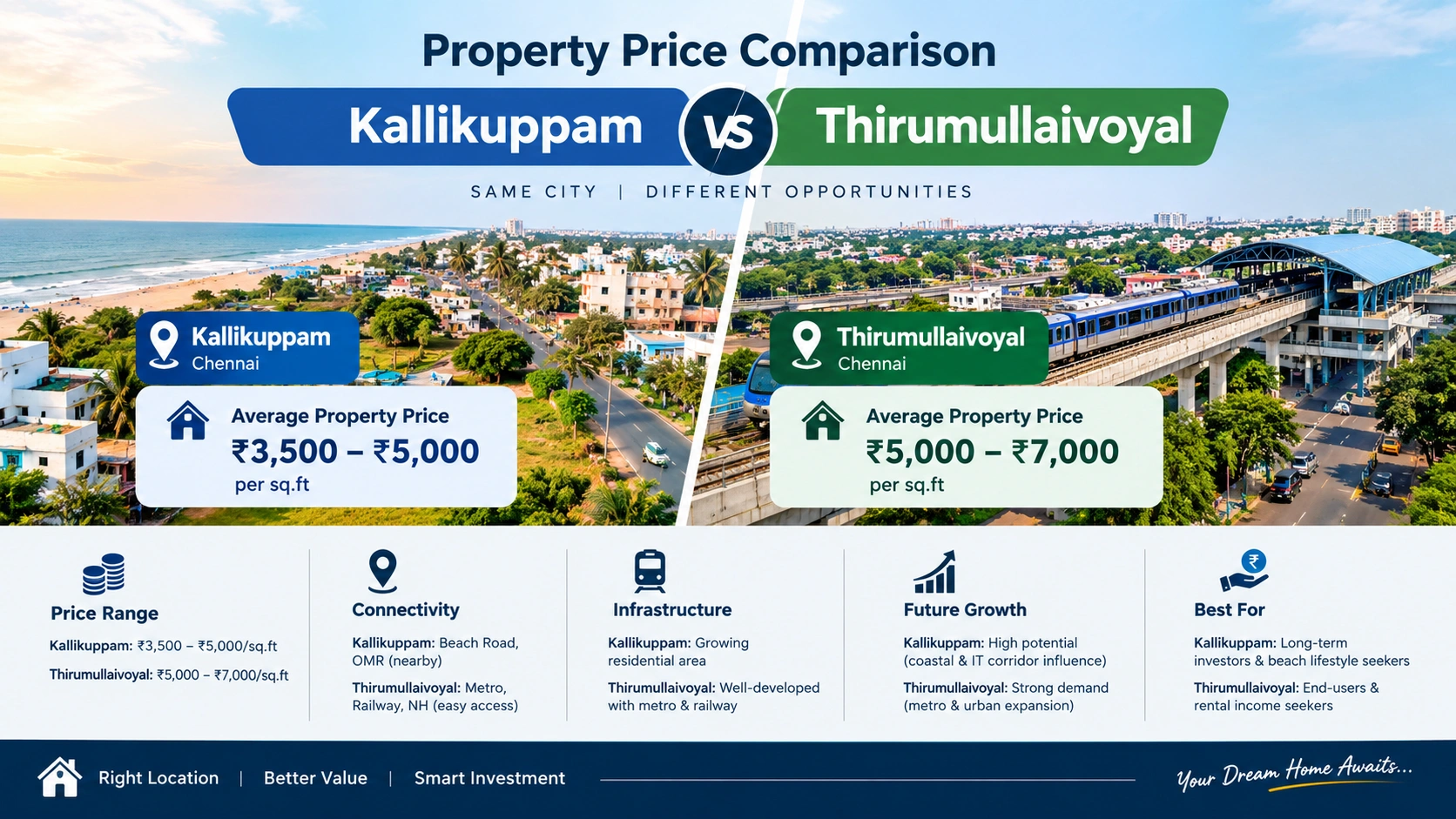
When Chennai homebuyers search for an affordable property in the western part of the city, Kallikuppam and Thirumullaivoyal often come into consideration. Both locations offer residential opportunities, but the buying experience can be quite different depending on the budget, property size, and purpose of purchase. In 2026, the real question for buyers is not simply “Which area has the lower price?” It is about understanding what a buyer receives for that price and whether the property can continue to hold its value in the future.
Property prices in these two areas can vary considerably from one street to another. A newly constructed apartment on a wider road cannot be compared directly with an older property in an interior street.
As a practical 2026 buying benchmark, buyers can broadly encounter:
| Property Category | Kallikuppam Indicative | Thirumullaivoyal Indicate |
| Older/standard residential property | Rs 5,000-6,500 sqft | Rs 6,500-4,500 sqft |
| Newer apartment | Rs 6,500-8,500 sqft | Rs 4,500-5,500 sqft |
| Premium/new construction | Rs 8,500+ sqft | Rs 5,500+ sqft |
| 2 BHK | Higher overall budget | Comparatively affordable |
| 3 BHK | Suitable for mid/premium | More budget-friendly options |
These are indicative working ranges for comparison, not fixed market quotations. The actual rate should be checked for the specific project, street, and property.
Kallikuppam benefits from being part of the wider Ambattur residential ecosystem. The area has developed into a practical residential choice for people who want access to employment zones, schools, shops, and everyday facilities.
The higher price in some parts of Kallikuppam can therefore be linked to:
For an end-user, paying more may make sense when the property provides better accessibility and convenience for everyday living.
Residential Property For Sale in Kallikuppam
Thirumullaivoyal offers a different proposition. Instead of paying the premium associated with some established pockets, buyers can explore properties at comparatively accessible prices.
This makes the locality particularly interesting for:
A lower purchase price can also make it easier for buyers to manage their home loan requirement and monthly EMI.
Residential Property For Sale in Thirumullaivoyal
This is one of the most important differences. Imagine that a buyer has a budget of Rs 60 lakh.
In a higher-priced pocket, the buyer may have to compromise on:
In a comparatively affordable locality such as Thirumullaivoyal, the same budget may provide an opportunity to look for:
The actual availability depends on the project and prevailing market price, but this budget-versus-space equation is an important reason why buyers compare these two locations.
Price should never be considered separately from connectivity.
Kallikuppam
Kallikuppam benefits from its proximity to the larger Ambattur region. Buyers can consider the locality if their daily travel involves Ambattur and nearby western or northern Chennai areas.
Its location can be useful for people working around:
Thirumullaivoyal
Thirumullaivoyal has an important advantage for public transport users because of its suburban railway connectivity.
It also provides access towards:
For someone who regularly uses suburban trains, this can be an important factor when choosing a home.
Whether you choose Kallikuppam or Thirumullaivoyal, conduct proper due diligence before paying an advance.
Check:
For apartments, buyers should also understand exactly what is included in the quoted price.
So, the better locality depends on your objective:
The smartest approach in 2026 is to compare two properties of similar size, construction quality, UDS, age, and connectivity rather than comparing locality averages alone.
Sep 09 2026
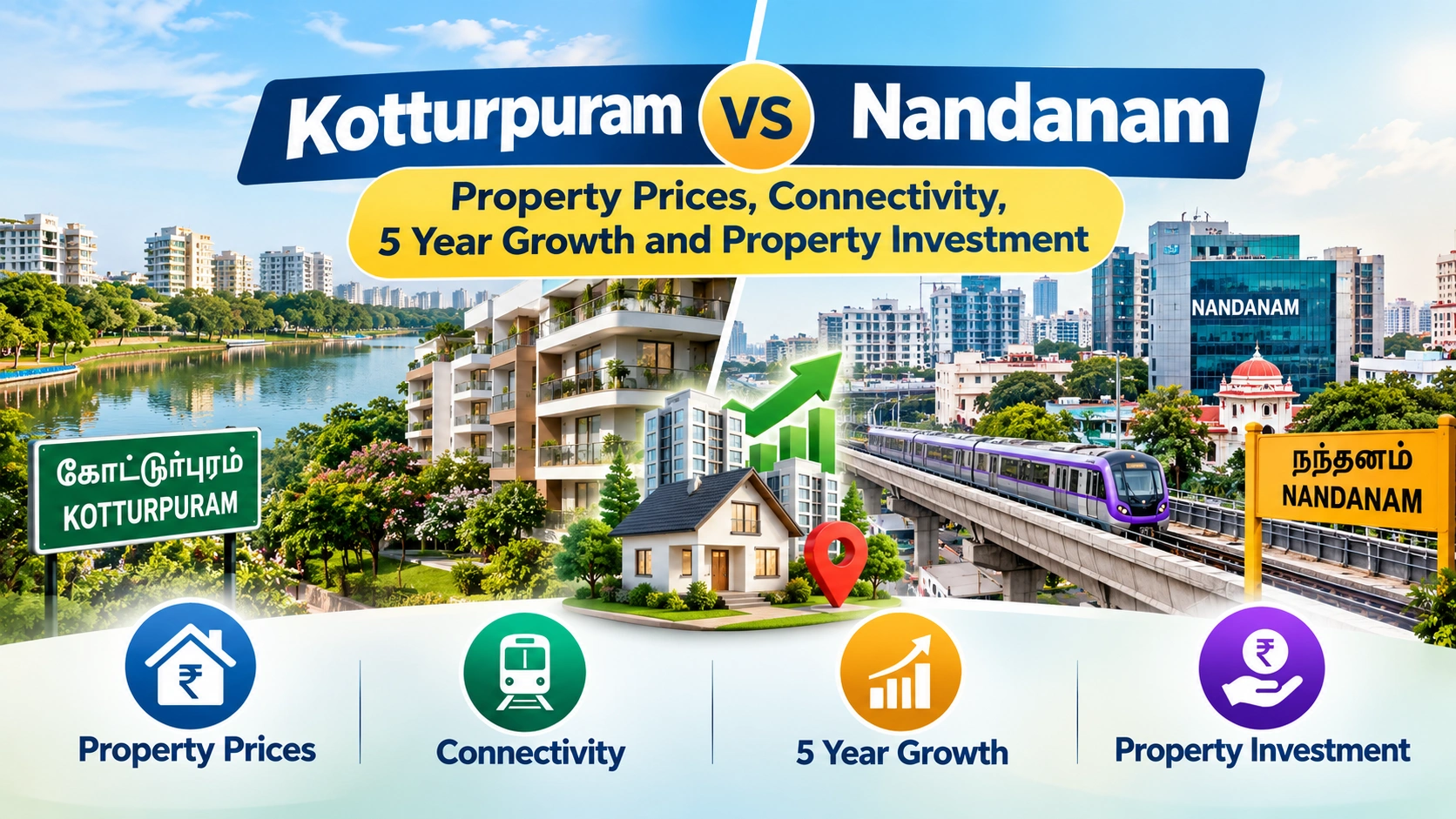
Choosing the right locality is one of the most important decisions when buying property in Chennai. Among the established premium neighborhoods of South Chennai, Kotturpuram and Nandanam continue to attract homebuyers, investors, professionals, and families. Both locations offer excellent access to established residential and commercial zones, but their real estate strengths are different. Kotturpuram is known for its spacious residential environment, premium independent houses, and strong land value, whereas Nandanam benefits from its central location, metro connectivity, and proximity to major business districts.
| Feature | Kotturpuram | Nandanam |
| Location | Central-South Chennai | Central-South Chennai |
| Property market | Premium residential | Premium residential and commercial |
| Property type | Flats, houses, plots | Flats, houses, redevelopment properties |
| Connectivity | Road + MRTS + nearby metro | Metro + road + bus connectivity |
| Land availability | Limited | Limited |
| Lifestyle | Quiet and residential | Urban and centrally located |
| Major advantages | Land value and residential environment | Connectivity and rental potential |
Kotturpuram is one of the most established residential areas in Chennai. Its location between Adyar, Guindy, Saidapet, and Nandanam gives residents access to several important parts of the city without moving into the heavily commercial core.
The locality has a distinctive property mix. Buyers can find:
Unlike developing suburbs where large parcels of land are still available, Kotturpuram has a limited new land supply. This scarcity is an important reason why good properties can command a premium.
What makes Kotturpuram attractive?
The locality combines residential comfort with central-city accessibility. It is also close to major educational institutions and employment areas, creating consistent end-user demand. For investors, properties with larger land components can be particularly interesting because the future value may depend not only on the building but also on the underlying land.
Residential Property For Sale in Kotturpuram
Nandanam has a different real estate profile. Its biggest strength is its strategic position along the Anna Salai corridor.
The locality provides convenient access to several established neighborhoods, including
Nandanam is therefore attractive to buyers who want to stay close to Chennai's established commercial and employment districts.
The property market includes premium apartments, older residential buildings, independent houses and redevelopment properties.
Why are buyers interested in Nandanam?
The combination of central location + Metro connectivity + employment access + rental demand makes Nandanam particularly attractive for investors. For an apartment investor, the ability to attract tenants from multiple employment hubs can be an important advantage.
Residential Property For Sale in Nandanam
2026 Price Comparison
| Property Price Comparison | Kotturpuram | Nandanam |
| Average Listed Rate | Rs 16,066 sqft | Rs 21,166 sqft |
| Current listed rate | Rs 14,242-19,986 sqft | Rs 25,000+ possible |
| Premium listed rate | Rs 20,000+ possible | Rs 25,000+ possible |
| Land/plot prices | Can be considerably higher | Can be considerably higher |
| Rental demand | High | Very high |
| Price positioning | Premium | Higher premium |
Flat Price Comparison by Budget
| Budget | Kotturpuram: What to look for | Nandanam: What to look for |
| Rs 1 cr | Smaller/older resale options | Smaller or older properties |
| Rs 1.5 cr | 2 BHK/compact 3 BHK properties | 2 BHK/older premium apartment |
| Rs 2 cr | Good 2-3 BHK options depending on property | 2 BHK / selected 3 BHK options |
| Rs 2.5 cr | Premium 3 BHK / large resale | Premium 2-3 BHK |
| Rs 3 cr | Luxury apartment / larger homes | Premium apartment / larger apartment |
| Rs 5 cr | Independent house/land opportunities | Premium large property / redevelopment opportunity |
The Chennai residential market has undergone considerable changes over the past five years. Established neighborhoods have benefited from buyers increasingly focusing on connectivity, infrastructure, and location quality. However, a five-year comparison should not simply use an assumed annual price number. Property portals often use different methodologies, property samples, and listing data.
Kotturpuram's long-term price support comes from:
Land scarcity:
There is limited availability of large residential plots.
Premium end-user demand:
Buyers seeking established neighborhoods continue to consider Kotturpuram.
Educational ecosystem:
Its proximity to major educational institutions supports residential demand.
Redevelopment:
Older independent houses and buildings can create opportunities for redevelopment.
Established infrastructure:
Unlike developing suburbs, the locality already has mature civic and social infrastructure.
Nandanam's five-year market performance has been supported by:
Metro connectivity:
Public transportation is a major selling point.
Anna Salai location:
The locality enjoys direct access to one of Chennai's major arterial corridors.
Rental demand:
Its proximity to offices and commercial districts creates a broad tenant base.
Limited land:
As an established central locality, new land supply is restricted.
T. Nagar proximity:
Residents can easily access one of Chennai's major retail and commercial destinations.
Kotturpuram benefits from a combination of road and suburban rail connectivity.
Major routes around the locality provide access towards:
The Kotturpuram MRTS station provides an additional public transport option. For private vehicle users, road connectivity is another major advantage. Residents can reach several major South Chennai neighborhoods without depending entirely on public transport.
Connectivity is one of Nandanam's strongest real estate advantages.
The locality's position on Anna Salai puts residents close to:
The presence of Nandanam Metro Station adds another layer of convenience for daily commuters. For professionals, this can be particularly valuable because commuting time often influences rental and purchase decisions.
Redevelopment can be an important opportunity in established Chennai localities.
Older properties may become attractive when:
Important: Redevelopment feasibility should always be verified by qualified architects, planners, and legal professionals before purchase.
Kotturpuram
Pros
Cons
Nandanam
Pros
Cons
Kotturpuram and Nandanam represent two different versions of premium Chennai real estate.
For a family planning to stay in the property for many years, Kotturpuram can be a strong choice.
Sep 08 2026
Puzhuthivakkam vs. Moovarasanpet is becoming an important comparison for homebuyers looking for residential properties in South Chennai. Both localities offer access to major parts of the city, including Madipakkam, Velachery, Nanganallur, Keelkattalai, Guindy, and Chennai Airport. However, the two locations differ in terms of property pricing, transport connectivity, neighborhood character, and investment potential. Puzhuthivakkam has an advantage in terms of established infrastructure and rail connectivity, while Moovarasanpet attracts buyers looking for relatively affordable residential properties.
| Features | Puzhuthivakkam | Moovarasanpet |
| Location | South Chennai | South Chennai |
| Residential development | Highly established | Developing/established |
| Property Price | Relatively higher | Comparatively affordable |
| Public transport | Strong | Good |
| MRTS advantage | Yes. | Relatively limited |
| Airport connectivity | Good | Good |
| Access to Velachery | Excellent | Good |
| Access to Madipakkam | Excellent | Excellent |
| Budget-friendly | Moderate | Better |
| Investment profile | Stable + established | Value + long-term |
| Best for | End user & investors | Budget buyers & investors |
Puzhuthivakkam and Moovarasanpet are neighboring residential pockets in the southern part of Chennai. Their location gives residents convenient access to several established neighborhoods.
Puzhuthivakkam is close to:
Moovarasanpet is close to:
This strategic positioning is one of the main reasons both locations continue to attract residential demand.
Puzhuthivakkam has developed into a well-established residential market. Property prices are generally higher than in Moovarasanpet because of its established infrastructure, location advantages, and transport accessibility. In 2026, indicative apartment prices in Puzhuthivakkam can broadly fall in the Rs 8,000–Rs 9,500 per sq.ft. range, although the actual price depends heavily on the project and exact street. Newer apartments, properties near important roads, and homes with better amenities can command a premium.
Factors affecting Puzhuthivakkam property prices:
For buyers, this means that comparing only the per-square-foot rate is not enough. The total land share, construction quality, and location should also be evaluated.
Residential Property For Sale in Puzhuthivakkam
Moovarasanpet is generally considered a more budget-friendly alternative to nearby established residential locations. Depending on the property type, construction age, and exact location, buyers may find properties in the broad range of Rs 5,000–Rs 7,500 per sq.ft. This relatively lower entry price can be attractive to first-time homebuyers.
For example, a buyer with a fixed budget may be able to consider a larger home in Moovarasanpet than in Puzhuthivakkam.
Why are buyers considering Moovarasanpet?
However, buyers should check the individual property's drainage, road access, title, and approval status before making a decision.
Residential Property For Sale in Moovarasanpet
| Year | Puzhuthivakkam Approx. sqft | Moovarasanpet Approx. sqft |
| 2021 | Rs 4,300 sqft | Rs 3,200 |
| 2022 | Rs 4,650 | Rs 3,450 |
| 2023 | Rs 5,250 | Rs 3,850 |
| 2024 | Rs 6,100 | Rs 4,400 |
| 2025 | Rs 7,200 | Rs 5,200 |
| 2026 | Rs 8,250-9,300 | Rs 6,000-7,500 |
Note: These are indicative reconstructed market ranges for blog comparison purposes, not official registration or guideline values. Actual rates vary by property type, road, project, land share, age, approvals, and exact micro-location. Current published estimates support Puzhuthivakkam's 2026 level, but a complete year-by-year historical series for Moovarasanpet is not readily available from a single authoritative source.
Connectivity is one of the biggest differences between these two locations.
Puzhuthivakkam Connectivity
Puzhuthivakkam benefits from its location between several important South Chennai neighborhoods. The locality has access to the Velachery–St Thomas Mount MRTS corridor, giving residents an important rail-transit option.
Road connectivity provides access towards:
This makes Puzhuthivakkam particularly attractive for professionals travelling regularly towards central and southern Chennai.
Moovarasanpet Connectivity
Moovarasanpet is primarily dependent on road-based connectivity, with nearby routes connecting the locality to Madipakkam, Keelkattalai, Puzhuthivakkam, and Nanganallur. Residents can also reach major transport hubs through surrounding areas.
Its location is useful for people travelling towards:
While it may not have the same direct rail advantage as Puzhuthivakkam, its surrounding road network makes it a practical residential choice.
Looking at property investment over a five-year period requires more than simply comparing today's property rates.
Several factors can influence future appreciation:
- Puzhuthivakkam already has an established residential market. Therefore, its investment proposition is based more on stable demand, connectivity, and resale potential.
- Moovarasanpet, on the other hand, has a lower entry price. If infrastructure and surrounding residential development continue to improve, the locality could attract more buyers looking for affordable alternatives to expensive nearby markets.
Advantages
Challenges
Moovarasanpet
Challenges
Conclusion
The answer depends on what you value most.
Sep 07 2026
For homebuyers searching for a property in central Chennai, Arumbakkam and Choolaimedu are two locations that deserve attention. Both are established residential neighborhoods with access to public transport, schools, hospitals, shopping centers, and important employment zones. But buying property in either locality requires more than comparing the advertised price. Arumbakkam has a strong advantage in metro connectivity and access to Koyambedu and Anna Nagar, while Choolaimedu benefits from its proximity to Nungambakkam, railway connectivity, and a well-established rental market.
| Features | Arumbakkam | Choolaimedu |
| Location | Central-West Chennai | Central Chennai |
| Property Type | Flats, builders' floors, houses | Flats, builder's floor, houses |
| Metro access | Excellent | Good |
| Railway access | Nearby | Very Good |
| Road connectivity | Excellent | Excellent |
| Social Infrastructure | Well established | Well established |
| Proximity to Nungambakkam | Good | Excellent |
| Proximity to Koyambedu | Excellent | Good |
| Investment Potential | High | High |
| Best advantage | Metro & transport connectivity | Rental & central-city accessibility |
Arumbakkam has evolved into a mature residential market with a mix of older homes, resale apartments, builder-floor developments, and newer residential projects.
Its strategic location gives residents relatively easy access to several major parts of Chennai, including:
One of the locality's biggest property-market advantages is metro connectivity.
For buyers who commute regularly, being close to a metro station can add considerable practical value to a home. It can also improve the property's attractiveness to tenants.
What makes Arumbakkam attractive to property buyers?
Residential Property For Sale in Arumbakkam
Choolaimedu is another established residential destination in central Chennai. It is surrounded by prominent localities such as Nungambakkam, Kodambakkam, Vadapalani, and Aminjikarai.
Unlike newly developing suburbs, Choolaimedu already has an established ecosystem. Residents can access everyday services without depending heavily on distant commercial hubs.
The locality's property market includes:
Its proximity to Nungambakkam and suburban railway connectivity is particularly useful for professionals and students.
Why are buyers considering Choolaimedu?
Residential Property For Sale in Choolaimedu
| Price Factor | Arumbakkam | Choolaimedu |
| Average listed price | Rs 14,726 sqft | Rs 11,775 sqft |
| Approx. listed price range | Rs 4,617-23,913 sqft | Rs 7,097-21.031 sqft |
| 1-year price trend | +33.39% | +9.14% |
| Entry-level market | Rs 4,617 sqft | Rs 7,097 sqft |
| Premium properties | Up to Rs 23,913 sqft | Rs 21,031 sqft |
| Overall price position | Higher | Relatively lower |
Important: Online property portals provide indicative asking/listing prices. The final transaction value can be different after negotiation and due diligence.
| Connectivity | Arumbakkam | Choolaimedu | Winner |
| Metro Connectivity | Direct access to Arumbakkam metro | Access to nearby metro stations | Arumbakkam |
| Railway connectivity | Nungambakkam railway station is accessible | Closer access to Nugambakkam railway | Choolaimedu |
| Koyambedu access | Very convenient | Convenient | Arumbakkam |
| CMBT access | Excellent | Good | Arumbakkam |
| Chennai central | Convenient through metro | Convenient through rail/metro connections | Arumbakkam |
| Vadapalani access | Easy road & metro connectivity | Good | Arumbakkam |
| Anna Nagar access | Very Convenient | Good | Arumbakkam |
| Main road network | Strong arterial-road connectivity | Strong Nelson Manickam Road/Arcot Road access | Tie |
| Overall connectivity | Excellent | Very Good | Arumbakkam |
Arumbakkam offers stronger overall connectivity because of its direct Metro access and proximity to Koyambedu and CMBT. Choolaimedu scores well for railway connectivity and access to central Chennai through Nungambakkam and surrounding road networks.
The investment potential of both localities comes from their central location rather than large-scale undeveloped land availability. Investors should focus on five major factors.
1. Connectivity
Metro and railway access can support both rental and resale demand.
2. Land Scarcity
As established, areas with large vacant residential parcels are relatively limited.
3. Redevelopment
Older buildings may provide opportunities for redevelopment as land values rise.
4. Rental Market
A property with good access to public transport can remain attractive to tenants.
5. Central Chennai Location
Being close to established commercial, educational, and residential zones can support long-term demand.
Arumbakkam – Advantages
Arumbakkam – Challenges
Choolaimedu – Advantages
Choolaimedu – Challenges
Arumbakkam and Choolaimedu are both established central-Chennai property markets, but they offer different advantages. Arumbakkam is the stronger choice for metro connectivity and access to Koyambedu and Anna Nagar. Choolaimedu is particularly attractive for buyers who value railway connectivity, Nungambakkam proximity, and rental demand.
Sep 05 2026
S. Kolathur vs. Keelkattalai is becoming an important comparison for homebuyers and property investors exploring South Chennai. Both locations offer access to major residential and employment zones, but their property markets have different strengths. If you are planning to buy a 2 BHK, 3 BHK flat, builder-floor apartment, independent house, or residential property, comparing these two locations can help you identify the better option based on your budget, lifestyle, and investment goals.
| Feature | S. Kolathur | Keelkattalai |
| Location | South Chennai | South Chennai |
| Market Character | Developing residential market | Established residential market |
| Property demand | Growing | Strong end-user demand |
| Connectivity | Good | Very good |
| Airport access | Convenient | Highly convenient |
| OMR access | Good | Good |
| Rental potential | Moderate to good | Good |
| New apartment availability | Relatively higher | Comparatively limited |
| Lifestyle | Residential and developing | Established and family-oriented |
| Investment profile | Growth-focused | Stable growth |
| Ideal buyer | Long-term buyer/investor | End user/rental investor |
S. Kolathur has gradually developed as a residential destination in South Chennai. Its location provides access to neighboring areas such as Keelkattalai, Kovilambakkam, Pallikaranai, Madipakkam, and Medavakkam. The locality attracts buyers looking for comparatively newer residential projects without moving too far away from established parts of Chennai.
Property options in S. Kolathur include:
One of the major attractions is the availability of properties across different price segments.
Who should consider S. Kolathur?
S. Kolathur can be suitable for:
Residential Property For Sale in S.Kolathur
Keelkattalai has a more established residential identity compared with several developing pockets around it. The locality has benefited from its proximity to Madipakkam, Kovilambakkam, Pallikaranai, Velachery, and Pallavaram, while its road network provides access to important parts of South Chennai.
The property market consists of:
Because the locality is already well established, it continues to attract end users rather than only speculative investors.
Who should consider Keelkattalai?
Keelkattalai may suit:
Residential Property For Sale in Keelkattalai
Property price is one of the most important factors when choosing between these two locations.
Rather than looking at one average price for the entire locality, buyers should understand that prices can change considerably depending on:
Indicative 2026 Comparison
| Flat Size | S. Kolathur | Keelkattalai | Approx. Differences |
| 800 sqft | Rs 58.7 L | Rs 68.0 L | Rs 9.4 L |
| 1000 sqft | Rs 73.3 L | Rs 85.1 L | Rs 11.7 L |
| 1200 sqft | Rs 88.0 L | Rs 1.02 cr | Rs 14.1 L |
| 1500 sqft | Rs 1.10 cr | Rs 1.20 cr | Rs 17.6 L |
Important: Online property portals show different rates because their datasets, property types, and listings differ. Therefore, these figures should be used for initial comparison rather than as a guaranteed market value.
Connectivity can have a direct impact on both livability and property appreciation.
S. Kolathur Connectivity
S. Kolathur provides road access towards several important South Chennai locations.
Residents can connect towards:
The location is particularly useful for people who frequently travel between residential areas and employment corridors.
Keelkattalai Connectivity
Keelkattalai has an advantage because of its established road network.
Important connecting routes provide access towards:
The Pallavaram–Thoraipakkam Radial Road is an important cross-connection for the wider region. For buyers who prioritize existing connectivity and transportation convenience, Keelkattalai has a slight edge.
Airport proximity is an important advantage for both locations. People travelling frequently for business or work can benefit from their position in South Chennai. Keelkattalai has particularly convenient access towards the airport through the Pallavaram side, while S. Kolathur can also reach airport-connected routes through neighboring localities.
Best for airport access: Keelkattalai
The difference is not necessarily dramatic for every property, so buyers should check the actual driving route and peak-hour travel time.
South Chennai's residential market is closely linked to employment hubs around OMR, Sholinganallur, Perungudi, and Thoraipakkam.
For an IT professional, the actual commute can vary substantially depending on:
Therefore, don't select a property solely because it is advertised as "near OMR."
Future infrastructure can influence property demand, but buyers should avoid paying a large premium based solely on proposed projects.
S. Kolathur
Its growth story is linked to:
This makes S. Kolathur interesting for investors with a longer holding period.
Keelkattalai
Keelkattalai's growth is more closely associated with:
It may therefore offer a combination of stability and future appreciation.
S. Kolathur may be better for:
Long-term capital appreciation Buyers entering a developing residential market can potentially benefit if infrastructure, demand, and surrounding development continue to improve.
Keelkattalai may be better for:
Stable residential demand and rental income Because the locality is already established, investors may find it easier to target tenants and end users.
Sep 04 2026
Vengaivasal vs. Sembakkam is an important comparison for homebuyers looking at South Chennai in 2026. Both locations offer apartments at different price points, good access to key residential and employment zones, and potential for long-term property growth. Vengaivasal is better suited to buyers looking for developing neighborhoods, newer apartments, and OMR-side connectivity, while Sembakkam is attractive for families who prefer established infrastructure, Tambaram connectivity, and a stronger resale market.
| Factor | Vengaivasal | Sembakkam |
| Location | South Chennai | South Chennai |
| Property market | Developing | Established |
| Apartment Choice | High | High |
| Budget-friendly options | Good | Good |
| OMR connectivity | Better | Good |
| Tambaram connectivity | Good | Better |
| Social infrastructure | Developing | Established |
| Rental demand | Growing | Strong |
| Resale Demand | Growing | Strong |
| New-Project Opportunities | High | Moderate to High |
| Long-term potential | High | Good |
| Best for | Growth-oriented buyers | Families & investors |
Vengaivasal has become an increasingly popular residential destination for buyers who want to stay connected to the major employment hubs of South Chennai without moving into higher-priced central locations. The locality benefits from its proximity to Medavakkam, Pallikaranai, Perumbakkam, and Sholinganallur. The growing number of residential projects has also increased the choice available to apartment buyers.
Why are buyers considering Vengaivasal?
For buyers planning to hold their property for several years, Vengaivasal can be an interesting location to monitor.
Residential Property For Sale in Vengaivasal
Sembakkam has a different advantage: maturity. Instead of relying mainly on future development, buyers in Sembakkam can benefit from infrastructure and residential activity that already exists around the locality. Its surrounding areas include Selaiyur, Tambaram, Rajakilpakkam, and Medavakkam, giving residents access to established schools, hospitals, shopping facilities, and public transport.
Why do families prefer Sembakkam?
This makes Sembakkam particularly attractive for buyers who want immediate liveability rather than waiting for an area to develop further.
Residential Property For Sale in Sembakkam
Property prices differ from one project to another, so a single locality-wide number can be misleading.
For a useful comparison, buyers can consider the following indicative 2026 apartment price ranges:
| Property Type | Vengaivasal | Sembakkam |
| Approx. apartment rate | Rs 6,000-8,000 sqft | Rs 5,500-8,000 sqft |
| 2 BHK | Rs 55-85L | Rs 50-80L |
| 3 BHK | Rs 75-1.25 cr | Rs 70-1.20 cr |
| 1000 sqft | Rs 60-80L | Rs 55-80L |
| 1200 sqft | Rs 72-96L | Rs 66-96L |
| 1500 sqft | Rs 90-1.20 cr | Rs 82.5L-1.20 cr |
Note: These are indicative market ranges for comparison purposes. Actual prices can vary according to project location, age, floor, amenities, road frontage, UDS, construction quality, and developer.
Vengaivasal is well connected to several important residential and IT corridors in South Chennai. Its location makes it convenient for people travelling towards Medavakkam, Sholinganallur, OMR, Pallikaranai, and Tambaram.
Key connectivity routes:
Public Transport
Residents depend mainly on MTC buses, autos, cabs, and nearby suburban railway stations. Tambaram Railway Station is an important rail hub for longer-distance connectivity.
Best for: OMR and Sholinganallur commuters.
Sembakkam has an advantage because it is surrounded by established neighborhoods and connects efficiently towards Tambaram, Selaiyur, Medavakkam, Velachery, and OMR.
Key connectivity routes:
Public Transport
Sembakkam benefits from its proximity to Tambaram Railway Station, which provides suburban rail connectivity towards Chennai and other parts of the region. Bus services also connect the locality with Tambaram and surrounding areas.
Best for: Tambaram, GST Road, and established South Chennai commuters.
Investment potential depends on entry price + demand + infrastructure + rental potential + future development.
Vengaivasal may suit investors with a longer holding period.
Potential growth factors include:
Best investment strategy:
Buy → Hold for 5–10 years → Benefit from gradual locality development
Sembakkam offers a more established investment environment.
Its advantages include:
Best investment strategy:
Buy → Earn rental income → Benefit from established demand and long-term appreciation
Vengaivasal
Pros
Cons
Sembakkam
Pros
Cons
Whether you choose Vengaivasal or Sembakkam, don't select a property based only on its advertised price.
Check these carefully:
1. Legal title
Verify the ownership and title documents.
2. Project approvals
Check applicable planning and building approvals.
3. RERA status
Verify TNRERA registration wherever applicable.
4. Water availability
Ask about the project's actual water source.
5. Drainage and flooding
Check the property's history during heavy rainfall.
6. UDS
Compare the undivided land share with competing projects.
7. Total purchase cost
Include registration, taxes/charges where applicable, parking, maintenance deposits, and other costs.
Vengaivasal is a better fit for buyers who want newer apartments, OMR-side connectivity, and long-term development potential. Sembakkam is a stronger choice for families and investors who prioritize established infrastructure, Tambaram connectivity, rental demand, and resale potential.
Sep 03 2026
Virugambakkam vs Saligramam is an important comparison for homebuyers looking at established residential areas in West Chennai. Both localities offer apartments, builder-floor homes, good social infrastructure and convenient access to major parts of the city. Virugambakkam can be attractive for buyers looking for better value and a family-oriented residential environment, while Saligramam can appeal to buyers who prioritise connectivity, proximity to Vadapalani and rental demand.
| Factor | Virugambakkam | Saligramam |
| Location | West Chennai | West Chennai |
| Property market | Established residential market | Established residenatial market |
| Approx. flat price range in 2026 | Rs 8,000-14,000 + sqft | Rs 9,500-16,000 + sqft |
| Property Types | Flats, builder floors, houses | Flats, builder floor, houses |
| 2 BHK demand | High | High |
| 3 BHK demand | High | High |
| Public transport | Good | Very Good |
| Metro access | Good | Better |
| Family suitability | Excellent | Excellent |
| Entry-level affordability | Better | Relatively higher |
| Investment potential | Strong | Strong |
*Indicative market range. Actual prices vary according to project, street, age, floor, UDS, amenities and construction quality.
Virugambakkam is an established residential destination in West Chennai. Its property market includes older apartments, newly constructed flats, builder floors and independent houses. In 2026, buyers can find properties across different price segments. Older resale apartments may offer comparatively lower entry prices, while newly developed apartments with lifts, covered parking and modern amenities generally command a premium.
Indicative Virugambakkam flat prices
| Propery Segment | Approx. 2026 price |
| Older/resale flats | Rs 8,000-10,000 sqft |
| Mid-range apartment | Rs 10,000-12,500 sqft |
| New/premium aparments | Rs 12,500-14,000+sqft |
A major advantage of Virugambakkam is that buyers can still find different property options across multiple budgets. For families planning to purchase a 2 BHK or 3 BHK for self-use, this flexibility can be important.
Saligramam is another well-established residential locality in West Chennai. Its strategic position near Vadapalani, Arcot Road and other important neighbourhoods supports continued demand for residential property. Property prices can be higher in locations offering better road access, newer construction and proximity to major commercial areas.
Indicative Saligramam flat prices
| Property Segment | Approx. 2026 price |
| Older/resale flats | Rs 9,500-11,000 sqft |
| Mid-range apartments | Rs 11,000-13,500 sqft |
| New/premium apartments | Rs 13,500-16,000 + sqft |
The locality's higher pricing can be viewed as a location premium, particularly for properties with convenient access to Vadapalani and public transport.
For buyers, the biggest difference is generally the entry cost.
| Example | Virugambakkam | Saligramam |
| 800 sqft | Rs 64-1.12 cr | Rs 76-1.28 cr |
| 1000 sqft | Rs 80-1.40 cr | Rs 95-1.60 cr |
| 1200 sqft | Rs 96-1.68 cr | Rs 1.14-1.92 cr |
| 1500 sqft | Rs 1.20-2.10 cr | Rs 1.43-2.40 cr |
These are illustrative calculations based on the indicative price ranges above and do not include registration, stamp duty, parking, floor-rise charges, maintenance deposits or interiors.
Which is more affordable?
Virugambakkam generally offers the lower entry price. This makes it attractive for buyers who want to maximise apartment size without moving too far away from established West Chennai locations.
Connectivity is one of the strongest reasons people consider both localities.
Virugambakkam Connectivity
Virugambakkam has access to important roads connecting it with:
Arcot Road is particularly important for everyday commuting. Residents can also reach major commercial and employment destinations in West and Central Chennai through the surrounding road network.
Virugambakkam advantage
Its location gives residents a balance between a residential neighbourhood and access to major city destinations.
Saligramam Connectivity
Saligramam benefits from its close proximity to Vadapalani and other established areas. The locality is connected through Arcot Road and nearby arterial roads, while Vadapalani provides access to Chennai Metro services. This can be particularly useful for professionals who commute regularly and prefer public transportation.
Saligrama has access to important roads connecting it with:
Saligramam advantage
Better proximity to Vadapalani and metro connectivity gives Saligramam an edge for buyers who depend on public transport.
The investment story of both locations is different.
Why Consider Virugambakkam?
Virugambakkam can appeal to investors looking for:
Its comparatively lower price point may also provide an opportunity to enter the West Chennai market without paying the full premium associated with some neighbouring locations.
Residential Property For Sale in Virugambakkam
Why Consider Saligramam?
Saligramam's investment case is driven more by location and connectivity.
Key advantages include:
For investors who prioritise rental income and location quality, Saligramam can be an attractive option.
Residential Property For Sale in Saligrmam
Choose Virugambakkam if you:
Choose Saligramam if you:
The Virugambakkam vs Saligramam comparison ultimately comes down to what you value most. Virugambakkam is a strong choice for homebuyers seeking space, affordability and a settled residential environment, while Saligramam is better suited to buyers who are ready to pay a premium for connectivity, accessibility and rental potential. For a 2026 home purchase, compare properties street by street, not just locality by locality. In established Chennai areas, the exact road, construction quality, land share, building age, parking, approvals and proximity to transport can make a significant difference to the property's actual value.
Sep 02 2026
When it comes to buying a home in North Chennai, Surapet and Kathirvedu are two locations worth comparing. Both areas have residential development, access to essential facilities, and good connections to surrounding parts of Chennai. Surapet is known for its established residential environment, educational institutions, and growing apartment market. Kathirvedu is gaining attention among buyers looking for residential plots, independent houses, and properties with long-term growth potential.
| Features | Surapet | Kathirvedu |
| Property Market | Established | Developing |
| Residentail Demand | High | Growing |
| Apartment Demand | Strong | Moderate to Strong |
| Plot Investment | Good | Good |
| Connectivity | Very Good | Good |
| Educational Facility | Strong | Good |
| Family Living | Excellent | Good |
| Investment Horizon | Short & Long Term | Mainly Long Term |
| Overall Advantages | Surapet | Kathirvedu for selected investments |
Here is a simple comparison for buyers planning their budget.
| Property Size | Suparet: Rs 6,500 sqft | Kathirvedu: Rs 6,000 sqft |
| 600 sqft | Rs 39L | Rs 36L |
| 800 sqft | Rs 52L | Rs 48L |
| 1000 sqft | Rs 65L | Rs 60L |
| 1200 sqft | Rs 78L | Rs 72L |
| 1500 sqft | Rs 97.5L | Rs 90L |
| 2000 sqft | Rs 1.30 cr | Rs 1.20 cr |
Note: This table is only an illustrative calculation to explain how property budgets change with the per-square-foot rate. Actual property prices will vary.
Surapet has several factors supporting residential demand.
1. Established Residential Area
Unlike newly developing locations, Surapet already has a sizeable residential population and established neighborhoods.
This makes it easier for homebuyers to find:
2. Educational Infrastructure
The surrounding area has several schools and educational institutions. For families, proximity to schools can be a major factor when choosing a property.
3. Good Road Connectivity
Surapet provides access to several important parts of North and West Chennai.
Residents can travel towards areas such as:
4. Employment Accessibility
Its location provides reasonable access to employment centers around Ambattur and other parts of North Chennai. This supports demand for both ownership and rental properties.
Why Surapet Property Demand Is Increasing
Surapet has several factors supporting residential demand.
1. Established Residential Area
Unlike newly developing locations, Surapet already has a sizeable residential population and established neighborhoods. This makes it easier for homebuyers to find:
2. Educational Infrastructure
The surrounding area has several schools and educational institutions. For families, proximity to schools can be a major factor when choosing a property.
3. Good Road Connectivity
Surapet provides access to several important parts of North and West Chennai.
Residents can travel towards areas such as:
4. Employment Accessibility
Its location provides reasonable access to employment centers around Ambattur and other parts of North Chennai. This supports demand for both ownership and rental properties.
Residential Property For Sale in Surapet
Kathirvedu has a different investment profile. Rather than being viewed only as an established residential location, it is increasingly being considered as a developing property market.
Key growth factors include:
For investors who are prepared to hold property for a longer period, these factors can make Kathirvedu an interesting option.
Residential Property For Sale in Kathirvedu
A property's five-year appreciation depends on much more than its locality name.
Between 2021 and 2026, property demand in developing Chennai corridors has been influenced by:
Surapet benefits from its already-established residential base. As more people look for homes in relatively accessible North Chennai locations, demand for apartments and independent houses can support property values. The biggest advantage is market maturity.
- Kathirvedu's 5-Year Growth Potential
Kathirvedu has greater scope for neighborhood development. As residential projects expand and surrounding infrastructure improves, demand could increase over the longer term. The potential advantage is development-led appreciation.
- Which has better 5-year potential?
Surapet: More established and comparatively lower-risk for end-use buyers.
Kathirvedu: Potentially attractive for investors willing to wait for further development.
Surapet Connectivity
Surapet is connected to several important roads serving North and West Chennai.
Its location provides access towards:
The wider road network makes it convenient for people travelling to different parts of the city.
Kathirvedu Connectivity
Kathirvedu benefits from its proximity to Surapet and Puzhal. Residents can access surrounding areas such as
The exact connectivity advantage depends heavily on where the property is located within Kathirvedu. Surapet gets a slight advantage because of its established road network and easier access to surrounding residential and commercial areas.
Surapet is suitable for buyers looking for:
Kathirvedu is suitable for buyers looking for:
Surapet can be a better choice if you are:
Kathirvedu may suit you if you are:
Sep 01 2026
Choosing the right residential locality in Chennai requires more than comparing the price per square foot. Perambur and Villivakkam are two established neighborhoods that attract homebuyers because of their railway connectivity, access to major roads, schools, hospitals, markets, and upcoming metro infrastructure. In 2026, the comparison becomes especially relevant for buyers looking for flats for sale, residential apartments, and property investment in North Chennai. While Perambur has a more established real estate market and stronger rental demand, Villivakkam offers a relatively lower entry price and could benefit from future infrastructure improvements.
| Feature | Perambur | Villivakkam |
| Property market | Mature & established | Established & developing |
| Price level | Relatively higher | Relatively affordable |
| Railway connectivity | Excellent | Excellent |
| Metro potential | High | High |
| Apartment demand | High | Growing |
| Budget suitability | Moderate | Better |
| Family Living | Excellent | Excellent |
| Investment potential | Strong | Strong |
| Best suited for | End-user & investors | Budget buyers & long-term investors |
In simple terms: Perambur is suitable for buyers who want an established market with strong connectivity, while Villivakkam can appeal to buyers looking for better affordability and future growth potential.
Perambur has developed into an important residential and commercial hub in the northern part of Chennai. Its location gives residents relatively convenient access to several established parts of the city.
The locality has a diverse property market consisting of
One of Perambur's biggest advantages is that it does not depend on a single future infrastructure project. The locality already has a strong transport ecosystem, established residential communities, and supporting social infrastructure.
Why are buyers interested in Perambur?
The locality benefits from its proximity to:
This makes Perambur relevant for both self-use and investment purposes.
Residential Property For Sale in Perambur
Villivakkam is another established residential destination in Northwest Chennai. It is particularly attractive to buyers who want access to developed neighborhoods without paying the highest prices seen in some premium central Chennai locations.
The property market includes:
Villivakkam's location between areas such as Anna Nagar, Kolathur, Perambur, and Ambattur gives it an important connectivity advantage. The locality is also receiving attention because of the planned Chennai Metro Phase-II network.
Residential Property For Sale in Villivakkam
| Price Factor | Perambur | Villivakkam |
| Average property price | Rs 8,957 sqft | Rs 7,745 sqft |
| Approx. price range | Rs 5,093-18,337 sqft | Rs 5,617-11,111 sqft |
| 1000 sqft | Rs 89.57 L | Rs 77.45L |
| 1200 sqft | Rs 1.07 cr | Rs 92.94 L |
| 1500 sqft | Rs 1.34 cr | Rs 1.16 cr |
Price difference: Based on these indicative averages, Perambur is approximately 15.6% costlier than Villivakkam.
Note: These are indicative market/listing rates, not fixed transaction prices. Actual rates can vary significantly by street, project, property age, builder, road width, and proximity to railway/metro facilities.
A five-year property comparison is useful because it shows how a locality has evolved rather than focusing only on today's price.
From 2021 to 2026, Chennai's residential market has been influenced by:
- Major growth drivers
1. Transport infrastructure
Railways and road networks support daily commuting.
2. Redevelopment
Older properties provide opportunities for redevelopment and new apartment construction.
3. Metro expansion
Planned metro connectivity adds another potential growth catalyst.
4. Established demand
The locality already has a large residential population and supporting facilities.
Villivakkam has also evolved steadily over the past five years.
- Its comparatively affordable positioning has helped maintain interest among middle-income homebuyers.
- The locality's future growth story is increasingly linked to infrastructure.
- Major growth drivers
Metro connectivity: Upcoming metro infrastructure can improve accessibility.
Anna Nagar proximity: Villivakkam benefits from being close to one of Chennai's major established residential and commercial zones.
Residential redevelopment: Older properties can make way for modern apartments.
Connectivity to Kolathur: Improved links with neighboring residential areas can support future demand.
Affordable entry point: Lower prices compared with some nearby premium localities can attract first-time buyers.
- Perambur Connectivity
Perambur has a strong transportation advantage.
The railway network is one of the locality's biggest strengths.
Residents can travel towards:
MTC buses, suburban trains, autos, and cabs provide multiple commuting options.
The proposed metro network could further improve the area's public transportation options.
Connectivity rating: 9/10
- Villivakkam Connectivity
Villivakkam is strategically located near several important northern and western Chennai neighborhoods.
It provides access towards:
The existing suburban railway and bus connectivity is supported by planned metro infrastructure.
Connectivity rating: 8.5/10
Villivakkam may appeal to families looking for a larger home while maintaining a relatively controlled budget. The best choice depends more on the individual property than simply the locality.
| investment factor | Permabur | Villivakkam |
| Entry cost | Higher | Lower |
| Existing demand | Strong | Strong |
| Rental market | Strong | Good |
| Railway access | Excellent | Excellent |
| Redevelopment | Strong | Strong |
| Metro potential | High | High |
| Budget investment | Moderate | Better |
Aug 31 2026
Porur vs. Valasaravakkam is an important real estate comparison for homebuyers and property investors looking at West Chennai. Both localities offer strong residential demand, good road connectivity, and access to major employment hubs. However, their property prices, buyer profiles, infrastructure advantages, and investment potential are different.
| Factor | Porur | Valasaravakkam |
| Location | West Chennai | West Chennai |
| Property Market | Apartments, builder floors & plots | Apartments, builder floors & independent houses |
| Connectivity | Excellent | Excellent |
| IT Corridor Access | Strong | Strong |
| Metro influence | Strong future potential | Strong future potential |
| Rental Demand | High | High |
| Family Suitability | Excellent | Excellent |
| Investment Potential | High | High |
| Best for | Investors, IT professionals & families | End-users, families & long-term investors |
Property prices are one of the biggest factors when comparing Porur vs. Valasaravakkam.
- Porur has developed into a major residential and commercial hub because of its location near the Mount-Poonamallee Road, Porur Junction, and OMR access routes. The locality has a wide range of apartments, premium projects, builder floors, and resale properties.
- Valasaravakkam, meanwhile, benefits from its established residential character and proximity to areas such as Virugambakkam, Alwarthirunagar, Saligramam, Ramapuram, and Porur.
| Property Type | Porur | Valasaravakkam |
| Apartments | Rs 6,500-10,000 sqft | Rs 7,000-11,000 sqft |
| Premium Apartment | Rs 9,000 + sqft | Rs 10,000 + sqft |
| Builder Floor | Rs 6,000-9,000 sqft | Rs 7,000-10,000 sqft |
| Independent Houses | Varies by plot size & street | Varies by plot size & street |
Prices are indicative market ranges and can vary significantly based on project age, exact street, land value, amenities, builder reputation, floor, facing, and approval status.
The five-year period from 2021 to 2026 has seen considerable changes in Chennai's residential market.
- Porur benefited from increasing demand from IT professionals, improved road connectivity, commercial development, and its strategic position between western Chennai and the city's major employment corridors.
- Valasaravakkam benefited from its established residential ecosystem, proximity to important neighborhoods, and demand from families looking for centrally located homes in West Chennai.
Indicative 5-Year Trend
| Year | Porur Trend | Valasarvakkam Trend |
| 2021 | Lower base | Lower base |
| 2022 | Moderate increase | Moderate increase |
| 2023 | Stronger demand | Steady growth |
| 2024 | Continued appreciation | Continued appreciation |
| 2025 | Strong residential demand | Strong residential demand |
| 2026 | Higher-Value Market | Higher-value established market |
The actual appreciation percentage differs considerably between individual properties. A new apartment close to major roads or employment hubs can perform very differently from an older property located on an interior street.
Porur has emerged as one of the key residential locations in West Chennai.
1. Strong Connectivity
Porur connects residents to important roads leading towards Guindy, Manapakkam, Ramapuram, Poonamallee, Kundrathur, and the OMR-side employment corridor. This makes Porur attractive for professionals who want access to multiple parts of Chennai.
2. Proximity to Employment Hubs
Porur's location provides relatively convenient access to employment centers around:
This employment connectivity supports residential and rental demand.
3. Wide Choice of Properties
Buyers can find:
This makes Porur suitable for both first-time buyers and investors.
Residential Property For Sale in Porur
Valasaravakkam is an established residential locality with strong demand from families and long-term homeowners.
1. Established Residential Neighborhood
Unlike emerging suburbs, Valasaravakkam already has schools, hospitals, supermarkets, restaurants, banks, and daily-use services.
2. Proximity to Major Chennai Localities
Valasaravakkam provides access to:
This makes the locality attractive for people who work or study in central and western parts of Chennai.
3. Strong End-User Demand
Valasaravakkam has traditionally attracted families looking for established neighborhoods rather than purely investment-driven emerging locations. This can support demand for 2BHK and 3BHK flats for sale in Valasaravakkam.
Residential Property For Sale in Valasaravakkam
Connectivity is one of the most important factors when buying property.
- Porur Connectivity
Porur is particularly attractive for buyers who need access to:
Its strategic road network is one of the biggest reasons behind Porur's residential growth.
- Valasaravakkam Connectivity
Valasaravakkam benefits from its position along the established western Chennai residential belt.
Key connectivity advantages include access to:
Winner for road connectivity: Porur has a slight advantage for buyers travelling towards multiple western employment corridors, while Valasaravakkam can be more convenient for established central-west Chennai neighbourhoods.
Both locations are suitable for families.
Porur may be better if you prefer:
Valasaravakkam may be better if you prefer:
- If your primary goal is buying a new flat in Chennai, Porur can offer a wider selection of newer residential projects.
- Valasaravakkam can be attractive if you want an established neighborhood and are willing to consider both newer apartments and resale properties.
Before purchasing, compare:
Porur – Pros
Porur – Cons
Valasaravakkam – Pros
Valasaravakkam – Cons
- Porur vs. Valasaravakkam in 2026 is essentially a comparison between an infrastructure-driven growth market and an established residential market.
- Choose Porur if your priority is connectivity, employment access, newer apartments, and potential infrastructure-led appreciation.
- Choose Valasaravakkam if your priority is an established neighborhood, family living, social infrastructure, and long-term end-user demand.
For investors, the best property is not necessarily in the locality with the highest average price growth. Project quality, exact location, purchase price, rental demand, legal approvals, and resale potential should all be evaluated before making a decision.
Aug 29 2026
Kodambakkam vs. Nandanam is becoming an important comparison for homebuyers and real estate investors looking for established locations in Chennai. Both localities offer central-city connectivity, mature residential neighborhoods, and strong demand, but their property markets are different. Kodambakkam generally provides a broader range of residential options and a comparatively lower entry point, while Nandanam has a stronger premium-location advantage because of its Anna Salai address, established commercial ecosystem, and Metro connectivity.
| Factor | Kodmabakkam | Nandanam |
| Property market | Established residential | Premium central residential |
| 2026 apartment price indication | Around Rs13,648 sqft average | Generally a higher premium segment |
| Entry affordability | Better | Higher |
| Public transport | Railway + road + future metro | Metro + road + bus |
| Metro transport | Phase II Corridor 4 | Phase II Corridor 4 |
| Rental demand | High | Very High |
| Redevelopment scope | High | High |
| Land availability | Limited | Very limited |
| Best for | Value-focused buyers | Premium buyers |
| Future infrastructure | Strong | Strong |
| Investment character | Growth + value | Stability + premium |
| Year | Kodambakkam Approx Price sqft | Nandanam Approx Price sqft |
| 2021 | Rs 8,000-9,000 | Rs 12,000-14,000 |
| 2022 | Rs 8,500-9,500 | Rs 13,000-15,000 |
| 2023 | Rs 10,173 | Rs 15,000-17,000 |
| 2024 | Rs 10,722 | Rs 17,000-19,000 |
| 2025 | Rs 12,090 | Rs 19,000-21,000 |
| 2026 | Rs 13,648-14,301 | Rs 21,000-21,166 |
Note: The 2023–2026 Kodambakkam figures are based on published portal data. Nandanam's historical figures are indicative market ranges rather than a consistent transaction-price series, so they should not be presented as official registration values.
- 2026 Price Difference
Property Value Comparison
| Property Size | Kodambakkam | Nandanam |
| 1000 sqft | Rs 1.36-1.43 cr | Rs 2.12 cr |
| 1200 sqft | Rs 1.64-1.72 cr | Rs 2.54 cr |
| 1500 sqft | Rs 2.05-2.15 cr | Rs 3.17 cr |
| 1800 sqft | Rs 2.46-2.57 cr | Rs 3.81 cr |
The two localities are relatively close geographically, but their real-estate identities are different.
- Kodambakkam
Kodambakkam is a mature residential and commercial neighborhood with a mix of:
Its established railway connectivity is an additional advantage for residents. Kodambakkam's proximity to T. Nagar, Vadapalani, Nungambakkam, and Ashok Nagar also makes it attractive for families and working professionals.
- Nandanam
Nandanam has a more premium residential profile. Its location along the Anna Salai corridor places it close to:
The locality also benefits from its metro infrastructure and its position within Chennai's established central business and residential network.
- Simple takeaway:
Kodambakkam offers value and variety, while Nandanam offers premium central-city positioning.
Residential Property For sale in Kodambakkam
The last five years have been important for Chennai's residential real estate market. Instead of presenting artificial year-by-year figures without a consistent transaction dataset, it is better to understand the direction of the market.
The residential market began recovering from the pandemic disruption. Established neighborhoods benefited from renewed demand for ready residential locations.
Homebuyers increasingly returned to the market, while demand for established neighborhoods remained strong.
Buyers increasingly considered connectivity, access to employment centers, and established infrastructure while selecting homes.
Metro expansion and redevelopment became increasingly important to Chennai property discussions.
Established areas with limited land supply continued to attract buyers. At the same time, infrastructure-led expectations around Chennai Metro Phase II added another layer to the investment story.
Overall five-year trend: Both Kodambakkam and Nandanam remain structurally strong markets, but the nature of appreciation is different.
Kodambakkam's future connectivity story is particularly interesting. The locality already has suburban railway connectivity, while Metro Phase II is expected to add another major public-transport option. CMRL's official Phase-II information identifies Kodambakkam Suburban among the Corridor-4 locations.
This could improve:
For investors with a 5–10 year horizon, this infrastructure story is worth monitoring.
Nandanam's advantage is that it does not have to wait for future connectivity to become attractive. Its location already places residents close to major transport and employment corridors. The additional Phase-II infrastructure can strengthen the existing ecosystem rather than create demand from scratch. CMRL's current project information also identifies Nandanam as a Corridor-4 location.
This creates an interesting investment difference:
This provides a better comparison between the two localities.
Kodambakkam Future Growth
Kodambakkam has several growth drivers:
The combination of existing infrastructure and planned Metro connectivity gives Kodambakkam an interesting long-term outlook.
Nandanam Future Growth
Nandanam's growth is likely to be driven more by:
Kodambakkam may offer greater value-led upside, while Nandanam may offer stronger premium-market stability.
Residential Property For Sale in Nandanam
Kodambakkam may suit you if:
Nandanam may suit you if:
Kodambakkam vs. Nandanam 2026 is essentially a comparison between value-led growth and premium-location investing. Kodambakkam has an attractive combination of established infrastructure, railway access, residential demand, and future Metro connectivity. Nandanam has the advantage of an already premium location, strong connectivity, and limited land availability.
- For first-time buyers and value-focused investors, Kodambakkam can be the more practical choice.
- For premium buyers and rental-focused investors, Nandanam can be the stronger option.
 Live Services
A Tamil Nadu registration audit has flagged an estimated Rs...
Due diligence is essential to prevent misuse of the insolvency...
Good news for home loan customers as lending rates fall...
Tamil Nadu Property Registration Reforms 2026-27 bring new rules, digital...
Tamil Nadu plans a new Assembly Secretariat complex at Chennai’s...
Pallikaranai Marshland faces growing concerns over ongoing construction activities, with...









Yes, we offer property management services for landlords who require assistance with managing their rental properties. Our services include finding tenants, collecting rent, handling maintenance issues, and ensuring compliance with legal requirements.
Construction is the process of building, assembling, or erecting structures, infrastructure, or facilities.
Look for designers with experience in projects similar to yours, check their portfolio, and ensure they understand your vision and budget.
Trends vary, but some popular ones include sustainable design, biophilic design (connecting with nature), and minimalist aesthetics.
The borrower receives a lump sum of money from the lender, which is then repaid over time with interest, typically through monthly payments.