BUILDER / DEVELOPER–RELATED DOCUMENTS
1.1 Builder Profile & Background
Before checking property documents, check who you are dealing with.
What to verify:
- Builder’s legal name and registration
- Years in real estate
- Completed projects vs delayed projects
- Pending court cases or consumer complaints
Why it matters:
Even a legally approved project can fail if the builder is financially weak or dishonest.
1.2 Builder–Land Owner Agreement (Joint Development)
If the builder does not own the land, there must be a Joint Development Agreement (JDA).
Check for:
- Landowner’s consent to sell flats
- Share of flats or revenue
- Power of Attorney given to builder
- Validity period
Risk if missing:
- Builder may not have legal authority to sell flats
- Sale deed may later be challenged in court
Also Read: Property Price Trends in Nungambakkam Is It Still Worth Investing in 2026
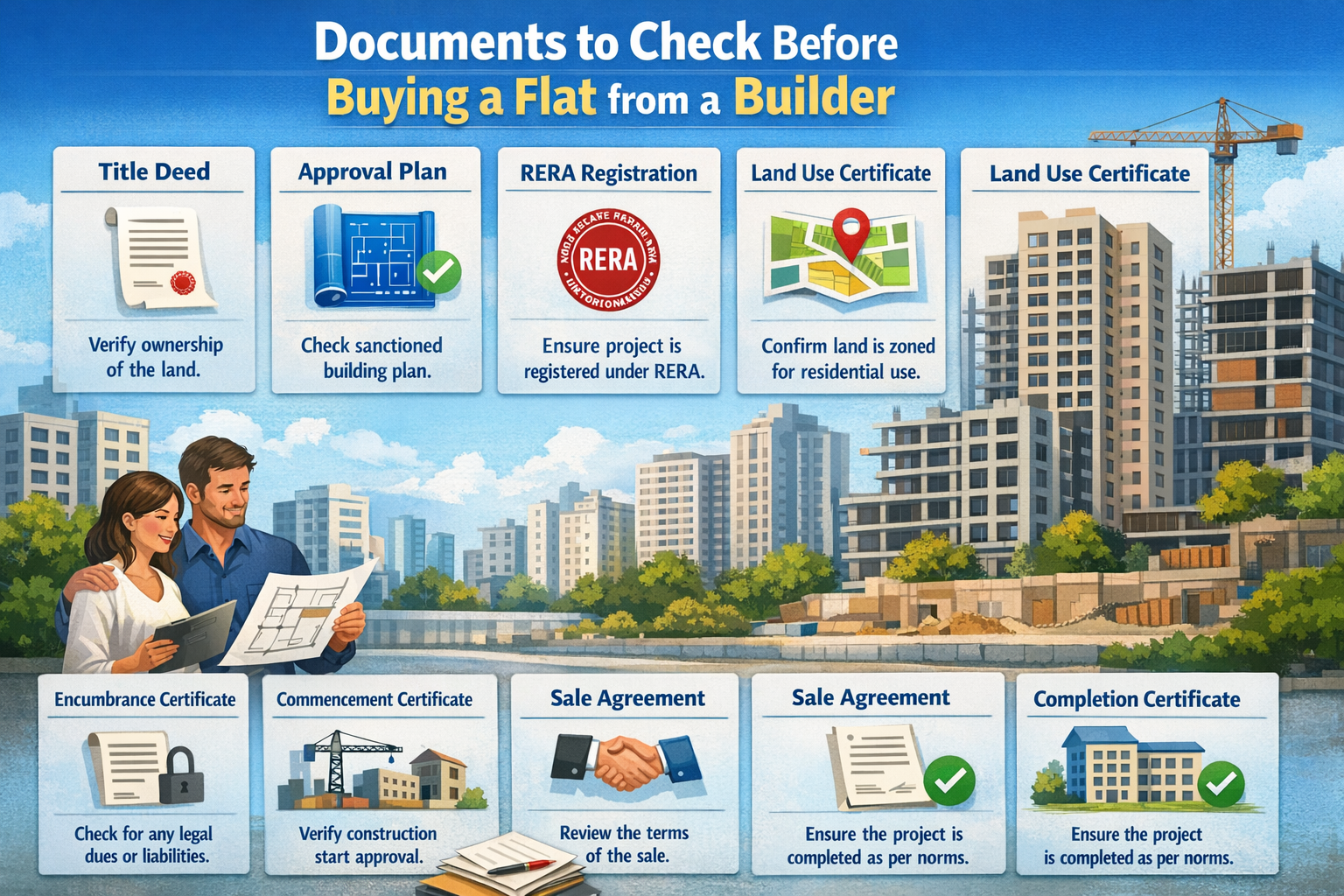
LAND OWNERSHIP & TITLE DOCUMENTS (MOST CRITICAL)
2.1 Sale Deed / Title Deed of the Land
This proves who legally owns the land.
Verify:
- Owner name matches land records
- Proper registration
- Stamp duty paid
Risk:
If land title is defective, your flat ownership becomes invalid
2.2 Chain of Title Documents (Minimum 30 Years)
This shows the ownership history of the land.
Includes:
- Sale deeds
- Gift deeds
- Partition deeds
- Inheritance records
Why it’s needed:
- Confirms land was transferred legally over time
- Identifies hidden disputes
2.3 Encumbrance Certificate (EC)
Shows whether land is free from loans, mortgages, or legal cases.
Check:
- Period: at least 15–30 years
- No bank charge or court attachment
Risk:
If land is mortgaged, bank can seize the project
2.4 Land Conversion Certificate
If land was originally agricultural, it must be converted to residential.
Issued by:
- Local revenue authority
Risk:
- Construction on non-converted land is illegal
- No Occupancy Certificate later
2.5 Land Tax & Revenue Records
Examples:
- Property tax receipts
- RTC / Patta / Khata (state-specific)
Why:
- Confirms land is recorded in government records
STATUTORY & GOVERNMENT APPROVALS
3.1 Approved Building Plan
Approved by:
- Municipal Corporation / Development Authority
Verify:
- Number of floors
- Flat layout
- Parking spaces
- Open spaces
Risk:
Deviations can lead to demolition or penalties
3.2 Commencement Certificate (CC)
Allows builders to legally start construction.
Check:
- Issued before construction began
- Covers entire project or phase
Risk:
Buying without CC = illegal construction
3.3 Environmental Clearance (Large Projects)
Required for:
- High-rise or large residential projects
Issued by:
- State or Central Environment Authority
3.4 Fire Safety Approval
Mandatory for:
- Multi-storey buildings
Ensures:
- Fire exits
- Fire equipment
- Safety compliance
RERA DOCUMENTS (EXTREMELY IMPORTANT)
4.1 RERA Registration Certificate
- Every eligible project must be registered with
- Real Estate Regulatory Authority (RERA)
Check on RERA website:
- Registration number
- Completion date
- Approved plans
- Carpet area
- Builder’s past projects
Benefits:
- Builder accountability
- Protection against delays
- Right to refund/interest
Also Read: TNRERA Guideline Value Of Property Valuation
FLAT-SPECIFIC LEGAL DOCUMENTS
5.1 Allotment Letter
Issued after booking.
Must include:
- Flat number
- Carpet area (not built-up)
- Total cost
- Payment milestones
5.2 Agreement for Sale (REGISTERED)
This is the most important buyer document.
Must clearly mention:
- Possession date
- Penalty for delay
- Cancellation and refund terms
- Construction specifications
- Amenities list
- Carpet area (RERA compliant)
Risk if unregistered:
Not legally enforceable
FINANCIAL & PAYMENT DOCUMENTS
6.1 Payment Schedule
Should be:
- Linked to construction stages
- Transparent and reasonable
6.2 Bank Approval Letter (Project Approval)
If banks have approved the project, it indicates:
- Basic legal checks done
Not a substitute for your own legal verification
CONSTRUCTION COMPLETION DOCUMENTS
7.1 Completion Certificate (CC)
Issued when:
- Construction matches approved plan
7.2 Occupancy Certificate (OC)
Confirms:
- Building is fit to live in
- Legal occupancy allowed
Without OC:
- Water and electricity issues
- Loan and resale problems
- Legal penalties
UTILITIES & COMMON AREA DOCUMENTS
- Electricity connection approval
- Water supply permission
- Sewage and drainage approval
- Parking allotment letter
- Lift safety certificate
SALE DEED & POSSESSION DOCUMENTS
9.1 Sale Deed
- Executed after full payment
- Must be registered
- Transfers ownership to buyer
9.2 Possession Letter
- Confirms handover date
- Required for utilities and society membership
SOCIETY & POST-POSSESSION DOCUMENTS
- Society registration certificate
- Share certificate
- Maintenance agreement
- Common area ownership clause
MASTER CHECKLIST
- Clear land title
- Encumbrance-free land
- Approved building plan
- RERA registration
- Registered Agreement for Sale
- Occupancy Certificate
- Registered Sale Deed
FREQUENTLY ASKED QUESTIONS (FAQs)
Q1. Is RERA compulsory?
Yes, for most residential projects. Avoid non-RERA projects.
Q2. Can I buy a flat before OC?
You can, but do not take possession without OC.
Q3. Is the carpet area mandatory?
Yes. Under RERA, pricing must be based on carpet area.
Q4. What if the builder delays possession?
You can:
- Claim interest
- Ask for refund
- File complaint under RERA
Q5. Should I hire a property lawyer?
Absolutely. A lawyer can:
- Verify title
- Identify hidden risks
- Protect you legally
Q6. What is the biggest mistake buyers make?
Trusting:
- Builder promises
- Advertisements
- Verbal assurances
- Instead of documents.
Q7. Can a project be demolished?
Yes, if:
- Built without approvals
- Major deviations from plan
https://www.livehomes.in/blogs