1. INTRODUCTION
In real-estate development in India, it is common for parties to execute a Joint Development Agreement (JDA) and later enter into one or more Supplementary / Addendum / Amendment Agreements to modify or clarify the original terms.
A recurring legal question is:
- Does a supplementary agreement to a JDA require compulsory registration?
The answer depends not on the title of the document, but on its legal effect.
2. LEGAL FRAMEWORK GOVERNING REGISTRATION
2.1 Registration Act, 1908
Section 17(1)(b) – Compulsory Registration
Registration is mandatory for any document that:
- Creates
- Declares
- Assigns
- Limits, or
- Extinguishes
any right, title, or interest in immovable property (present or future) of value exceeding ?100.
2.2 Section 49 – Effect of Non-Registration
If a document which requires registration is not registered:
- It cannot affect immovable property
- It cannot be relied upon as evidence
- It cannot be enforced in court
2.3 Transfer of Property Act, 1882 – Section 53A
If a contract:
- Grants possession (or confirms possession)
- In part performance of a transfer
then registration is mandatory, otherwise protection under Section 53A is lost.
3. WHAT IS A SUPPLEMENTARY AGREEMENT TO A JDA?
A Supplementary Agreement:
- Is ancillary to the original JDA
- Modifies or supplements certain clauses
- Does not replace the JDA unless expressly stated (novation)
- Must be read together with the main JDA
Courts look at substance over form. Calling it an “addendum” or “clarification” does not avoid registration.
Also Read: How RERA Impact joint venture Projects in Tamil Nadu
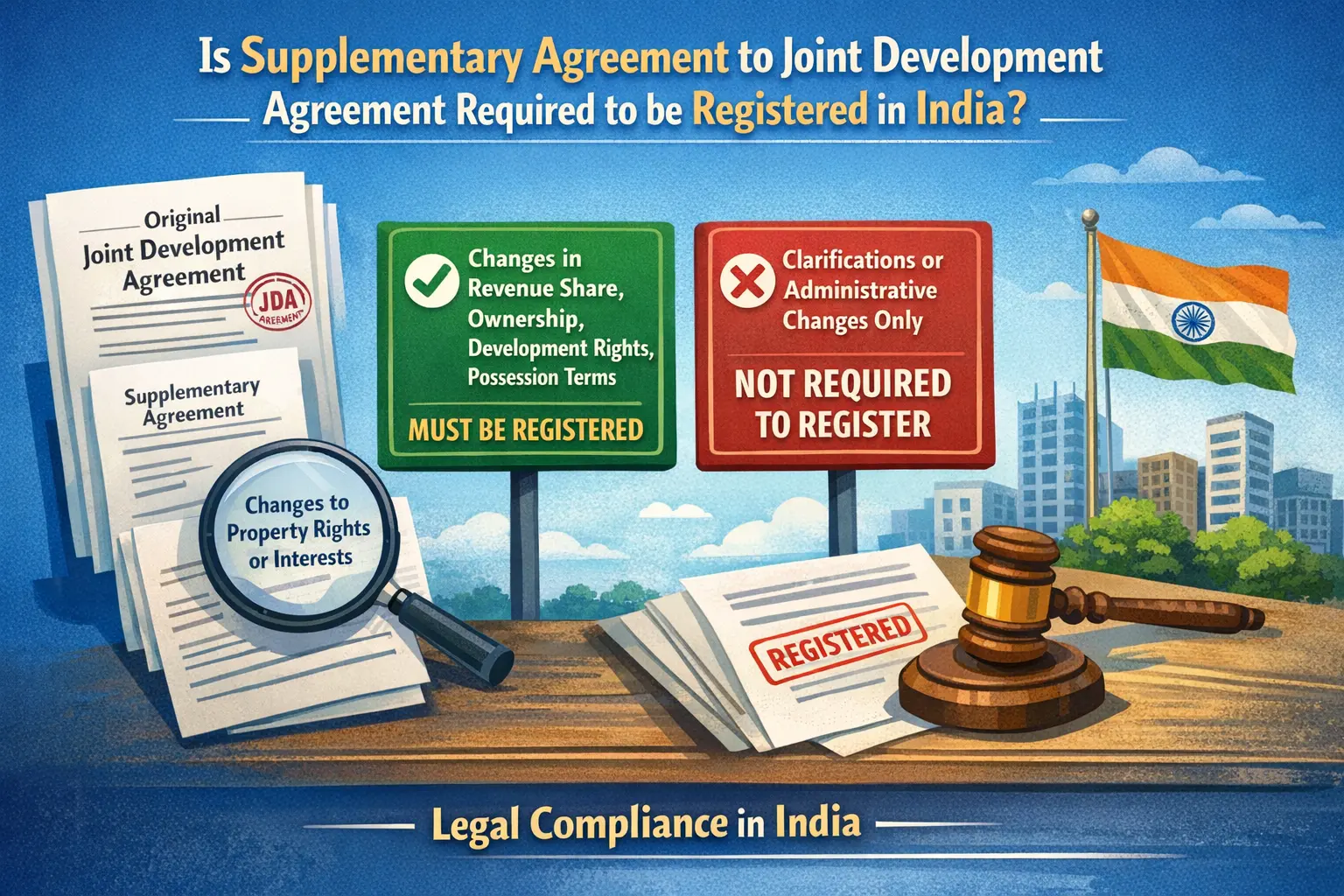
4. WHEN REGISTRATION OF A SUPPLEMENTARY JDA IS MANDATORY
4.1 If It Creates or Transfers Rights in Immovable Property
Registration is compulsory if the supplementary agreement:
- Grants additional development rights
- Increases FSI/FAR/TDR
- Permits additional floors or built-up area
- Alters landowner’s or developer’s entitlement
This amounts to a fresh transfer of immovable property rights.
4.2 If It Changes Sharing Ratio or Consideration
Examples:
- Landowner’s share reduced or increased
- Developer’s constructed area enhanced
- Monetary consideration revised
- Revenue-sharing percentage modified
These affect beneficial ownership
Registration mandatory
4.3 If It Grants, Confirms, or Extends Possession
If the supplementary agreement:
- Hands over possession for development
- Confirms deemed possession
- Extends possession period linked to rights
Attracts Section 53A
Must be registered
4.4 If It Assigns or Substitutes the Developer
If:
- Rights are assigned to another developer
- SPV or group company is inducted
- Development rights are transferred
Considered conveyance/assignment
Registration compulsory
4.5 If the Original JDA Was Registered
If the original JDA is registered:
- Any modification affecting rights must also be registered
- Otherwise, the change has no legal validity
5. WHEN REGISTRATION IS NOT MANDATORY
Registration is not compulsory if the supplementary agreement is purely clarificatory or administrative and does not affect property rights.
Examples:
- Rectification of typographical errors
- Clarification of ambiguous clauses
- Change in construction schedule (without affecting possession)
- Inclusion of RERA, GST, environmental compliance clauses
- Internal project management provisions
Even in such cases, stamp duty may still be payable.
6. STAMP DUTY VS REGISTRATION (IMPORTANT DISTINCTION)
| Aspect | Stamp Duty | Registration |
| Governing Law | Indian Stamp Act ( State laws ) | Registration Act, 1908 |
| Mandatory | Almost always | Depends on content |
| Purpose | Revenue | Public notice & enforceability |
An unstamped agreement is invalid.
An unregistered agreement (when registration is mandatory) is unenforceable.
Also Read: Stamp Duty in Tamil Nadu
7. CONSEQUENCES OF NOT REGISTERING (WHEN REQUIRED)
7.1 Legal Consequences
- Agreement becomes unenforceable
- Rights under it are void in law
- Courts will ignore it
7.2 RERA Consequences
- Material changes without registration violate RERA
- Risk of penalties and project suspension
- Buyer complaints possible
7.3 Banking & Finance
- Banks reject project finance
- Title due diligence fails
- Escrow disbursements blocked
7.4 Tax Risks
- Income-tax authorities may ignore unregistered transfers
- Capital gains disputes
- GST valuation issues
8. PRACTICAL LEGAL TEST (VERY IMPORTANT)
Ask these questions:
- Does the supplementary agreement change who gets what?
- Does it increase development rights?
- Does it affect possession?
- Does it revise consideration?
- Does it alter landowner/developer share?
If the answer to ANY is YES → Registration is compulsory.
9. DRAFTING & COMPLIANCE BEST PRACTICES
9.1 Mandatory Clauses
- Reference to original JDA
- Statement that it forms an integral part
- Stamp duty & registration clause
- No-novation clause (if applicable)
9.2 Adjudication of Stamp Duty
- Recommended before execution
- Avoids future disputes and penalties
CONCLUSION
In India, a supplementary agreement to a Joint Development Agreement must be registered if it affects rights in immovable property in any manner. Failure to do so can render the agreement unenforceable, expose parties to regulatory, tax, and litigation risks, and jeopardize the entire project.
Frequently Asked Questions (FAQs)
Q1. Is every supplementary agreement to a JDA compulsorily registrable?
No. Only those that create, modify, or transfer rights in immovable property.
Q2. If the original JDA is unregistered, can a registered supplementary agreement validate it?
No. A defective original JDA cannot be cured by a supplementary agreement.
Q3. Is notarization sufficient instead of registration?
No. Notarization does not replace registration.
Q4. Does extension of project timelines require registration?
No, if it only extends time
Yes, if linked with possession or consideration
Q5. Is stamp duty payable even if registration is not required?
Yes, as per state stamp laws.
Q6. Can an unregistered supplementary agreement be used in arbitration?
Not if it affects immovable property rights.
Q7. Can delayed registration be done?
Yes, subject to:
State-specific time limits
Penalty and fine
Q8. Does RERA require registration of supplementary JDAs?
Indirectly yes, if the changes are material and affect:
Project details
Allottees’ rights
Development scope
Q9. Are buyers affected by an unregistered supplementary JDA?
Yes. Their title and entitlement may be questioned.
Q10. What is the safest legal approach?
Stamp and register every supplementary agreement that alters rights, possession, consideration, or development scope.
https://www.livehomes.in/blogs