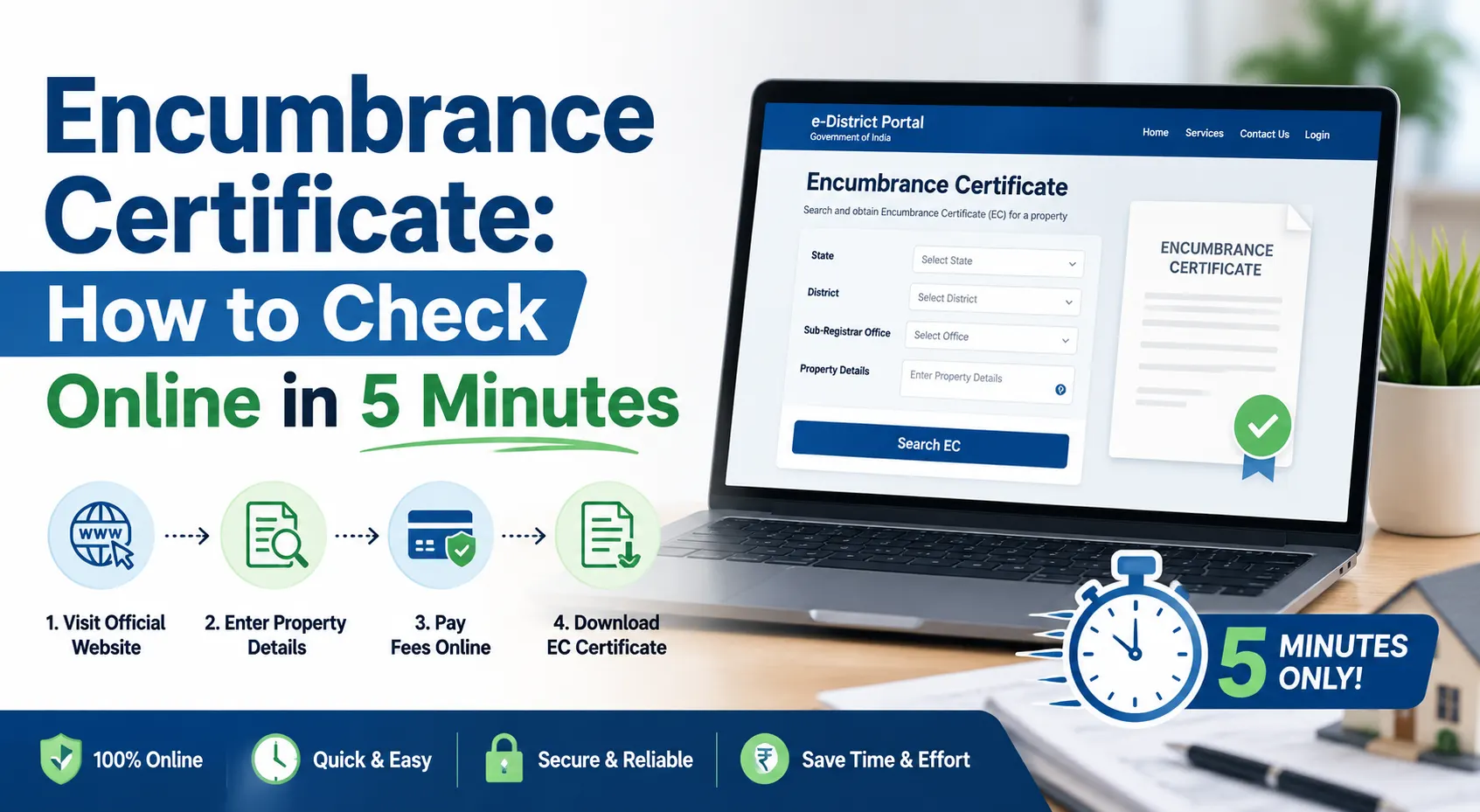
An Encumbrance Certificate (EC) is a legal document issued by the Sub-Registrar’s Office that confirms whether a property is free from financial or legal liabilities (like loans, mortgages, or court attachments) during a specified period. Today, most Indian states allow you to check and download EC online within minutes.
What Is an Encumbrance Certificate?
An Encumbrance means any charge or liability on a property.
The EC shows:
- Sale, purchase, gift, release, partition deeds
- Home loans or mortgages registered
- Court attachments (if registered)
- Lease agreements (if registered)
If no transaction exists, the EC will state “Nil Encumbrance.”
Why Is an Encumbrance Certificate Important?
You need an EC for:
- Buying or selling property
- Applying for a home loan
- Property mutation / khata transfer
- Legal verification of ownership
- Tax assessment and records
Banks will not approve loans without a clear EC.
Types of Encumbrance Certificates
1. Form 15 – With Encumbrances
Issued when transactions exist during the selected period.
2. Form 16 – Nil Encumbrance
Issued when no transactions are recorded for that period.
Documents Required to Check EC Online
You do NOT need to upload documents online.
Just keep these details ready:
- Property owner’s name
- Survey number / Plot number
- Document number (if known)
- Registration year
- Property address
How to Check Encumbrance Certificate Online in 5 Minutes (Step-by-Step)
- Each Indian state has its own official land records portal. The steps are almost identical.
Step 1: Visit Your State’s Official Land Records Portal
Examples of popular state portals:
- Karnataka – Kaveri Online Services
- Telangana – Dharani Portal
- Tamil Nadu – TNREGINET
- Maharashtra – IGR Maharashtra
Open the portal of the state where the property is located.
Step 2: Select “Encumbrance Certificate” / “Search EC”
Look for options such as:
- Encumbrance Certificate
- EC Search
- View Encumbrance
Click on it.
Step 3: Enter Property Details
You will be asked to fill in:
- District
- Taluk / Mandal
- Village
- Survey number / Plot number
- From Year – To Year
Choose the correct time period (usually last 30–40 years).
Step 4: Submit & View EC
- Click Search / Submit
- EC details will appear on screen instantly
- If available, you can download EC as PDF
Step 5: Download or Apply for Digitally Signed EC (Optional)
Some states offer:
- Free view-only EC
- Paid digitally signed EC (Rs 10–Rs 200)
Digitally signed EC is legally valid.
Offline Method (If EC Is Not Available Online)
If records are old or missing:
- Visit the Sub-Registrar Office (SRO)
- Fill Form 22
- Submit property details
- Pay fee (Rs 50–Rs 500)
- EC issued in 3–15 working days
Validity of Encumbrance Certificate
- EC does not expire
- But banks usually require latest EC (up to current date)
Common Mistakes to Avoid
- Selecting wrong survey number
- Choosing incorrect year range
- Assuming unregistered loans appear in EC
- Not verifying seller name matching title deed
Conclusion
- Encumbrance Certificate protects you from legal disputes & fraud
- Online EC saves time and money
- Always verify EC before buying property
FAQs – Encumbrance Certificate (EC)
1. Is an Encumbrance Certificate mandatory for property purchase?
Yes. It confirms the property is free from legal or financial liabilities.
2. Does EC show unregistered loans?
No. Only registered transactions appear in EC.
3. How many years EC should I check?
Ideally 30–40 years to ensure clean title history.
4. Can I get EC online for free?
- Viewing EC is free in most states.
- Digitally signed EC may have a small fee.
5. What does “Nil Encumbrance” mean?
It means no registered transactions exist during the selected period.
6. Can EC prove ownership?
No. EC only shows transactions.
Ownership is proven through sale deeds + title documents.
7. Is online EC legally valid?
Yes, digitally signed EC is legally valid and accepted by banks.
8. What if my property doesn’t appear online?
Older records may not be digitized.
Apply offline at the Sub-Registrar Office.
9. Can EC be taken by anyone?
Yes. EC is a public document.
10. Is EC required for home loans?
Mandatory. Banks will not process loans without it.