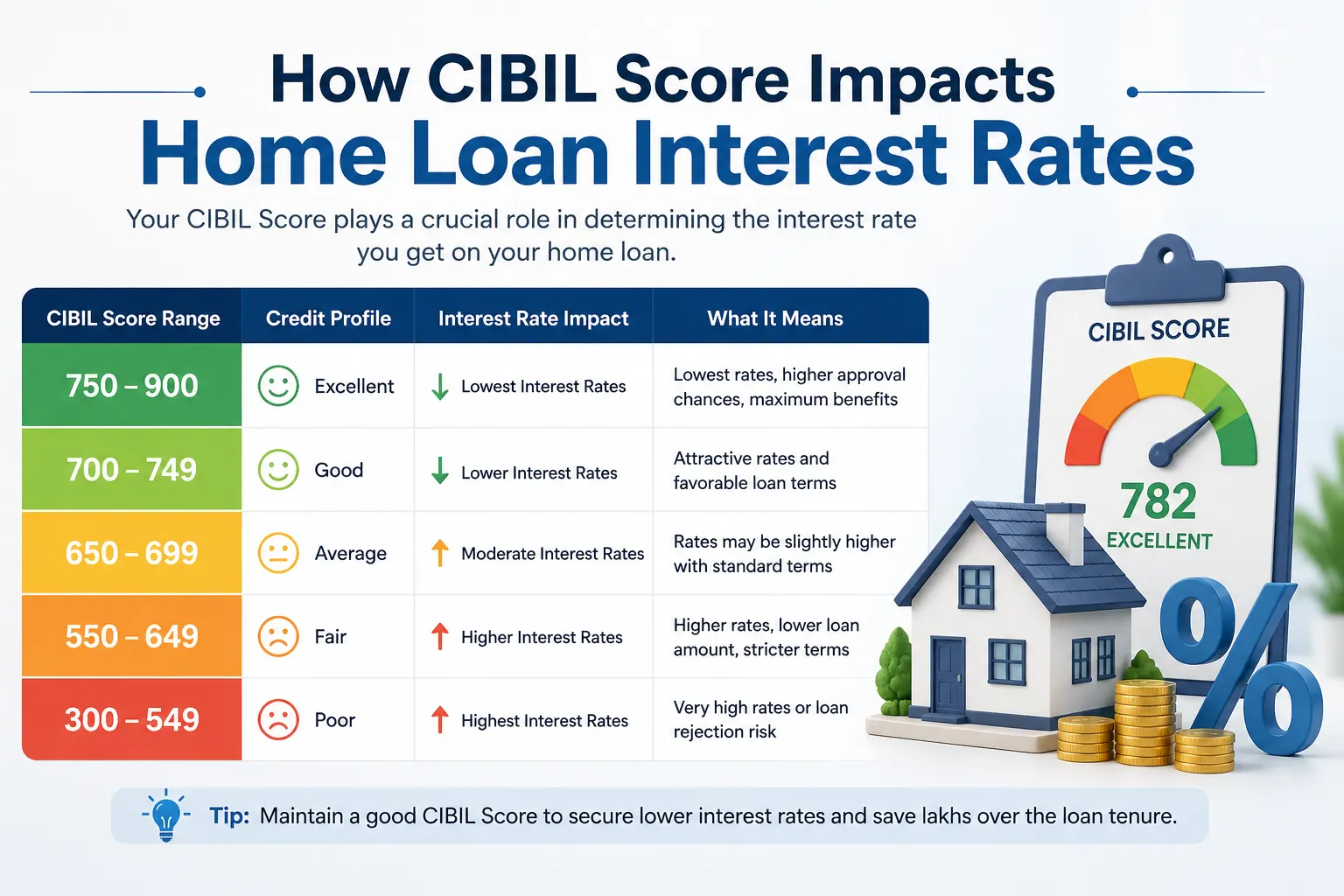
A CIBIL score is one of the most decisive factors in determining whether you will get a home loan, how much loan you will get, and the interest rate you will pay. Since a home loan is usually a long-term financial commitment (often 20–30 years), even a small change in interest rate can result in huge savings or losses over time.
What Is a CIBIL Score?
The CIBIL score is a three-digit number ranging from 300 to 900, issued by TransUnion CIBIL. It is calculated based on your credit history, which includes:
- Repayment record of loans and credit cards
- Number of active and closed loans
- Credit card usage and limits
- Loan inquiries made by lenders
- Length of your credit history
Higher score = Better credit discipline
A lower score means a higher risk for lenders
Why Banks Use CIBIL Score for Home Loans
Home loans involve large amounts and long tenures, making them risky for lenders. To minimize risk, banks and housing finance companies use your CIBIL score to evaluate:
- Your ability to repay EMIs on time
- Your past financial discipline
- Chances of loan default
Based on this assessment, lenders decide the following:
- Whether to approve or reject your loan
- The interest rate applicable
- The loan amount sanctioned
- Repayment tenure and conditions
How CIBIL Score Affects Home Loan Interest Rates
750 – 900 (Excellent Credit Score)
- Interest Rate: Lowest available in the market
- Loan Approval: Almost guaranteed (subject to income criteria)
- Advantages:
- Minimum EMIs
- Higher loan eligibility
- Faster processing and approval
- Better negotiation power
Borrowers in this range are considered low-risk customers, so lenders reward them with the best rates.
700 – 749 (Good Credit Score)
- Interest Rate: Slightly higher than the best rates
- Loan Approval: Very high chances
- What to Expect:
- Competitive interest rates
- Standard loan terms
- Easy approval with proper documentation
A small improvement in this range can help you qualify for the lowest interest slab.
650 – 699 (Average Credit Score)
- Interest Rate: Moderate to slightly high
- Loan Approval: Possible but cautious
- Challenges:
- Higher EMI compared to top scorers
- A lower loan amount may be approved
- Increased scrutiny of income and expenses
Borrowers in this range are seen as medium-risk, so lenders price the loan accordingly.
550 – 649 (Fair Credit Score)
- Interest Rate: High
- Loan Approval: Difficult
- Common Conditions:
- Higher EMIs
- Lower sanctioned amount
- A co-applicant or guarantor may be required
- Stricter documentation
Lenders see this range as risky, leading to costly borrowing.
300 – 549 (Poor Credit Score)
- Interest Rate: Very high or loan rejection
- Loan Approval: Low probability
- Risks:
- Loan rejection is common
- Limited lender options
- Shorter tenure and strict terms
Improving your credit score is strongly recommended before applying.
Also Read: Home Loan Interest Rates in 2026
Real Impact of Interest Rate Difference
Even a 0.5% increase in interest rate can significantly increase the total interest paid.
Example:
For a Rs50 lakh home loan for 20 years:
- At 8.5% → Total interest ≈ Rs 54 lakh
- At 9.5% → Total interest ≈ Rs 63 lakh
Difference: ~Rs 9 lakh extra, just due to a lower CIBIL score.
Other Loan Factors Influenced by CIBIL Score
Apart from interest rates, your CIBIL score also affects:
- Loan processing fees
- Prepayment flexibility
- Requirement of collateral or co-applicant
- Approval speed
How to Improve Your CIBIL Score Before Applying
- Pay all EMIs and credit card dues on time
- Keep credit card usage below 30% of limit
- Avoid frequent loan or card applications
- Maintain a mix of secured and unsecured loans
- Check your credit report regularly for errors
Conclusion
Your CIBIL score is not just a number—it directly impacts the cost of your home loan. A higher score means:
- Lower interest rate
- Lower EMIs
- Huge long-term savings
Improving your score before applying can save you lakhs of rupees over the loan tenure.
Frequently Asked Questions
1. What is a good CIBIL score for the lowest home loan interest rate?
A score of 750 or above is ideal for securing the lowest interest rates.
2. Can I get a home loan with a CIBIL score below 650?
Yes, but at higher interest rates and stricter conditions. Approval is not guaranteed.
3. Does a higher income compensate for a low CIBIL score?
A high income helps, but it cannot fully compensate for a poor credit score.
4. How long does it take to improve a low CIBIL score?
It can take 6–12 months with disciplined repayment and credit management.
5. Does checking my CIBIL score reduce it?
No. Checking your own score is a soft inquiry and does not affect your score.
6. Is the CIBIL score the same for all banks?
Yes, but each lender may have different internal approval criteria.