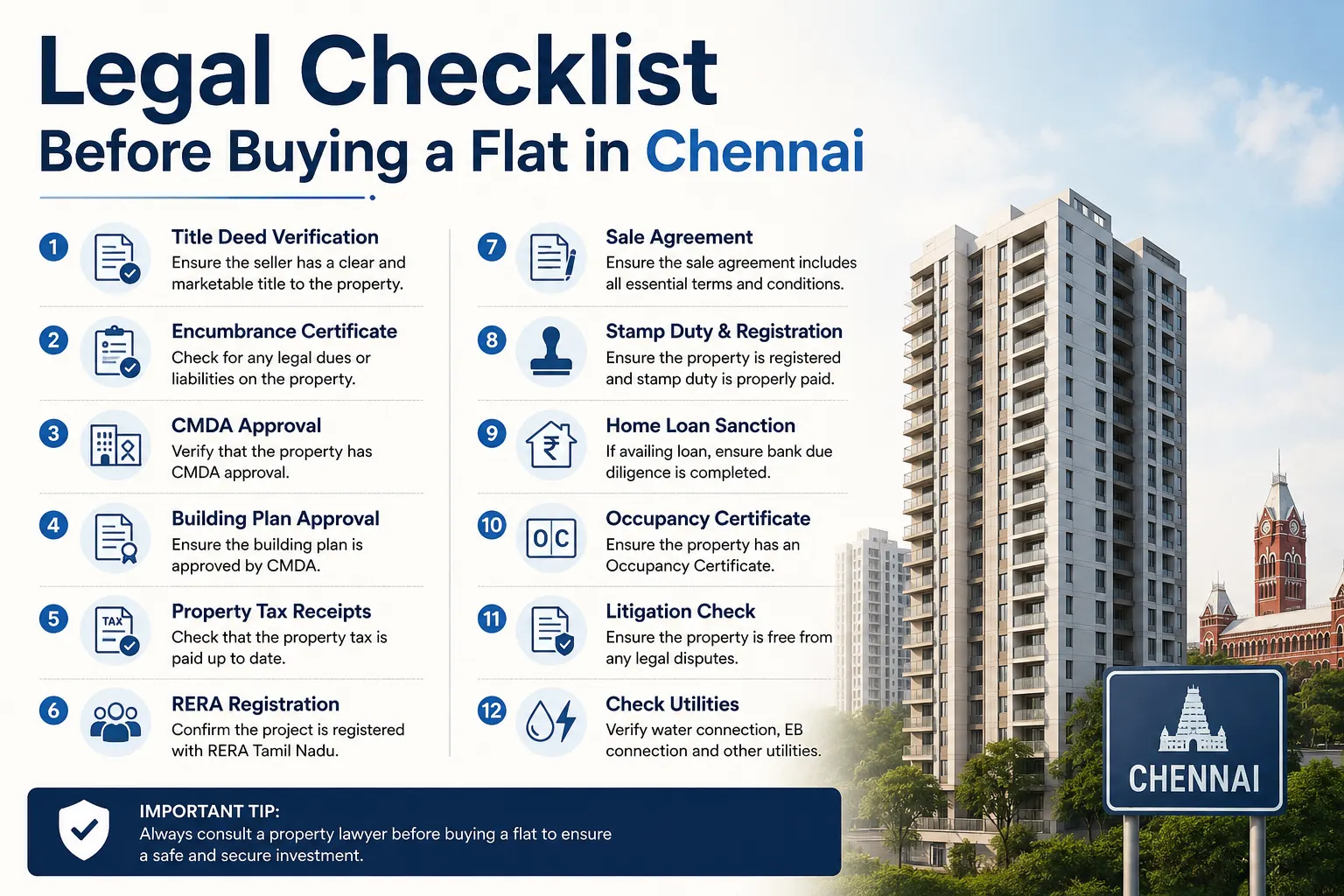
Buying a flat in Chennai involves more than choosing a good location or builder. You must ensure the property complies with Tamil Nadu land laws, planning regulations, and registration rules. Missing even one legal check can result in financial loss, legal disputes, or inability to resell the property.
1. Title Deed Verification
The title deed proves who legally owns the property.
What you must verify:
- The seller is the absolute owner
- Ownership history (parent documents) is clear and continuous
- No missing links in ownership transfer (sale, gift, settlement, inheritance)
Why this matters:
If the title is unclear:
- You may lose ownership in court
- Banks may reject home loans
- Property cannot be resold safely
Ideally, verify 30 years of title history through a lawyer.
2. Encumbrance Certificate (EC)
The Encumbrance Certificate shows whether the property has any financial or legal liabilities.
What EC confirms:
- No existing home loans or mortgages
- No court attachments
- No sale agreements already registered
Key point:
- EC must be taken from the sub-registrar office.
- The period should match the full ownership history
Also Read: Encumbrance Certificate How to check online in 5 minutes
3. CMDA Approval (Mandatory in Chennai)
Projects inside Chennai must be approved by CMDA.
What CMDA approval ensures:
- Land is approved for residential use
- Roads, open spaces, and amenities follow planning norms
- Construction is legally permitted
Risk of non-CMD Approval:
- Building violations
- Heavy penalties
- No Occupancy Certificate
- Demolition risk in extreme cases
4. Building Plan Approval
Even if the land is approved, the building plan must be sanctioned.
You should check:
- Number of floors approved
- Flat size and layout match the sanctioned plan
- No extra floors or illegal extensions
Why this is critical:
Any deviation may:
- Block OC issuance
- Cause legal notices
- Affect resale and loan eligibility
Also Read: Importance of Building Approval and CMDA Norms in Chennai Real Estate
5. Property Tax Payment Verification
Property tax must be fully paid by the seller until the date of sale.
Check:
- Latest property tax receipts
- No arrears with the corporation or Municipality
Important:
Unpaid taxes legally transfer to the new owner.
6. RERA Registration
Under the Real Estate Act, most projects must be registered with RERA Tamil Nadu.
What RERA protects you from:
- Delayed possession
- Misleading advertisements
- Changes in layout without consent
Verify:
- RERA registration number
- Approved plans
- Possession timeline
- Builder details
7. Sale Agreement (Legal Contract)
The Agreement for Sale defines the legal relationship between buyer and builder/seller.
Must clearly mention:
- Total price (including GST, amenities, parking)
- Carpet area (not super built-up)
- Payment schedule
- Possession date & delay penalty
- Cancellation and refund clauses
8. Stamp Duty & Registration
Property ownership becomes legal only after registration.
In Tamil Nadu:
- Stamp Duty: approx. 7%
- Registration Fee: approx. 4%
Ensure:
- Correct guideline value
- Correct buyer and seller details
- Registration at the correct Sub-Registrar Office
Without registration, ownership has no legal validity.
9. Home Loan Due Diligence
Banks conduct legal and technical checks before approving loans.
What bank approval indicates:
- The title is broadly acceptable
- The project meets basic norms
10. Occupancy Certificate (OC)
OC confirms that the building is constructed according to approved plans and is safe for occupation.
Why OC is crucial:
- Required for water and sewage connection
- Needed for resale
- Required by banks
Buying without OC may result in:
- Utility disconnections
- Penalties
- Legal complications
11. Litigation & Dispute Check
Ensure the property is free from:
- Court cases
- Family disputes
- Land acquisition issues
How to check:
- Seller declaration
- Advocate search in civil courts
- EC cross-verification
12. Utility & Infrastructure Verification
Confirm availability of essential services.
Verify:
- Metro Water or approved water source
- EB electricity connection
- Sewage and drainage approval
- Lift, fire safety, and common area approvals
Utilities must be legally sanctioned, not temporary.
Frequently Asked Question
1. Is RERA registration mandatory in Chennai?
Yes. All new and ongoing projects (above prescribed limits) must be registered under RERA Tamil Nadu.
2. Can I buy a flat without CMDA approval?
No. Buying a non-CMDA-approved flat is risky and may lead to loan rejection, penalties, or demolition.
3. Is bank approval enough to trust a property?
No. Bank approval helps, but banks protect their interest—not yours. Independent legal verification is essential.
4. What happens if I buy a flat without an occupancy certificate?
You may face:
Utility disconnections
Resale difficulties
Legal notices from authorities
5. How many years of Encumbrance Certificate should I check?
Ideally 30 years or from the first registered document of the property.
6. Who pays stamp duty and registration charges?
The buyer bears both stamp duty and registration charges in Tamil Nadu.
7. Is a lawyer really necessary for buying a flat?
Yes. A property lawyer checks title defects, hidden clauses, litigation risks, and regulatory compliance.