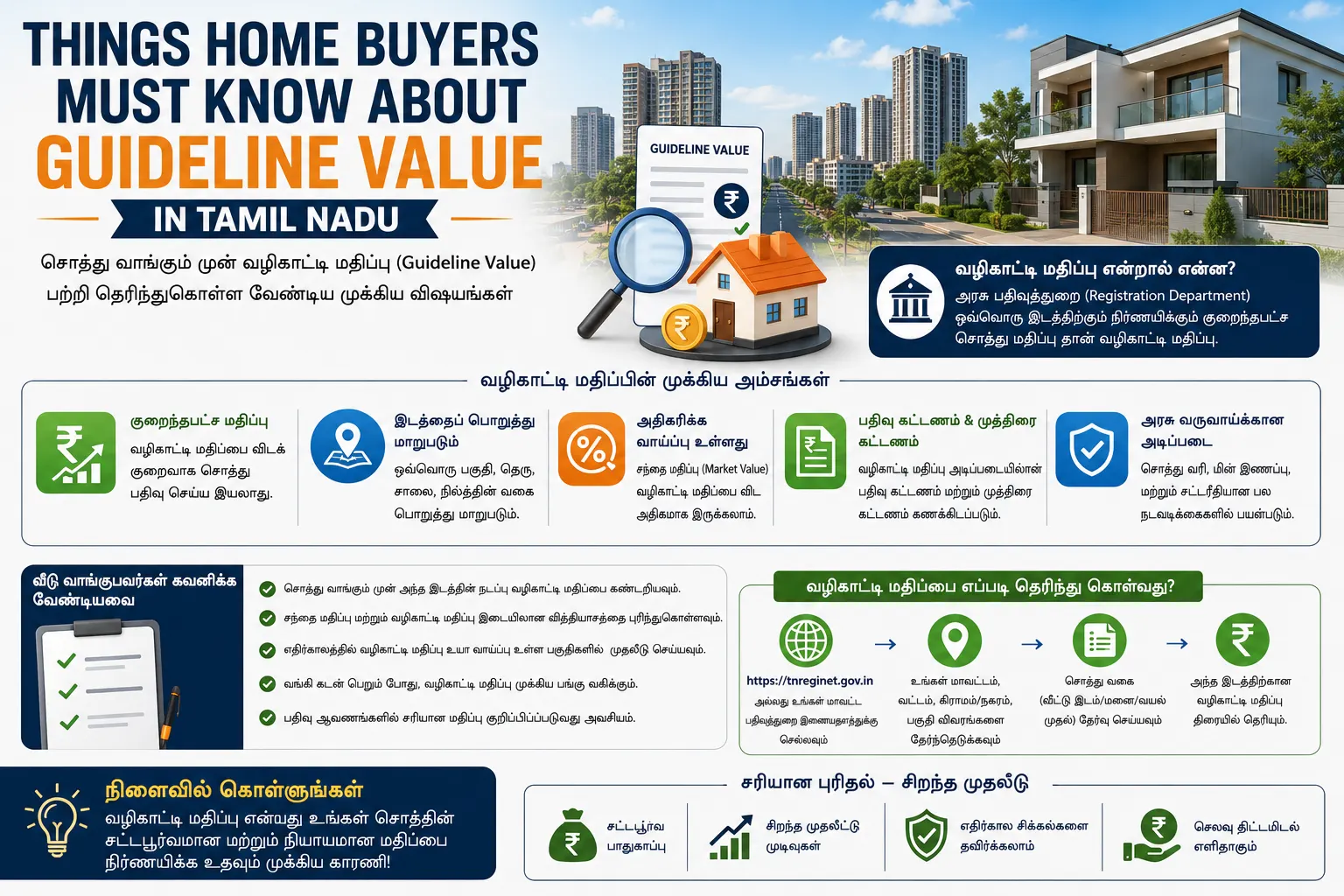
1. What is Guideline Value?
Guideline Value is the minimum government-approved value at which a property can be legally registered in Tamil Nadu. It is officially fixed and published by the Tamil Nadu Registration Department. This value acts as a benchmark price for property transactions and ensures that properties are not undervalued during registration.
Key points:
- It is not the market price but a statutory value.
- It applies to every property transaction — sale, gift, exchange, or settlement.
- Registration authorities cannot accept a value below the guideline value without special procedures.
2. Purpose of Guideline Value
The main objectives of fixing guideline values are
- To prevent under-reporting of property value
- To control black money in real estate,
- To ensure fair collection of stamp duty and registration fees
- To bring uniformity in property valuation across regions
Without guideline value, buyers and sellers could declare extremely low prices to reduce taxes, causing revenue loss to the government.
3. Who Fixes the Guideline Value?
The Government of Tamil Nadu fixes guideline values based on recommendations from the following:
- Registration officials
- Revenue authorities
- Market transaction data
- Local development indicators
Once approved, the value becomes legally binding until revised again.
4. How Guideline Value is Calculated
Guideline value is not random. It is calculated after considering multiple factors:
a) Location
- Urban areas have higher values than rural areas.
- Prime localities cost more than interior streets.
b) Road Access
- Properties facing main roads have higher guideline values.
- Interior plots have comparatively lower value.
c) Property Usage
Different rates apply for:
- Residential property
- Commercial property
- Industrial property
- Agricultural land
d) Infrastructure & Development
- Availability of roads, drainage, water supply
- Proximity to schools, hospitals, transport hubs
- Growth potential of the area
e) Past Registered Transactions
- Average value of recently registered sale deeds in that locality
Because of this, guideline values can differ even between two adjacent streets.
5. Guideline Value and Property Registration
During registration:
- The sub-registrar compares the following:
- Sale consideration (agreed price)
- Guideline value
- Stamp duty and registration fees are calculated on whichever is higher.
If the declared sale value is lower than guideline value:
- The document may be referred for valuation review.
- Registration can be delayed or questioned.
- Market value reflects demand and supply.
- Guideline value reflects government valuation norms.
6. Impact on Stamp Duty and Registration Charges
In Tamil Nadu, generally:
- Stamp Duty: 7%
- Registration Fee: 2%
- These are calculated based on:
- Higher of guideline value or sale value
Example:
- Sale price: Rs 60 lakh
- Guideline value: Rs 70 lakh
Stamp duty and registration fee will be calculated on Rs 70 lakh, not Rs 60 lakh.
7. Guideline Value for Apartments and Flats
For apartments, valuation includes:
a) Undivided Share (UDS) of Land
- Calculated based on land guideline value.
b) Building Value
- Depends on:
- Type of construction (RCC, load-bearing, etc.)
- Age of building
- Number of floors
- Amenities (lift, parking, power backup)
The combined value is known as the composite value, and registration charges are calculated on this total.
8. Effect on Home Loans
Guideline value affects home loans in these ways:
- Banks usually consider registered value for loan calculation.
- If guideline value is lower than market price:
- Loan amount may be restricted.
- If guideline value is higher:
- Higher stamp duty increases the buyer's upfront cost.
Banks may also conduct their independent valuation, but guideline value remains an important reference.
9. Buying Property Below Guideline Value
Buying below guideline value is legally sensitive.
- What happens if the sale price is lower?
- The sub-registrar may reject or refer to the document.
- The buyer must request valuation adjudication.
- Officials inspect property and determine fair value.
- If not convinced, higher value will be enforced.
This process:
- Takes time
- Has no guaranteed outcome
- May involve additional costs
10. Zero Guideline Value – What Buyers Should Know
If a property shows a zero guideline value, it usually means the following:
- Property details are not updated
- Survey number mismatch
- Village records incomplete
Such properties:
- Are not automatically illegal
- Require careful verification
- May face delays during registration
Frequently Asked Questions
1. Is guideline value compulsory in Tamil Nadu?
Yes. Property registration must follow guideline value norms.
2. Can I register property below the guideline value?
Only through special valuation approval, which is difficult and time-consuming.
3. Does guideline value apply to gift deeds and settlements?
Yes. It applies to all types of property transfers.
4. Is guideline value the same across a city?
No. It varies by street, locality, and survey number.
5. Does guideline value affect resale properties?
Yes. It applies equally to new and resale properties.
6. Can guideline values be revised suddenly?
Yes. The government can revise it through official notification.
7. Is higher guideline value good or bad for buyers?
- Good for long-term valuation
- Increases stamp duty and upfront costs