Buying a home is one of the most important decisions for any family. Apart from the property price, homebuyers consider safety, privacy, peaceful surroundings, accessibility, maintenance expenses and the comfort of their family members. In a growing city like Chennai, choosing the right type of apartment is becoming increasingly important. Among the different residential property options available, low-rise apartments are gaining attention among families looking for comfortable, less-crowded and community-oriented living spaces. Unlike high-rise residential towers with numerous floors, low-rise buildings generally have fewer floors and a limited number of residential units. For families who prefer a peaceful residential environment without compromising on essential facilities, low-rise apartments can be a suitable option. In this blog, we will explore the major benefits of buying a low-rise apartment in Chennai, the features families should consider, important locations, investment potential and the factors to check before purchasing a property in 2026.
What Is a Low-Rise Apartment?
A low-rise apartment is a residential building constructed with a relatively small number of floors compared with a high-rise apartment tower. These buildings generally accommodate fewer residential units, depending on the plot size, building design and approved construction plan. In Chennai, low-rise apartments are commonly found in residential neighbourhoods where independent houses, builder-floor apartments and smaller residential developments are popular.
Common features of low-rise apartments include:
- Ground floor with two or three upper floors.
- Limited residential units on each floor.
- Lift facilities, depending on the building design.
- Dedicated or common car parking.
- Individual balconies or sit-out spaces.
- CCTV surveillance and security facilities.
- Common terrace and utility areas.
- Rainwater harvesting facilities.
The exact classification of a building depends on applicable building regulations, approved height, number of floors and local planning rules. Buyers should verify the sanctioned building plan rather than relying only on the project's marketing description.
1. A More Peaceful Living Environment for Families
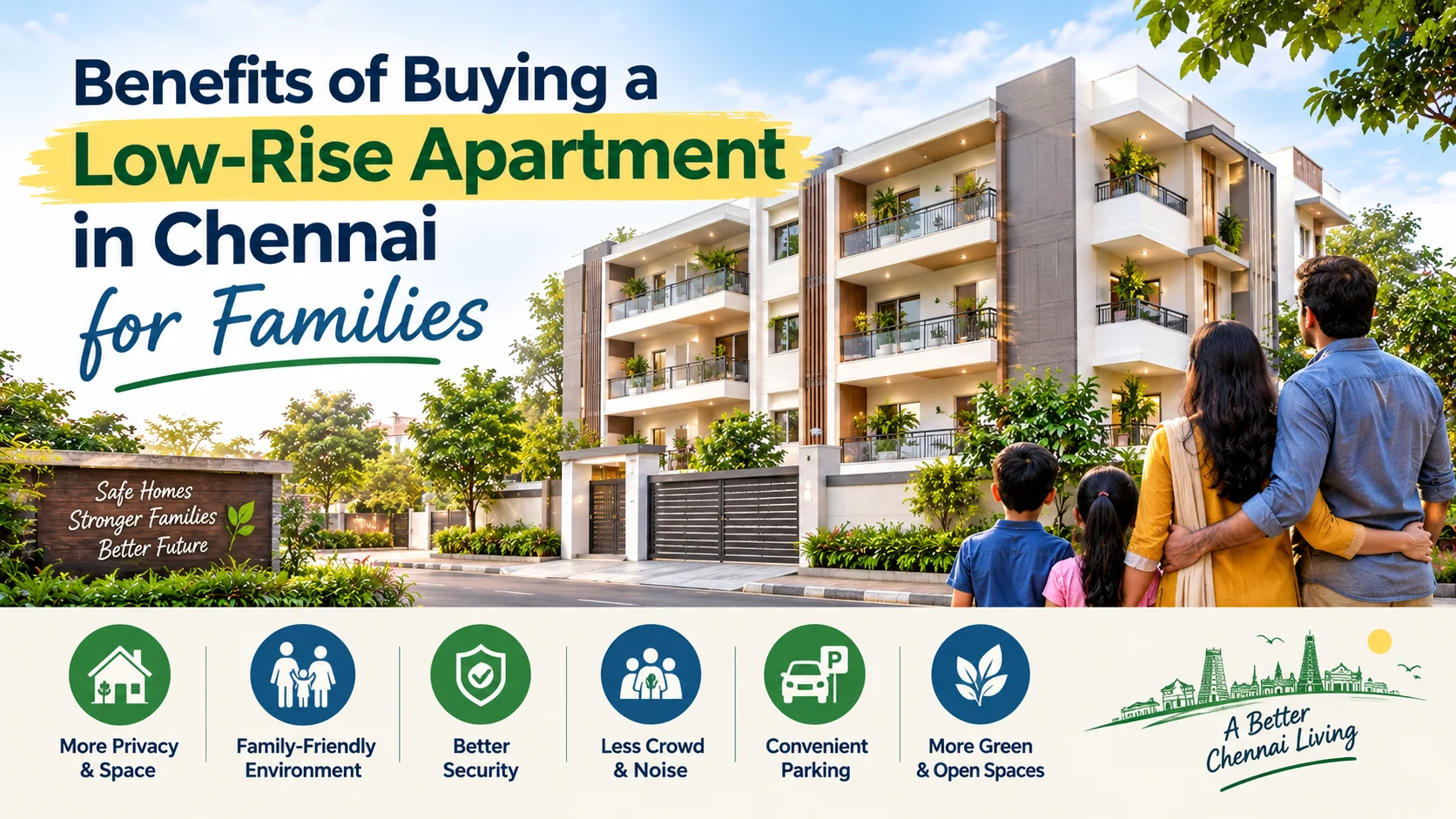
One of the major reasons families consider low-rise apartments is the possibility of enjoying a less-crowded residential environment. High-rise apartment complexes may accommodate hundreds of families within a single development. In comparison, smaller low-rise residential buildings generally have fewer households sharing common facilities. This can create a more comfortable atmosphere for everyday family life.
Some advantages include:
- Less crowding in common areas.
- Fewer people sharing corridors and staircases.
- A quieter residential atmosphere.
- Better opportunities to interact with neighbours.
- A more familiar community environment.
For families with children, working professionals and elderly parents, a peaceful home environment can make everyday living more comfortable.
2. Better Privacy for Every Family
Privacy is an important consideration when purchasing a residential property. Families often prefer a home where they can enjoy personal space without excessive movement and disturbance from other residents. Low-rise apartments with fewer residential units may offer a more private living experience. For example, a building with two apartments per floor can provide a different living experience compared with a large residential tower containing multiple apartments on every floor. Potential privacy advantages include fewer neighbours sharing the same floor, reduced movement in common corridors, less congestion around entrances and more manageable common spaces. Families should also check the distance between neighbouring buildings, balcony positioning, window placement and ventilation before finalising a property.
3. Convenient Living for Senior Citizens
For families living with parents or grandparents, accessibility is an important factor. In high-rise buildings, residents may depend heavily on lifts to travel between floors. Although lifts are useful, their availability during maintenance or power interruptions can become a concern.
Low-rise apartments may offer easier access to common areas and entrances, particularly when the apartment is located on the ground or first floor.
Important features to consider include:
- Lift availability and maintenance.
- Anti-skid flooring in common areas.
- Handrails along staircases.
- Ramps near the building entrance.
- Well-lit corridors.
- Easy access to parking areas.
- Nearby hospitals and pharmacies.
A low-rise apartment is not automatically senior-friendly. Families should check the actual floor level, staircase design, lift backup and accessibility features before purchasing.
4. Better Opportunities for Natural Light and Ventilation
Natural lighting and ventilation play an important role in creating a healthy and comfortable home. Many homebuyers prefer apartments with good window placement, open balconies and sufficient space between neighbouring buildings. Depending on the building layout and surrounding structures, low-rise apartments may offer opportunities for better natural light and airflow.
Important features to look for include:
- Cross ventilation: Windows positioned on different sides of the apartment can help air circulate naturally.
- Balcony space: A well-designed balcony can provide additional ventilation and an outdoor sitting area.
- Natural sunlight: Proper window orientation can bring daylight into living rooms and bedrooms.
- Open surroundings: Buildings with adequate setbacks and open spaces may provide better airflow.
In Chennai's hot and humid climate, ventilation is especially important. Buyers should inspect the apartment at different times of the day to understand sunlight exposure and airflow.
5. More Family-Friendly Community Living
A home is not just a place to sleep. It is also where families build relationships and create memories. Low-rise residential developments can create opportunities for residents to become familiar with their neighbours. Since fewer families may live in the same building, residents can develop a closer community.
Some family-friendly advantages include:
- Children can become familiar with neighbouring families.
- Residents can communicate more easily.
- Common areas may be less crowded.
- Neighbours can support one another during emergencies.
- Community activities can be easier to organise.
For parents with young children, having a familiar residential environment can provide additional peace of mind. However, parents should check whether the building has safe play areas, secure access and suitable common spaces.
6. Potentially Lower Maintenance Expenses
Maintenance costs are another important factor when purchasing an apartment. Large high-rise developments may require the maintenance of multiple lifts, extensive common corridors, swimming pools, clubhouses, security systems, generators and other shared facilities. A smaller low-rise apartment building may have fewer common facilities and simpler infrastructure to maintain.
Possible maintenance advantages include:
- Fewer lifts or simpler lift systems.
- Smaller common areas.
- Lower maintenance requirements for shared facilities.
- Fewer common amenities requiring regular servicing.
- Simpler building management arrangements.
However, lower maintenance is not guaranteed. Actual monthly maintenance depends on the building's age, lift facilities, water supply, generator, security arrangements, housekeeping and residents' association decisions. Before buying, request the estimated monthly maintenance charges and understand which expenses are included.
7. Easier Access to Essential Facilities
One of the practical advantages of smaller residential buildings can be easier access to entrances, parking and common facilities. In a large apartment complex, residents may need to travel through long corridors, multiple blocks and common areas before reaching their homes. In a low-rise apartment, the building layout may provide more direct access to the main entrance, staircase, lift, car parking, two-wheeler parking, water facilities and common utility areas. For families who regularly travel for work, school and other activities, convenient access can make daily routines easier. Buyers should check the actual parking allocation, entrance width and vehicle movement space before purchasing.
8. Suitable for Families with Children
Families with children generally look for homes that provide safety, convenience and a comfortable environment for their growing children. Low-rise apartments can be attractive to such families because smaller developments may have fewer residents and less movement in common areas.
The following features can make a low-rise apartment suitable for families:
- Secure entrance: CCTV cameras and controlled entry can improve building security.
- Balcony safety: Proper balcony railings and child-safe window fittings are important.
- Comfortable surroundings: A residential street with less traffic may provide a better environment for families.
- Nearby educational facilities: Schools, tuition centres and daycare facilities should be accessible.
- Open spaces: A nearby park or designated play area can provide children with outdoor recreation opportunities.
Parents should remember that a low-rise building is not automatically safer for children. Staircase access, terrace restrictions, balconies and vehicle movement areas require proper attention.
Also Read: Standalone Apartment in Chennai: Meaning, Benefits, Costs & Buying Guide 2026
9. Better Scope for Individualised Interior Design
Another advantage of buying a low-rise apartment is the opportunity to create a home that matches your family's lifestyle. Many homebuyers prefer apartments where they can customise the interiors according to their requirements.
Depending on the apartment layout and structural limitations, families can plan:
- Modular kitchen with additional storage.
- Space-saving wardrobes.
- TV unit and living room interiors.
- False ceiling with modern lighting.
- Dedicated pooja space.
- Study area for children.
- Work-from-home corner.
- Storage cabinets and utility areas.
For example, a 3 BHK low-rise apartment can provide separate bedrooms for parents and children, along with a living room and dining area. Before making structural changes, buyers should obtain the necessary approvals and confirm that the proposed interior work does not affect structural members or common services.
10. Suitable for Work-from-Home Families
Work-from-home arrangements have changed the way many families select residential properties. A home should now accommodate not only daily family activities but also professional requirements. Low-rise apartments with practical floor plans can provide suitable spaces for remote working.
Families can consider:
- A separate study room.
- A dedicated work desk in the bedroom.
- Good natural lighting.
- Proper electrical points.
- Reliable internet connectivity.
- Sound insulation and privacy.
- Space for office furniture and storage.
A well-planned 2 BHK or 3 BHK apartment can provide a comfortable balance between personal and professional life.
11. A Practical Option for 2 BHK and 3 BHK Homebuyers
Low-rise apartments are available in different configurations depending on the land area, building design and development plan. For Chennai families, 2 BHK and 3 BHK apartments are popular configurations to consider.
2 BHK Low-Rise Apartment
Suitable for small families, couples and first-time homebuyers. It generally provides two bedrooms, a living room, kitchen and bathrooms, depending on the layout.
3 BHK Low-Rise Apartment
Suitable for growing families who need additional bedrooms, a guest room, children's study space or a work-from-home area. When comparing apartments, families should look beyond the advertised square footage. Check the carpet area, room dimensions, storage space, balcony size and furniture arrangement.
12. More Residential Choices Across Chennai
Chennai has a variety of residential neighbourhoods where buyers can explore smaller apartment developments and builder-floor properties. The right location depends on workplace connectivity, children's education, healthcare facilities, public transport and budget.
Some areas worth exploring include:
- Madipakkam: Known for residential neighbourhoods and 2 BHK and 3 BHK housing options.
- Velachery: Offers access to shopping, employment centres and transport facilities.
- Nanganallur: An established residential neighbourhood with family housing options.
- West Mambalam: Offers residential convenience and access to commercial areas.
- Ashok Nagar: A well-established neighbourhood with connectivity to important parts of Chennai.
- Arumbakkam: Provides access to major roads and public transport facilities.
- Porur: Offers residential developments and access to employment corridors.
- Ullagaram: A residential location where buyers can explore apartment options.
- Perungudi: Suitable for buyers looking for access to IT employment areas and OMR.
- Koyambedu: Offers connectivity to major transport facilities.
These are suggested locations to research, not a verified ranking of low-rise apartment availability. Buyers should compare actual projects, local road conditions, approvals and prevailing prices in each neighbourhood.
13. Low-Rise Apartments Can Offer a Practical Investment Option
A residential property is both a place to live and a long-term financial commitment. Low-rise apartments may attract buyers who prefer smaller residential communities and practical home layouts. Their resale and rental potential, however, depend on several factors.
- Location advantage: Properties near employment centres, schools, hospitals, metro stations and major roads may attract a wider range of buyers and tenants.
- Demand for family homes: Well-maintained 2 BHK and 3 BHK apartments can appeal to families looking for long-term accommodation.
- Building condition: Construction quality, waterproofing, plumbing, electrical systems and maintenance influence the property's long-term condition.
- Undivided Share of Land (UDS): The land share associated with an apartment is an important ownership consideration. Buyers should verify the UDS mentioned in the sale documents.
- Resale considerations: Building age, available parking, lift condition, location and legal approvals can influence future resale demand.
Low-rise apartments do not automatically appreciate faster than high-rise apartments. A property's investment performance should be evaluated based on its purchase price, location, construction quality, rental demand and future resale prospects.
14. Low-Rise Apartments vs High-Rise Apartments – Which Is Better for Families?
Both low-rise and high-rise apartments have their own advantages. The right choice depends on family size, lifestyle, budget and expectations.
| Comparosn factor | Low-rise apartment | High-rise apartment |
| Building structure | Fewer floors | More floors |
| Residential density | Often fewer households | Can accommodate many households |
| Privacy | May offer fewer shared neighbours | Depends on floor and layout |
| Lift dependency | Depends on building height and | Generally higher |
| Amenities | Often essential or limited amenities | May offer extensive amenities |
| Maintenance | May have simpler common facilities | May involve more shared infrastructure |
| Community | Smaller residential community | Larger residentail community |
| Open spaces | Depends on plot and layout | May include planned common spaces |
| Family suitability | Depends on layout and facilities | Depends on layout and facilities |
| Investment | Depends on location and demand | Depends on location and demand |
Which should families choose?
- Choose a low-rise apartment if you prefer a smaller residential building, fewer households and a simpler living environment.
- Choose a high-rise apartment if you prefer extensive shared amenities, larger residential communities and facilities such as clubhouses or swimming pools.
The best property is the one that meets your family's practical requirements rather than simply the number of floors in the building.
15. Is a Low-Rise Apartment the Right Choice for Your Family in 2026?
Choosing a low-rise apartment can be a practical decision for families who prioritise privacy, comfortable living, accessibility and a smaller residential community. For example, a family with two children and elderly parents may prefer a well-planned 3 BHK low-rise apartment with lift access, covered parking, CCTV surveillance, good ventilation and nearby healthcare facilities. Similarly, a young couple purchasing their first home may find a 2 BHK low-rise apartment suitable for their current requirements and future plans. Before making a decision, compare different properties based on location and connectivity, apartment size and layout, construction quality, building approval and legal documents, amenities and maintenance, total purchase cost and future resale and rental potential. The goal should be to purchase a home that supports your family's lifestyle today while remaining practical for the future.
Conclusion
Low-rise apartments are an attractive residential option for families looking for a balance between privacy, convenience and comfortable living. With fewer residential units in many developments, practical layouts and essential facilities, these apartments can provide an alternative to large high-rise residential communities. In Chennai, buyers can explore low-rise apartments and builder-floor apartments across established and developing residential neighbourhoods based on their budget and requirements. However, the final decision should depend on the property's location, construction quality, legal approvals, ventilation, maintenance and long-term value. At Live Homes, we help homebuyers explore residential property options, including builder-floor apartments and flats for sale, to find homes that match their family requirements and budget.
Frequently Asked Questions
1. What is a low-rise apartment?
A low-rise apartment is a residential building with relatively fewer floors compared with a high-rise apartment tower. It generally accommodates a smaller number of residential units, depending on the building design and plot size.
2. Are low-rise apartments good for families?
Yes. Low-rise apartments can be suitable for families who prefer a less-crowded residential environment, privacy, convenient access and a smaller community. The actual suitability depends on the building's design, facilities and location.
3. What are the main benefits of buying a low-rise apartment?
The major benefits include potentially less crowded common areas, better opportunities for privacy, a smaller residential community, convenient access to common facilities, family-friendly living arrangements and potentially simpler maintenance requirements.
4. Are low-rise apartments cheaper than high-rise apartments?
Not necessarily. Apartment prices depend on location, land value, construction quality, amenities, apartment size and developer specifications. Some premium low-rise apartments can cost more than high-rise apartments in the same locality.
5. Are low-rise apartments suitable for senior citizens?
Yes, provided they have suitable accessibility features such as lifts, handrails, ramps, anti-skid flooring and convenient access to essential facilities. Ground-floor or lower-floor apartments may also be worth considering.
6. Do low-rise apartments have lift facilities?
Some low-rise apartments provide lift facilities, while others have only staircases. Buyers should confirm lift availability, maintenance arrangements and power backup before purchasing.
7. Are low-rise apartments better than high-rise apartments?
Both have advantages. Low-rise apartments may offer a smaller residential community and fewer shared households, while high-rise apartments may provide extensive amenities and larger residential facilities. The better option depends on family requirements and budget.
8. Are low-rise apartments suitable for families with children?
Yes. They can be suitable for families with children, especially when the building has secure entrances, safe staircases, child-friendly balconies and nearby recreational spaces.
9. What is the difference between a low-rise apartment and a builder-floor apartment?
A low-rise apartment refers to a building with relatively fewer floors. A builder-floor apartment generally refers to an arrangement where individual floors or units are sold separately, often with fewer apartments sharing the building. The terms can overlap, but they are not exactly the same.
10. Do low-rise apartments have good resale value?
They can have good resale potential depending on the location, UDS, construction quality, legal approvals, building maintenance and buyer demand. There is no guarantee that low-rise apartments will appreciate faster than other property types.