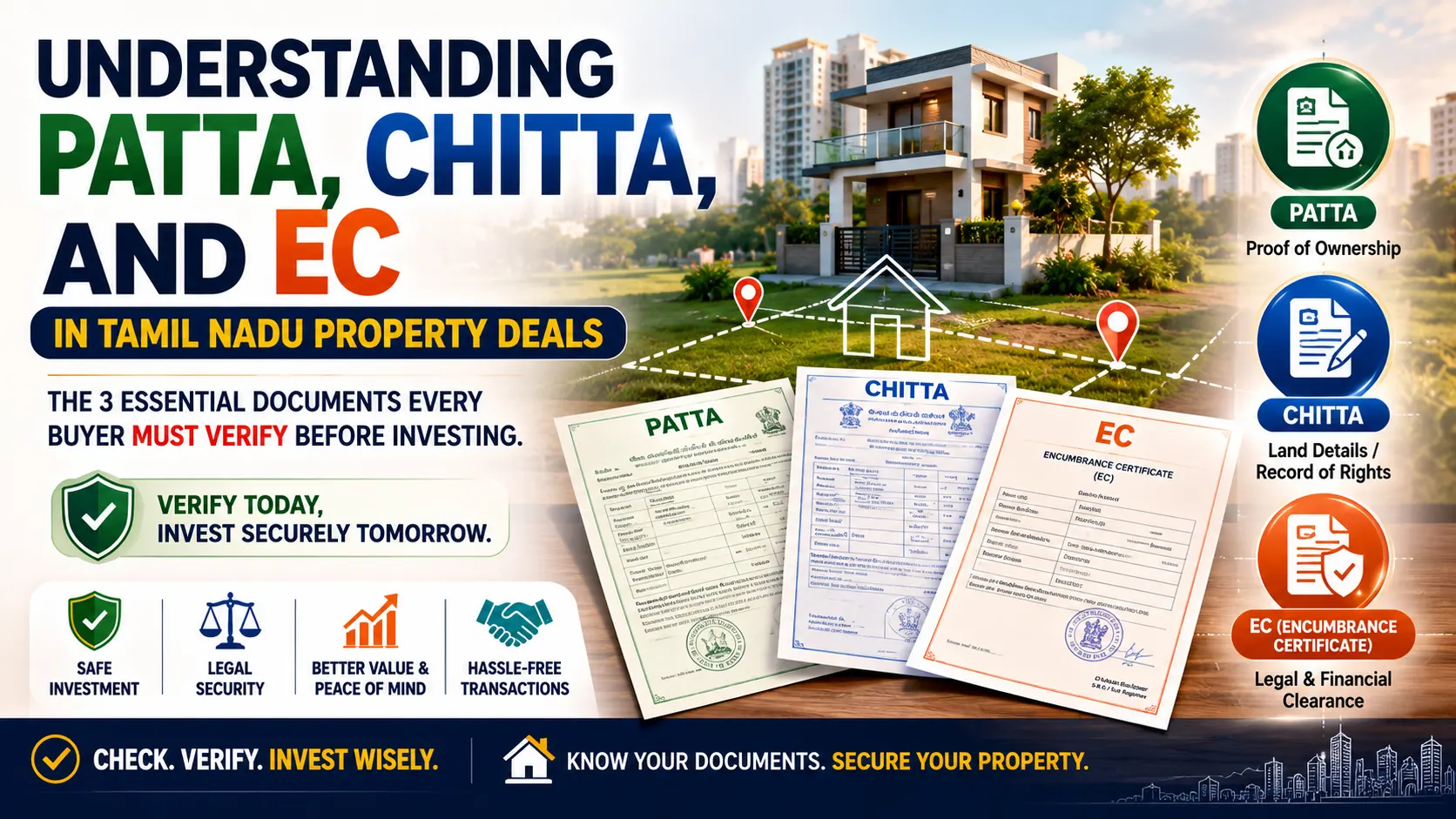
In Tamil Nadu, property transactions—especially land purchases—require verification of specific government records. Among them, Patta, Chitta, and Encumbrance Certificate (EC) are the most important. Each document serves a different legal purpose, and together they provide clarity on ownership, land classification, and transaction history.
1. Patta
What is Patta?
A patta is a revenue record issued by the Tamil Nadu Revenue Department that establishes legal ownership of land. It is officially known as a Record of Rights (ROR).
Information contained in a Patta
- Name of landowner
- Patta number
- Survey number and sub-division
- Total land extent (area)
- District, taluk, and village
- Land type (agricultural / residential)
- Revenue or tax details
Why Patta is important
- Confirms who is recognized as the owner by the government
- Required for sale, gift, or inheritance of land
- Mandatory for bank loans
- Needed for government approvals and compensation
- Used in land dispute resolution
A registered sale deed alone does not update Patta automatically. Patta must be transferred separately after purchase.
Also Read: What Exactly Is a Patta Under Tamil Nadu Law
2. Chitta
What is Chitta?
Chitta is a land revenue document that describes the classification and nature of the land. It was traditionally maintained by the Village Administrative Officer (VAO).
Information contained in Chitta
- Land classification:
- Nanjai – Wetland
- Punjai – Dry land
- Land usage details
- Area and cultivation type (for agricultural land)
Current status of Chitta
- Patta and Chitta have been merged into a single digital document known as Patta Chitta
- Today, Chitta details are accessed along with Patta details
Why Chitta matters
- Determines whether construction is legally allowed
- Affects conversion approvals (agricultural to residential)
- Important for planning permission and layout approval
3. Encumbrance Certificate (EC)
What is an encumbrance certificate?
An Encumbrance Certificate (EC) is issued by the Registration Department and shows the registered legal and financial transactions related to a property for a chosen period.
What EC shows
- Sale deeds
- Gift deeds
- Partition deeds
- Mortgages and loans
- Lease agreements (if registered)
- Court attachments (if registered)
What EC does NOT show
- Ownership confirmation
- Unregistered agreements
- Oral loans
- Some pending court cases not registered with the Sub-Registrar
Types of EC
- Form 15 – Shows all registered transactions
- Form 16 (Nil EC) – Shows no registered transactions for the selected period
A Nil EC does not guarantee the property is free from disputes—it only confirms no registered transactions exist during that period.
Also Read: Patta, EC & Legal Documents Required to Buy Property in Chennai
4. Difference Between Patta, Chitta and EC
Documents:
- Patta
- Chitta
- EC
Purpose:
- Ownership record
- Land classification
- Transaction history
Issued by:
- Revenue Department
- Revenue Department
- Registration Department
What if the process:
- Who owns the land
- Nature of land
- Loans, sales, liabilities
- Each document covers a different legal aspect. Relying on only one is risky.
5. Role of These Documents in a Property Purchase
During verification (before purchase)
- Patta Chitta confirms the following:
- The seller is the recognized landowner
- Land type matches intended use
- EC confirms:
- No existing mortgage or sale
- Clear transaction history
During registration
- The sale deed is registered at the sub-registrar office.
- EC gets updated automatically after registration
- Patta must be transferred separately
After purchase
- The buyer must apply for Patta transfer
- Failure to do so leaves revenue records in the seller’s name
6. Common Issues and Risks
- The sale deed name and Patta name do not match
- EC period is too short (important older entries missed)
- Land classified as agricultural but sold as residential
- Joint Patta without clear subdivision
- Patta not transferred after inheritance or gift
7. Best Practices for Buyers
- Verify Patta Chitta and EC together
- Check EC for at least 13–30 years
- Ensure survey numbers match across all documents
- Confirm land classification before construction
- Do not assume registration equals ownership update
- Consult a legal expert for disputed or ancestral properties
Frequently Asked Questions
Q1: Is a patta mandatory to buy land in Tamil Nadu?
Yes. Without Patta in the seller’s name, ownership is not recognized by the Revenue Department.
Q2: Can EC prove ownership?
No. EC only shows transaction history, not ownership.
Q3: Is Patta required for flats or apartments?
Patta applies to land. For apartments, buyers usually rely on Undivided Share (UDS) and parent land Patta.
Q4: Can Patta be jointly held?
Yes. A joint patta is common for inherited or jointly purchased land.
Q5: How long does the Patta transfer take?
Typically a few weeks to a few months, depending on verification and objections.
Q6: Does EC show legal disputes?
Only if the dispute is registered with the Sub-Registrar. Many court cases may not appear in EC.
Q7: Is Chitta still issued separately?
No. Chitta is now part of the combined Patta Chitta document.
Q8: Can land be sold without EC?
Legally yes, but practically unsafe. Banks and informed buyers always require EC.
Q9: What if the Patta details are wrong?
Corrections must be applied for through the Revenue Department with supporting documents.
Q10: Is online Patta Chitta legally valid?
Yes. Digitally issued Patta Chitta records are valid and accepted.