Introduction
Under Tamil Nadu land laws, a patta is one of the most important land-related documents. It plays a crucial role in identifying the person recorded by the government as the landholder for revenue purposes. Whether you are buying property, inheriting land, applying for loans, or dealing with government approvals, understanding what a Patta is—and what it is not—is essential.
What Is a Patta?
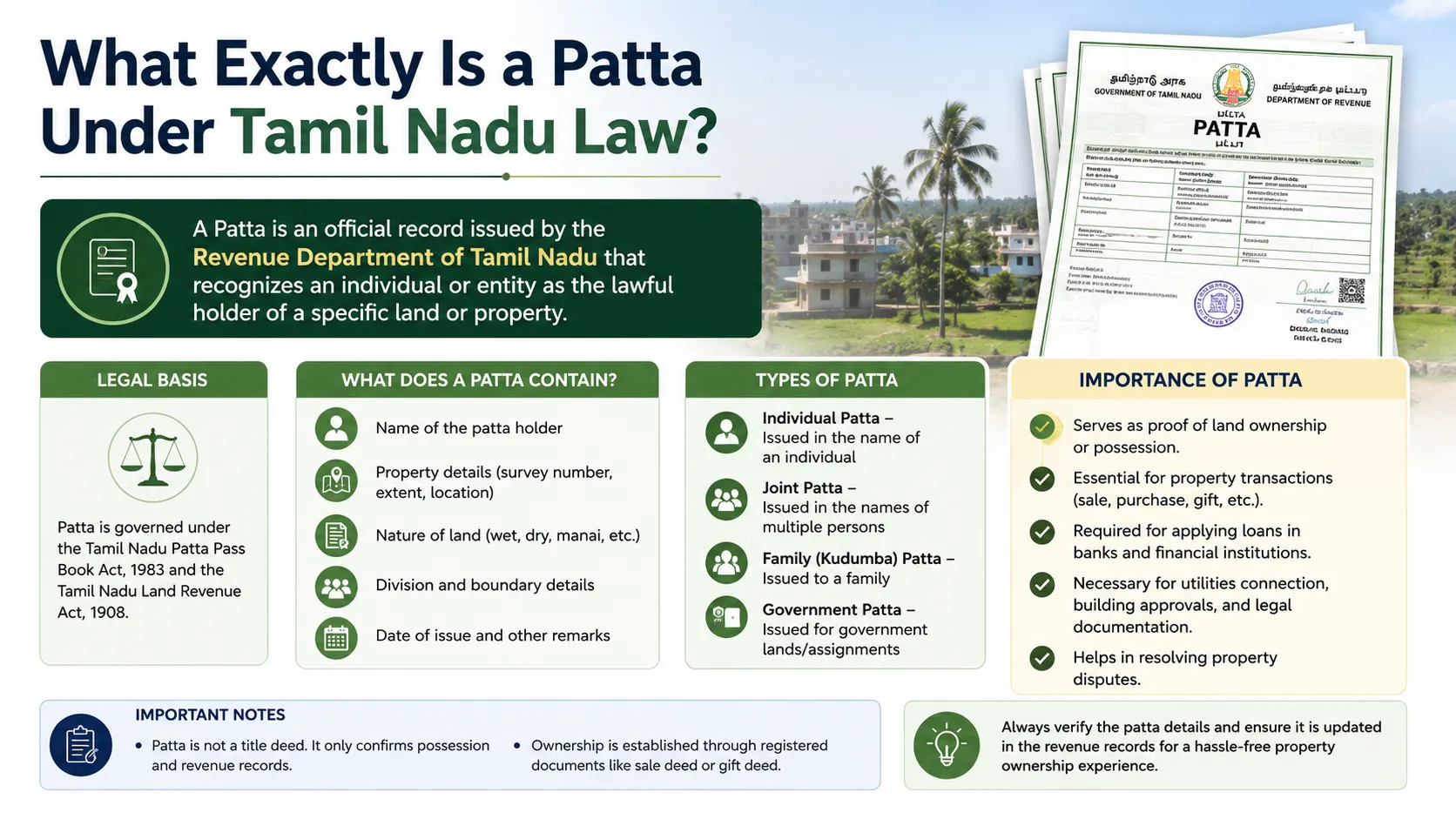
A patta is an official revenue record issued by the Revenue Department of the Government of Tamil Nadu. It records details of a specific parcel of land and the name of the person recognized by the government as responsible for paying land revenue (tax) for that land.
In simple terms:
- Patta = Government land revenue record
- It connects land + survey number + landholder name
A patta is issued and maintained by the local revenue authorities such as the tahsildar and village administrative officer (VAO).
Legal Framework Governing Patta in Tamil Nadu
Patta records are governed primarily under:
- The Tamil Nadu Patta Passbook Act
- Revenue Standing Orders (RSO)
- Administrative instructions issued by the Revenue Department
The Patta Passbook Act provides statutory backing for issuing, maintaining, updating, and correcting Patta records.
Purpose of a Patta
A patta serves multiple administrative and practical purposes:
1. Revenue Administration
- Identifies who must pay land revenue
- Helps the government maintain updated land records
- Used for land acquisition compensation calculations
2. Property Transactions
- Required during sale, purchase, and settlement of land
- Helps verify whether land details match registered documents
- Often demanded during due diligence
3. Banking and Financial Use
- Mandatory for availing loans against land
- Used as supporting proof by banks and housing finance companies
4. Government and Local Body Approvals
- Required for building plan approvals
- Used for land use conversion and development permissions
Information Contained in a Patta
A Patta document usually contains the following details:
- Patta Number – Unique identification number
- Name of Landholder – Individual(s) recorded in revenue records
- Survey Number and Sub-Division Number
- Land Extent—Area measured in hectares, acres, or cents
- Land Classification – Wetland (Nanjai) or Dry land (Punjai)
- Village, Taluk, and District
- Revenue Assessment Details
These details together uniquely identify a piece of land in government records.
Types of Patta in Tamil Nadu
Depending on the nature of ownership, Pattas can be
- Individual Patta – Issued in the name of a single owner
- Joint Patta – Issued when land is jointly owned by multiple persons
- Subdivision Patta – Issued when land is divided among owners
- Ancestral / Inheritance Patta—Issued after succession or partition
Patta vs Title Deed
It is important to clearly understand the legal distinction between a Patta and a Title Deed:
- Nature
- A Patta is a revenue record maintained by the government for land tax and administrative purposes.
- A title deed is a legal document that establishes lawful ownership of a property.
- Issued by
- A Patta is issued by the Revenue Department through authorities such as the Tahsildar.
- A title deed is issued and registered at the sub-registrar office under registration laws.
- Proof of ownership
- A Patta does not conclusively prove ownership; it only shows who is recorded as the landholder in revenue records.
- A Title Deed proves ownership, provided it is validly executed and registered.
- Legal value
- A Patta has supporting evidentiary value and can strengthen a claim of possession.
- A title deed has primary legal value and is the main document relied upon by courts to determine ownership.
Key Legal Position
A Patta does not by itself confer ownership. Courts have consistently held that:
- Ownership flows from registered title documents
- A patta is only supporting evidence showing possession and revenue recognition
Sale deeds, gift deeds, settlement deeds, and partition deeds establish title—not Patta alone.
Patta and Chitta – What Is the Difference?
Earlier, Tamil Nadu maintained two separate land records:
- Patta – Ownership and revenue responsibility
- Chitta – Land classification and cultivation details
Patta Chitta Merged Record
The government later merged both into a single digital document called Patta Chitta, which now:
- Shows ownership details
- Specifies land type (Nanjai / Punjai)
- Is available online through official portals
Why Patta Transfer Mutation Is Important
Whenever land changes hands due to:
- Sale
- Inheritance
- Gift
- Court decree
- Partition
The Patta must be mutated (transferred) to reflect the new landholder’s name.
Risks of Not Updating Patta
- Revenue records continue in previous owner’s name
- Difficulty in selling property
- Loan rejections
- Problems during government compensation or acquisition
- Increased risk of disputes
How to Obtain or Verify a Patta in Tamil Nadu
Online Method
Patta and Patta Chitta can be
- Viewed
- Verified
- Downloaded
using official Tamil Nadu land record portals by entering:
- Patta number or
- Survey number and subdivision
Offline Method
Applications can be made through:
- VAO
- Tahsildar Office
Documents typically required:
- Registered title deed
- Encumbrance Certificate
- Identity proof
- Previous Patta (if available)
Common Issues Related to Patta
Despite digitization, common problems include the following:
- Name mismatches
- Survey number errors
- Old manual Pattas not digitized
- Joint Patta disputes
- Wrong land classification
- Pending civil court disputes
Correction or cancellation of Patta requires formal application and inquiry by revenue authorities.
Legal Disputes and Patta
Revenue authorities cannot decide title disputes. If ownership is contested:
- Parties must approach civil courts
- Patta entries are subject to court decrees
- Revenue officials act only after judicial orders
Conclusion
A Patta under Tamil Nadu law is a critical land revenue document that records who the government recognizes as the landholder for a specific piece of land. While it is not a conclusive proof of ownership, it is indispensable for land transactions, loans, approvals, and administrative purposes. Every landowner must ensure that their Patta is accurate, updated, and consistent with registered title documents.
Frequently Asked Questions
1. Is Patta compulsory for owning land in Tamil Nadu?
Patta is not the ownership document itself, but it is practically mandatory for transactions, loans, and government dealings.
2. Can Patta be cancelled?
Yes. If issued wrongly or obtained by misrepresentation, Patta can be cancelled by revenue authorities or modified based on court orders.
3. Is Patta required for apartments?
Usually no individual Patta is issued for flats. Land Patta remains in the builder's or association’s name, while owners rely on sale deeds and UDS (Undivided Share).
4. Can Patta be issued without a registered deed?
Generally no. Revenue authorities rely on registered documents or court orders to issue or transfer Patta.
5. How long does a Patta transfer take?
Normally 15–30 working days, subject to verification and absence of objections.
6. Does Patta guarantee freedom from legal disputes?
No. Patta does not guarantee clear title. Buyers must still verify the chain of title and encumbrances.
7. What happens to Patta after the owner’s death?
Legal heirs must apply for Patta transfer based on succession documents, wills, or partition deeds.