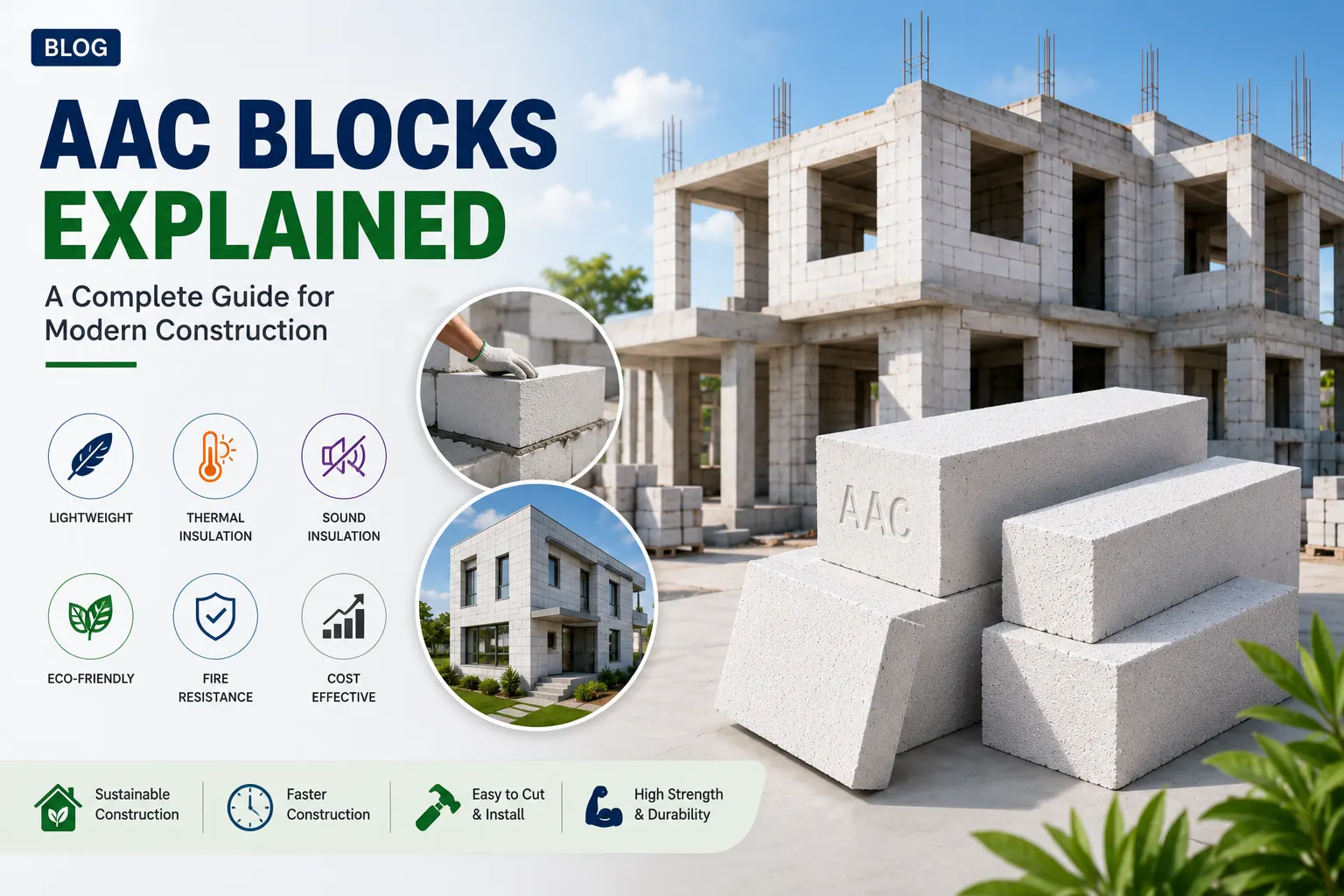
AAC blocks have become one of the most preferred building materials in modern construction due to their strength, lightweight nature, and energy efficiency. In residential, commercial, and high-rise projects, AAC blocks are increasingly replacing traditional red bricks.
What Is an AAC Block?
AAC stands for Autoclaved Aerated Concrete. AAC blocks are precast, lightweight, foam-based concrete blocks manufactured using cement, lime, fly ash, sand, water, and an expanding agent such as aluminum powder. During manufacturing, the aluminum reacts with calcium hydroxide to form microscopic air pockets. These air pores give AAC blocks their unique lightweight and thermal insulation properties.
How AAC Blocks Are Manufactured
The AAC block manufacturing process involves the following steps:
- Raw Material Preparation
- Cement, lime, fly ash or sand, and water are precisely measured and mixed.
- Aeration Process
- Aluminum powder is added, causing a chemical reaction that releases hydrogen gas. This forms millions of tiny air bubbles.
- Moulding and Rising
- The mixture expands to nearly three times its original volume and is poured into molds.
- Cutting
- The semi-solid mass is cut into blocks or panels of required dimensions.
- Autoclaving
- Blocks are cured under high pressure and temperature in an autoclave, forming a strong crystalline structure.
This controlled process ensures uniform quality and strength.
Key Properties of AAC Blocks
Lightweight
AAC blocks weigh nearly one-third of conventional red bricks, reducing dead load on the structure.
High Compressive Strength
Despite being lightweight, AAC blocks offer excellent structural strength suitable for load-bearing and non-load-bearing walls.
Thermal Insulation
The air pores inside AAC blocks provide excellent insulation, keeping interiors cooler in summer and warmer in winter.
Sound Insulation
AAC blocks significantly reduce sound transmission, making them ideal for residential and commercial buildings.
Fire Resistance
AAC blocks are non-combustible and can resist fire for up to 4–6 hours, enhancing building safety.
Eco-Friendly
AAC blocks use industrial waste like fly ash and consume less raw material, making them environmentally sustainable.
Standard Sizes of AAC Blocks
AAC blocks are available in multiple sizes, commonly the following:
- Length: 600 mm
- Height: 200 mm or 250 mm
- Thickness: 75 mm, 100 mm, 125 mm, 150 mm, 200 mm
Custom sizes are also available for large projects.
Advantages of AAC Blocks
Faster Construction
AAC blocks are larger in size and lighter, reducing brickwork time and labor costs.
Reduced Structural Cost
A lower dead load means reduced foundation and structural steel requirements.
Better Energy Efficiency
Buildings constructed with AAC blocks consume less electricity for cooling and heating.
Lower Plaster Thickness
AAC blocks have smooth and uniform surfaces, reducing plaster thickness and material usage.
Termite and Pest Resistant
AAC blocks are inorganic and do not attract termites or pests.
Disadvantages of AAC Blocks
Higher Initial Cost
AAC blocks cost more per unit compared to traditional red bricks.
Skilled Labor Requirement
Improper handling or installation can lead to cracks if workers are not trained.
Moisture Absorption
AAC blocks are porous and require proper waterproofing and exterior finishing.
Limited Availability in Rural Areas
AAC blocks may not be readily available in remote locations.
AAC Blocks vs Red Bricks
AAC blocks outperform red bricks in weight, insulation, fire resistance, and construction speed. While red bricks are cheaper initially, AAC blocks reduce long-term costs through energy savings, faster construction, and lower maintenance.
Applications of AAC Blocks
AAC blocks are widely used in:
- Residential houses and apartments
- High-rise buildings
- Commercial offices
- Hospitals and schools
- Industrial structures
- Partition walls and infill walls
They are suitable for both load-bearing and framed structures.
Also Read: Red Bricks for Building Construction
AAC Block Cost in India (2026)
The average AAC block price ranges between Rs 3,200 to Rs 5,500 per cubic meter, depending on:
- Block size
- Brand
- Location
- Transportation cost
Though the initial cost is higher, overall construction cost is reduced by 10–15% due to savings in steel, cement, labor, and plaster.
Life Span and Durability of AAC Blocks
AAC blocks have a life expectancy of 50–75 years when properly constructed and maintained. They do not deteriorate due to moisture, pests, or fire, making them highly durable.
AAC Blocks and Sustainability
AAC blocks are considered a green building material because:
- They use fly ash (industrial waste)
- They reduce carbon emissions
- They improve energy efficiency
- They minimize construction waste
Many green-certified buildings prefer AAC blocks.
Frequently Asked Questions
1. Are AAC blocks stronger than red bricks?
AAC blocks have lower compressive strength than red bricks but provide better structural efficiency due to reduced load on the building.
2. Can AAC blocks be used for load-bearing walls?
Yes, AAC blocks are suitable for load-bearing walls in low-rise buildings and framed structures.
3. Do AAC blocks crack easily?
AAC blocks do not crack if installed correctly using proper mortar, reinforcement, and curing methods.
4. Is plaster necessary for AAC blocks?
Yes, plaster or putty is required, but the thickness is much lower compared to red brick walls.
5. Are AAC blocks waterproof?
AAC blocks are not fully waterproof and require proper external waterproofing or coating.
6. What mortar is used for AAC blocks?
Thin-bed AAC block adhesive mortar is recommended instead of conventional cement mortar.
7. Are AAC blocks suitable for high-rise buildings?
Yes, AAC blocks are widely used in high-rise construction due to reduced dead load.
8. Do AAC blocks reduce electricity bills?
Yes, their thermal insulation properties reduce air-conditioning and heating costs.
9. Are AAC blocks eco-friendly?
Yes, AAC blocks are one of the most eco-friendly construction materials available today.
10. What is the lifespan of AAC block construction?
AAC block buildings can last 50 years or more with proper construction and maintenance.