1. What Is Immovable Property?
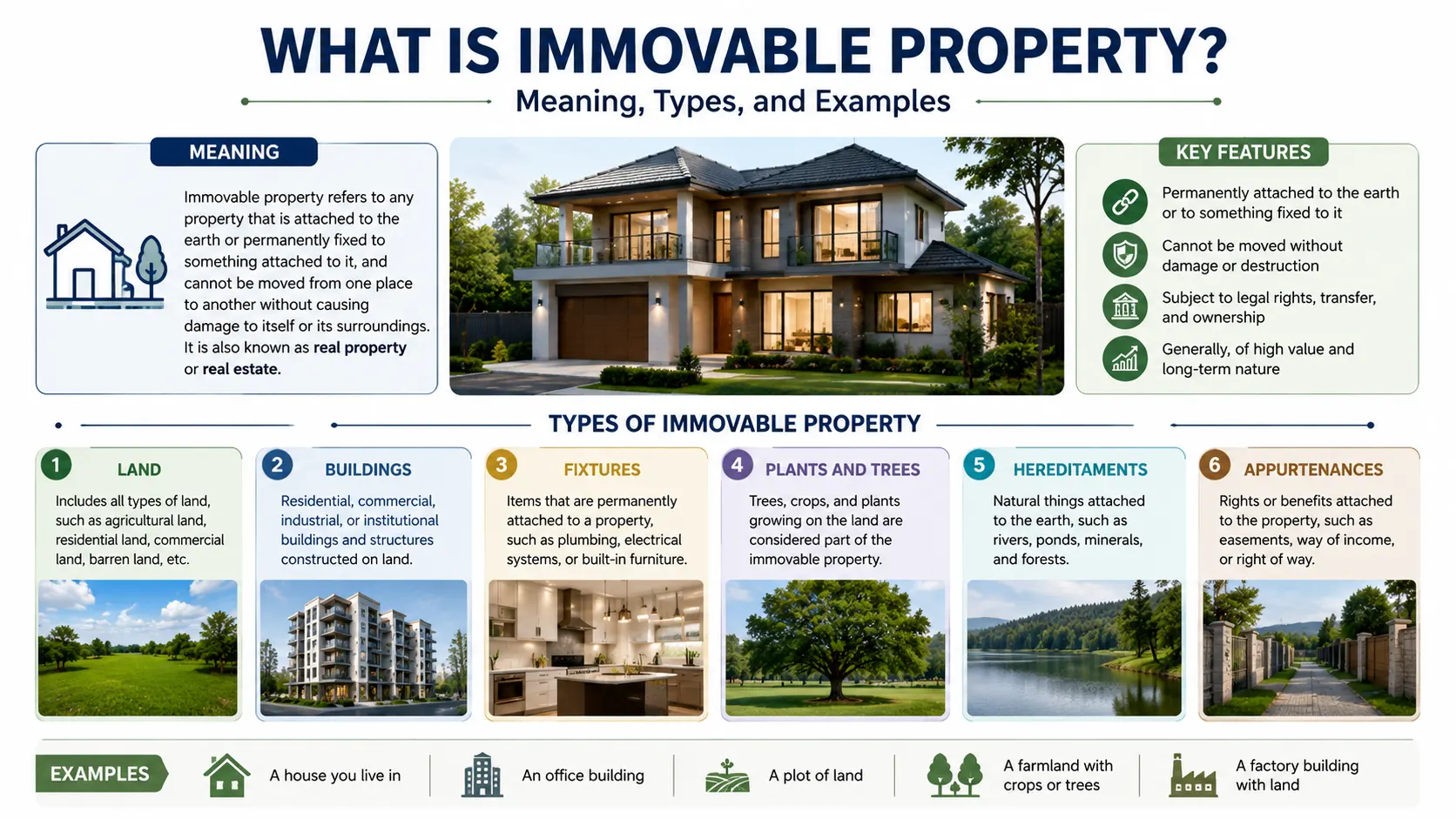
Immovable property refers to property that cannot be moved from one place to another without causing damage or alteration. It is permanently attached to the earth or embedded in land and includes land, buildings, and anything permanently fixed to them.
In simple terms:
If a property cannot be shifted without destroying its nature or structure, it is immovable property.
Legal Meaning
Legally, immovable property includes:
- Land
- Buildings
- Benefits arising from land (like rent, lease rights)
- Things permanently attached to land (trees, wells, pipelines, etc.)
It excludes movable items such as vehicles, furniture, jewelry, or machinery not permanently fixed.
2. Key Characteristics of Immovable Property
Immovable property has the following defining features:
- Permanent Location – It exists at a fixed geographical location
- Attached to Earth – Either rooted in the soil or permanently embedded
- Cannot Be Transported – Movement is impossible without damage
- Long-Term Value – Usually appreciates over time
- Legal Registration Required—Ownership transfer must be registered
3. What Is Included in Immovable Property?
3.1 Land
- Agricultural land
- Residential land
- Commercial land
- Industrial plots
3.2 Buildings & Structures
- Houses
- Apartments
- Offices
- Factories
- Warehouses
- Shops
3.3 Things Attached to the Earth
- Trees (especially fruit-bearing or timber trees)
- Wells
- Borewells
- Fences
- Roads
- Pipelines permanently laid underground
3.4 Benefits Arising from Land
These are legal rights connected to land, such as:
- Rental income
- Lease rights
- Right to collect tolls
- Mining rights
4. What Is NOT Immovable Property?
The following are movable property, not immovable:
- Cars, bikes, buses
- Furniture
- Electrical appliances
- Jewelry
- Cash
- Crops that can be harvested
- Machinery not permanently fixed
5. Types of Immovable Property
5.1 Residential Property
Used for living purposes.
Examples:
- Independent houses
- Apartments
- Villas
- Builder floors
5.2 Commercial Property
Used for business or professional activities.
Examples:
- Office buildings
- Retail shops
- Malls
- Hotels
5.3 Industrial Property
Used for manufacturing or production.
Examples:
- Factories
- Industrial sheds
- Manufacturing plants
5.4 Agricultural Property
Land used for farming or cultivation.
Examples:
- Farmland
- Plantations
- Orchards
5.5 Institutional Property
Used for public or social purposes.
Examples:
- Schools
- Colleges
- Hospitals
- Government buildings
6. Examples of Immovable Property
Example / Category
- A residential house
- Residential immovable property
- A shopping mall
- Commercial immovable property
- Agricultural farmland
- Agricultural immovable property
- A factory building
- Industrial immovable property
- A well on land
- Property attached to earth
- Lease rights of land
- Benefit arising from land
7. Legal Aspects of Immovable Property
7.1 Ownership
Ownership of immovable property is established through:
- Sale deed
- Gift deed
- Inheritance
- Partition deed
7.2 Transfer of Immovable Property
Transfer can occur via:
- Sale
- Gift
- Lease
- Mortgage
- Exchange
- Inheritance (will or succession)
Registration is mandatory for most immovable property transfers.
7.3 Taxation
- Property tax
- Capital gains tax (on sale)
- Stamp duty & registration charges
- Wealth tax (where applicable)
Also Read: How To Pay Property Tax in Chennai Online & Offline
8. Difference Between Movable and Immovable Property
Basis / Immovable Property / Movable Property
- Mobility
- Cannot be moved
- Can be moved
- Attachment
- Fixed to land
- Not attached
- Examples
- Land, house, building
- Car, furniture
- Registration
- Mandatory
- Usually not required
- Value
- Generally high
- Usually lower
9. Importance of Immovable Property
- Provides long-term financial security
- Generates regular income (rent/lease)
- Appreciates in value
- Acts as collateral for loans
- Essential for housing and business infrastructure
10. Frequently Asked Questions (FAQs)
Q1. Is land always considered immovable property?
Yes. Land is the primary form of immovable property.
Q2. Are trees immovable property?
Yes, trees rooted in the ground are immovable property. However, once cut, they become movable property.
Q3. Is a house movable or immovable property?
A house is immovable property because it is permanently attached to land.
Q4. Is agricultural land immovable property?
Yes. Agricultural land is a classic example of immovable property.
Q5. Can immovable property be transferred without registration?
No. Registration is compulsory for most transfers like sale, gift, or long-term lease.
Q6. Are lease rights considered immovable property?
Yes. Benefits arising from land, such as lease or rent rights, are legally treated as immovable property.
Q7. Is a factory machine immovable property?
- If permanently fixed to the land → Immovable
- If easily removable → Movable
Q8. Why is immovable property important in law?
Because it involves high value, long-term rights, taxation, inheritance, and economic stability.
Q9. Can immovable property be mortgaged?
Yes. Immovable property is commonly used as security for loans.
Q10. What is the biggest advantage of immovable property?
Its stability, appreciation in value, and long-term income potential.