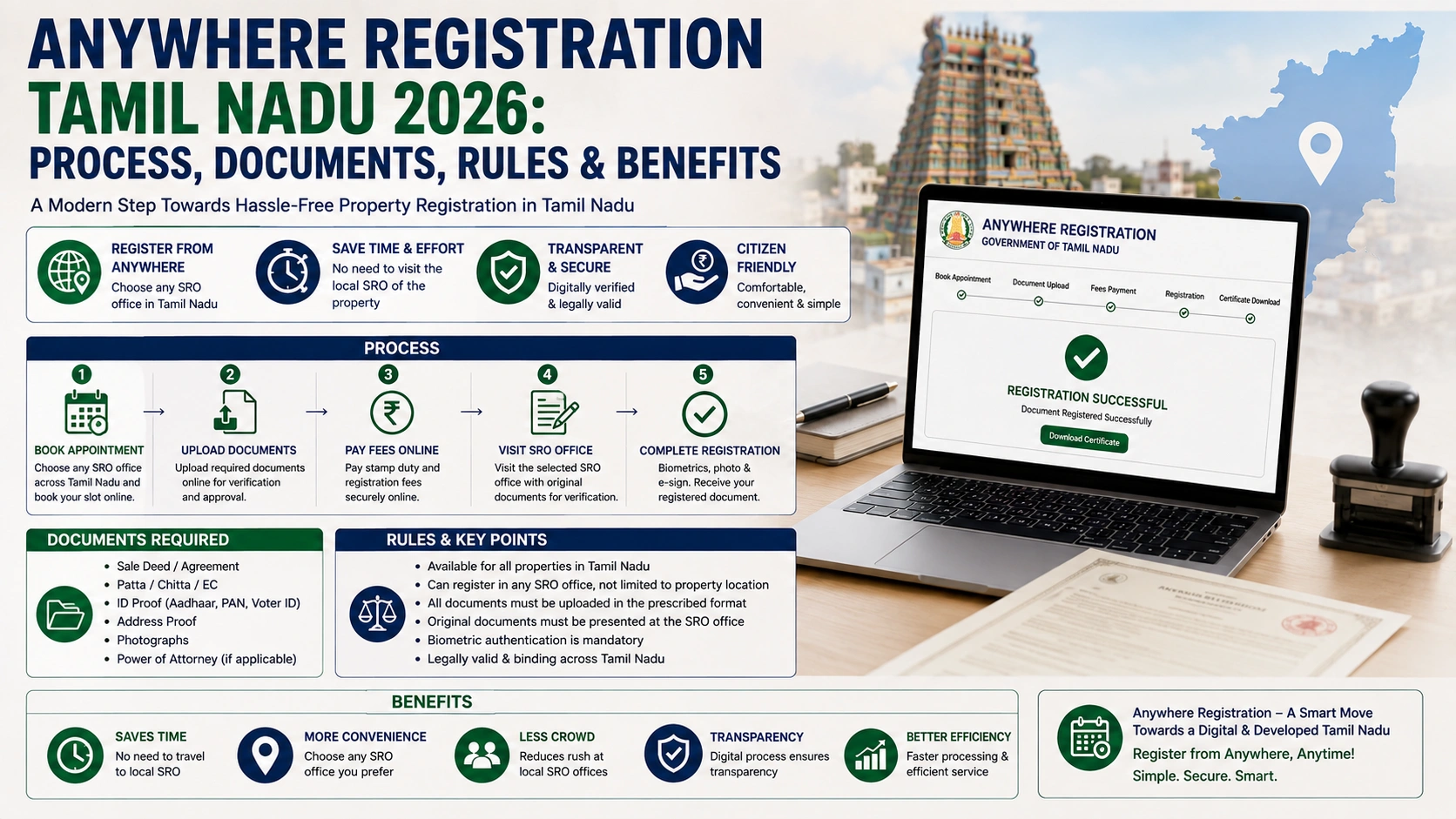
What Is Anywhere Registration in Tamil Nadu 2026?
Anywhere Registration in Tamil Nadu 2026 is a digital property registration system designed to reduce physical visits to sub-registrar offices and simplify eligible property transactions through online document submission and digital authentication. From August 17, 2026, online presence-less registration became mandatory for covered first-sale plots and apartments. The system uses digital document processing, Aadhaar-based authentication, and biometric verification. Registered documents can include digital signatures and QR-code-based security features.
Anywhere Registration Tamil Nadu 2026: Complete Guide
Tamil Nadu's property-registration system is moving towards a more digital and convenient process with the introduction of Anywhere Registration and presence-less registration. The reform is particularly important for buyers purchasing new flats, apartments, and plots, as eligible transactions can be processed digitally without requiring the traditional physical appearance at the Sub-Registrar Office. For property buyers, understanding the Anywhere Registration process, documents, eligibility, rules, benefits, and verification requirements is essential before completing a property purchase.
What Is Anywhere Registration in Tamil Nadu?
Anywhere Registration is a digital property-registration initiative of the Tamil Nadu Registration Department. It aims to make eligible property transactions more convenient by allowing documents to be submitted and processed electronically.
The system reduces dependence on:
- Physical paperwork
- Repeated SRO visits
- Manual document handling
- Face-to-face interaction
- Traditional office-based processing
For eligible transactions, authentication is carried out digitally using prescribed identity-verification methods.
When Did Anywhere Registration Start in Tamil Nadu?
The online presence-less registration system for covered first-sale plots and apartments became mandatory from August 17, 2026. This is particularly significant for developers and buyers involved in first-sale residential property transactions. The implementation is being introduced in phases, so buyers should check whether their particular document type is currently covered before starting the registration process.
Who Can Use Anywhere Registration?
The initial implementation primarily covers selected property transactions.
Major categories include:
- First sale of approved-layout plots
- First sale of apartments/flats
- Certain Tamil Nadu Housing Board transactions
- Certain mortgage and receipt-related documents
However, not every property transaction automatically qualifies for Anywhere Registration. Resale properties and instruments such as gift, settlement, and partition documents may have different procedures depending on the latest rules.
Anywhere Registration Process in Tamil Nadu 2026
The process can broadly be understood through the following steps.
Step 1: Prepare the Property Documents
Prepare the sale deed and supporting documents with accurate:
- Buyer details
- Seller/developer details
- Survey number
- Plot/flat number
- Property extent
- Boundaries
- Sale consideration
- Ownership information
Step 2: Submit Documents Online
Eligible documents are uploaded through the designated online registration system.
- All uploaded documents should be clear and accurate.
Step 3: Complete Aadhaar Authentication
The parties involved in the transaction complete the prescribed Aadhaar-based identity verification and biometric authentication.
Step 4: Pay Government Charges
Applicable stamp duty, registration fees, and other prescribed charges must be paid.
Step 5: Registration Department Verification
The registration officer examines the submitted documents.
The application may be:
- Approved
- Returned for correction
- Rejected
Step 6: Correct Errors if Required
If the application is returned for rectification, the applicant can correct the specified issues and resubmit it within the prescribed period.
Step 7: Digital Registration
Once approved, the document is digitally registered.
The registered document can include security features such as
- Digital signature
- Dynamic endorsement
- QR code
Step 8: Download the Registered Document
After successful registration, the registered document can be accessed through the online system according to the applicable download/access period.
Also Read: Online Property Registration Process in Chennai Step by Step Guide
Documents Required for Anywhere Registration
The exact requirements depend on the transaction type. Property buyers should generally keep the following information and documents ready.
- Buyer Documents
- Aadhaar details
- PAN details, wherever applicable
- Mobile/contact details
- Address details
- Bank or loan-related documents, if applicable
- Other identity documents required by the registration system
- Property Documents
- Sale deed
- Parent/previous title documents
- Encumbrance-related records
- Approved layout documents for plots
- Building approval documents for apartments
- Property identification details
- Survey and subdivision details
- Flat/plot number
- Extent and boundary details
- UDS details for apartments
- RERA details, where applicable
- Builder/Seller Documents
For first-sale transactions, the developer/seller may need to provide:
- Title documents
- Parent documents
- Planning approvals
- Building approvals
- Layout approval
- Project-related documents
- RERA information, where applicable
- Other documents required by the Registration Department
Anywhere Registration Rules in Tamil Nadu 2026
The important rules buyers should know include:
1. Online registration is mandatory for covered first-sale transactions.
From August 17, 2026, eligible first-sale plots and apartments are covered by mandatory online presence-less registration.
2. Physical SRO appearance is reduced.
Eligible transactions can be completed without the traditional physical appearance at the Sub-Registrar Office.
3. Aadhaar authentication is used.
Identity verification and biometric authentication form an important part of the process.
4. Digital signatures improve document security.
Registered documents can carry the digital signature of the registering authority.
5. QR codes support verification.
QR-code-based features can help users verify registration-related information.
6. Applications have a defined processing timeline.
The registration officer is required to take action on the application within the prescribed timeline.
7. Returned documents can be rectified.
Applicants can correct errors and resubmit documents within the prescribed period.
Benefits of Anywhere Registration for Property Buyers
1. Saves Time
Buyers can avoid unnecessary trips to registration offices for eligible transactions.
2. Reduces Physical Paperwork
The process moves more registration activity into a digital environment.
3. Greater Convenience
Buyers, developers, and other parties can manage eligible transactions online.
4. Better Transparency
Digital processing can make it easier to track the progress of a registration application.
5. Stronger Authentication
Aadhaar-based biometric verification provides an additional layer of identity verification.
6. Digital Document Access
Registered documents can be accessed digitally through the prescribed system.
7. Useful for Outstation Buyers
The digital process can be particularly convenient for buyers who live outside the city or state.
8. Reduced Dependence on Intermediaries
A more digital process can reduce unnecessary dependence on middlemen for eligible transactions.
Anywhere Registration vs. Traditional Registration
| Feature | Traditional Registration | Anywhere Registration |
| Process | Mainly office-based | Digital for eligible transactions |
| Physical visit | Generally required | Reduced/not required for covered transactions |
| Identity verification | Physical process | Aadhaar/biometric authentication |
| Document submission | Physical/digital depending on service | Online |
| Document security | Registered document | Digital signature and QR features |
| Convenience | Moderate | Higher |
| Processing | Office-based | Digital work |
Is Anywhere Registration Available for Resale Flats?
Not necessarily.
The initial mandatory implementation focuses on specified transactions, particularly first-sale plots and apartments. A resale flat may follow a different registration process depending on the type of document and the rules applicable at the time of registration. Buyers should verify the current eligibility before beginning the transaction.
Does Anywhere Registration Reduce Stamp Duty?
No.
Anywhere registration changes the method of registering eligible property documents, but it does not automatically eliminate or reduce applicable stamp duty and registration charges. Buyers should calculate the applicable government charges based on the current Tamil Nadu rules and the nature and value of the transaction.
Does Online Registration Mean the Property Is Legally Safe?
No.
Digital registration does not replace property due diligence.
Before buying a flat or plot, buyers should independently verify:
- Property title
- Parent documents
- Encumbrance
- Planning approval
- Building approval
- Layout approval
- RERA registration, where applicable
- Survey details
- UDS
- Property measurements
- Seller's ownership rights
- Applicable taxes and dues
Online registration makes the process easier; it does not guarantee that the property has a defect-free title.
What Should Buyers Check Before Any Registration?
Before submitting the registration application, verify that the following details match across the documents:
- Buyer name → Seller name → Survey number → Property extent → Flat/plot number → Boundaries → Sale consideration → UDS → Approval details
Even a small mismatch can result in the document being returned for correction.
Why Anywhere Registration Matters for Chennai Real Estate
Anywhere registration can have a significant impact on Chennai's residential property market because the city has a large number of new apartment and plotted-development transactions.
The digital process can benefit:
- First-time homebuyers
- Apartment buyers
- Plot buyers
- NRIs
- Outstation investors
- IT professionals
- Builders and developers
For Chennai property buyers, however, the priority should remain legal verification first and registration second.
Conclusion
Anywhere Registration Tamil Nadu 2026 represents a major move towards digital property registration.
The key points are:
- The online presence-less system became mandatory for covered first-sale plots and apartments from August 17, 2026.
- Eligible transactions can be processed digitally.
- Aadhaar-based authentication and biometric verification are part of the system.
- Physical SRO visits are reduced for covered transactions.
- Registered documents can include digital signatures and QR-code security features.
- Buyers still need to pay applicable stamp duty and registration charges.
- Property title and approval verification remain essential.
- Not every type of property transaction is automatically covered.
FAQs
1. What is Anywhere Registration in Tamil Nadu?
Anywhere Registration is a digital property-registration system designed to simplify eligible transactions through online document submission and digital authentication.
2. When did Anywhere Registration start in Tamil Nadu?
The mandatory online presence-less registration process for covered first-sale plots and apartments started on August 17, 2026.
3. Is Anywhere Registration mandatory?
It is mandatory for the specified first-sale transactions covered by the new online registration system.
4. Can I register a resale flat through Anywhere Registration?
The initial mandatory coverage primarily focuses on first-sale plots and apartments. Resale transactions may follow separate procedures depending on the applicable rules.
5. Is Aadhaar required for Anywhere Registration?
Aadhaar-based authentication and biometric verification are part of the prescribed process for covered transactions.
6. Do I need to visit the Sub-Registrar Office?
For eligible presence-less transactions, physical appearance at the SRO is not required under the digital process.
7. What documents are required?
Documents can include identity details, sale deed, title documents, property details, approval documents, encumbrance records, and other documents applicable to the specific transaction.
8. Does Anywhere Registration reduce registration charges?
No. The digital registration process does not automatically reduce applicable stamp duty or registration fees.
9. Can documents be corrected after submission?
If the registration officer returns a document for rectification, the applicant can make the required corrections and resubmit it within the prescribed period.
10. Is Anywhere Registration available across Tamil Nadu?
The reform is being implemented for specified categories of transactions. Buyers should check the current applicability of the system to their particular property and document.
11. Is Anywhere Registration the same as faceless registration?
They are closely related digital-registration reforms, but they are not necessarily identical terms. Anywhere Registration concerns the broader flexibility and digital processing of eligible registrations, while presence-less/faceless registration focuses on reducing physical interaction.
12. Should I hire a lawyer before registering property online?
For a significant property purchase, independent legal due diligence is strongly advisable, particularly for checking title, encumbrances, approvals, and the sale deed.