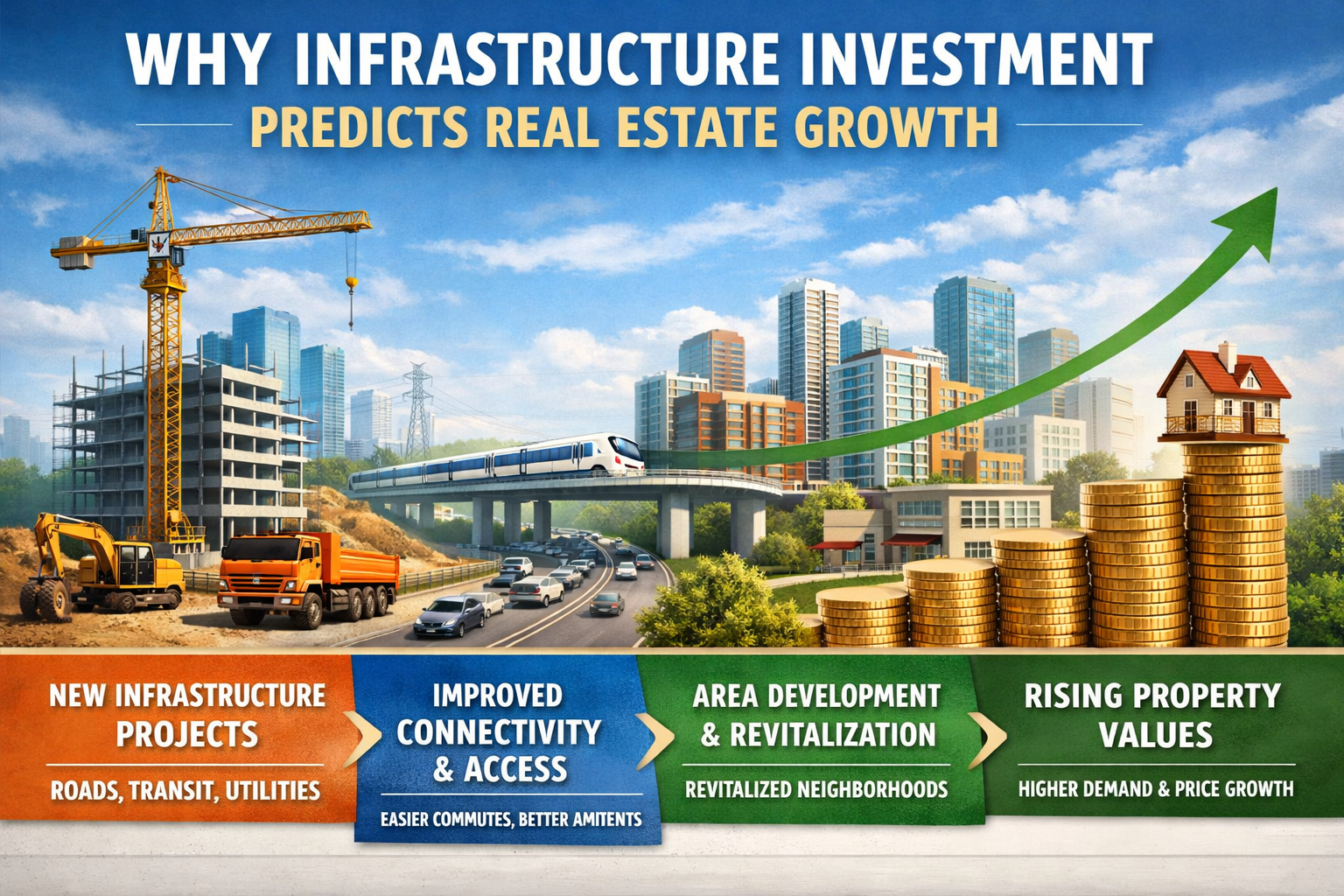
Infrastructure investment is one of the strongest leading indicators of real estate growth because it changes how people live, work, and move. When governments or private entities invest in infrastructure, they unlock demand, reduce costs, and increase land utility, which directly boosts property values.
1. Infrastructure Improves Accessibility (The #1 Driver)
What infrastructure includes
- Roads, highways, bridges
- Railways, metro lines, bus corridors
- Airports and ports
Why this matters
Accessibility determines how valuable land is.
When travel time decreases:
- People are willing to live farther from city centers
- Businesses can reach customers and workers more easily
- Logistics and supply chains become cheaper and faster
Real estate impact
- Residential demand rises near transit corridors
- Commercial rents increase in well-connected locations
- Peripheral or “undeveloped” areas become viable markets
Example:
A new metro station can increase nearby residential property values by 10–30% because commuting becomes easier.
2. Infrastructure Attracts Jobs and Businesses
What happens after infrastructure investment
- Companies relocate or expand
- Industrial parks and office hubs emerge
- Retail and service sectors follow employment
Why jobs drive real estate
Jobs = people
People = housing demand
As employment grows:
- Workers need homes (rentals and ownership)
- Businesses need offices, warehouses, and retail space
Real estate impact
- Office and industrial real estate grows first
- Residential and mixed-use developments follow
- Long-term rental demand becomes stable
Key insight:
Real estate prices don’t rise just because of buildings—but because people with income move in.
3. Infrastructure Reduces Development Costs
Before infrastructure
- Developers must pay for roads, water, electricity, drainage
- Construction risk is high
- Financing is expensive
After infrastructure
- Utilities are already available
- Faster approvals from authorities
- Lower construction and operating costs
Real estate impact
- More developers enter the market
- Larger and higher-quality projects are built
- Land prices rise because land becomes “ready to build”
Important:
Land with infrastructure is worth significantly more than land without it—even if location is similar.
4. Infrastructure Drives Urban Expansion & Land Use Change
Infrastructure changes zoning reality.
What changes
- Agricultural land → residential or commercial
- Low-density areas → high-density urban zones
- Informal areas → planned developments
Real estate impact
- Massive appreciation in land values
- New cities, suburbs, and economic corridors emerge
- Early investors benefit the most
Example:
Highways and ring roads often create real estate corridors where land values multiply over 5–10 years.
5. Infrastructure Improves Quality of Life
People pay more to live where life is easier.
Infrastructure that improves lifestyle
- Water supply and sanitation
- Electricity and broadband internet
- Schools, hospitals, parks
- Public transport and walkability
Real estate impact
- Higher home prices and rents
- Lower vacancy rates
- Strong end-user demand (not just investors)
Investor insight:
Areas with good social infrastructure attract long-term residents, which stabilizes prices and reduces volatility.
6. Infrastructure Increases Investor Confidence
Large infrastructure projects signal:
- Government commitment
- Long-term economic planning
- Political and economic stability
Why investors care
- Lower risk = higher willingness to invest
- Banks are more willing to finance projects
- Institutional investors enter the market
Real estate impact
- Increased capital inflows
- Faster price discovery
- Growth becomes more predictable
Key point:
Smart investors follow infrastructure announcements, not just current prices.
7. Infrastructure Creates a Multiplier Effect
Infrastructure spending doesn’t stop at construction.
Multiplier chain
- Government builds infrastructure
- Jobs are created
- Income rises
- Consumption increases
- Demand for housing, offices, retail grows
Real estate impact
- Growth spreads across multiple asset classes
- Long-term appreciation, not short-term speculation
Economic truth:
Real estate growth is strongest when backed by real economic activity, not hype.
8. Infrastructure as a Leading Indicator (Timing Advantage)
Real estate prices usually rise in stages:
- Infrastructure announced
- Land prices start rising
- Development begins
- Population moves in
- Prices peak
Why infrastructure predicts growth
Because it happens before people and businesses arrive.
Best strategy:
Buy when infrastructure is announced or under construction, not after it’s fully completed.
Summary: The Cause-and-Effect Chain
Infrastructure Investment →
- Better connectivity
- More jobs
- Lower costs
- Higher quality of life
- Strong investor confidence.
https://www.livehomes.in/live_insights