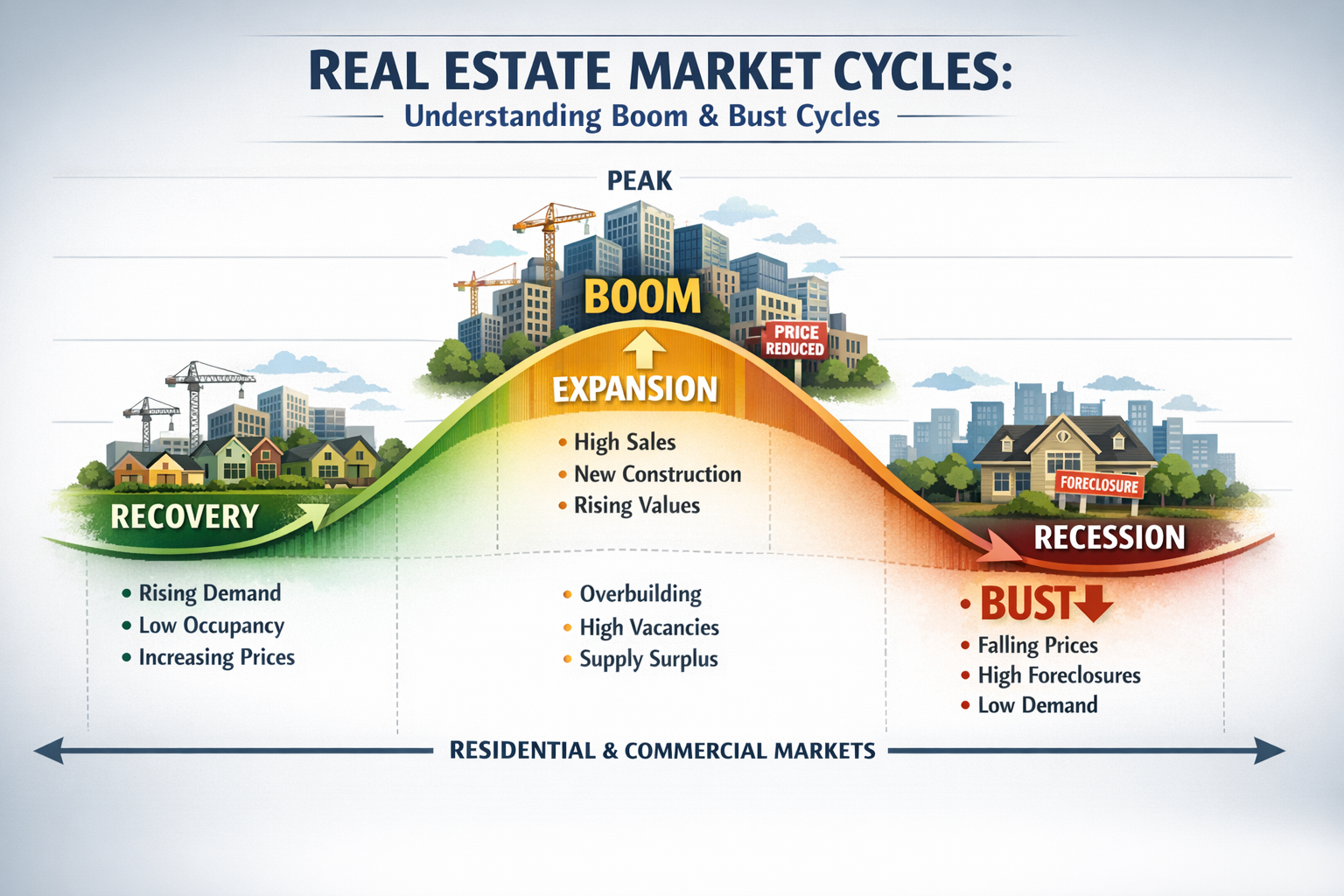
1. What Are Real Estate Market Cycles?
Real estate markets move in predictable cycles driven by:
- Economic growth and contraction
- Interest rates and credit availability
- Supply and demand imbalances
- Investor psychology and speculation
- Government policy and demographics
Unlike stock markets, real estate cycles are slower, often lasting 7–18 years, because properties take time to plan, finance, build, and sell.
2. The Four Phases of the Real Estate Market Cycle
Real estate cycles are commonly divided into four phases:
- Recovery
- Expansion (Boom)
- Hyper Supply (Peak)
- Recession (Bust)
These phases apply to both residential and commercial real estate, though they can occur at different speeds and magnitudes.
3. Phase 1: Recovery
Overview
The recovery phase begins after a market crash or recession. Prices have bottomed out, but confidence remains low.
Key Characteristics
- Low property prices
- High vacancies (commercial)
- Foreclosures still present (residential)
- Limited new construction
- Banks tighten lending standards
Residential Market in Recovery
- Home prices stabilize after falling
- Investors and first-time buyers enter
- Rental demand increases as fewer people can buy
- Foreclosures gradually decline
Commercial Market in Recovery
- High vacancy rates in offices, retail, and industrial spaces
- Lease rates stop falling
- Investors look for distressed or undervalued assets
- Minimal new developments
Opportunities
- Best time for long-term investors
- Lower purchase prices
- Less competition
4. Phase 2: Expansion (Boom)
Overview
The expansion phase is marked by strong economic growth and rising confidence.
Key Characteristics
- Job growth
- Easier access to credit
- Rising property prices and rents
- Increased transaction volume
- New construction begins
Residential Market in Expansion
- Home prices rise steadily
- High buyer demand
- Low inventory
- Mortgage lending increases
- New housing developments expand
Commercial Market in Expansion
- Falling vacancy rates
- Rising lease rates
- Businesses expand office and retail space
- New commercial construction increases
- Investors chase yield
Boom Psychology
- Optimism dominates
- Fear of missing out (FOMO)
- Speculation increases
- Investors expect prices to keep rising
Risks
- Overconfidence
- Buying at inflated prices
- Excessive leverage (debt)
5. Phase 3: Hyper Supply (Peak)
Overview
This is the danger zone. Supply grows faster than demand.
Key Characteristics
- Overbuilding
- Rising vacancies
- Slowing price growth
- Speculative buying peaks
- Debt levels are high
Residential Market at Peak
- Too many new homes and condos
- Prices plateau or grow slowly
- Buyers struggle with affordability
- Investors rely on appreciation rather than cash flow
Commercial Market at Peak
- Excess office, retail, or industrial space
- Vacancy rates start rising
- Lease incentives increase
- Developers complete projects started earlier
Warning Signs
- Prices rising faster than incomes
- High investor speculation
- Relaxed lending standards
- Construction boom despite weakening demand
Also Read: Why Waiting foe the Perfect Market Costs More than You Think
6. Phase 4: Recession (Bust)
Overview
The bust phase occurs when demand collapses and prices fall.
Key Characteristics
- Falling property values
- Rising vacancies
- Loan defaults increase
- Foreclosures rise
- Credit tightens sharply
Residential Market in Bust
- Home prices decline
- Foreclosures increase
- Buyers disappear
- Sellers compete aggressively
- Negative equity becomes common
Commercial Market in Bust
- Businesses downsize or close
- High vacancy rates
- Lease rates fall
- Property income declines
- Distressed asset sales increase
Market Psychology
- Fear dominates
- Investors retreat
- Liquidity disappears
- Long-term opportunities begin to form
7. Key Differences Between Residential and Commercial Cycles
| Factor | Residential | Commercial |
| Cycle Speed | Faster | Slower |
| Volatility | Moderate | Higher |
| Financing | Mortgages | Business loan |
| Demand Driver | Population and income | Business growth |
| Vacancy impact | Less severe | Highly sensitive |
| Recovery time | Shorter | Longer |
Commercial real estate often lags residential markets because businesses react more slowly to economic changes.
8. What Drives Boom and Bust Cycles?
1. Interest Rates
- Low rates → borrowing increases → prices rise
- High rates → demand falls → prices drop
2. Credit Availability
- Easy lending fuels bubbles
- Tight credit accelerates downturns
3. Supply and Construction Lag
- Projects started in booms finish during downturns
- Leads to oversupply
4. Investor Behavior
- Speculation amplifies booms
- Panic selling worsens busts
5. Economic Shocks
- Financial crises
- Pandemics
- Policy changes
- Geopolitical events
9. Investment Strategies by Cycle Phase
Recovery
- Buy undervalued assets
- Focus on cash flow
- Target distressed properties
Expansion
- Hold and optimize properties
- Raise rents gradually
- Avoid overleveraging
Hyper Supply
- Reduce risk exposure
- Sell overvalued assets
- Increase liquidity
Recession
- Look for distressed deals
- Strong negotiation power
- Prepare for next recovery
10. Key Takeaways
- Real estate cycles are inevitable and repeatable
- Booms create opportunity but also risk
- Busts are painful but produce the best long-term investments
- Residential and commercial markets follow the same cycle but behave differently
- Understanding the cycle allows better timing, pricing, and risk management
https://www.livehomes.in/live_insights