1. Introduction
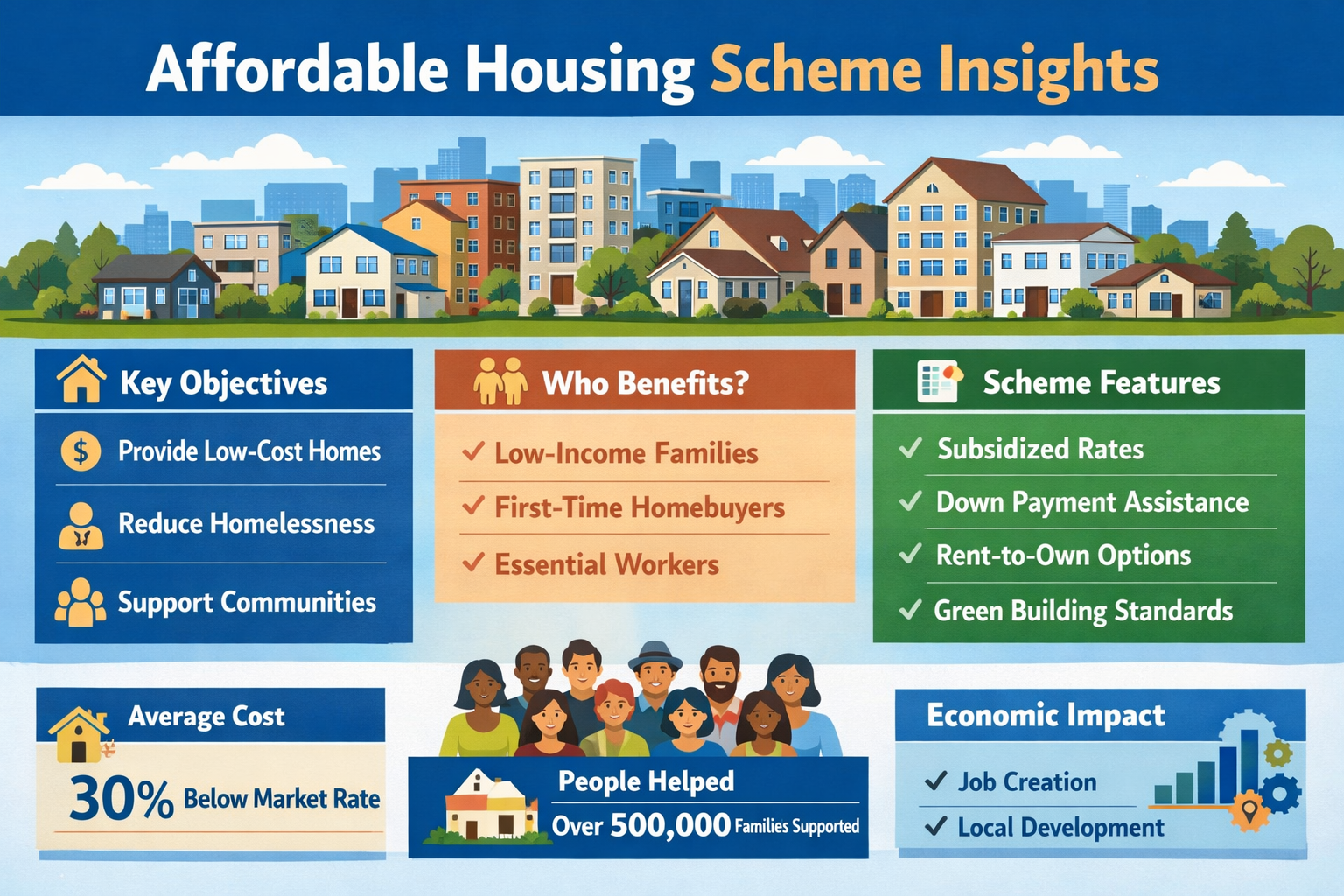
Affordable housing schemes are government-led or public-private initiatives designed to provide safe, decent, and affordable housing to individuals and families who cannot afford homes at prevailing market prices. These schemes play a critical role in addressing urbanization pressures, rising real estate costs, income inequality, and homelessness while promoting inclusive and sustainable development. Housing is a basic human necessity, and affordable housing ensures social stability, economic growth, and improved quality of life for low- and middle-income populations.
2. Objectives of Affordable Housing Schemes
2.1 Provide Low-Cost Housing
The primary goal is to reduce the cost of home ownership or rental housing by offering:
- Subsidized home prices
- Lower interest rates on housing loans
- Reduced land and construction costs
This enables economically weaker sections to own or rent homes without financial distress.
2.2 Reduce Homelessness
Affordable housing helps:
- Decrease informal settlements and slums
- Provide permanent shelter to vulnerable groups
- Improve living standards and dignity
2.3 Promote Social Inclusion
These schemes ensure equitable access to housing for:
- Low-income households
- Migrant workers
- Elderly and disabled individuals
This fosters socially balanced and inclusive communities.
2.4 Support Sustainable Urban Development
Planned affordable housing reduces urban sprawl and promotes:
- Efficient land use
- Infrastructure planning
- Environmentally responsible construction
3. Target Beneficiaries (Who Benefits?)
3.1 Low-Income Families
Families earning below a defined income threshold benefit through:
- Subsidized housing prices
- Rental assistance
- Housing grants
3.2 Economically Weaker Sections (EWS)
Includes individuals with minimal income who receive:
- Maximum government subsidies
- Small-sized but well-equipped housing units
3.3 First-Time Homebuyers
Special incentives are provided to encourage ownership, such as:
- Lower down payments
- Interest subsidies on loans
- Tax benefits
3.4 Essential Workers
Includes:
- Teachers
- Healthcare workers
- Police and sanitation staff
These workers often live near urban centers but struggle with high rents.
3.5 Senior Citizens and Persons with Disabilities
Housing units may include:
- Barrier-free access
- Elevators and ramps
- Proximity to healthcare facilities
4. Key Features of Affordable Housing Schemes
4.1 Subsidized Interest Rates
Governments provide interest subsidies on home loans, reducing monthly EMI payments and overall loan burden.
4.2 Down Payment Assistance
Financial aid or grants help beneficiaries meet initial down payment requirements.
4.3 Rent-to-Own Options
Tenants can convert rental payments into ownership over time, helping those unable to purchase outright.
4.4 Fixed Price Caps
Housing units are sold or rented at prices significantly below market rates to ensure affordability.
4.5 Smaller, Efficient Housing Units
Homes are designed to be:
- Compact
- Cost-efficient
- Functional and safe
4.6 Green and Sustainable Construction
Many schemes include:
- Energy-efficient designs
- Solar panels
- Rainwater harvesting
- Eco-friendly materials
5. Eligibility Criteria (Typical Requirements)
While criteria vary by region, common conditions include:
- Income limits based on household earnings
- Citizenship or residency proof
- First-time homeownership status
- Age requirements (usually 18+)
- No ownership of another permanent home
6. Financial Structure and Cost Benefits
6.1 Below-Market Pricing
Affordable housing units are typically priced 20%–40% lower than market rates, making them accessible to low-income buyers.
6.2 Government Subsidies
Subsidies may include:
- Direct financial grants
- Reduced land costs
- Tax exemptions for developers
6.3 Affordable EMIs
Lower interest rates and longer loan tenures reduce monthly financial stress.
7. Economic Impact of Affordable Housing
7.1 Job Creation
Affordable housing construction generates employment in:
- Construction
- Manufacturing
- Transportation
- Services
7.2 Boost to Local Economy
Housing projects stimulate:
- Demand for local materials
- Small business growth
- Infrastructure development
7.3 Increased Productivity
Stable housing improves:
- Worker efficiency
- School attendance
- Health outcomes
8. Social Impact
8.1 Improved Quality of Life
Residents gain:
- Safe living conditions
- Access to clean water and sanitation
- Security and stability
8.2 Community Development
Affordable housing encourages:
- Mixed-income neighborhoods
- Social cohesion
- Reduced crime rates
8.3 Education and Health Benefits
Children perform better academically, and families experience better health outcomes due to improved living conditions.
9. Challenges in Affordable Housing Implementation
9.1 Land Availability
High land costs in urban areas limit project scalability.
9.2 Funding Constraints
Limited public budgets can slow project execution.
9.3 Infrastructure Gaps
Affordable housing must be supported by:
- Transportation
- Schools
- Healthcare facilities
9.4 Regulatory Delays
Complex approval processes may delay housing delivery.
10. Role of Public–Private Partnerships (PPP)
Governments often collaborate with private developers to:
- Share financial risk
- Improve construction efficiency
- Increase housing supply
Incentives to developers include:
- Tax exemptions
- Faster approvals
- Free or subsidized land
11. Future Outlook
Affordable housing will continue to be a priority due to:
- Rapid urbanization
- Population growth
- Rising real estate prices
Future strategies may include:
- Smart housing technologies
- Modular construction
- Increased rental housing policies
- Digital application and allocation systems
12. Conclusion
Affordable Housing Schemes are essential for building equitable, sustainable, and resilient societies. By providing cost-effective housing solutions, these schemes reduce inequality, strengthen communities, stimulate economic growth, and ensure that every citizen has access to a safe and dignified home. Governments, private developers, financial institutions, and communities must work together to expand affordable housing access and meet growing demand.
https://www.livehomes.in/live_insights