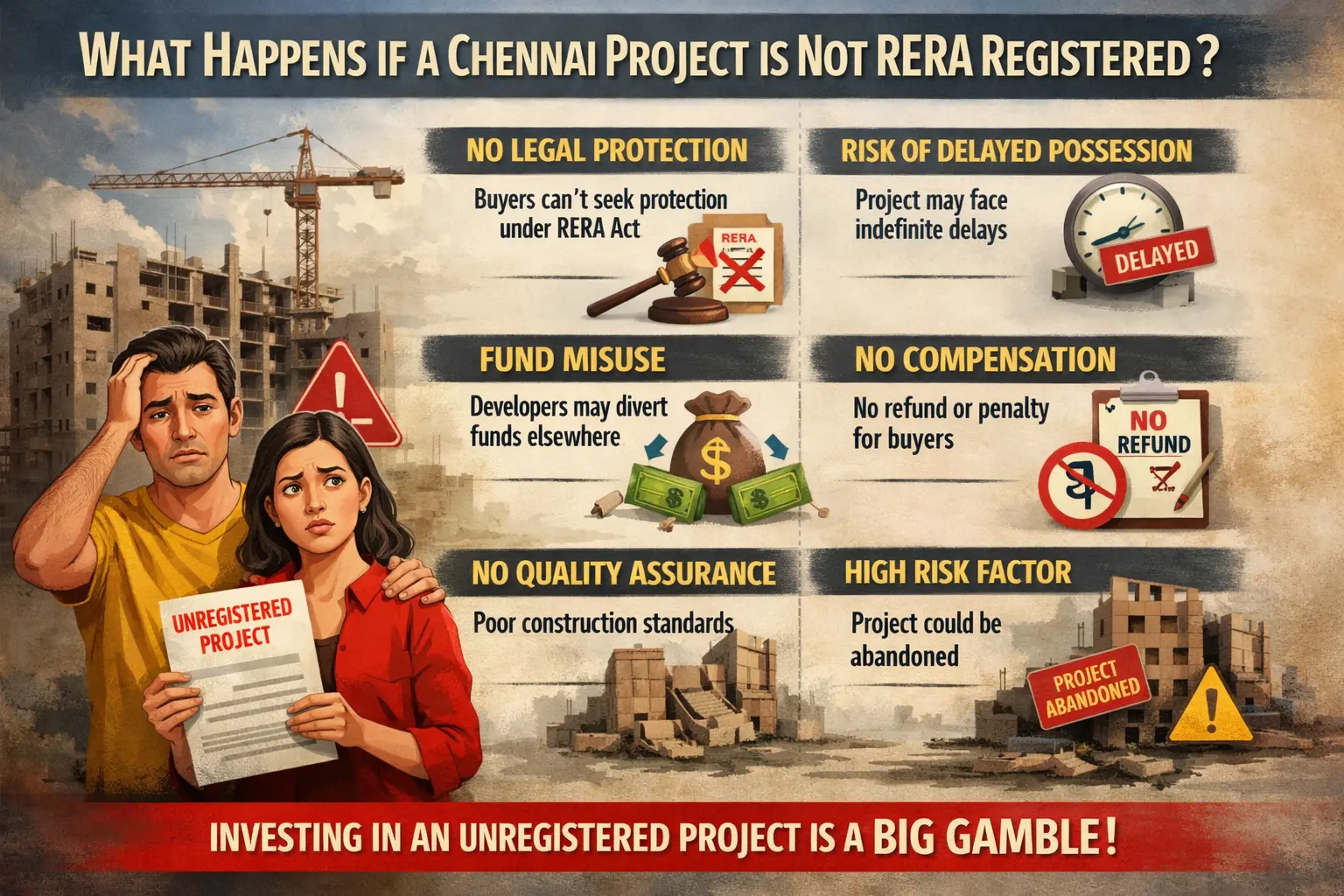
Buying a home is often the largest financial decision for families in Chennai. When a project is not registered under Tamil Nadu RERA (TNRERA), buyers expose themselves to serious legal, financial, and structural risks that can affect them for decades.
1. Loss of Statutory Buyer Rights
RERA creates statutory rights for buyers. These rights exist only if the project is registered.
If a project is not registered:
- Buyers cannot demand information under RERA
- No legally enforceable buyer rights exist
Builder is not obligated to follow RERA timelines
Buyers become contract-dependent, not law-protected.
2. Agreements Strongly Favor the Builder
In non-RERA projects:
- Sale agreements are builder-drafted
- Clauses favor the developer
- Delay penalties are missing or symbolic
- Cancellation terms are one-sided
RERA normally standardizes agreements—but that protection disappears.
Also Read: What is RERA Act
3. No Project Transparency
RERA requires public disclosure of:
- Land title
- Encumbrances
- Approved plans
- Construction progress
- Contractor and architect details
Without RERA:
- Buyers rely only on verbal assurances
- No public database to verify facts
- Critical details may be hidden
4. Increased Risk of Legal Violations
Many non-RERA projects also violate:
- Zoning rules
- FSI norms
- Environmental laws
- Fire safety regulations
Consequences:
- Stop-work notices
- Fines
- Demolition threats
- No Occupancy Certificate (OC)
5. Weak Possession Commitments
Non-RERA builders:
- Avoid committing to possession dates
- Use “approximate” timelines
- Blame force majeure indefinitely
Buyers have no automatic compensation rights.
6. No Refund Certainty
If the buyer exits:
- Refund timelines are unclear
- Builder may deduct heavy charges
- Refund may be delayed for years
RERA mandates refunds with interest—non-RERA does not.
Also Read: RERA Registration Process
7. Absence of Defect Rectification Rights
Under RERA:
- Structural defects must be fixed for 5 years
In non-RERA projects:
- Builders deny responsibility after possession
- Buyers bear maintenance and repair costs
- Associations struggle to enforce quality claims
8. Bank and Market Disadvantages
Non-RERA projects face:
- Limited loan approval
- Reduced buyer confidence
- Lower resale value
- Poor rental demand
End result: Asset depreciation.
9. Greater Risk During Economic Slowdowns
During downturns:
- Non-RERA projects are first to stall
- Builders prioritize RERA-compliant projects
- Funding dries up faster
Buyers remain stuck with unfinished homes.
10. Buyer Remedies Are Complicated
Available remedies:
- Civil court
- Consumer forum
- Criminal complaints (fraud)
Challenges:
- Long timelines
- High legal costs
- Emotional stress
RERA avoids all this—if registration exists.
11. Why Some Builders Avoid RERA Registration
Common reasons:
- Lack of approvals
- Financial mismanagement
- Fear of disclosure
- Past project liabilities
These are red flags, not advantages.
12. Practical Warning Signs for Buyers
No RERA number in ads
- Heavy discounts or urgency sales
- “Approval under process” claims
- Cash payment preference
13. How to Protect Yourself as a Buyer
Verify RERA status on TNRERA website
- Check approvals and land title
- Avoid booking without legal vetting
- Demand written commitments
- Avoid pressure-based sales
Conclusion
- A non-RERA registered project in Chennai removes legal safeguards that protect your money, your time, and your future.
FAQs
Q1. Can a builder register later under RERA?
Yes, but sales done before registration remain risky.
Q2. Are old Chennai projects exempt from RERA?
Only if they had a Completion Certificate before May 2017.
Q3. Can buyer associations approach RERA?
Yes, if the project falls under RERA eligibility.
Q4. Does RERA apply to redevelopment projects?
Only if new units are sold.
Q5. Is RERA mandatory for plotted layouts?
Yes, if size limits are exceeded.
https://www.livehomes.in/blogs