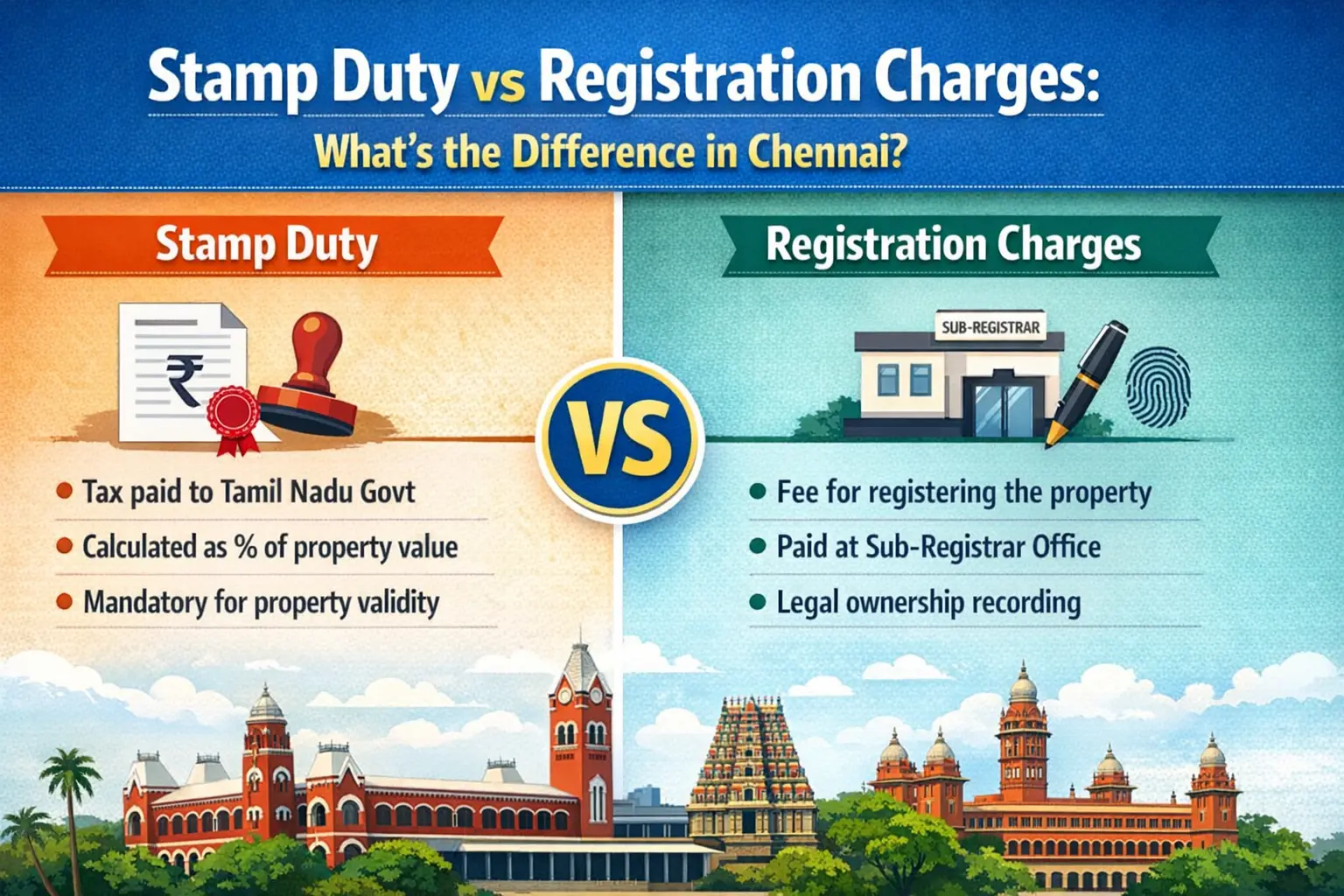
When you buy, sell, or transfer property in Chennai, you must pay two mandatory government charges:
- Stamp Duty
- Registration Charges
Though they are often mentioned together, they serve different legal purposes. Understanding the difference is essential for budgeting and ensuring your property ownership is legally valid.
1. What Is Stamp Duty?
Stamp Duty is a tax levied by the Tamil Nadu State Government on property transactions.
It is paid for creating a legally valid document such as a sale deed, gift deed, or exchange deed.
Purpose of Stamp Duty
- Gives legal validity to the property document
- Acts as evidence of ownership
- Makes the document admissible in court
- Helps prevent property fraud and disputes
Without paying stamp duty, a property document has no legal standing, even if signed by both parties.
Stamp Duty Rate in Chennai
In most normal property sale transactions:
- Stamp Duty: 7%
- Calculated on the higher of:
- Actual sale value, or
- Government guideline value
2. What Are Registration Charges?
Registration Charges are the fees paid to the Sub-Registrar’s Office for officially recording the property transaction in government records.
Purpose of Registration Charges
- Registers the document under the law
- Updates ownership details in public land records
- Ensures transparency and traceability of ownership
- Provides permanent proof of ownership
A property transaction is incomplete and legally unenforceable without registration.
Registration Charge Rate in Chennai
For standard property sales:
- Registration Charges: 4%
- Calculated on the same value used for stamp duty
Also Read: Chennai Property Registration Charges for Flats Villas & Plots
3. Key Differences Between Stamp Duty and Registration Charges
| Aspect | Stamp Duty | Registration Charges |
| Nature | Tax | Government Services fees |
| Purpose | Legal valiilty of document | Official record of onwership |
| Padi to | State Government | Sub - Registrar Office |
| Moderate | Yes | Yes |
| Rate in Chennai | 7 % | 4% |
| When Paid | Before or at registation | At registartion |
4. Combined Cost for Property Buyers in Chennai
In a typical sale deed:
- Stamp Duty: 7%
- Registration Charges: 4%
Total Government Charges = 11% of property value
Example:
- Property value: Rs 50,00,000
- Stamp Duty (7%): Rs 3,50,000
- Registration (4%): Rs 2,00,000
- Total payable: Rs 5,50,000
5. Guideline Value and Its Importance
The guideline value is the minimum value fixed by the Tamil Nadu government for property registration.
- If your agreement value is lower than the guideline value,
→ charges are calculated on the guideline value
- If your agreement value is higher,
→ charges are calculated on the agreement value
This rule prevents undervaluation and tax evasion.
6. Who Pays Stamp Duty and Registration Charges?
- Usually paid by the buyer
- In special cases (family transfers, agreements), parties may mutually decide
- Legally, the responsibility must be fulfilled before registration is accepted
7. Stamp Duty & Registration for Different Documents (Tamil Nadu)
| Document Type | Stamp Duty | Registration Charges |
| Sale Deed | 7 % | 4% |
| Gift Deed ( family ) | Lower rate | Lower rate |
| Exchange Deed | 7% ( higher value ) | 4 % |
| Simple Mortgage | 1% ( swith cap ) | 1 % |
| Mortgage with Possession | 4% | 1% |
| Agreement to sale | Nominal | Based on Adavance |
Rates vary based on document type as per Tamil Nadu Stamp Act.
8. How Stamp Duty and Registration Are Paid in Chennai
- e-Stamping through authorized portals
- Non-judicial stamp paper
- Payment at designated bank or Sub-Registrar office
After payment:
- Parties appear before the Sub-Registrar
- Biometric verification and document registration are completed
- Registered document is issued as proof
Also Read: Stamp Duty vs Registration Charges What the Differences in Chennai
9. Why These Charges Are Important
- Establishes clear legal ownership
- Required for bank loans and resale
- Prevents disputes and multiple claims
- Mandatory for inheritance and succession planning
Conclusion
In Chennai property transactions:
- Stamp Duty gives legal force to the document
- Registration Charges officially record ownership
Both are essential and together typically amount to about 11% of the property value. Paying them correctly ensures lawful ownership, financial security, and peace of mind.
Frequently Asked Questions (FAQs)
1. Are stamp duty and registration charges compulsory in Chennai?
Yes. Both are mandatory for most property transactions under Tamil Nadu law.
2. Is stamp duty refundable if a deal is cancelled?
Generally, no. Limited refunds may apply under specific legal conditions and within a fixed time frame.
3. Are charges different for new property and resale property?
No. Rates are the same. Charges depend on value, not whether the property is new or resale.
4. Do women get any concession in Chennai?
Yes. For certain value limits and conditions, women buyers may receive reduced registration charges as per state notifications.
5. Is GST applicable on stamp duty or registration charges?
No. GST does not apply to stamp duty or registration fees.
6. What happens if stamp duty is underpaid?
The document may be:
- Declared invalid
- Subject to penalties and additional duty
- Rejected for registration or future legal use
7. Can a property be sold without paying these charges?
No. Without stamp duty and registration, the sale has no legal validity.
https://www.livehomes.in/blogs