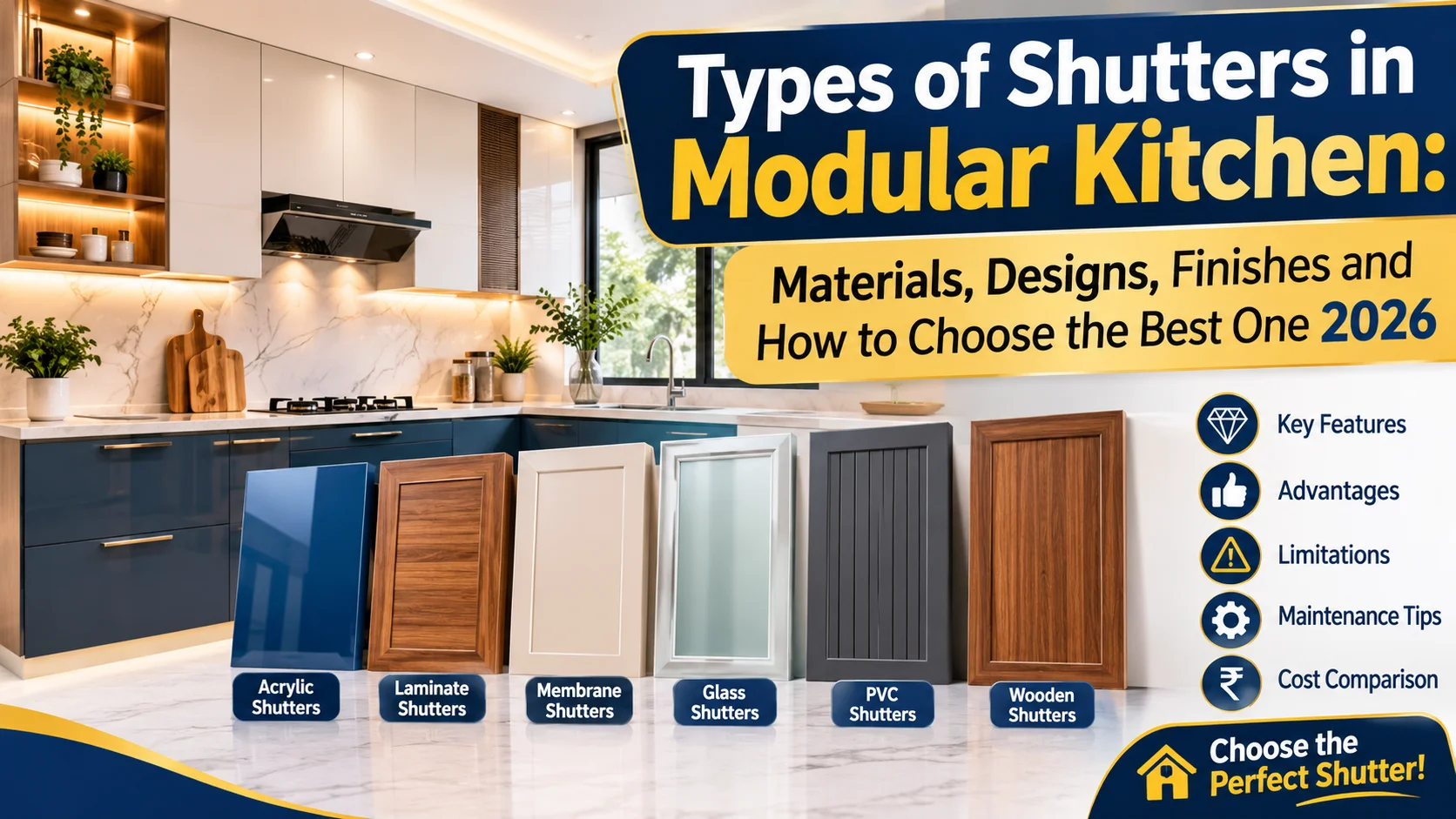
A modular kitchen is an essential part of a modern home. Its appearance, storage capacity, and functionality depend on the materials and designs used in its construction. One of the most important elements is the kitchen shutter, which influences both the appearance and usability of kitchen cabinets. Kitchen shutters are the front panels fitted to cabinets, drawers, and storage units. They are available in different materials, colors, textures, and finishes to suit various interior styles and budgets. Choosing the right kitchen shutter requires more than selecting an attractive color. Homeowners should consider durability, moisture resistance, heat exposure, cleaning requirements, maintenance, and overall cost.
In 2026, kitchen interiors are increasingly focusing on practical materials, minimal designs, natural textures, and easy-to-maintain surfaces. This guide explains the different types of modular kitchen shutters, their materials, designs, finishes, advantages, disadvantages, and important factors to consider before choosing one.
1. What Are Modular Kitchen Shutters?
Modular kitchen shutters are the front doors or panels attached to kitchen cabinets. They provide access to storage spaces while protecting the contents of cabinets from dust and external exposure.
They are commonly installed in:
- Base kitchen cabinets.
- Wall-mounted cabinets.
- Tall storage units.
- Pantry cabinets.
- Kitchen drawer units.
- Display cabinets.
A typical kitchen shutter consists of a core board covered with a decorative surface. The core provides structural strength, while the outer finish determines its appearance and surface properties. The quality of a kitchen shutter depends on its material, thickness, surface finish, edge protection, hardware, and installation.
Also Read: Modular Kitchen Cost in Chennai 2026: Complete Price Guide & Designs
2. Different Types of Modular Kitchen Shutters Based on Materials
2.1 Laminate Kitchen Shutters
Laminate shutters are widely used in residential kitchens because they offer different colors, patterns, and surface textures at various price levels. They are manufactured by bonding a decorative laminate sheet to an engineered wood board.
Types of laminate finishes:
- Matte finish.
- Glossy finish.
- Textured finish.
- Wood-grain finish.
- High-pressure laminate.
Advantages:
- Available in different colors and patterns.
- Easy to clean.
- Suitable for modern and traditional kitchens.
- Offers good everyday wear resistance depending on quality.
- Available at different budget levels.
Disadvantages:
- Damaged surfaces can be difficult to repair.
- Poorly sealed edges may allow moisture penetration.
- Low-quality materials may peel over time.
Best suited for: Budget-friendly kitchens, apartments, and homes requiring practical cabinet surfaces.
2.2 Acrylic Kitchen Shutters
Acrylic shutters are known for their smooth, glossy, and reflective appearance. They are generally manufactured by applying an acrylic decorative sheet over a suitable board. They can make a kitchen look brighter and more spacious by reflecting light.
Advantages:
- Premium glossy appearance.
- Smooth surface.
- Available in multiple colors.
- Easy to wipe and clean.
- Suitable for contemporary kitchen designs.
Disadvantages:
- Fingerprints may be visible.
- Some surfaces can develop scratches.
- More expensive than many standard laminate options.
- Requires careful handling and installation.
Best suited for: Modern apartments and premium kitchen interiors.
2.3 Membrane Kitchen Shutters
Membrane shutters are generally manufactured using a medium-density fiberboard base covered with a decorative PVC film. The film is pressed over the surface and edges to create a continuous finish. They are available in simple and decorative designs.
Advantages:
- Available in different colors and textures.
- Suitable for decorative cabinet profiles.
- Provides a continuous surface appearance.
- Works well with traditional and modern interiors.
Disadvantages:
- Poor-quality films may peel.
- Excessive heat can damage the surface.
- Moisture entering damaged edges can affect the core board.
- Repairs may be difficult.
Best suited for: Decorative kitchens and homeowners looking for a traditional cabinet appearance.
2.4 PU Painted Kitchen Shutters
PU-painted shutters are created by applying a polyurethane coating over a prepared board. They provide a smooth surface and allow homeowners to select customized colors.
Available finishes:
- Matte.
- Glossy.
- Satin.
- Metallic.
- Textured.
Advantages:
- Wide range of colors.
- Smooth and elegant appearance.
- Suitable for customized interior designs.
- Creates a refined cabinet finish.
Disadvantages:
- Higher cost compared with basic laminate options.
- Scratches may require professional repair.
- Surface quality depends on application.
- Needs suitable cleaning and maintenance.
Best suited for: Premium homes and customized kitchen interiors.
2.5 PVC Kitchen Shutters
PVC shutters are manufactured using polyvinyl chloride-based boards or panels. Their moisture resistance and structural performance depend on the quality and construction of the material.
Advantages:
- Some varieties offer good moisture resistance.
- Lightweight construction.
- Easy to clean.
- Available in different designs.
- Suitable for selected budget-oriented kitchen applications.
Disadvantages:
- Quality varies between products.
- Some boards may deform under excessive heat.
- Low-quality varieties may have limited screw-holding strength.
- Not all varieties are suitable for heavy cabinets.
Best suited for: Selected kitchen storage applications where the board specifications are appropriate.
2.6 Glass Kitchen Shutters
Glass shutters are used to create an elegant and contemporary kitchen appearance. They generally consist of safety glass fitted into a suitable frame.
Popular glass options:
- Clear glass.
- Frosted glass.
- Tinted glass.
- Fluted glass.
- Textured glass.
- Back-painted glass.
Advantages:
- Creates an elegant appearance.
- Makes cabinets look visually lighter.
- Suitable for decorative storage.
- Allows selected kitchen accessories to be displayed.
- Available in different designs.
Disadvantages:
- Requires regular cleaning.
- Fingerprints may be visible.
- Glass can break if damaged.
- Transparent varieties do not conceal cabinet contents.
Best suited for overhead cabinets, display storage, and contemporary kitchens.
2.7 Solid Wood Kitchen Shutters
Solid wood shutters are made from natural timber. They are selected for their distinctive grain patterns, warm appearance, and timeless design.
Advantages:
- Natural appearance.
- Distinctive grain patterns.
- Suitable for traditional and premium interiors.
- Can be refinished in suitable conditions.
- Offers a rich decorative appearance.
Disadvantages:
- Higher cost.
- Requires regular maintenance.
- Can expand or contract due to humidity changes.
- Needs protection from prolonged moisture exposure.
Best suited for: Traditional homes and premium kitchen interiors.
2.8 Veneer Kitchen Shutters
Veneer shutters are manufactured by applying a thin natural wood layer over an engineered board. They provide the appearance of natural timber while using less solid wood.
Advantages:
- Natural wood appearance.
- Different grain patterns.
- Suitable for modern and luxury interiors.
- Creates a warm and elegant atmosphere.
- Available in various shades.
Disadvantages:
- Requires proper moisture protection.
- Scratches may need refinishing.
- Natural color and grain may vary.
- More expensive than basic laminate options.
Best suited for: Natural-themed and contemporary luxury kitchens.
2.9 Aluminum Profile Kitchen Shutters
Aluminium profile shutters use metal frames combined with glass or other suitable panel materials. They provide a clean and modern appearance.
Advantages:
- Lightweight frame construction.
- Suitable for contemporary kitchens.
- Can be combined with different panel materials.
- Good corrosion resistance when properly finished.
- Works well for display cabinets.
Disadvantages:
- Premium profile systems can be expensive.
- Glass panels need careful handling.
- Requires appropriate hardware.
- Not every design suits every cabinet application.
Best suited for: Modern kitchens and overhead display cabinets.
2.10 Lacquer Finish Kitchen Shutters
Lacquer shutters feature a decorative coating applied over a prepared board to create a smooth and refined surface.
Advantages:
- Smooth appearance.
- Available in multiple colors.
- Suitable for premium kitchens.
- Creates a consistent cabinet finish.
Disadvantages:
- Requires careful maintenance.
- Some finishes may show scratches.
- Repairing damaged coatings can be difficult.
- Generally costs more than basic laminate shutters.
Best suited for: Luxury and customized modular kitchens.
3. Types of Modular Kitchen Shutters Based on Designs
- Flat Panel Shutters: These shutters have a smooth and simple surface without decorative patterns. They are suitable for minimalist and contemporary kitchens.
- Shaker-Style Shutters: These shutters feature a central flat panel surrounded by a raised or recessed frame. They are suitable for classic and transitional interiors.
- Handleless Shutters: Handleless shutters use integrated channels, recessed profiles, or push-to-open systems instead of conventional handles. They create a clean and seamless appearance.
- Fluted Shutters: Fluted shutters feature vertical or horizontal grooves that create a decorative textured appearance. They are commonly used for selected cabinets and display sections.
- Raised Panel Shutters: These shutters feature an elevated central section with decorative borders. They are suitable for traditional kitchen interiors.
- Glass Panel Shutters: These shutters combine glass panels with suitable frames to create an open and decorative appearance.
4. Types of Kitchen Shutters Based on Opening Mechanisms
| Opening Type | Function | Suitable application |
| Hinged shutters | Open sideways | Base and wall cabinets |
| Lift-up shutters | Open upwards | Overhead cabinets |
| Bi-fold shutters | Fold into two sections | Wide overhead cabinets |
| Sliding shutters | Move horizontially | Selected storage units |
| Pocket shutters | Slide into side cavities | Premium storage units |
| Roller shutters | Roll upwards | Specialised appliance stroage |
The opening mechanism should be selected according to cabinet size, available space, accessibility and everyday usage.
5. Popular Kitchen Shutter Finishes in 2026
- Matte Finish
Matte shutters provide a smooth, non-reflective appearance. They are suitable for homeowners who prefer simple and elegant interiors.
- Glossy Finish
Glossy shutters reflect light and create a bright appearance. They are particularly useful in kitchens with limited natural lighting.
- High-Gloss Finish
High-gloss shutters provide a more reflective surface and are commonly selected for contemporary kitchen interiors.
- Textured Finish
Textured finishes create patterns resembling natural wood, stone or other decorative materials.
- Wood-Grain Finish
Wood-grain shutters provide a natural timber-inspired appearance and work well with neutral kitchen interiors.
-Super-Matte Finish
Super-matte shutters have a very low-reflective surface and create a subtle, sophisticated appearance.
6. Comparison of Different Modular Kitchen Shutter Materials
| Material | Appearance | Maintenance | Cost level |
| Laminate | Matte, gloss and textured | Low | Budget to mid-range |
| Acrylic | Gloosy and smooth | Medium | Premium |
| Membrance | Smooth and decorative | Low to medium | Budget to mid-range |
| PU paint | Customised finishes | Medium | Premium |
| PVC | Different surface designs | Low | Budget to mid range |
| Glass | Modern and elegant | Medium | Premium |
| Solid Wood | Natural apperance | Medium to high | Premium |
| Veneer | Natural wood texture | Medium | Premium |
| Aluminium profile | Modern and sleek | Low to medium | Mid-range to premium |
| Lacquer | Smooth and refined | Medium | Premium |
Cost levels are indicative comparisons, not fixed prices. Actual costs depend on material quality, thickness, fabrication and installation.
7. Price Compariosn of Different Kitchen Shutter Materials
Estimated shutter-panel prices per sq ft in 2026.
| Kitchen Shutter material | Estimated price per sq ft |
| Lamintae shutters | Rs 250-450 |
| Acrylic shutters | Rs 550-900 |
| Membrance shutters | Rs 350-650 |
| PU-panited shutters | Rs 700-1,100 |
| PVC shutters | Rs 300-650 |
| Glass shutters | Rs 700-1,200 |
| Solid wood shutters | Rs 900-2,000 |
| Veneer shutters | Rs 600-1,200 |
| Aluminimum profile shutters | Rs 800-1,200 |
| Lacquer finish shutters | Rs 700-1,300 |
8. Which Kitchen Shutter Material Is Best for Indian Homes?
Indian kitchens experience frequent cooking, steam, oil splashes and regular cleaning. Therefore, shutter materials should be selected according to daily usage.
- For regular cooking: Quality laminate shutters are a practical option.
- For premium interiors: Acrylic and PU shutters offer attractive finishes.
- For traditional kitchens: Membrane and solid wood shutters provide decorative appearances.
- For natural interiors: Veneer shutters offer wood-inspired aesthetics.
- For display cabinets: Glass and aluminium profile shutters create an elegant look.
- For compact kitchens: Light-coloured glossy or matte finishes can create a brighter appearance.
For homes in Chennai, consider humidity, moisture exposure, proper edge sealing and ventilation when selecting kitchen shutters. Pay particular attention to the cabinets installed below the sink.
9. How to Choose the Best Modular Kitchen Shutters
Before selecting kitchen shutters, homeowners should consider the following factors.
- Budget: Compare material costs and installation expenses.
- Kitchen usage: Select surfaces that can handle regular cooking and cleaning.
- Moisture resistance: Check the board quality and edge protection.
- Colour selection: Choose shades that complement the kitchen walls and flooring.
- Cleaning requirements: Consider how much maintenance the surface needs.
- Hardware quality: Check hinges, drawer channels and opening mechanisms.
- Material samples: Examine actual samples before confirming the design.
- Long-term durability: Consider replacement and maintenance requirements.
10. Best Colour Combinations for Modular Kitchen Shutters in 2026
| Colour Combination | Appearance |
| White and walnut | Elegant and warm |
| Beige and cream | Soft and minimal |
| Sage green and white | Natural and refreshing |
| Grey and oak | Modern and balanced |
| Navy blue and white | Bold and sophicated |
| Black and wood | Rich and luxurious |
Light shades are suitable for smaller kitchens, while darker shades can be used as accent colours.
11. Common Mistakes to Avoid When Choosing Kitchen Shutters
- Selecting materials only based on appearance.
- Ignoring the quality of the core board.
- Using poor-quality edge sealing.
- Installing unsuitable materials near heat sources.
- Choosing colours without checking actual samples.
- Ignoring hinge and hardware quality.
- Overlooking cleaning and maintenance requirements.
- Not checking warranty and installation details.
12. Kitchen Shutter Maintenance Tips
Proper maintenance helps kitchen shutters retain their appearance and functionality.
- Daily care
- Wipe oil splashes immediately.
- Use a soft cleaning cloth.
- Avoid standing water near cabinet edges.
- Keep sink cabinets dry.
- Regular care
- Clean cabinet surfaces with suitable mild cleaning products.
- Check hinges and handles.
- Remove grease deposits.
- Inspect edges for peeling or damage.
- Long-term care
- Check for swelling around wet areas.
- Adjust loose hinges.
- Repair damaged edge sealing.
- Maintain proper kitchen ventilation.
- Follow the cleaning instructions provided for each material.
13. Important Things to Check Before Ordering Modular Kitchen Shutters
| Factor | Importance |
| Core board material | Determines structual performance |
| Board thickness | Influences strength and stability |
| Surface finish | Determines appearance and cleaning |
| Edge-banding quality | Helps prevent moisture penetration |
| Backside balancing | Support panel stability |
| Hinge quality | Ensures smooth operation |
| Warranty | Clarifies product coverage |
| Installation | Infulences long-term performance |
Always request a detailed quotation that clearly mentions the shutter material, board thickness, finish, hardware and installation charges.
Conclusion
Modular kitchen shutters play an important role in determining the appearance, functionality and durability of kitchen interiors. Different materials offer different advantages, from affordable laminate surfaces to premium acrylic, PU, glass, veneer and natural wood options. Before choosing a kitchen shutter, homeowners should consider their budget, cooking habits, kitchen layout, moisture exposure, maintenance requirements and preferred interior style. Selecting the right combination of materials, finishes and hardware helps create a kitchen that remains attractive, comfortable and functional for years.
Frequently Asked Questions
1. Which type of shutter is best for a modular kitchen?
Quality laminate shutters are a practical choice for most Indian homes because they offer affordability, design variety and easy maintenance. Acrylic and PU are suitable for premium kitchens.
2. Which is better: laminate or acrylic kitchen shutters?
Laminate is generally more affordable and practical, whereas acrylic offers a premium glossy appearance. The choice depends on budget and design preferences.
3. Are acrylic kitchen shutters durable?
Yes. Quality acrylic shutters offer good everyday performance when installed on suitable boards and maintained properly.
4. What is the difference between membrane and laminate shutters?
Membrane shutters use a decorative PVC film pressed over a shaped board, whereas laminate shutters use a decorative sheet bonded to a board.
5. Which kitchen shutter material is waterproof?
No material should automatically be considered completely waterproof. Certain PVC and glass options offer good moisture resistance, while other materials require properly sealed edges and suitable substrates.
6. Are PU shutters suitable for Indian kitchens?
Yes. PU shutters are suitable when manufactured and installed correctly. They offer customised colours and smooth finishes.
7. Which kitchen shutter finish is easiest to maintain?
Matte laminate is generally a practical and easy-to-maintain option for everyday kitchens.
8. Which shutters are suitable for small kitchens?
Light-coloured laminate and glossy acrylic shutters can help create a brighter and more spacious appearance.
9. Are glass shutters suitable for modular kitchens?
Yes. Glass shutters are suitable for overhead cabinets and display units. Frosted and fluted glass options offer decorative privacy.
10. What is the difference between solid wood and veneer shutters?
Solid wood shutters are made from natural timber, while veneer shutters use a thin natural wood layer bonded to an engineered board.