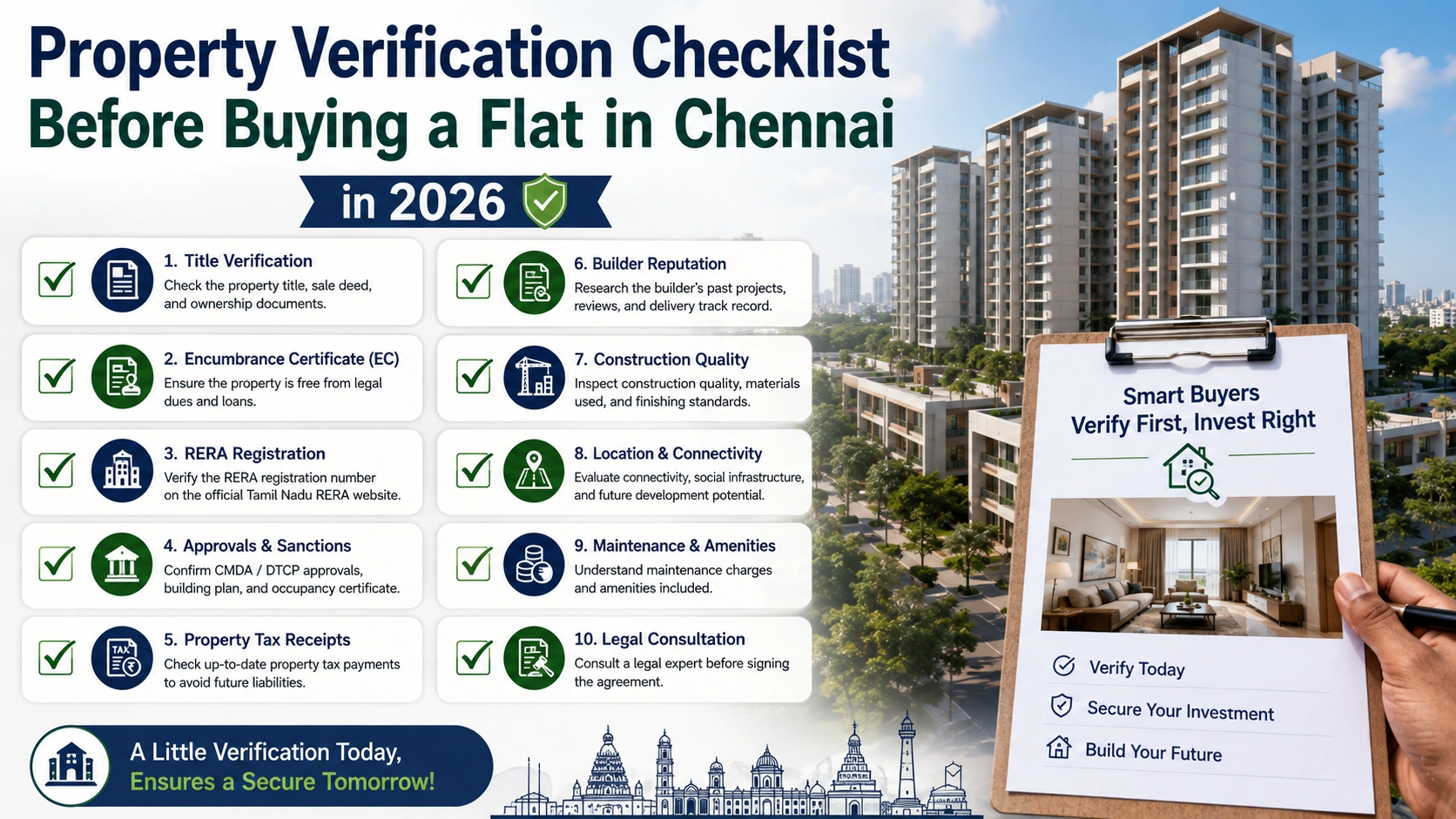
Buying a flat is a major financial decision, and checking the property documents before making an advance payment can help buyers avoid legal, financial, and ownership-related issues. In Chennai, buyers should verify the title, approvals, RERA registration, construction permissions, encumbrance, tax records, and sale agreement before completing the purchase. Here is a practical property verification checklist for buying a flat in Chennai in 2026.
1. Verify the Property Title
The first step is to confirm who legally owns the land on which the apartment is being constructed.
Check:
- Parent documents / mother's deed
- Previous sale deeds
- Current title deed
- Chain of ownership
- Patta and related land records
- Whether the seller has the legal right to sell the property
Whether the title is clear and transferable
A property lawyer can examine the documents and provide a title opinion before you proceed.
2. Check the Encumbrance Certificate (EC).
An encumbrance certificate helps identify registered transactions or encumbrances associated with the property.
Buyers should check whether the property has:
- Existing mortgage
- Registered sale transactions
- Legal claims reflected in registration records
- Other registered encumbrances
The EC should be checked for an appropriate period based on the property's history.
Also Read: Patta, EC & Legal Documents Required to Buy Property in Chennai
3. Verify CMDA/DTCP Approval
For properties in and around Chennai, verify whether the project has the required planning approval from the relevant authority.
Depending on the location, check:
- CMDA approval
- DTCP approval, where applicable
- Approved building plan
- Planning permission
- Layout approval, where applicable
Do not rely only on a builder's brochure. Compare the approval documents with the actual project details.
4. Check TNRERA Registration
If the project falls under RERA requirements, verify its registration with the Tamil Nadu Real Estate Regulatory Authority (TNRERA).
Check:
- RERA registration number
- Promoter details
- Approved project details
- Number of apartments
- Project completion date
- Construction progress
- Litigation disclosures
- Quarterly project updates
The information provided in the RERA records should broadly match what the builder is advertising and selling.
5. Verify the Approved Building Plan
The approved plan should be compared with the actual apartment and common areas.
Check whether:
- The number of floors matches the approval.
- The number of apartments matches the sanctioned plan.
- Your flat's size and location are correct.
- Parking areas are properly shown.
- Common areas are identified.
- Amenities mentioned by the builder are part of the approved project where applicable.
This is particularly important for under-construction flats.
6. Check the Land Use and Zoning
Before purchasing a flat, buyers should verify whether the land is being used for the permitted purpose.
Check:
- Land-use classification
- Zoning restrictions
- Residential-use permission
- Road access
- Any development restrictions affecting the property
This can help identify issues that may affect construction or future resale.
7. Verify the Sale Agreement
Read the sale agreement carefully before signing or paying a substantial amount.
Important points include:
- Flat number
- Carpet/built-up/saleable area as applicable
- Undivided share of land (UDS)
- Total consideration
- Payment schedule
- Possession date
- Construction specifications
- Cancellation terms
- Delay-related provisions
- Maintenance responsibilities
- Parking allocation
Make sure there are no major differences between the advertisement, booking form, cost sheet, agreement, and approved documents.
8. Check the Undivided Share of Land (UDS)
UDS is an important part of apartment ownership in Chennai.
It represents the buyer's undivided share in the underlying land.
Before buying, verify:
- UDS mentioned in the sale deed
- Total land extent
- Number of apartments
- Whether the UDS calculation appears reasonable
- Whether the document correctly identifies the underlying land
A higher or lower UDS can have implications for the property's long-term value, particularly in redevelopment situations.
9. Verify Property Tax and Other Dues
Check whether the property has outstanding government or local-body dues.
Depending on the property, verify:
- Property tax
- Water charges
- Electricity dues
- Maintenance charges
- Other applicable local charges
For a resale flat, request the relevant receipts and confirm that previous dues are cleared before registration.
10. Check the Completion Certificate and Occupancy Certificate.
- For a ready-to-move-in apartment, buyers should check whether the required completion and occupancy-related approvals have been obtained.
- An Occupancy Certificate (OC) is particularly important because it indicates that the completed building has met the applicable requirements for occupation.
Do not assume that a flat being physically ready means all necessary approvals have been obtained.
11. Verify the Flat's Actual Measurements
Before registration or possession, compare the documents with the physical property.
Check:
- Flat number
- Floor
- Room layout
- Area
- Balcony
- Doors and windows
- Common areas
- Parking
- Utility spaces
For under-construction properties, compare the promised specifications with the final handover.
12. Check Parking Rights
Parking can become a source of disputes in apartment communities.
Verify:
- Whether parking is allotted
- Parking number
- Location
- Type of parking
- What is mentioned in the agreement
- Whether the parking arrangement complies with applicable rules
Avoid relying solely on verbal promises from the salesperson.
13. Verify Builder and Project History
Before buying a flat, research the developer's previous projects.
Look at:
- Delivery record
- Construction quality
- Previous RERA complaints/orders
- Maintenance history
- Possession delays
- Quality of common amenities
- Customer feedback
This is especially useful when comparing multiple flats for sale in Chennai.
14. Check Bank Approval Carefully
If you are taking a home loan, a bank's legal and technical assessment can provide an additional layer of due diligence.
However, bank approval should not be treated as a substitute for your own legal verification.
The buyer should still independently verify the title, approvals, agreement, and other property documents.
15. Verify the Final Cost
The advertised property price may not always represent the total amount payable.
Prepare a complete cost sheet covering:
- Basic property price
- GST, where applicable
- Registration charges
- Stamp duty
- Maintenance deposit
- Corpus fund
- Parking charges, where legally applicable
- Utility or infrastructure charges
- Legal/documentation expenses
- Other builder charges
Ask for a written breakup before making the final payment.
Property Verification Checklist – Quick Table
| Documents/Check | What to Verify |
| Title Deed | Legal Ownership |
| Parent Documents | Ownership history |
| Encumbrance Certificate | Registered encumbrance |
| Patta/Land Records | Land ownership details |
| CMDA/DTCP Approval | Planning approval |
| Building Plan | Approved construction |
| TNRERA | Project registration and disclosures |
| Sale Agreement | Commercial and legal terms |
| UDS | Share in underlying land |
| Property Tax | Outstanding dues |
| OC/Completion Documents | Legality of completed building |
| Parking | Allocation and documentation |
| Cost Sheet | Complete purchase cost |
| Builder History | Track record and project delivery |
Why Property Verification Matters in Chennai
Chennai's residential market includes everything from independent builder-floor apartments to large gated communities and high-rise projects. Each property can have different approval, title, land, and documentation requirements.
A proper verification process helps buyers reduce the risk of:
- Unclear property title
- Approval discrepancies
- Undisclosed mortgages
- Construction deviations
- Possession delays
- Unexpected financial liabilities
- Disputes over UDS or parking
- Problems during resale
For this reason, property verification should happen before signing the final agreement or making a significant non-refundable payment, rather than being treated as a final registration formality.
FAQs
1. What documents should I check before buying a flat in Chennai?
Check the title deed, parent documents, EC, land records, planning approval, building plan, RERA details, sale agreement, tax receipts, and applicable completion/occupancy documents.
2. Is RERA registration mandatory for every flat?
Not every real estate project falls under the same RERA requirements. Buyers should check whether the particular project is required to be registered and verify its status.
3. What is UDS in an apartment?
UDS means Undivided Share of Land. It represents the buyer's undivided ownership share in the land associated with the apartment.
4. Should I check the EC before buying a flat?
Yes. The EC is an important document for checking registered transactions and encumbrances associated with the property.
5. Is CMDA approval enough to buy a flat?
No. CMDA or other planning approval is only one part of property due diligence. Buyers should also verify title, EC, building approval, RERA status where applicable, UDS, tax records, and other relevant documents.
6. Should I hire a property lawyer?
Yes. For a significant property purchase, an independent property lawyer can examine the title and legal documents and identify potential issues before you commit your money.
7. What is the most important document when buying a flat?
There is no single document that proves everything. Clear title, valid approvals, relevant RERA compliance, and properly executed sale documents should all be verified together.
8. Can I buy a flat without checking the property documents?
It is strongly advisable not to. Proper document verification before payment can help prevent legal and financial problems later.