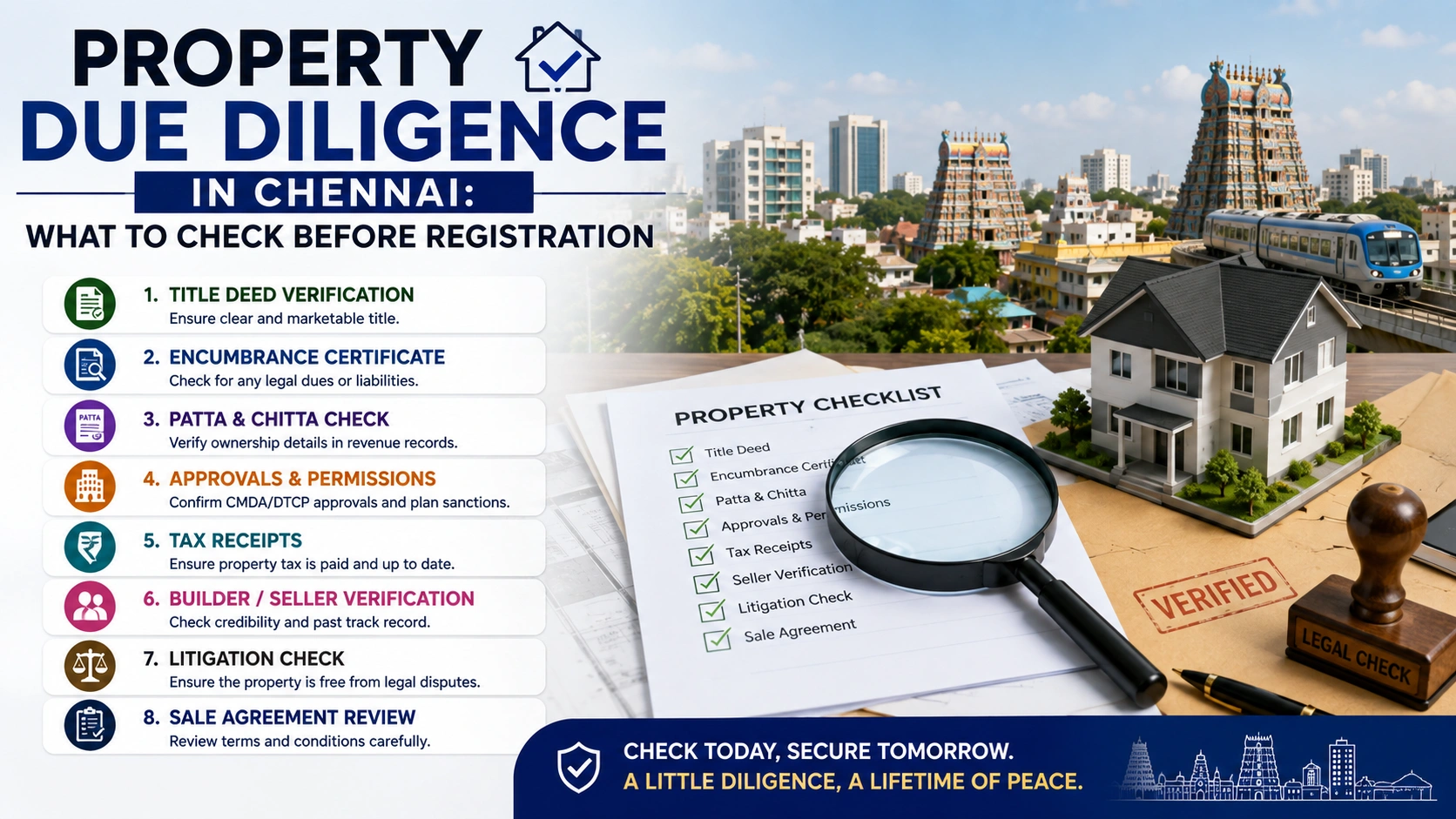
Buying a property in Chennai is a major financial decision. Whether you are purchasing a flat, builder-floor apartment, independent house, plot, or resale property, checking the property's legal ownership and approval status before registration can help you avoid future disputes and unexpected expenses. Property due diligence in Chennai means systematically verifying the property's ownership, title, encumbrances, approvals, land records, construction permissions, taxes, and other relevant documents before signing the final sale deed. A property may look perfect physically, but its documents could reveal ownership disputes, unpaid dues, approval issues, or restrictions. Therefore, document verification should happen before registration—not after paying the entire purchase amount.
1. Verify the Property Title
The first and most important step is checking whether the seller actually has a clear and transferable title.
Ask for:
- Current sale deed
- Parent or mother documents
- Previous sale deeds
- Settlement or gift deeds, if applicable
- Partition deeds, if applicable
- Legal-heir documents, where relevant
- Court orders, if applicable
- Power of Attorney documents, if someone is acting for the owner
For Chennai properties, title verification should cover the property's ownership history and ensure that there are no unexplained gaps in the chain of documents.
Tamil Nadu government documentation for property-related approvals also refers to parent documents, current title documents and supporting revenue records as part of document verification.
2. Check the Encumbrance Certificate (EC).
An encumbrance certificate is an important document to check before purchasing property.
It can help identify registered transactions and certain encumbrances affecting the property during the period searched.
Before registration:
- Obtain a recent EC.
- Check the property details carefully.
- Match the survey number, subdivision number, and extent.
- Verify the names of previous owners.
- Check whether registered mortgages, sales, or other transactions appear.
- Compare the EC with the title documents.
Tamil Nadu's Registration Department provides an online process for applying for an EC.
Important: An EC should not be treated as a complete substitute for a professional title search. A lawyer should examine the underlying documents and applicable records.
Also Read: Patta, EC & Legal Documents Required to Buy Property in Chennai
3. Verify Patta and Revenue Records
For land and properties involving individual plots, check relevant revenue records such as:
- Patta
- Chitta, where applicable
- Adangal, where applicable
- FMB sketch
- TSLR records for urban areas, where applicable
- Survey and subdivision details
The details should broadly correspond with the registered documents and the property on the ground.
Tamil Nadu's official building-approval documentation lists records such as TSLR/FMB, Chitta, Adangal, parent documents and EC among supporting documents.
4. Check CMDA or Relevant Planning Approval
For properties within the Chennai Metropolitan Area, verify the applicable planning approval.
Depending on the property, this may involve:
- CMDA approval
- Local Planning Authority approval
- Approved layout
- Building plan approval
- Planning permission
- Regularization documents, where applicable
Do not rely only on a builder's statement that a project is "approved."
Check the approval number and approved documents wherever possible. CMDA's official portal provides information relating to approved/regularised layouts and related processes.
5. Verify Building Plan and Construction Approval
For a flat, builder-floor apartment or independent house, compare the actual construction with the sanctioned plan.
Check:
- Number of floors
- Number of dwelling units
- Built-up area
- Setbacks
- Parking provision
- Common areas
- Building usage
- Approved plan
- Building permit
Tamil Nadu's urban local-body approval system specifically captures details such as survey number, plot area, proposed floors, building usage and approved layout documents.
6. Check RERA Registration for Applicable Projects
If you are buying a project covered by RERA, verify its registration with the Tamil Nadu Real Estate Regulatory Authority (TNRERA).
Check:
- RERA registration number
- Promoter details
- Project address
- Approved plans
- Project completion information
- Declared completion date
- Number of units
- Litigation or disclosures shown in the project information
- Construction and financial updates, where available
Do not depend exclusively on brochures or advertisements. Compare the information given by the developer with the official project records.
Also Read: Benefits of Buying a RERA Registered Apartment A Complete Guide for Homebuyers 2026
7. Verify the Seller's Identity and Authority
Before signing the sale agreement, verify the seller's:
- Name
- Government-issued identity
- Address
- Ownership documents
- Signature
- PAN, where applicable
- Authority to sell the property
If the property is being sold through a Power of Attorney, carefully verify the POA, its scope and whether it legally authorises the transaction.
For inherited properties, check the relevant death certificate, legal-heir documentation, Will/probate documents where applicable, and the rights of all legal heirs.
8. Check Property Tax and Other Dues
Before registration, verify whether property-related payments are up to date.
Check:
- Property tax
- Water charges
- Electricity dues
- Vacant land tax, where applicable
- Maintenance dues
- Association charges
- Other local authority dues
For apartments, obtain a maintenance/no-dues confirmation from the association or management, where applicable.
Unpaid dues can create unnecessary complications after purchase.
9. Verify the Apartment's UDS
For an apartment purchase, don't focus only on the super built-up area.
Understand:
Carpet Area + Built-up Area + Common Area + UDS
The Undivided Share (UDS) represents the buyer's undivided interest in the underlying land.
Make sure the UDS stated in the agreement and sale deed is clearly mentioned and consistent with the project documents.
10. Check Parking Rights Clearly
Parking disputes are common after apartment purchases.
Before registration, confirm:
- Whether parking is allotted
- Parking number
- Location
- Type of parking
- Whether it is covered/open
- What the sale agreement says
- Whether the sanctioned plan reflects the relevant parking arrangement
Do not rely only on a verbal promise from the seller or sales representative.
11. Verify Occupancy/Completion Documents
For a completed property, check whether the applicable Completion Certificate (CC) and/or Occupancy Certificate (OC) has been obtained.
This is particularly important for ready-to-occupy apartments and recently completed buildings.
An OC/CC can help establish that the completed development has received the applicable completion/occupancy certification from the competent authority.
12. Check for Litigation
A property may have disputes that are not obvious from a simple site visit.
Look for possible issues involving:
- Ownership
- Family disputes
- Partition
- Mortgage
- Boundary disputes
- Court cases
- Government acquisition
- Access roads
- Development rights
If the title history is complicated, obtain a property title search and legal opinion from an independent property lawyer before proceeding.
13. Physically Inspect the Property
Legal due diligence is only one part of the process.
Visit the property and check:
- Actual boundaries
- Access road
- Drainage
- Waterlogging history
- Construction quality
- Cracks or structural concerns
- Water supply
- Electricity connection
- Parking
- Common areas
- Surrounding development
- Road width
- Neighboring properties
For Chennai buyers, physical inspection is particularly useful for understanding site-level conditions that may not be obvious from documents alone.
14. Compare Agreement and Final Sale Deed
Before registration, carefully compare the draft sale deed with the earlier agreement.
Check:
- Seller and buyer names
- Property description
- Survey number
- Extent
- UDS
- Apartment number
- Floor
- Boundaries
- Consideration amount
- Payment details
- Parking details
- Common-area rights
- Possession terms
- Other promised facilities
Any important promise made by the seller or builder should be properly documented rather than left as a verbal assurance.
15. Create a Property Due Diligence Checklist
Before paying the final amount, make sure you have checked:
| Due-Diligence Item | What to Verify |
| Title | Clear Ownership |
| Parent Documents | Complete title chain |
| EC | Registered transaction/encumbrances |
| Patta | Owner and land details |
| FMB/TSLR | Survey and physical details |
| CMDA/Planning Approval | Applicable and approved |
| Building Plan | Sanctioned construction |
| RERA | Applicable project registration |
| Tax | No outstanding dues |
| UDS | Correct land share |
| Parking | Written allocations/details |
| OC/CC | Applicable completion documents |
| Litigation | No unresolved title concerns |
| Physical Inspection | Actual property condition |
| Sale Deed | Correct final property description |
Why Property Due Diligence Matters in Chennai
The biggest advantage of due diligence is that it allows a buyer to identify legal and financial risks before registration.
A low-priced property is not necessarily a good investment if it has:
- Unclear ownership
- Missing parent documents
- Unapproved construction
- Disputed land
- Incorrect property details
- Outstanding dues
- Unclear UDS
- Access problems
- Litigation
Therefore, the objective should not simply be to find a property for sale in Chennai at the lowest price, but to find a property with clear title, proper approvals and reliable documentation.
Conclusion
Property due diligence in Chennai should be completed before registration and before making the final payment. Start with title verification and EC, then check revenue records, planning/building approvals, RERA applicability, taxes, UDS, litigation, physical condition and the final sale deed. For high-value transactions or properties with a complicated ownership history, getting an independent property lawyer's written title opinion is a prudent step.
FAQs
1. What is property due diligence?
It is the process of checking a property's legal, ownership, approval, financial and physical details before purchase.
2. Is EC enough to verify a property?
No. EC is important, but complete title verification should also examine parent documents and other relevant records.
3. What documents should I check before buying a flat in Chennai?
Sale deed, parent documents, EC, applicable patta/revenue records, planning/building approvals, RERA details, tax receipts, UDS and applicable OC/CC.
4. Should I verify CMDA approval before buying?
Yes, where CMDA/planning approval is applicable, verify the approval and sanctioned documents independently.
5. Is a lawyer necessary for property due diligence?
For a significant purchase, an independent property lawyer can identify title and legal risks that a buyer may overlook.
6. When should due diligence be completed?
Ideally, complete the major legal and document checks before signing the final sale deed and making the final payment.