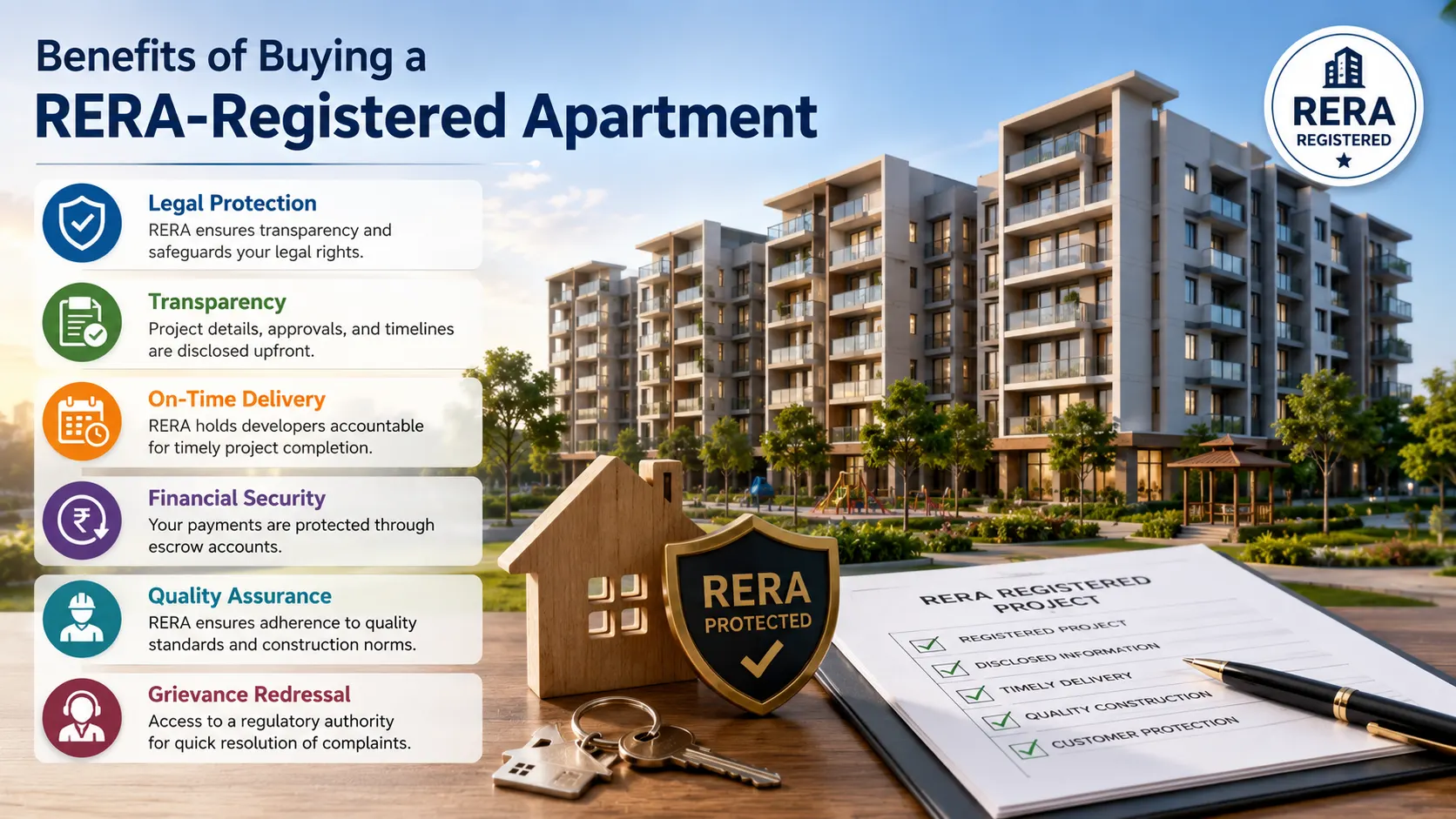
Buying a home is one of the biggest financial decisions in a person's life. However, before the implementation of the Real Estate (Regulation and Development) Act, 2016 (RERA), many homebuyers faced issues such as project delays, misleading advertisements, hidden charges, poor construction quality, and lack of transparency. The Real Estate Regulatory Authority (RERA) was introduced to bring accountability, transparency, and trust into India's real estate sector. Today, purchasing a RERA-registered apartment is one of the safest ways to invest in residential property.
What is a RERA-registered apartment?
A RERA-registered apartment is a residential property that belongs to a project officially registered with the respective state real estate regulatory authority.
Every registered project receives a unique RERA registration number that buyers can verify through the state's RERA website.
Developers are required to disclose project details such as:
- Project approvals
- Layout plans
- Construction schedule
- Land ownership documents
- Number of apartments
- Carpet area
- Completion timeline
- Financial information
This ensures that buyers receive accurate and legally verified information before investing.
Why is RERA registration important?
Before RERA, many developers launched projects without proper approvals or financial planning. Buyers often experienced:
- Delayed possession
- Cost escalation
- Fake promises
- Legal disputes
- Poor construction quality
- Lack of accountability
RERA introduced strict regulations to protect buyers and improve confidence in the real estate market.
Major Benefits of Buying a RERA-Registered Apartment
1. Complete Transparency
Transparency is one of the biggest advantages of RERA.
Builders cannot hide important project details.
Homebuyers can verify:
- Project registration
- Construction status
- Land ownership
- Government approvals
- Litigation status
- Completion timeline
- Approved layout plans
This reduces investment risks significantly.
2. Protection Against Project Delays
One of the biggest problems before RERA was delayed possession.
Under RERA:
- Developers must commit to a possession date.
- Construction progress is monitored.
- Any delay without valid reasons can attract penalties.
- Buyers may receive compensation or interest for delays as per RERA provisions.
This ensures timely project completion.
3. Standardized Carpet Area Calculation
Before RERA, builders used different measurement methods, such as:
- Super Built-up Area
- Built-up Area
- Saleable Area
- These often confuse buyers.
RERA introduced a standard definition of carpet area, ensuring buyers pay only for the usable area inside their apartment, excluding common areas and external walls.
This creates uniformity and fair pricing.
4. No Misleading Advertisements
Developers cannot make false marketing claims.
Every advertisement must match the approved project details.
Builders cannot falsely advertise:
- Amenities
- Possession dates
- Project approvals
- Apartment sizes
- Clubhouse facilities
- Infrastructure promises
Any misleading advertisement can lead to penalties.
5. Financial Security
RERA protects buyers' money.
Developers must deposit 70% of the money collected from buyers into a separate escrow account.
These funds can only be used for:
- Construction
- Land development
- Project-related expenses
This prevents diversion of funds to other projects.
6. Legal Protection for Homebuyers
If developers violate RERA rules, buyers can file complaints before the respective RERA Authority.
Common complaints include:
- Possession delays
- Hidden charges
- Poor construction quality
- False promises
- Refund disputes
- Agreement violations
RERA offers a structured dispute resolution process compared to lengthy civil litigation.
7. Timely Possession
Builders must complete projects within the promised timeline.
If possession is delayed:
- Buyers may receive interest on the amount paid.
- Buyers may seek compensation where applicable.
- In certain circumstances, buyers may choose to withdraw and seek a refund under RERA provisions.
This improves accountability.
8. Better Construction Quality
Developers remain responsible for structural defects even after handing over the apartment.
If structural defects or workmanship issues arise within the period prescribed under RERA, the builder is required to rectify them without additional cost to the buyer. This improves long-term construction quality.
9. Verified Legal Documents
RERA requires developers to upload important legal documents, including:
- Land title
- Encumbrance details
- Building approvals
- Environmental clearance (where applicable)
- Layout approval
- Occupancy and completion-related information when available
This reduces legal uncertainty.
10. Fair Builder-Buyer Agreement
Earlier, agreements heavily favored developers.
RERA standardizes important contract terms, including:
- Payment schedule
- Possession timeline
- Delay compensation
- Cancellation terms
- Refund conditions
This creates a more balanced agreement between buyers and developers.
11. Regular Construction Updates
Developers must periodically update project information on the RERA portal, including:
- Construction progress
- Stage-wise completion
- Financial updates (where required)
- Status of approvals
Buyers can independently track project progress.
12. Protection Against Hidden Charges
Builders cannot impose arbitrary or undisclosed charges after booking.
All costs should be clearly disclosed, such as:
- Apartment price
- Parking charges
- Maintenance deposits
- Registration-related charges
- Other applicable fees
This helps buyers plan their finances.
13. Improved Accountability of Developers
Developers must comply with:
- Approved plans
- Promised specifications
- Construction timelines
- Financial regulations
- Quality standards
Non-compliance may lead to penalties or other regulatory action.
14. Increased Buyer Confidence
Because of RERA:
- Property transactions have become more transparent.
- Homebuyers can make informed decisions.
- Investor confidence has improved.
- Genuine developers benefit from higher credibility.
15. Higher Resale Value
RERA-registered apartments often attract greater buyer confidence in the resale market because project information is transparent and regulatory compliance is easier to verify.
16. Easier Home Loan Approval
Banks and housing finance companies often conduct legal due diligence before approving loans.
A RERA-registered project with clear approvals may make the due diligence process smoother, although loan approval ultimately depends on the lender's policies and the borrower's eligibility.
17. Reduced Risk of Fraud
RERA helps reduce fraudulent practices by requiring developers to disclose:
- Genuine project approvals
- Ownership details
- Construction timelines
- Financial information
- Project status
This creates a safer buying environment.
18. Better Investment Security
Whether purchasing for self-use or investment, RERA reduces risks associated with:
- Project abandonment
- Unauthorized construction
- Approval issues
- Title disputes
- Delayed possession
This makes long-term property investment more secure.
Also Read: CMDA vs DTCP vs TNRERA Guide for Chennai Property Buyers
How to Verify a RERA-Registered Apartment
Before booking an apartment:
- Ask the builder for the RERA registration number.
- Visit your state's RERA website.
- Search using the registration number or project name.
- Verify the project details, approvals, and status.
- Review construction updates and timelines.
Always ensure the information provided by the developer matches the details available on the RERA portal.
Things to Check Before Buying a RERA Apartment
- RERA registration number
- Project approvals
- Land ownership documents
- Construction progress
- Possession date
- Carpet area
- Amenities
- Builder's track record
- Payment schedule
- Sale agreement
- Refund policy
- Maintenance charges
- Parking allocation
- Completion and occupancy status (where applicable)
Is Buying a Non-RERA Apartment Risky?
Projects that are required to be registered but are not registered may expose buyers to greater risks, such as:
- Limited transparency
- Legal complications
- Delayed possession
- Unverified approvals
- Funding issues
- Higher chances of disputes
However, note that certain projects are exempt from RERA registration based on the Act and applicable state rules (for example, some small projects or specific categories).
Who Should Buy a RERA-Registered Apartment?
A RERA-registered apartment is suitable for
- First-time homebuyers
- Families purchasing a primary residence
- NRIs investing in Indian real estate
- Property investors
- Senior citizens
- Buyers seeking under-construction homes
- Individuals looking for long-term investment security
Conclusion
Buying a RERA-registered apartment offers greater transparency, legal protection, financial security, and accountability compared to projects that fall outside the scope of RERA. From standardized carpet area calculations and escrow safeguards to dispute resolution and mandatory disclosures, RERA has significantly improved the home-buying experience in India. While buyers should still conduct independent due diligence regarding location, pricing, builder reputation, and loan eligibility, choosing a RERA-registered project is an important step toward reducing risk and making a more informed property investment.
Frequently Asked Questions
1. What is a RERA-registered apartment?
A RERA-registered apartment is part of a real estate project registered with the State Real Estate Regulatory Authority and subject to the provisions of the RERA Act.
2. How can I verify a RERA registration number?
You can verify the registration number by searching the project on your respective state's RERA website.
3. Is buying a RERA-registered apartment safer?
Yes. RERA improves transparency, accountability, and legal protection for buyers.
4. Does RERA guarantee on-time possession?
RERA requires developers to adhere to declared timelines and provides remedies if there are unjustified delays, but it does not guarantee that delays can never occur.
5. What is the 70% escrow rule under RERA?
Developers must deposit 70% of the amounts collected from buyers into a dedicated account to be used only for that project's land and construction costs.
6. Can I file a complaint against a builder under RERA?
Yes. Buyers can file complaints with the respective state RERA authority for violations covered under the act.
7. Does RERA apply to completed projects?
RERA primarily applies to projects that are required to be registered under the Act. Completed projects with a completion certificate obtained before the Act came into force are generally outside its scope.
8. What is the carpet area under RERA?
The carpet area is the net usable floor area inside the apartment, measured according to the definition provided under the RERA Act.
9. Can a builder change the approved project layout?
Major changes generally require the consent of the required percentage of affected allottees and compliance with RERA and other applicable laws.
10. Is RERA registration mandatory for every real estate project?
No. Some projects are exempt based on the RERA Act and applicable state rules, while eligible projects must be registered before marketing or selling units.