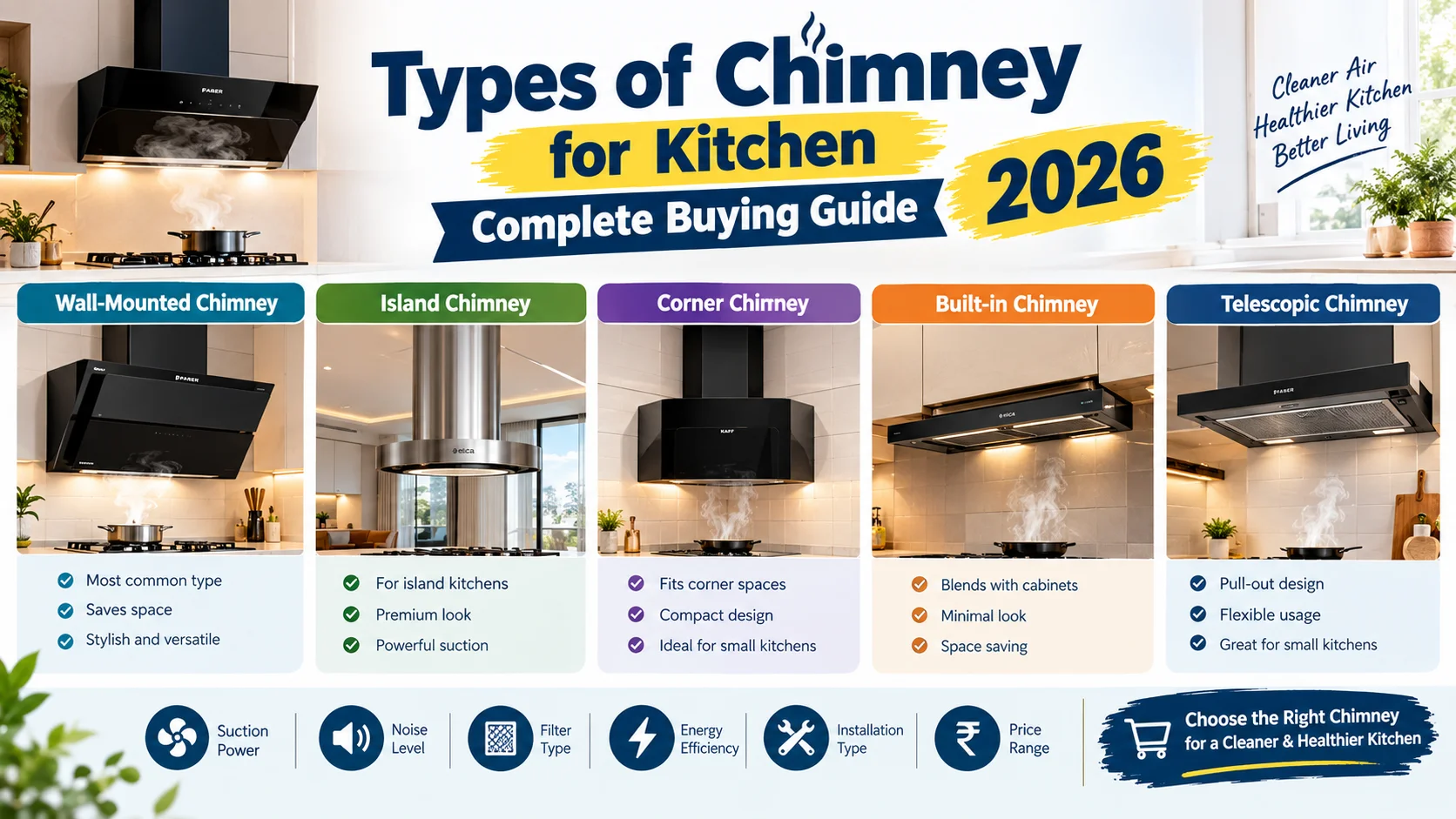
A kitchen chimney is an essential appliance in modern homes, helping maintain a clean, comfortable, and well-ventilated cooking environment. With the growing popularity of modular kitchens, choosing the right chimney has become an important part of kitchen planning. A suitable chimney helps remove smoke, grease, oil particles, and cooking odors while reducing the accumulation of grease on kitchen cabinets, walls, and ceilings. In 2026, kitchen chimneys are available in various designs, including wall-mounted, island, built-in, telescopic, and auto-clean models. Each type offers different features, installation requirements, and maintenance needs. Understanding these differences can help homeowners select a chimney that suits their kitchen layout, cooking habits, and budget. This blog explains the different types of kitchen chimneys, their features, advantages, prices, installation requirements, and essential buying tips.
What Is a Kitchen Chimney?
A kitchen chimney is a ventilation appliance installed above a cooking stove or hob. It draws in smoke, grease, steam, and cooking fumes using a motor and fan. Depending on the model, the extracted air is either released outdoors through a duct or filtered and circulated back into the kitchen. A typical kitchen chimney consists of a suction motor, filters, a control panel, LED lights, and an oil collection system. Some advanced models also include auto-clean technology, touch controls, motion sensors, and energy-efficient motors. Kitchen chimneys are particularly useful in Indian kitchens, where frying, deep-frying, tempering, and cooking with spices can generate substantial smoke and strong odours.
Types of Kitchen Chimneys in 2026
Kitchen chimneys are available in several designs to suit different kitchen layouts and interior styles.
1. Wall-Mounted Kitchen Chimney
Wall-mounted chimneys are among the most commonly used types in Indian homes. They are installed against a wall directly above the cooking stove and are suitable for kitchens where the hob is positioned along a wall. These chimneys are available in curved glass, straight-line, T-shaped, and pyramid designs. They come in different suction capacities and filter technologies to accommodate different cooking requirements.
Advantages:
- Suitable for most conventional and modular kitchens.
- Available in different sizes, styles, and price ranges.
- Easy to integrate into many kitchen layouts.
- Available in both ducted and ductless versions.
Disadvantages:
- Requires sufficient wall space.
- Ducted models need a suitable exhaust route.
- Incorrect installation height can reduce smoke-capture efficiency.
2. Island Kitchen Chimney
An island chimney is designed for kitchens where the cooking hob is installed on a central island rather than against a wall. It is suspended from the ceiling and positioned directly above the cooking area. Island chimneys are commonly used in large, open-plan, and luxury kitchens. Their contemporary designs can also serve as a decorative feature.
Advantages:
- Suitable for island cooking layouts.
- Provides ventilation directly above the cooking hob.
- Complements modern and open-plan kitchen interiors.
- Available in premium finishes and designs.
Disadvantages:
- Generally more expensive than standard wall-mounted models.
- Requires strong and suitable ceiling support.
- Ceiling ducting can make installation more complicated.
- Requires careful positioning to capture fumes effectively.
Best Modular Kitchen Interior Designer in Chennai
3. Built-In or Integrated Kitchen Chimney
Built-in chimneys are installed inside overhead kitchen cabinets, keeping most of the appliances concealed. They are ideal for homeowners who prefer a minimalistic kitchen design with a clean and seamless appearance. These models are commonly selected for contemporary modular kitchens where the cabinetry is designed around the appliance.
Advantages:
- Provides a neat and concealed appearance.
- Integrates with modular kitchen cabinets.
- Helps maintain a consistent interior design.
- Available in different suction capacities.
Disadvantages:
- Requires accurate cabinet measurements.
- Installation needs to be planned during kitchen design.
- Servicing may require access to the concealed components.
- Ducting and ventilation need to be considered in advance.
4. Under-Cabinet Kitchen Chimney
Under-cabinet chimneys are fitted beneath overhead cabinets, directly above the cooking stove. Their compact design makes them suitable for smaller kitchens and renovation projects. They are available in different widths, finishes, and suction capacities. Some models have a slim profile that fits neatly into existing cabinetry.
Advantages:
- Space-efficient design.
- Suitable for compact kitchens.
- Can be integrated with existing cabinets if dimensions match.
- Available in different budget ranges.
Disadvantages:
- Cabinet dimensions may restrict model selection.
- Some models have a smaller capture area.
- Requires adequate clearance above the cooking hob.
5. Pull-Out or Telescopic Kitchen Chimney
Telescopic chimneys feature a sliding panel that can be pulled out while cooking and pushed back when not in use. They are designed for homeowners who prefer a discreet appliance that takes up less visible space. These models are generally integrated into overhead cabinets and are particularly suitable for compact modular kitchens.
Advantages:
- Compact and space-saving design.
- The retractable panel provides additional coverage while cooking.
- Blends well with kitchen cabinetry.
- Suitable for modern and smaller kitchens.
Disadvantages:
- Sliding mechanisms require proper care.
- Capture area may be limited in certain models.
- Not all models are suitable for heavy cooking.
Types of Kitchen Chimneys Based on Filters
The filter system plays an important role in separating grease and oil particles from cooking fumes. Different filter technologies are available depending on the chimney design.
1. Baffle Filter Chimney
Baffle filters use specially shaped metal panels to change the direction of airflow, separating grease particles from the air. The collected oil drains into an oil collector in compatible models. Baffle filters are widely used in Indian kitchens because they are suitable for regular cooking that involves frying and tempering.
Benefits:
- Durable and reusable.
- Suitable for frequent Indian cooking.
- Generally easy to remove and wash.
- Can maintain effective airflow when cleaned regularly.
2. Mesh Filter Chimney
Mesh filters consist of fine metal layers that trap oil and grease particles as air passes through them. They are commonly found in traditional chimney models.
Benefits:
- Generally affordable.
- Removable and washable in compatible models.
- Suitable for light to moderate cooking.
However, grease can accumulate within the mesh and restrict airflow, so these filters may need more frequent cleaning.
3. Filterless Kitchen Chimney
Filterless chimneys are designed without conventional removable grease filters. Their internal airflow mechanism helps separate oil particles, which are directed into an oil collection tray in compatible models.
Benefits:
- Reduces the need for manual filter cleaning.
- Convenient for everyday use.
- Often available with auto-clean technology.
- Suitable for homeowners seeking easier maintenance.
Filterless models still require regular cleaning of the oil collector and accessible internal surfaces according to the manufacturer's recommendations.
4. Charcoal Filter Chimney
Charcoal filters use activated carbon to absorb certain cooking odors. They are generally used in ductless or recirculating chimney systems.
Benefits:
- Helps reduce lingering cooking smells.
- Useful where external ducting is not possible.
- Can be used in suitable recirculating chimney models.
Charcoal filters usually require periodic replacement and do not remove heat and moisture from the kitchen in the same way as a ducted system.
Ducted vs. Ductless Kitchen Chimneys
Kitchen chimneys are also classified according to how they handle extracted air. A ducted chimney carries smoke, grease particles, heat, and cooking fumes outside the building through an exhaust duct. It is often suitable for households that cook frequently or use high-heat cooking methods. A ductless chimney filters the air and returns it to the kitchen. It can be useful when installing an external exhaust duct is impractical, although it does not provide the same removal of heat and moisture as a ducted chimney.
| Feature | Ducted Chimney | Ductless Chimney |
| Airflow | Exhaust air outdoors | Filters and recirculates air |
| Smoke removal | Expels extracted smoke | Does not fully remove smoke |
| Odour control | Removes fumes through exhaust | Reduces odors using suitable filters |
| Installation | Requires ducting | No external exhaust duct required |
| Maintenance | Filters and ducts need attention. | Filters and charcoal media need attention. |
| Suitable for | Homes with an approved exhaust route | Kitchens where ducting is impractical |
For homes with frequent frying and heavy cooking, a ducted chimney can be a practical option if the building allows an appropriate exhaust route.
Types of Kitchen Chimneys Based on Design
Kitchen chimneys are also available in various shapes and finishes to complement different interior styles.
- T-Shaped Chimney: Features a flat horizontal canopy and a vertical body. It is commonly selected for modern modular kitchens.
- Angular Chimney: Has a slanted front that can provide more headroom around the cooking area. It is available in contemporary glass and metal finishes.
- Pyramid Chimney: Features a pyramid-shaped canopy, usually made with stainless steel or a combination of metal and glass.
- Curved Glass Chimney: Uses a curved glass canopy that creates a stylish appearance and complements contemporary kitchen interiors.
The design should be chosen based on the hob size, installation space, head clearance, and ventilation requirements rather than appearance alone.
How to Choose the Right Suction Capacity
Suction capacity refers to the volume of air a chimney can move in one hour and is measured in cubic metres per hour (m³/hr). Choosing suitable suction capacity helps the chimney capture smoke, oil particles and cooking fumes effectively.
The following are indicative ranges for different cooking requirements:
| Cooking Requirements | Approximate Suction Capacity |
| Light cooking in a small kitchen | 700-1000 m³/hr |
| Regular family cooking | 1000-1200 m³/hr |
| Frequent frying and heavy cooking | 1200-1500 m³/hr |
| Large or open-plan kitchen | 1400-1600 m³/hr |
The required capacity depends on kitchen volume, hob dimensions, cooking intensity, duct length and the chimney's capture efficiency. Actual selection should follow the manufacturer's specifications and installation recommendations.
How to Choose the Right Kitchen Chimney Size
Chimney width should provide adequate coverage over the cooking hob. Common sizes include 60 cm, 75 cm, 90 cm and 120 cm.
| Chimney Size | Typical Application |
| 60 cm | Compact cooking hubs |
| 75 cm | Medium-sized hubs |
| 90 cm | Wider cooking hubs |
| 120 cm | Large cooking ranges and selected open kitchens |
A chimney should generally be at least as wide as the hob, subject to the manufacturer's guidance. Measuring the actual cooking area before purchasing can help avoid insufficient coverage.
Important Features to Consider Before Buying a Chimney
Modern kitchen chimneys come with different technologies and convenience features. Understanding them can help homeowners choose a model that suits their daily requirements.
- Auto-Clean Technology: Helps reduce internal grease accumulation using the cleaning mechanism provided by the manufacturer.
- BLDC Motor: Can provide energy-efficient operation and adjustable airflow, depending on the model.
- Touch Controls: Allow convenient adjustment of suction speed and lighting.
- Motion or Gesture Controls: Enable hands-free operation in compatible models.
- LED Lighting: Provides illumination over the cooking surface.
- Multiple Speed Settings: Allow users to adjust suction based on the amount of smoke and fumes.
- Oil Collector: Collects separated grease and makes disposal easier.
- Low-Noise Operation: Can improve comfort in open kitchens and connected living spaces.
- Warranty and Service: A reliable service network and clear warranty terms are important for long-term ownership.
Before selecting a model, compare its motor specifications, energy consumption, noise levels, maintenance requirements and warranty coverage.
Also Read: 21 Kitchen Color Combination for your Kitchen
Kitchen Chimney Price in India 2026
Kitchen chimney prices depend on the design, motor technology, suction capacity, filter type and additional features. The following are approximate budget ranges for planning.
| Types of Chimney | Approximate Price |
| Basic wall-mounted chimney | Rs 5,000-10,000 |
| Baffle filter chimney | Rs 7,000-15,000 |
| Curved glass chimney | Rs 8,000-18,000 |
| Auto-clean chimney | Rs 10,000-22,000 |
| Filterless chimney | Rs 10,000-25,000 |
| BLDC motor chimney | Rs 15,000-30,000 |
| Built-in chimney | Rs 12,000-30,000 |
| Telescopic chimney | Rs 8,000-20,000 |
| Island chimney | Rs 25,000-50,000+ |
| Premium smart chimney | Rs 20,000-45,000+ |
These are indicative estimates, not fixed market prices. Actual costs can vary depending on the manufacturer, model, location, offers, installation charges and ducting accessories.
Kitchen Chimney Installation Requirements
Proper installation is essential for the performance and safe operation of a kitchen chimney.
- Mounting Height: Install the chimney at the height recommended by the manufacturer. Many models specify approximately 65–75 cm above the hob, but the correct distance varies according to the appliance and cooktop.
- Ducting: For ducted models, use the recommended duct diameter and keep the exhaust route as short and straight as practical to reduce airflow resistance.
- Electrical Connection: Provide a suitable electrical connection with proper earthing and follow the manufacturer's safety requirements.
- Wall and Ceiling Support: Ensure the mounting surface can safely support the appliance, especially for ceiling-mounted island chimneys.
- Service Access: Allow enough space to remove filters, clean oil collectors and carry out maintenance.
In apartments, confirm the approved exhaust route with the builder or apartment association before installing a ducted chimney.
Kitchen Chimney Maintenance Tips
Regular cleaning and servicing can help maintain suction performance and extend the appliance's service life.
- Clean the exterior using a soft cloth and a suitable cleaning solution.
- Wash reusable baffle or mesh filters at the frequency recommended by the manufacturer.
- Empty and clean the oil collector before it becomes full.
- Replace charcoal filters when required.
- Check for unusual noise, vibration or reduced suction.
- Arrange professional servicing as recommended by the manufacturer.
Always switch off and isolate the electrical supply before cleaning or servicing. Avoid pouring water into the motor or electrical components.
Common Mistakes to Avoid When Buying a Kitchen Chimney
Choosing a chimney based only on price or appearance can lead to ventilation and maintenance problems. Homeowners should avoid the following mistakes:
- Selecting insufficient suction capacity for heavy cooking.
- Choosing a chimney that is narrower than the hob.
- Ignoring duct length, bends and outlet requirements.
- Overlooking the noise level of the appliance.
- Choosing a filter system that does not match cooking habits.
- Ignoring cleaning and filter replacement costs.
- Failing to check installation requirements and warranty terms.
- Installing the chimney at an unsuitable height.
Planning these details before purchasing can help prevent unnecessary expenses and installation changes.
Which Kitchen Chimney Is Suitable for Different Homes?
- Small Apartments: Compact wall-mounted, under-cabinet or telescopic chimneys can be suitable for kitchens with limited space. The final selection should depend on hob size and cooking requirements.
- Medium-Sized Family Homes: A wall-mounted chimney with suitable suction capacity and an appropriate filter system can accommodate regular family cooking.
- Luxury Homes: Island or premium ceiling-mounted chimneys may suit open-plan kitchens with island cooking areas. Ceiling support and ducting need to be planned in advance.
- Minimalist Modular Kitchens: Built-in or integrated chimneys can provide a concealed appearance that blends with cabinetry.
Conclusion
Choosing the right kitchen chimney is an important part of creating a functional and comfortable modern kitchen. From wall-mounted and island chimneys to built-in, telescopic and filterless models, each type offers different benefits for different kitchen layouts and cooking requirements. Before making a purchase, consider suction capacity, chimney size, filter technology, installation requirements, maintenance and overall cost. For new apartments and kitchen renovations, planning the chimney during the interior design stage can make installation easier and help create a well-organised kitchen. A properly selected and maintained kitchen chimney can help reduce cooking fumes, control grease accumulation and improve everyday kitchen comfort.
Frequently Asked Questions
1. Which type of kitchen chimney is suitable for Indian cooking?
Ducted chimneys with appropriate suction capacity and baffle filters or filterless technology are commonly considered for Indian cooking, particularly when frying and tempering are frequent.
2. Which is better: a filterless chimney or a baffle filter chimney?
Both can be suitable. Baffle filters are durable and washable, while filterless models can reduce manual filter-cleaning requirements. The choice depends on cooking habits, maintenance preferences and the specific model.
3. What suction capacity is suitable for a kitchen chimney?
Many households consider models rated around 1,000–1,500 m³/hr, but the actual requirement depends on kitchen size, hob dimensions, cooking intensity and ducting.
4. Is a ductless kitchen chimney effective?
A ductless chimney can reduce certain cooking odours and grease particles through filtration. However, it recirculates air rather than exhausting smoke, heat and moisture outdoors.
5. How much does a kitchen chimney cost in India in 2026?
Basic models may cost approximately Rs 5,000–Rs 10,000, while many auto-clean and premium models range from Rs 10,000 to Rs 30,000 or more. Island chimneys can cost considerably more.
6. What is the ideal installation height for a kitchen chimney?
Many models specify around 65–75 cm above the hob, but the manufacturer's installation manual should always be followed.
7. Is an auto-clean chimney maintenance-free?
No. Auto-clean technology reduces certain internal cleaning tasks, but oil collectors, filters where fitted and exterior surfaces still need regular maintenance.
8. Which chimney size is suitable for a four-burner gas stove?
A 60 cm or 90 cm model may be suitable depending on the actual hob dimensions and chimney coverage. The appliance should provide adequate coverage according to the manufacturer's specifications.
9. How often should a kitchen chimney be cleaned?
Cleaning frequency depends on cooking intensity and filter type. Homes that cook oily or fried foods regularly may need more frequent filter and oil collector cleaning.
10. Can a kitchen chimney be installed in an apartment?
Yes, provided there is a suitable mounting location, safe electrical connection and an approved exhaust route for ducted models. Building ventilation and façade rules should be checked beforehand.