A Joint Venture (JV) is an important property development arrangement in which a landowner and a builder work together to develop residential or commercial property. Instead of selling the land directly, the landowner provides the land for development, while the builder takes responsibility for construction, project management, and other development activities. After completing the project, both parties receive their agreed share of the developed property. One of the most important questions in any joint venture is how the completed apartments are divided between the landowner and the builder. How much percentage does the landowner receive? What does the builder get in return for construction? Who pays for building expenses? How are individual flats allocated? Understanding the difference between landowner share and builder share helps both parties make informed decisions before entering into a joint development agreement. In this guide, we explain how JV property distribution works, different sharing models, percentage calculations, legal documentation, construction responsibilities, and important considerations for property development in Chennai.
1. What Is a Joint Venture in Real Estate?
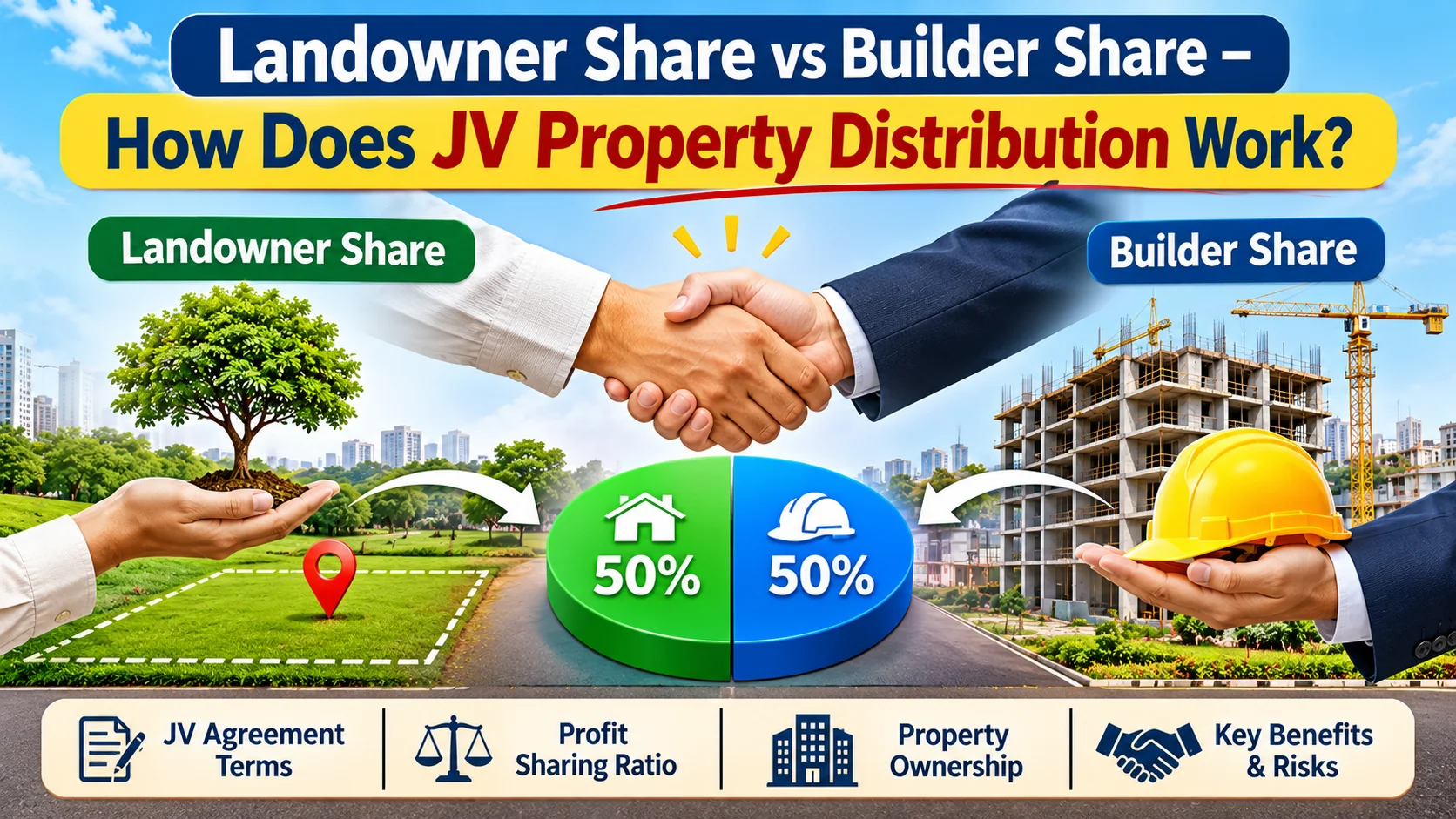
A joint venture in real estate is an agreement between a landowner and a property developer to construct a building on an existing piece of land. Both parties contribute different resources to complete the development project. The landowner contributes the land, while the builder contributes construction expertise, financial investment, technical professionals, and project management. Once the development is completed, the apartments or commercial spaces are distributed according to the sharing ratio mentioned in the agreement. For example, a landowner owns a residential plot in Chennai but does not want to sell the property. A builder approaches the owner with a proposal to construct an apartment building. Both parties agree to develop the land and divide the completed apartments. The landowner receives the agreed apartments, and the builder retains the remaining apartments as the builder's share.
This arrangement allows landowners to utilize the development potential of their property without independently managing the entire construction process.
Also Read: Builder Floor Rules in Chennai: A Complete Guide
2. What Is Landowner Share in a Joint Venture?
Landowner share is the portion of the completed building allocated to the original property owner in exchange for contributing the land. In an area-sharing arrangement, the landowner receives a specific number of completed apartments or an agreed percentage of the total distributable area. The landowner can retain these apartments for personal use, rent them out, or sell them according to the agreement and applicable legal requirements.
Factors that determine landowner share
Several factors influence the percentage negotiated between the landowner and builder:
- Location and market value of the land.
- Total plot area and dimensions.
- Road width and accessibility.
- Permissible Floor Space Index (FSI).
- Applicable setback and building regulations.
- Total construction potential.
- Expected apartment selling prices.
- Estimated project expenses.
- Demand for residential properties in the area.
A plot in a well-developed residential location may offer different development opportunities compared with a property in an emerging neighborhood. Therefore, landowners should evaluate the actual development potential of their property before agreeing to a sharing percentage.
3. What Is Builder Share in a Joint Venture?
"Builder share" refers to the portion of the completed property allocated to the developer for undertaking construction and managing the development project. The builder takes responsibility for converting the available land into a completed residential or commercial building.
Depending on the agreement, the builder's responsibilities may include:
- Preparing architectural and structural drawings.
- Appointing architects and engineers.
- Obtaining necessary building permissions.
- Arranging construction materials.
- Managing labor and contractors.
- Handling construction expenses.
- Supervising quality and project progress.
- Installing lifts and other common facilities.
- Coordinating electrical and plumbing work.
- Marketing and selling the builder's allocated apartments.
The builder receives an agreed share of the completed property to recover development costs and generate a potential return from the project. The builder's share is therefore influenced by the construction budget, financing requirements, expected revenue, and overall project feasibility.
4. What Is the Normal Landowner and Builder Sharing Ratio?
There is no fixed sharing percentage that applies to every joint venture project. The ratio is negotiated based on land value, construction costs, project location, development potential, and expected profitability.
The following are illustrative sharing arrangements:
- 50:50 Sharing Model
In this arrangement, the landowner and builder receive equal portions of the agreed distributable property.
- Landowner: 50%
- Builder: 50%
This arrangement may be considered when both parties agree that their respective contributions and project economics justify an equal division.
- 40:60 Sharing Model
In this arrangement, the landowner receives 40%, while the builder receives 60%.
- Landowner: 40%
- Builder: 60%
This may be negotiated when construction costs, financing requirements, and development responsibilities justify a higher builder allocation.
- 60:40 Sharing Model
In this arrangement, the landowner receives 60%, while the builder receives 40%.
- Landowner: 60%
- Builder: 40%
This may be negotiated where the land has a strong market value or the project economics support a higher landowner allocation. These percentages are examples for understanding negotiations, not guaranteed market rates or standard Chennai JV ratios.
5. How Are Apartments Divided Between the Landowner and Builder?
After finalizing the sharing ratio, the next step is deciding which specific apartments will be allocated to each party. The landowner and builder may agree that the landowner receives four apartments and the builder receives six apartments, provided the individual unit areas and values reasonably match the agreed allocation.
The allocation process should consider:
- Apartment size: The area of each apartment should be recorded accurately.
- Floor preference: Ground-floor, middle-floor, and top-floor apartments may have different market preferences.
- Road-facing position: Apartments with better frontage or views may have different market values.
- Parking facilities: Car parking rights and their allocation should be clearly documented.
- Undivided Share of Land: Each apartment must receive its appropriate UDS.
- Common facilities: Access to lifts, staircases, terraces, and other common areas should follow the approved plans and applicable laws.
A proper apartment allocation schedule prevents future disagreements between the landowner and builder.
6. Different Types of Joint Venture Sharing Models
Joint Venture projects can follow different distribution arrangements depending on the commercial requirements of both parties.
- Area Sharing Model
In area sharing, the landowner receives an agreed percentage of the completed apartments, while the builder receives the remaining portion. For example, if the total distributable area is 12,000 sq. ft. and the sharing ratio is 40:60, the landowner receives 4,800 sq. ft. and the builder receives 7,200 sq. ft. This arrangement is suitable for landowners who prefer receiving completed apartments rather than selling their land for a one-time payment.
- Revenue Sharing Model
In revenue sharing, the landowner and builder divide the revenue generated from apartment sales according to the agreed percentage. For example, if the agreed project sales revenue is Rs 10 crore and the landowner's share is 40%, the landowner receives Rs 4 crore. The builder receives Rs 6 crore.
The agreement must clearly define whether the percentage applies to gross collections or revenue after specified deductions.
- Profit Sharing Model
In profit sharing, the parties divide the project profit after deducting the expenses agreed upon in the contract.
For example:
- Total project revenue: Rs 10 crore.
- Agreed project expenses: Rs 6 crore.
- Distributable profit: Rs 4 crore.
- Landowner share at 40%: Rs 1.6 crore.
- Builder share at 60%: Rs 2.4 crore.
The agreement should define allowable expenses, accounting methods, and financial verification procedures.
- Hybrid Sharing Model
A hybrid arrangement combines property sharing with monetary consideration. For example, the landowner may receive a fixed payment along with a specified portion of the completed apartments. This structure should clearly explain the payment schedule, apartment allocation, and any adjustment of monetary consideration.
7. Who Pays for Construction Expenses in a JV Project?
In a typical area-sharing joint venture, the builder undertakes the construction expenses in exchange for receiving the builder's agreed property share. However, the financial responsibilities must be specifically mentioned in the agreement.
Common development expenses include:
- Construction materials.
- Labor and contractor charges.
- Architect and structural consultant fees.
- Building approval expenses.
- Electrical and plumbing work.
- Lift installation.
- Water and electricity connections.
Common facilities and amenities.
- Construction equipment.
- Marketing and project management.
- Applicable taxes and statutory charges.
The landowner should verify whether any additional financial contribution is required before signing the agreement.
8. Step-by-Step Process of a Joint Venture Project
A residential joint venture generally involves the following stages.
Step 1: Land Identification
The builder identifies suitable land based on location, dimensions, accessibility, and development potential.
Step 2: Landowner Discussion
The builder meets the landowner to understand their expectations and discuss possible development arrangements.
Step 3: Legal Verification
Property ownership, title documents, encumbrances, loans, disputes, and other legal matters are checked.
Step 4: Project Feasibility Study
The technical team evaluates the land, permissible FSI, setbacks, parking requirements, and proposed building configuration.
Step 5: Sharing Ratio Negotiation
Both parties discuss the landowner's share and builder's share based on the project's financial and technical feasibility.
Step 6: Joint Development Agreement
The parties execute the appropriate legal agreement describing their respective rights, responsibilities, financial arrangements, and sharing percentages.
Step 7: Building Approvals
The builder arranges the necessary planning permissions and building approvals from the competent authorities.
Step 8: Construction
Construction begins according to the sanctioned plans and agreed specifications.
Step 9: Apartment Allocation and Sales
The landowner and builder receive their allocated apartments and exercise their respective rights according to the agreement.
Step 10: Completion and Handover
The completed apartments are inspected, relevant completion documents are obtained and the allocated units are handed over.
Also Read: FSI Rules in Tamil Nadu 2026: Calculation, Permissible Limits and Building Regulations
9. What Legal Documents Are Required for a Joint Venture?
Legal verification is essential before starting a property development project.
The landowner and builder should check the following documents:
- Parent documents.
- Original title deed.
- Encumbrance Certificate.
- Patta and relevant revenue records.
- Property tax receipts.
- Survey sketch and land measurements.
- Legal heir documents, where applicable.
- Joint Development Agreement.
- Power of Attorney, where required.
- Approved building plan.
- Applicable building permit.
- RERA registration details, where applicable.
Importance of a Joint Development Agreement
The Joint Development Agreement is an important legal document that establishes the development arrangement between the landowner and builder.
It should clearly explain:
- Land ownership and property boundaries.
- Development rights.
- Landowner and builder sharing ratios.
- Apartment allocation schedule.
- Construction specifications.
- Financial responsibilities.
- Project completion timeline.
- Marketing and sales rights.
- UDS allocation.
- Delay compensation.
- Termination conditions.
- Dispute resolution procedures.
Both parties should obtain independent legal advice and verify applicable stamp duty and registration requirements before executing the agreement.
10. Is RERA Registration Required for JV Projects?
The Real Estate (Regulation and Development) Act, 2016, regulates eligible real estate development projects and protects homebuyers. A Joint Venture project is not automatically exempt from RERA requirements. Projects that meet the statutory registration criteria generally need registration with the relevant Real Estate Regulatory Authority before advertising, marketing, booking or selling, subject to applicable exemptions. The general central-law threshold refers to projects exceeding 500 square metres of land area or having more than eight apartments, inclusive of all phases. Where the landowner and builder are different parties involved in development and sales, both may have promoter responsibilities under RERA, depending on their roles. Important compliance requirements include project registration, approved plans, promoter disclosures, construction timelines and applicable separate-account requirements. Before starting a JV project in Tamil Nadu, the parties should verify the applicable requirements with Tamil Nadu RERA and qualified legal professionals.
11. Tax Implications of Joint Venture Property Distribution
Tax treatment depends on the structure of the agreement, the parties involved and the nature of the consideration.
- Income Tax for Landowners
Section 45(5A) of the Income-tax Act, 1961, provides a special capital gains timing provision for qualifying registered Joint Development Agreements entered into by individuals or Hindu Undivided Families. Subject to its conditions, capital gains are generally chargeable in the year the competent authority issues the completion certificate for the whole or part of the project. The deemed consideration is determined using the stamp duty value of the landowner's share in the developed property on the relevant date, together with any monetary consideration received. Special rules apply in certain circumstances, including an early transfer of the landowner's share.
- Income Tax for Builders
The builder's tax treatment depends on the business structure, project accounting and the treatment of developed apartments. Sales revenue, construction costs and other business expenses must be accounted for under applicable tax provisions.
- GST on Joint Venture Projects
GST treatment depends on the development arrangement, development rights, construction services, timing and applicable exemptions. Area-sharing, revenue-sharing and monetary arrangements may have different tax implications. Both parties should consult a Chartered Accountant before finalising the agreement.
12. How to Choose the Right Builder for a Joint Venture?
Selecting the right developer is an important decision for any landowner.
Before entering into an agreement, check:
- Previous completed projects.
- Construction quality.
- Financial capability.
- Project management experience.
- Legal compliance.
- Customer feedback.
- Transparency in documentation.
- Ability to complete projects within agreed timelines.
A developer's completed projects and actual delivery record are important indicators when evaluating their suitability for a Joint Venture.
13. Benefits of Joint Venture for Landowners and Builders
Benefits for Landowners
- Develop land without independently managing construction.
- Receive completed residential apartments.
- Retain property for future appreciation or rental income.
- Generate value from underutilised land.
- Sell allocated apartments when required.
- Participate in development without funding the entire project in a typical area-sharing arrangement.
Benefits for Builders
- Develop projects without purchasing the entire land outright.
- Utilise construction and development expertise.
- Expand residential project portfolios.
- Earn through the sale of allocated apartments.
- Build relationships with landowners.
- Explore suitable residential locations for development.
Benefits for Homebuyers
- Access newly developed residential apartments.
- More choices in established neighbourhoods.
- Opportunities to purchase apartments from the landowner's or builder's allocated share.
- Access to relevant approved plans and property documentation.
Also Read: Top Benefits of a Joint Venture Partnership for Landowners
Conclusion
Understanding landowner share vs builder share is essential before entering into a real estate Joint Venture. The landowner contributes the land, while the builder undertakes construction and development responsibilities. Both parties receive their agreed portion of the completed property or project revenue. A successful Joint Venture depends on the right sharing ratio, accurate property valuation, proper legal documentation, transparent financial arrangements and timely construction. For landowners, a JV can provide an opportunity to develop existing property without independently managing the entire construction process. For builders, it offers an opportunity to undertake residential development through collaboration with property owners. Before signing an agreement, both parties should evaluate the project's feasibility, verify all legal documents and clearly define their respective rights and responsibilities.
Frequently Asked Questions
1. What is the difference between landowner share and builder share?
Landowner share is the portion of completed property allocated to the original landowner for contributing the land. Builder share is the portion allocated to the developer for construction, investment and project development.
2. What is the normal JV sharing ratio?
There is no compulsory sharing ratio. Common illustrative negotiation examples include 40:60, 50:50 and 60:40, depending on land value and project feasibility.
3. Does a landowner need to invest money in construction?
In a typical area-sharing arrangement, the builder undertakes construction expenses. However, any additional contribution from the landowner must be specified in the agreement.
4. Who pays for building approval expenses?
The responsibility for approval expenses should be specifically mentioned in the Joint Development Agreement. In many development arrangements, the builder handles these expenses.
5. Can the landowner receive flats instead of money?
Yes. Under an area-sharing model, the landowner receives an agreed portion of completed residential apartments.
6. Can a landowner sell their share of apartments?
Yes, subject to the agreement, applicable laws, registration requirements and proper transfer of the corresponding property rights.
7. What happens if the builder delays construction?
The agreement should explain completion deadlines, extension conditions, delay compensation and termination rights.
8. Is a Joint Development Agreement necessary?
A properly drafted JDA is essential for documenting the rights and responsibilities of both parties. Applicable stamp duty and registration requirements should be verified.
9. What is UDS in a JV apartment?
UDS means Undivided Share of Land. It represents the proportionate ownership interest of an apartment owner in the underlying land.
10. Can an old house be developed through a JV?
Yes. An old independent house can be considered for redevelopment if its ownership, plot conditions and applicable planning rules permit the proposed development.