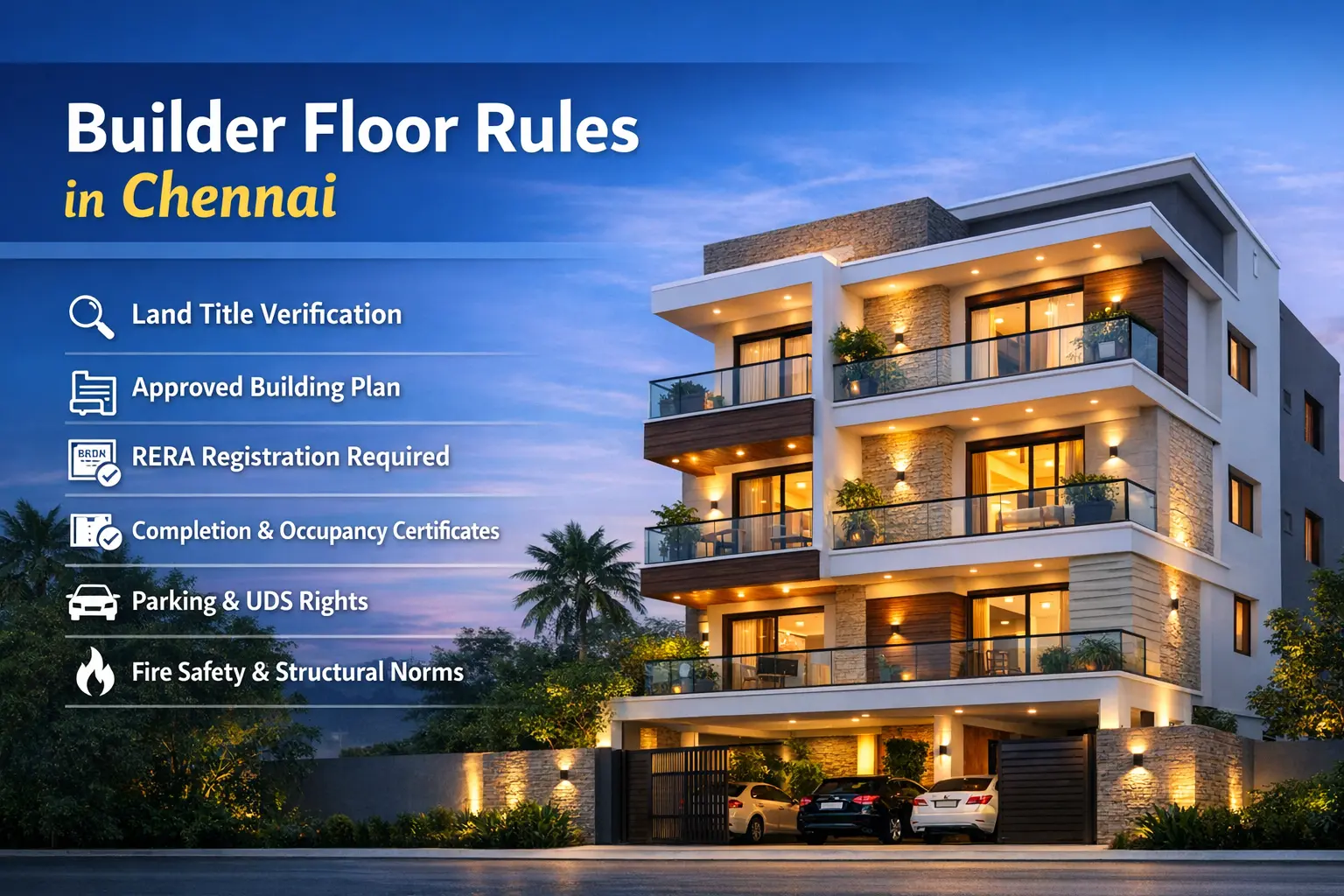
In Chennai, builder floors are governed by Tamil Nadu Town & Country Planning laws, CMDA (Chennai Metropolitan Development Authority) regulations, local municipal bodies, and Tamil Nadu RERA (TNRERA). Unlike large apartment projects, builder floors often fall into a grey zone, so understanding the rules is crucial.
1. What Is a Builder Floor in Chennai?
A builder floor generally means:
- A low-rise building (usually G+1, G+2, or G+3)
- Built on a single residential plot
- Each floor sold to a different owner
- Common staircase, parking, and utilities
Builder floors are common in areas like:
2. Land & Zoning Rules (MOST IMPORTANT)
Governing Authority
- CMDA (within Chennai Metropolitan Area)
- Local Municipality / Corporation
Zoning Compliance
The plot must fall under:
- Primary Residential Zone
- Mixed-use zones (with restrictions)
Builder floors are NOT allowed on:
- Agricultural land (unless converted)
- Water bodies / OSR land
- Unapproved layouts
Buyer Check
- CMDA-approved layout
- Patta in landowner’s name
- No encroachment or road widening notices
3. Minimum Plot Size & Dimensions
As per CMDA norms (general guidance):
| Types | Minimun Plot Size |
| Individual Resideantial | ~800 - 1200 sqft sqft ( varies by area ) |
| Multi floor / Builder Floor | Larger plots preferred |
Other requirements:
- Minimum road width
- Proper access road
- Setback space on all sides
Very small plots with 3–4 floors are usually rule violations
4. Floor Height & Number of Floors Allowed
General Norms
- Stilt + 2 floors is commonly allowed
- G+3 allowed only on wider roads & larger plots
- High-rise rules apply beyond certain height
Height Restrictions
- Floor height usually ~3 meters
- Total building height capped based on road width
Extra floors built beyond approval are illegal and risky
5. CMDA Building Plan Approval
Mandatory Requirement
Every builder floor must have:
- Approved building plan from CMDA
- Sanctioned floor-wise plan
- Approved setbacks
What Buyers Must Verify
- Approval copy (not just application receipt)
- Plan matches actual construction
- Floor number matches your purchase
Deviations can lead to:
- Demolition notices
- Penalties
- No Occupancy Certificate
6. Setback Rules (Side Space Around Building)
Setbacks ensure ventilation, light, and safety.
Typical Requirements
- Front setback
- Rear setback
- Side setbacks (left & right)
The setback size depends on:
- Plot size
- Number of floors
- Road width
Many builder floors violate setback norms → future legal trouble
7. Parking Rules in Chennai Builder Floors
Mandatory Parking
- Minimum 1 car parking per dwelling unit
- Parking can be:
- Open
- Stilt
- Covered (within approval)
Legal Position
- Parking is a common area
- Open parking cannot be sold separately
Buyer Tip
Ensure parking rights are clearly mentioned in sale deed
8. FSI (Floor Space Index) Rules
FSI determines:
- How much construction is allowed on a plot
FSI depends on:
- Road width
- Zone
- Plot size
Over-FSI construction = illegal floor
9. Undivided Share of Land (UDS)
Mandatory in Chennai
Each builder floor owner must receive:
- Clearly defined undivided share of land
Importance
- Legal ownership
- Redevelopment rights
- Bank loan eligibility
No UDS = weak title
10. Occupancy Certificate (OC) Rules
Legal Requirement
OC confirms:
- Building constructed as per approved plan
- Safe for occupation
Ground Reality
- Many builder floors do not have OC
- Still occupied (common but risky)
Risk Without OC
- Water/electricity issues
- No resale clarity
- Legal action possible
11. Completion Certificate (CC)
Issued by:
- Local authority / CMDA
Confirms:
- Construction completion
- Compliance with approvals
12. Registration & Sale Deed Rules
Mandatory
- Sale deed must be registered
- Stamp duty as per Tamil Nadu rules
- UDS + floor details must be included
GPA Sales
- Risky and discouraged
- Not full ownership
13. RERA Applicability in Chennai
Tamil Nadu RERA (TNRERA)
Builder floor projects require RERA registration if:
- Land area > 500 sq.m OR
- More than 8 units
Many builder floors avoid RERA—buyers must be cautious
14. Utilities Rules
Water
- Metro water or borewell
- CMDA approval needed for borewell
Electricity
- Individual EB meters preferred
- Temporary power = red flag
15. Common Areas & Terrace Rules
Common Areas Include
- Staircase
- Lift
- Parking
- Water tanks
Terrace
- If not mentioned, builder often retains rights
- Buyers must insist on clarity
16. Maintenance & RWA Rules
- Builder responsible till handover
- RWA formation recommended
- Maintenance charges must be reasonable
17. Illegal Builder Floors – Common Violations
- Extra floors
- No CMDA approval
- No setbacks
- No OC
- Encroachment on road or OSR
Such properties face:
- Demolition risk
- Loan rejection
- Low resale value
FREQUENTLY ASKED QUESTIONS (FAQs)
Q1. Are builder floors legal in Chennai?
Yes, if constructed with CMDA approval and within rules.
Q2. Is OC mandatory for builder floors?
Yes legally, though many older ones don’t have it.
Q3. Can I get a bank loan for builder floor?
Yes, if:
- Clear title
- Approved plan
- UDS mentioned
Q4. Can builder sell terrace separately?
Only if legally mentioned in sale deed.
Q5. Is RERA compulsory for builder floors?
Only if project meets size/unit threshold.
Q6. Can I buy a builder floor without CMDA approval?
Highly risky and not recommended.
Q7. What happens if rules are violated?
Penalties, demolition, no resale, legal notices.
Q8. Who owns common areas?
All floor owners collectively unless deed states otherwise.
https://www.livehomes.in/blogs