What is DTCP?
DTCP stands for Directorate of Town and Country Planning. It is a government authority responsible for regulating planned urban and rural development. DTCP ensures that land layouts, residential plots, and infrastructure development follow approved planning standards. DTCP functions under the Town and Country Planning Act of the respective state (commonly Tamil Nadu, Telangana, Andhra Pradesh, etc.).
What is DTCP Layout Approval?
DTCP Layout Approval is the official permission granted by the Directorate of Town and Country Planning to develop a piece of land into plots (residential, commercial, or mixed-use) following government planning rules. Without DTCP approval, a layout is considered unauthorized or illegal, even if plots are sold or houses are constructed.
Why is DTCP Layout Approval Important?
DTCP approval ensures:
- Proper road width and access
- Adequate open spaces and parks
- Availability of basic amenities
- Safe and legal land subdivision
- Long-term value and legality of the property
Buying or developing land without DTCP approval can lead to:
- Demolition notices
- Legal disputes
- Denial of utilities (water, electricity, drainage)
- Difficulty in getting loans or resale
Also Read: What is RERA Act
Types of DTCP Approvals
DTCP approvals are categorized based on land size and location:
1. DTCP Layout Approval
- Required for large layouts
- Usually for developments outside municipal limits
- Approval issued directly by DTCP
2. Local Planning Authority (LPA) Approval
- For layouts within city or town planning limits
- Issued by the local planning authority
- Still falls under DTCP regulations
3. CMDA Approval (Tamil Nadu – Chennai Region)
- Applicable for Chennai Metropolitan Area
- Issued by Chennai Metropolitan Development Authority
When is DTCP Layout Approval Required?
DTCP approval is mandatory when:
- Agricultural or non-agricultural land is divided into plots
- More than 8 plots are formed (may vary by state)
- Roads, parks, or common facilities are created
- Land is intended for sale as individual plots
Visit: https://tcp.tn.gov.in/home
Eligibility Criteria for DTCP Layout Approval
To obtain DTCP approval, the land must:
- Have clear title and ownership
- Be free from legal disputes
- Not fall under restricted zones (forest, water bodies, highways)
- Have proper access road connectivity
- Be converted for non-agricultural use (if applicable)
Documents Required for DTCP Layout Approval
Commonly required documents include:
- Sale Deed / Title Deed
- Patta / Land Ownership Records
- Encumbrance Certificate (EC)
- Field Measurement Book (FMB)
- Survey Sketch
- Land Conversion Order (if agricultural land)
- Approved Layout Plan (prepared by licensed surveyor)
- No Objection Certificates (if applicable)
- Access Road Documents
- Undertaking for infrastructure development
DTCP Layout Approval Process (Step-by-Step)
Step 1: Land Verification
Check land classification
Verify ownership and legal status
Step 2: Preparation of Layout Plan
Prepared by licensed planner/surveyor
Includes plot sizes, roads, parks, drainage, etc.
Step 3: Submission of Application
Application submitted to DTCP or LPA
Along with all required documents
Step 4: Scrutiny by Authorities
Technical and legal review
Site inspection if needed
Step 5: Compliance & Modifications
Applicant must rectify objections (if any)
Step 6: Approval & Conditions
DTCP grants approval with conditions
Infrastructure development commitments included
Conditions Imposed After Approval
DTCP may require:
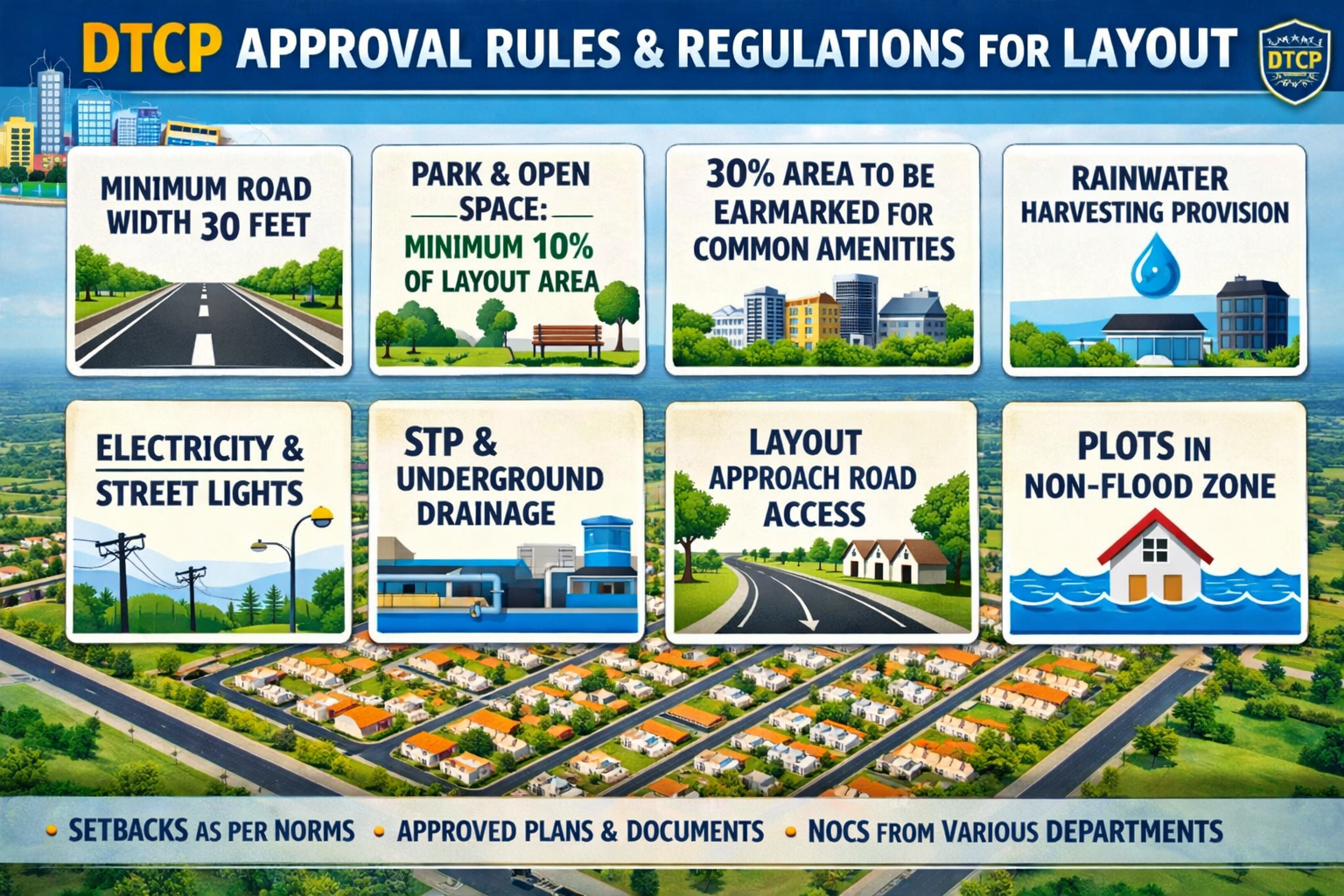
- Formation of roads
- Development of parks and open spaces
- Drainage and stormwater facilities
- Handing over common areas to local bodies
- Payment of development charges
Validity of DTCP Layout Approval
- Typically valid for 3 years
- Extensions may be granted if applied on time
- Development must follow approved plan strictly
DTCP Approved vs Unapproved Layout
| Feature | DTCP Approved | Unapproved |
| Legal Status | Fully legal | Lllegal |
| Bank Loan | Available | Not Available |
| Resale Value | High | Low |
| Utilities | Guaranted | Uncertain |
| Risk | Minimal | High |
Penalties for Unauthorized Layouts
- Heavy fines
- Cancellation of registration
- Demolition of structures
- No basic services approval
- Blacklisting of land
Benefits of Buying DTCP Approved Layout
- Peace of mind
- Safe investment
- Easy resale
- Bank loan eligibility
- Protection from future legal issues
Frequently Asked Questions (FAQs)
1. Is DTCP approval mandatory for all plots?
Yes, if land is subdivided into plots and sold, DTCP or LPA approval is mandatory as per planning laws.
2. Can I build a house without DTCP approval?
Construction without DTCP-approved layout is illegal and may lead to demolition or penalties.
3. How long does DTCP approval take?
Typically 3 to 6 months, depending on documentation and compliance.
4. Is DTCP approval same as patta?
No. Patta proves ownership, while DTCP approval permits land development.
5. Can DTCP approval be cancelled?
Yes, if conditions are violated or false information is submitted.
6. Are DTCP approved plots eligible for bank loans?
Yes, most banks and housing finance companies require DTCP approval.
7. Can an unapproved layout be regularized later?
In some states, regularization schemes may be announced, but they involve high fees and uncertainty.
8. How can I verify DTCP approval?
- Check approval number
- Verify with DTCP/LPA office
- Compare approved layout plan with actual site
9. Is DTCP approval required for agricultural land?
Yes, if agricultural land is converted into plots, DTCP approval is mandatory.
10. Who applies for DTCP approval – buyer or developer?
The land owner or developer must obtain approval before selling plots.
https://www.livehomes.in/blogs