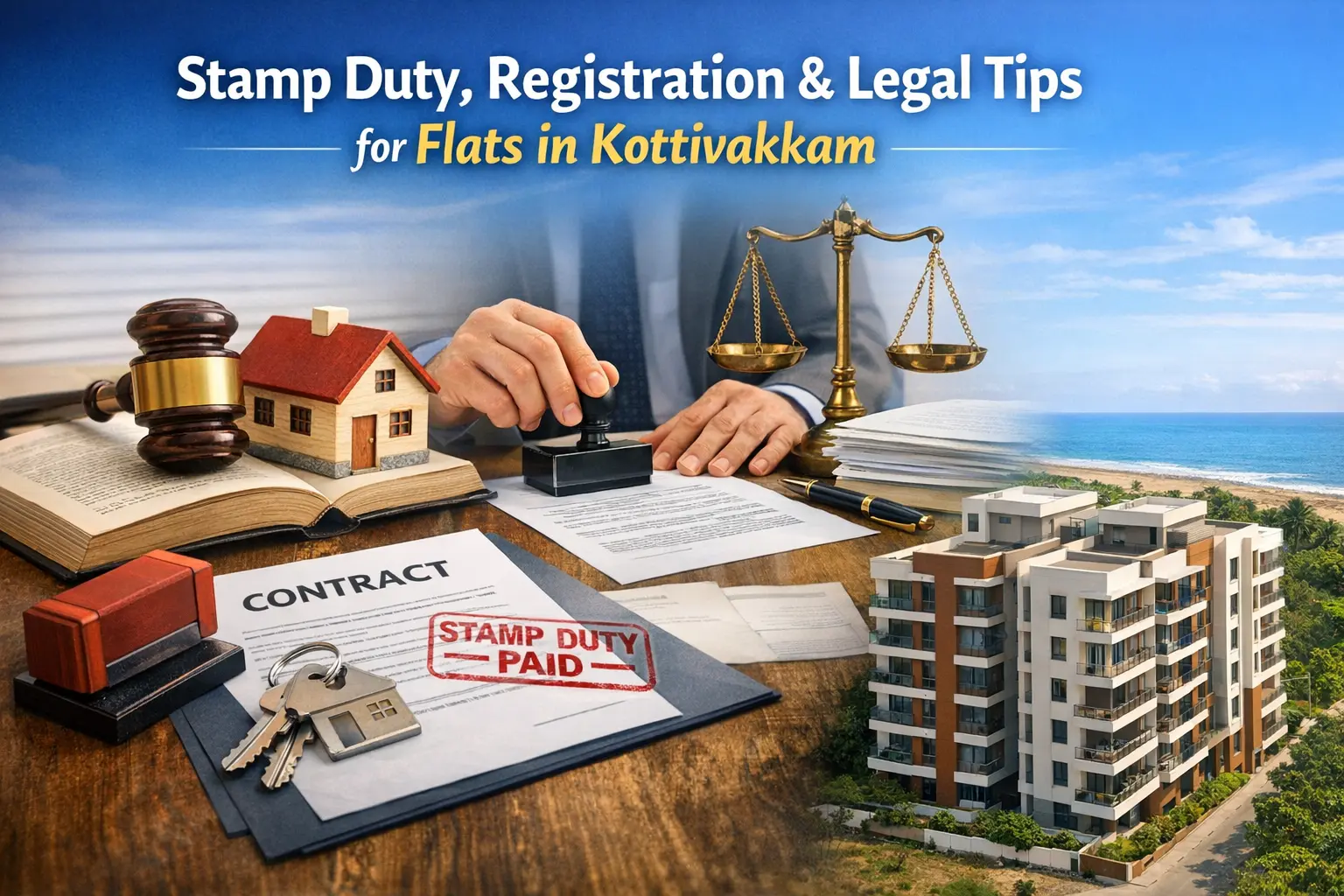
Buying a flat in Kottivakkam, a premium residential locality along Chennai’s ECR corridor, is a major financial and legal commitment. Beyond location and pricing, the legal framework governing stamp duty, registration, approvals, and ownership rights determines whether your investment is secure. This guide provides a deep, step-by-step explanation of every legal and statutory aspect involved.
1. Stamp Duty for Flats in Kottivakkam – Detailed Explanation
What Is Stamp Duty?
Stamp duty is a statutory tax levied by the Government of Tamil Nadu under the Indian Stamp Act, 1899 (as amended by the state). It gives legal recognition to property transactions and makes the sale deed admissible as evidence in a court of law.
Without proper stamp duty payment:
- The sale deed becomes invalid
- Ownership cannot be legally enforced
- Heavy penalties and fines may apply later
How Stamp Duty Is Calculated
Stamp duty for flats in Kottivakkam is calculated on:
- Higher of the following values:
- Government Guideline Value
- Actual Sale Consideration
This prevents undervaluation of property during registration.
What Is Guideline Value?
Guideline value is the minimum value fixed by the Tamil Nadu government for land and buildings in a particular area.
In Kottivakkam:
- Guideline value varies by street, proximity to ECR, road width, and land classification
- Flats closer to the beach or main roads usually attract higher guideline values
Components Included in Stamp Duty Calculation
Stamp duty applies to:
- Undivided Share (UDS) of land
- Construction cost of the flat
- Amenities permanently attached to the building (lifts, parking structure, clubhouses)
Loose furniture and movable items are excluded.
Consequences of Underpayment
If stamp duty is underpaid:
- Registration may be rejected
- Property may be subject to audit
- Buyer must pay deficit duty + penalty
- Resale or loan approval becomes difficult
2. Registration Charges – Legal Ownership Transfer
Why Registration Is Critical
Registration transfers ownership from the seller to the buyer under the Registration Act, 1908. Until registration is complete:
- Buyer is not the legal owner
- Sale has no legal sanctity
Sub-Registrar Jurisdiction
Flats in Kottivakkam fall under the respective Chennai Sub-Registrar Office assigned to that locality. Registration must be done only at the correct jurisdiction office.
What Happens During Registration
- Sale deed submission
- Verification of identities
- Biometric capture (photo + fingerprint)
- Payment confirmation
- Entry into government land records
- Registered document issued with a unique number
Registration Timeline
- Registration must be completed within four months from the date of execution of the sale deed
- Delay attracts penalties
3. Legal Due Diligence – Critical Checks Before Buying
3.1 Title Verification – The Foundation of Ownership
A clear title means:
- The seller legally owns the property
- Ownership can be transferred without dispute
A thorough title check includes:
- Minimum 30 years of title deeds
- Verification of each ownership transfer
- No missing links in ownership
3.2 Encumbrance Certificate (EC) – Financial Safety
EC confirms:
- Mortgages
- Bank loans
- Legal claims
- Court attachments
A “Nil Encumbrance” is ideal, but if a loan exists, ensure it is closed and documented.
3.3 Land Classification & Zoning
In coastal areas like Kottivakkam:
- Confirm land is residential
- Verify compliance with Coastal Regulation Zone (CRZ) norms
- Ensure land is not classified as:
- Water body
- Poramboke
- OSR land
This is crucial to avoid demolition or penalties later.
4. Planning Approvals & Building Compliance
CMDA / Local Authority Approval
Every flat must be built on land approved by:
- CMDA (Chennai Metropolitan Development Authority)
Check:
- Approved layout plan
- Building plan approval
- Floor Space Index (FSI) compliance
Deviations & Their Risks
Even small deviations can lead to:
- Non-issuance of OC
- Utility disconnections
- Reduced resale value
- Loan rejection by banks
5. RERA Compliance – Buyer Protection
Why RERA Matters
Tamil Nadu RERA protects homebuyers by ensuring:
- Transparency in pricing
- Timely possession
- Accountability of builders
Always verify:
- Project registration number
- Approved plans uploaded
- Completion timeline
- Escrow account compliance
Also Read: Understanding RERA Registration and its Importance Before Buying Property
6. Completion Certificate (CC) & Occupancy Certificate (OC)
Completion Certificate
Issued by the local authority confirming:
- Construction matches approved plan
Occupancy Certificate
Confirms:
- Building is safe for occupation
- Fire safety and structural norms are met
Without OC:
- Water and electricity connections may be temporary
- Banks may refuse home loans
- Resale becomes risky
7. Undivided Share (UDS) – Long-Term Asset Value
Why UDS Is Crucial
UDS represents your legal ownership of land, not just the building.
Higher UDS means:
- Better resale value
- Higher compensation in redevelopment
- Stronger legal ownership
Always ensure:
- UDS is clearly mentioned in sale deed
- Matches builder agreement
Also Read: Why UDS is More Important than Built up Area in Property Investment
8. Sale Agreement & Sale Deed – Key Clauses to Review
Critical Clauses to Verify
- Carpet area definition
- Possession date and penalty
- Maintenance charges
- Common area rights
- Parking allocation
- Exit and cancellation terms
Any ambiguity can lead to disputes later.
9. Bank Loan Legal Scrutiny – Additional Safety Net
Banks verify:
- Title documents
- Approvals
- EC
- OC / CC
While bank approval is helpful, it does not replace independent legal verification.
FAQs – In-Depth Legal Queries
1. Is guideline value the same as market value?
No. Guideline value is government-fixed; market value may be higher.
2. Can registration be done without full payment?
Yes, but legally risky. Ideally, registration should be done after full payment or with escrow safeguards.
3. Is buying an unapproved flat legal?
No. Unapproved flats carry high legal, financial, and demolition risks.
4. How long should I keep property documents?
For lifetime ownership and future resale—never discard originals.
5. What legal documents are most important?
- Sale Deed
- Parent Documents
- EC
- CMDA approval
- OC
- RERA certificate
6. Is power of attorney sale safe?
Only if legally registered and verified. Extra caution is required.
7. Does GST apply to flats in Kottivakkam?
GST applies to under-construction flats but not to ready-to-move flats with OC.
8. Can stamp duty be refunded if the deal is cancelled?
Partial refunds may be possible under strict conditions, subject to government rules.
https://www.livehomes.in/blogs