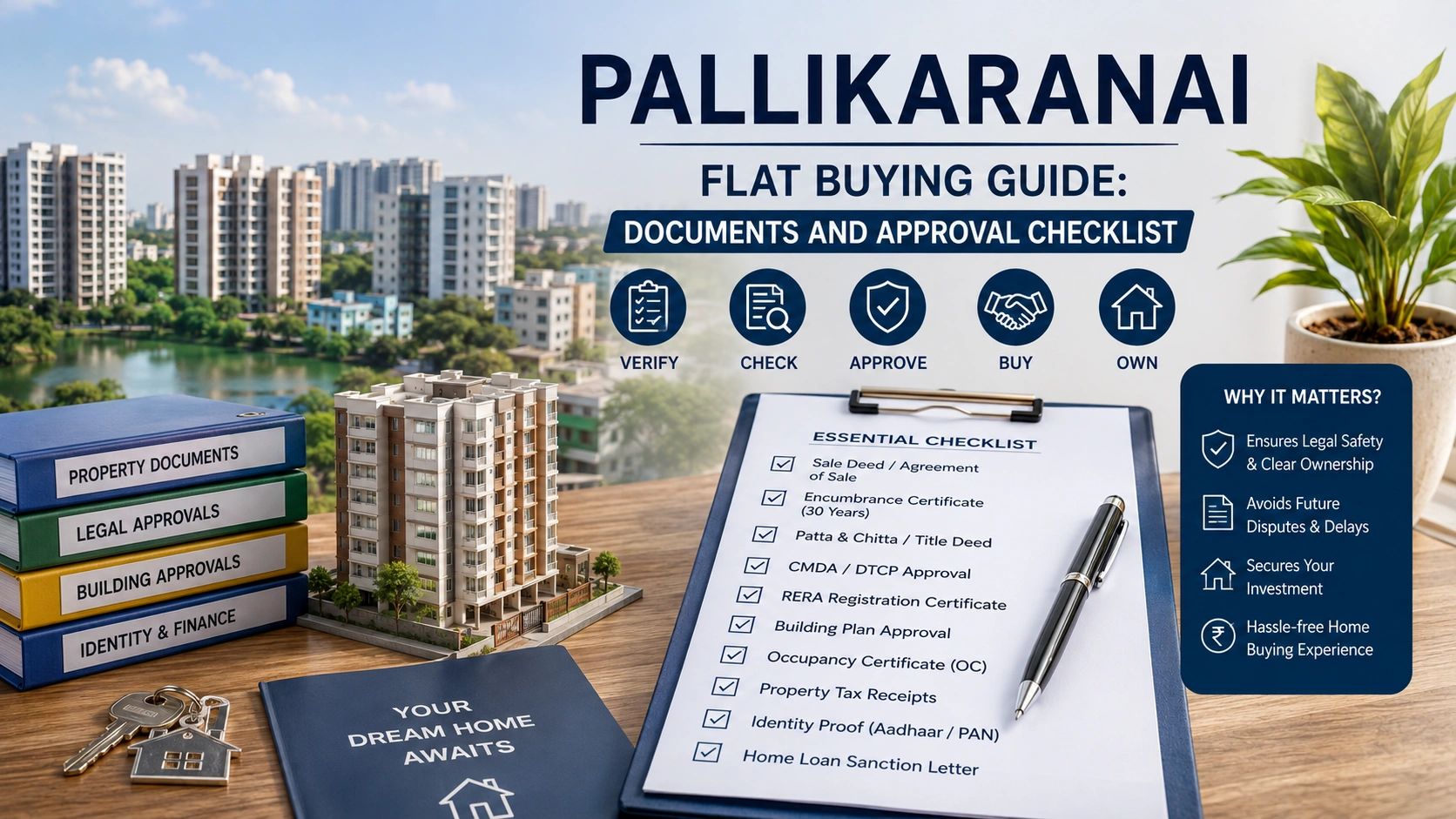
Buying a flat in Pallikaranai, Chennai, can be a good residential decision, but the purchase should not begin and end with checking the apartment's price, amenities, and location.
1. Why Pallikaranai Flat Buyers Need Extra Due Diligence
Pallikaranai is connected to several important residential and employment destinations, including Velachery, Medavakkam, Sholinganallur, Perumbakkam, and OMR. This has supported apartment development in and around the locality.
However, Pallikaranai also has a unique environmental and planning consideration because of the Pallikaranai Marsh Ramsar Site.
- The regulatory position around the marsh has also evolved. In 2025, the NGT directed authorities regarding development in the Ramsar site and its influence area, and CMDA subsequently issued Office Order No. 07/2025 concerning approvals in the affected area.
- Importantly, the position is not as simple as saying that every property within a fixed 1-km circle is permanently prohibited. In July 2026, the Tamil Nadu State Wetland Authority told the Madras High Court that the zone of influence should not be treated as a fixed or uniform buffer and that scientific assessment is required.
What does this mean for a buyer?
Don't rely on:
- “This is Pallikaranai, so approval is not a problem.”
- “The project is near the marsh, but everyone is building.”
- “The builder says approval is coming.”
- “The property has a patta, so everything is clear.”
Instead, check the exact survey number, approval status, and applicable restrictions for that particular property.
2. The Complete Flat-Buying Process
A safe purchase can broadly follow this sequence:
Property search
↓
Site visit
↓
Collect property details
↓
Verify survey number.
↓
Check title.
↓
Check EC.
↓
Check Patta/TSLR & survey records.
↓
Verify CMDA approval.
↓
Verify building permit.
↓
Check RERA.
↓
Check wetland/flood/drainage issues.
↓
Compare the approved plan with the actual building.
↓
Check sale agreement
↓
Independent legal opinion
↓
Home loan/legal valuation
↓
Registration
↓
Possession & document handover
The important point is that booking should not be the first serious legal step.
Residential Property For Sale in Pallikaranai
3. Collect the Basic Property Details
Before investigating documents, ask the builder/seller for a complete property information sheet.
Collect:
- Project name
- Builder/promoter name
- Full address
- Survey number
- Subdivision number
- Plot number
- Total land extent
- Number of blocks
- Number of floors
- Number of flats
- Flat number
- Proposed carpet area
- UDS
- Parking details
- RERA number, if applicable
- CMDA approval number
- Building permit number
Why start here?
Because these details become the identity of the property.
If the project brochure says one survey number but the approval document mentions another, you need an explanation before moving forward.
4. Visit the Property—Don't Just See the Sample Flat
A property inspection should go beyond:
“Is the living room spacious?”
Look at the actual surroundings.
Check the approach road.
Look at:
- Road width
- Road condition
- Street lighting
- Traffic
- Access during rain
- Parking congestion
- Public transport access
Check the immediate surroundings.
Look for:
- Open drains
- Low-lying plots
- Water stagnation
- Garbage dumping
- Sewage overflow
- Nearby vacant land
- Water bodies
- High-tension lines
- Commercial activity
- Industrial activity
Visit at different times.
If possible, visit:
- Morning
- Evening
- Weekend
The locality can feel very different during peak traffic hours.
5. Verify the Land Title
This is one of the most important stages.
You need to understand who legally owns the land and how that ownership reached the present seller/developer.
Documents may include:
- Parent deed
- Previous sale deeds
- Partition deed
- Settlement deed
- Gift deed
- Release deed
- Legal-heir documents
- Joint Development Agreement
- Power of Attorney
- Court orders, where applicable
6. Check the Encumbrance Certificate.
The Encumbrance Certificate (EC) is another major document.
It can reveal registered transactions and encumbrances recorded against the property during the searched period.
Check for:
- Previous sale transactions
- Mortgages
- Mortgage releases
- Registered charges
- Other registered transactions
Important point
An EC should not be checked in isolation.
Compare:
- Parent deed + current title + EC + revenue records
- If these don't tell the same ownership story, stop and investigate.
7. Verify Patta and Survey Records
Now move from title documents to land/revenue records.
Depending on the property, check the relevant:
- Patta
- TSLR
- FMB/survey sketch
- Survey number
- Subdivision number
- Land classification
- Extent
Cross-check everything.
For example:
Sale deed: Survey No. X
Patta: Survey No. X
CMDA approval: Survey No. X
RERA: Survey No. X
If one document suddenly shows a different survey number, don't assume it's a printing mistake.
There may be a legitimate subdivision/reclassification history—but it needs to be established.
8. Verify CMDA Planning Permission
For an apartment in the Chennai Metropolitan Area, the applicable CMDA planning approval should be verified.
Don't be satisfied with a builder's brochure saying:
“CMDA Approved.”
Ask for the actual approval details.
Check:
- Approval number
- Date
- Survey numbers
- Site extent
- Approved floors
- Number of dwelling units
- Building configuration
- Approved plan
- Road/access details
- Conditions attached to the approval
CMDA maintains online planning-permission approval information that can be used for cross-checking.
9. Verify the Building Permit
This is where many buyers make mistakes.
Planning permission is not the same as a building permit.
The applicable local-body building approval should also be checked.
Compare the approved plan with the building you can actually see.
| Item | What to verify |
| Floors | Approved vs. actual |
| Flats | Approved vs. actual |
| Setbacks | Approved vs. actual |
| Parking | Approved vs. actual |
| Building footprint | Approved vs. actual |
| Staircase | Approved vs. actual |
| Common areas | Approved vs. actual |
| Amenities | Approved/project documents |
If you notice an additional floor or major alteration, ask for the revised approval.
10. Verify RERA Registration
For projects covered by RERA registration requirements, check the project's Tamil Nadu RERA registration.
Don't only verify the registration number.
Compare the RERA information with the project's other documents.
Check:
- Promoter
- Project name
- Survey numbers
- Land extent
- Number of units
- Approved plans
- Completion timeline
- Project status
- Construction updates
The golden rule:
RERA details should make sense alongside CMDA approval and your sale agreement.
A mismatch deserves clarification.
11. Check the Apartment You Are Actually Buying
Now move from the project level to your individual flat.
Check:
- Flat number
- Block
- Floor
- Carpet area
- Built-up area
- Balcony
- Utility area
- UDS
- Parking
- Common-area share where applicable
12. Understand UDS
UDS = Undivided Share of Land.
When you buy an apartment, you're not buying only the physical flat.
You also acquire an undivided interest in the land on which the apartment stands.
Verify:
- Total land extent
- Your UDS
- Survey number
- UDS calculation
- UDS mentioned in agreement
- UDS mentioned in sale deed
Why does UDS matter?
It can become important during:
- Resale
- Redevelopment
- Reconstruction
- Legal disputes
- Future land-related transactions
Never treat UDS as a minor technical detail.
13. Verify Parking Properly
Ask exactly what parking you're purchasing or being allotted.
Check:
- Parking number
- Location
- Type
- Dimensions
- Covered/open status
- Allocation method
- Whether it is documented
14. Check Completion/Occupancy Documents
If you're buying a ready-to-move-in flat, ask for the applicable completion and occupancy-related documentation.
Also verify:
Approved building = Actual building
Look for changes such as
- Extra floors
- Converted common areas
- Altered parking
- Additional rooms
- Changed setbacks
- Unapproved structures
A building being physically occupied does not by itself answer every legal-approval question.
15. Check Water Supply
Pallikaranai buyers should understand the project's actual water source.
Ask:
Main water source
- Metro Water?
- Borewell?
- Tanker?
- Combination?
Also check:
- Overhead tank
- Underground sump
- Water storage capacity
- Rainwater harvesting
- Water treatment
- Maintenance arrangements
16. Check Sewage and Stormwater
Don't confuse sewage drainage with rainwater drainage.
Check both.
Sewage
- Sewer connection
- STP where applicable
- Maintenance
- Disposal arrangement
Rainwater
- Stormwater drains
- Road-level drainage
- Site-level drainage
- Basement drainage
- Pumping arrangements
- Waterlogging history
17. Check Flood History Yourself
Documents are important, but ground-level information matters too.
Talk to:
- Nearby residents
- Security guards
- Shopkeepers
- Association members
- Existing flat owners
Ask:
- How was the last major rain?
- Did water enter the street?
- Did the basement flood?
- How quickly did water drain?
- Was electricity affected?
- Did residents use pumps?
- Has the building faced repeated waterlogging?
Best method
Visit the location after heavy rain if possible.
18. Check the Builder's Track Record
Legal documents are essential, but the builder's history also matters.
Look at previous projects.
Check:
- Delivery record
- Quality of construction
- Complaint history
- Maintenance
- Water supply
- Association feedback
- Previous approval issues
- Resale experience
If possible, speak directly with residents of the builder's completed projects.
19. Check Home-Loan Eligibility
If you're taking a home loan, get the bank's property evaluation completed early.
A bank may examine:
- Title
- Property documents
- Approvals
- Valuation
- Project documentation
But remember:
Bank approval ≠ complete legal guarantee.
Your own lawyer should independently verify the property.
20. Calculate the Real Cost of the Flat
Don't calculate your budget using only:
Flat price = Rs X per sq. ft. × area
Your actual acquisition cost can include:
- Apartment price
- Car parking
- Floor-rise charges
- Amenities/other project charges
- Maintenance advance
- Corpus fund
- Legal/documentation costs
- Stamp duty
- Registration charges
- Loan-related costs
- Interiors
- Utility deposits
- Other applicable charges
Ask the builder for a complete cost sheet.
This prevents the common situation where the advertised price looks attractive but the final amount is significantly higher.
21. Understand Stamp Duty and Registration
Before registration, confirm the applicable:
- Stamp duty
- Registration fee
- Transfer-related charges
- Applicable government fees
The final calculation should be based on the current applicable rules and the property's transaction value/guideline-value requirements.
22. Review the Sale Agreement.
Before signing, carefully check:
Property description
- Survey number
- Flat number
- Floor
- Block
- Land extent
- UDS
Apartment details
- Carpet area
- Other stated areas
- Parking
- Amenities
- Common areas
Financial terms
- Total price
- Payment schedule
- Taxes/charges
- Maintenance
- Corpus
- Other charges
Timeline
- Construction
- Possession
- Registration
Legal terms
- Cancellation
- Default
- Delay
- Refund
- Dispute resolution
Never sign an agreement you haven't understood.
23. Get an Independent Legal Opinion
This is one of the best investments you can make before buying a property.
Choose a property lawyer who represents you, not the builder.
Ask for verification of:
- Title
- Parent documents
- EC
- Patta/TSLR
- Survey details
- CMDA approval
- Building permit
- RERA
- UDS
- Agreement
- Applicable wetland/planning restrictions
Why independent?
The person helping you buy the property should not be the same person whose primary responsibility is to protect the seller/developer's interests.
24. Registration Day Checklist
Before signing the final sale deed, confirm:
- Correct buyer name
- Correct seller name
- Correct property description
- Correct survey number
- Correct flat number
- Correct UDS
- Correct consideration
- Correct parking details
- Correct boundaries
- Required supporting documents
- Payment records
- Applicable government charges
Read the final document carefully before execution.
25. What to Collect After Registration
Your property file shouldn't end at registration.
Keep:
- Registered sale deed
- Registration receipt
- EC after registration
- Tax receipts
- Possession letter
- Approved plan copies
- RERA documents
- Building approval documents
- Maintenance records
- Parking documentation
- Utility documents
- Builder correspondence
- Loan documents, if applicable
Maintain both physical and digital copies.
Complete Pallikaranai Flat Buying Checklist
A. Before Booking
- Visit the property.
- Check locality and access roads.
- Collect survey number.
- Collect promoter details.
- Check project RERA status.
- Obtain approval details.
- Understand total cost
- Investigate drainage/flood history.
B. Land Verification
- Parent deed
- Title chain
- Sale deeds
- EC
- Patta/TSLR
- FMB/survey records where applicable
- Survey number
- Subdivision number
- Land extent
- Legal opinion
C. Project Approval
- CMDA planning permission
- Approved building plan
- Building permit
- RERA registration, where applicable
- Fire-related approval, where applicable
- Environmental approvals, where applicable
- Completion/occupancy-related documentation
D. Apartment Verification
- Flat number
- Floor
- Carpet area
- UDS
- Parking
- Balcony/utility
- Actual construction
- Common areas
E. Pallikaranai-Specific Checks
- Flood history
- Stormwater drainage
- Basement waterlogging
- Marsh/wetland proximity
- Exact survey-number status
- Applicable Ramsar/influence-area restrictions
- Current planning-permission position
F. Before Registration
- Sale agreement reviewed
- Final sale deed checked
- Dues cleared
- Loan/legal verification completed
- Stamp duty checked
- Registration fee checked
- Independent lawyer's approval obtained
End-to-End Advice
For a Pallikaranai flat purchase in 2026, the safest approach is to think beyond the apartment itself.
First: Verify the land.
Title → Parent Documents → EC → Patta/TSLR → Survey Details
Second: Verify the building.
CMDA → Building Permit → Approved Plan → RERA → Completion/Occupancy Documents
Third: Verify your flat.
Carpet Area → UDS → Parking → Agreement → Sale Deed
Fourth: Verify the location.
Road → Drainage → Water → Flood History → Wetland/Marsh-related restrictions
FAQs
Is Pallikaranai a good location to buy a flat?
Pallikaranai can suit buyers looking for connectivity to Velachery, Medavakkam, OMR, and South Chennai. But the suitability of an individual property depends on its exact location, construction quality, approvals, price, and drainage conditions.
What documents are required to buy a flat in Pallikaranai?
The key documents include the title chain, parent documents, EC, applicable Patta/TSLR records, CMDA planning permission, approved plan, building permit, RERA details where applicable, and UDS and sale agreement.
How can I verify CMDA approval?
Cross-check the project's approval number, survey numbers, floors, and dwelling units through CMDA's planning-permission records.
Is RERA registration enough to buy a flat?
No. RERA verification is only one part of the due-diligence process. Title, EC, land records, and planning/building approvals must also be checked.
What is UDS in a Pallikaranai apartment?
UDS, or Undivided Share of Land, is your proportionate ownership interest in the land associated with the apartment.
Should I check flood risk before buying in Pallikaranai?
Yes. Check the property's street-level drainage, previous waterlogging, basement conditions, and exact location relative to the Pallikaranai marsh and applicable planning/environmental restrictions.
Should I hire a property lawyer before buying?
Yes. For a significant property purchase, an independent lawyer should verify the title, encumbrances, approvals, and sale agreement before you make a major non-refundable payment.