An Occupancy Certificate (OC) is one of the most important legal documents a homebuyer should verify before taking possession of a property. It confirms that the building has been constructed according to the approved plans and complies with all applicable building regulations. An occupancy certificate is issued by the local municipal authority or development authority after inspecting the completed project. Whether you are buying a ready-to-move apartment, builder floor, villa, or independent house, checking the Occupancy Certificate online helps ensure that the property is legally approved for occupation.
What is an occupancy certificate?
An occupancy certificate is an official document issued by the local authority stating that:
- The construction has been completed according to the sanctioned building plan.
- The building complies with applicable building rules and safety standards.
- Essential services such as water supply, electricity, sewage, drainage, and road access are available.
- The building is safe and fit for residential or commercial occupancy.
Without an occupancy certificate, a completed building may not be legally approved for occupation.
Why is an Occupancy Certificate Important?
An occupancy certificate provides legal assurance that the property has met the required construction and safety standards.
It helps buyers:
- Verify the legality of the construction.
- Confirm that the builder followed approved plans.
- Avoid unauthorized or illegal buildings.
- Ensure access to municipal services.
- Facilitate property resale.
- Simplify loan processing with banks.
- Reduce future legal disputes.
Who Issues the Occupancy Certificate?
The Occupancy Certificate is issued by the competent local authority after inspecting the completed project.
Depending on the property's location, it may be issued by:
- Municipal Corporation
- Municipal Council
- Town Panchayat
- Development Authority
- Urban Local Body
- Special Planning Authority
The issuing authority depends on the jurisdiction where the property is located.
When is an occupancy certificate issued?
The certificate is generally issued after:
- Construction is fully completed.
- Structural work is finished.
- Fire safety requirements are met (where applicable).
- Drainage and sewage systems are completed.
- Water and electricity infrastructure is available.
- The authority completes its final inspection.
- All required approvals are obtained.
Only after successful inspection is the occupancy certificate granted.
Why Should Buyers Check the Occupancy Certificate Online?
Checking the Occupancy Certificate online offers several advantages:
Confirms Legal Completion
It verifies that the building has received official approval for occupancy.
Prevents Fraud
Buyers can avoid properties with unauthorized construction or incomplete approvals.
Ensures Compliance
The OC confirms that the project complies with sanctioned building plans.
Supports Loan Approval
Many financial institutions prefer or require an occupancy certificate before processing loans for ready-to-move properties.
Helps During Resale
Properties with valid occupancy certificates are generally easier to sell.
Also Read: Legal Checklist Before Buying a Flat in Chennai
Information Required Before Checking an Occupancy Certificate Online
Keep the following details ready:
- Property address
- Survey number
- Building approval number
- Planning permit number
- Application number
- Builder or developer name
- Project name
- Property registration details (if required)
Having accurate information makes the search easier.
How to Check an Occupancy Certificate Online
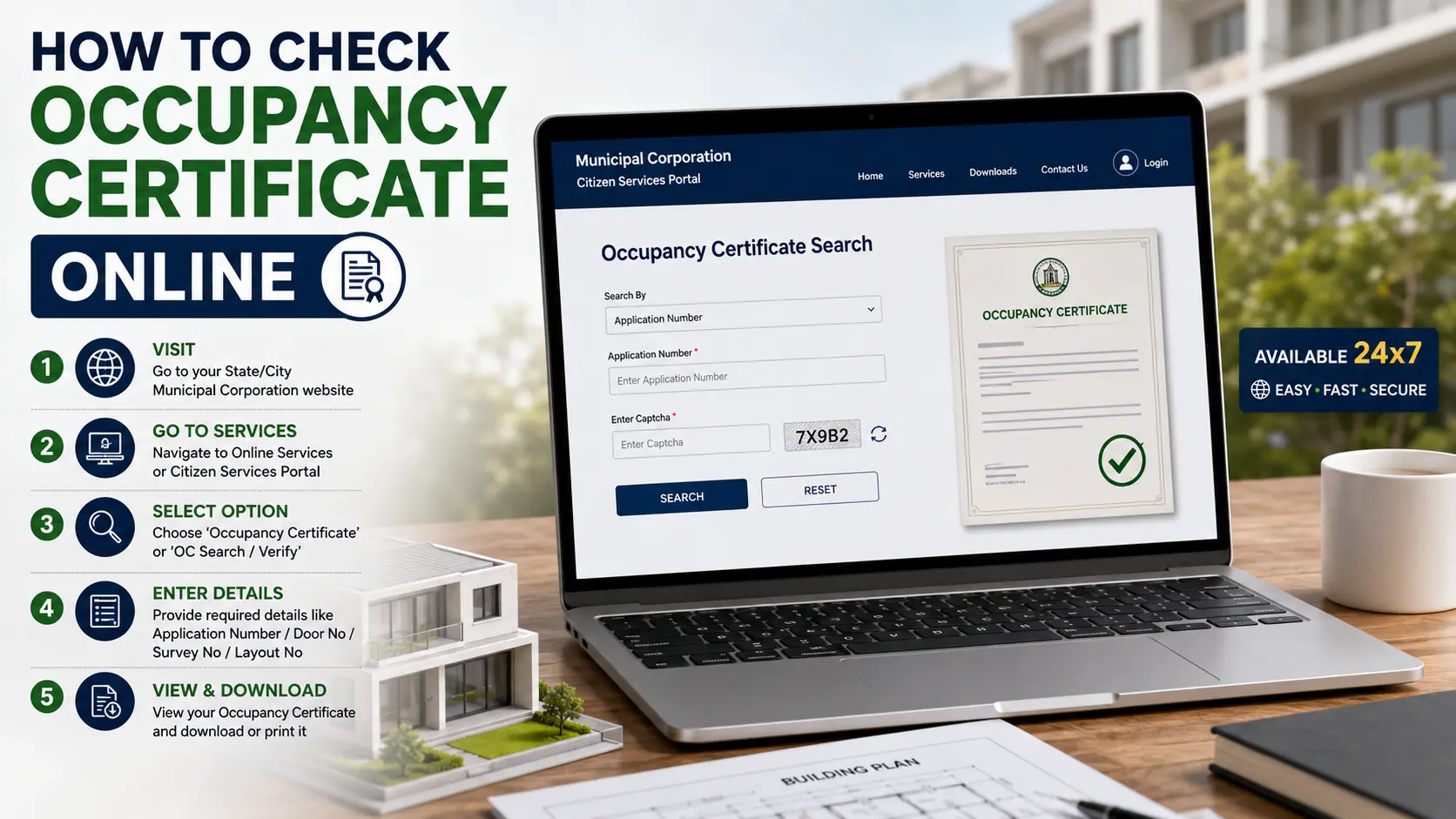
The exact process varies by state and local authority, but the general steps are:
Step 1: Visit the Official Local Authority Portal
Open the official website of the municipal corporation or development authority responsible for the property's location.
Step 2: Navigate to Building Approval Services
Look for services related to:
- Building Plan Approval
- Building Permission
- Occupancy Certificate
- Completion Certificate
- Citizen Services
- Online Building Services
Step 3: Select Occupancy Certificate Search
Choose the option to verify or search for an occupancy certificate.
Step 4: Enter Property Details
Provide the required information, such as
- Application number
- Building permit number
- Property address
- Survey number
- Project ID
Step 5: Submit the Search
Click the search or submit button.
Step 6: View the Certificate Status
The portal may display:
- Approved
- Pending
- Under Inspection
- Rejected
- Certificate Issued
Step 7: Download the Certificate
If available, download the Occupancy Certificate in PDF format for future reference.
Information Available in an Occupancy Certificate
A typical occupancy certificate contains:
- Certificate number
- Date of issue
- Building address
- Owner or developer details
- Project name
- Building approval reference
- Number of floors approved
- Land details
- Inspection details
- Occupancy approval date
- Issuing authority
- Official seal or digital signature
How to Verify the Authenticity of an Occupancy Certificate
Before accepting an Occupancy Certificate:
- Check the certificate number.
- Verify the issue date.
- Ensure the project details match the property.
- Confirm the survey number.
- Verify the building approval number.
- Check the issuing authority's seal or digital signature.
- Ensure there are no alterations or missing pages.
Difference Between Occupancy Certificate and Completion Certificate
| Occupancy Certificate | Completion Certificate |
| Issued after final inspection confirming the building is fit for occupancy | Issued after construction work is completed |
| Certifies the building is legally ready for occupation | Confirms that construction has been completed |
| Required before occupying the building | Indicates physical completion of the project |
| Focuses on habitability and compliance | Focuses on completion of construction |
Can You Buy a Property Without an Occupancy Certificate?
Although some completed properties may be offered without an occupancy certificate, buyers should carefully evaluate the risks.
Potential issues include:
- Delays in utility connections.
- Difficulty obtaining certain bank loans.
- Problems during resale.
- Legal complications if the construction deviates from approved plans.
- Delays in obtaining municipal approvals.
It is generally advisable to verify that an occupancy certificate has been issued before taking possession.
Common Reasons for Delay in Issuing an Occupancy Certificate
Several factors may delay issuance:
- Deviations from approved plans.
- Unauthorized construction.
- Pending inspections.
- Incomplete infrastructure.
- Fire safety non-compliance.
- Missing documents.
- Unpaid statutory fees.
- Environmental clearance issues, where applicable.
Documents Commonly Used for Occupancy Certificate Verification
Authorities may require:
- Building approval copy
- Completion Certificate
- Property tax details
- Approved building plan
- Planning permission
- Builder application number
- Property address
- Identity details (for applicant services, where applicable)
Benefits of Checking an Occupancy Certificate Before Buying
Verifying the Occupancy Certificate helps buyers:
- Confirm the building is legally approved.
- Ensure construction matches sanctioned plans.
- Reduce legal risks.
- Improve confidence in the transaction.
- Support smoother resale and financing.
- Confirm the property is officially approved for occupation.
Frequently Asked Questions
1. What is an Occupancy Certificate (OC)?
An occupancy certificate is a document issued by the local authority confirming that a building is safe and legally fit for occupancy.
2. Why is an occupancy certificate important?
It proves that the building complies with approved plans and local building regulations.
3. Can I check an occupancy certificate online?
Yes, many municipal and development authority portals allow online OC verification.
4. What details are needed to check an OC online?
You may need the application number, building approval number, survey number, or property address.
5. Who issues an occupancy certificate?
The local municipal corporation or development authority issues the certificate after inspection.
6. Is an occupancy certificate mandatory?
Yes, it is an important document for legally occupying a completed building.
7. What is the difference between an occupancy certificate and a completion certificate?
A Completion Certificate confirms construction is complete, while an Occupancy Certificate confirms the building is fit for occupancy.
8. Can I buy a property without an occupancy certificate?
You can, but it may lead to legal, financing, or utility-related issues.
9. Can a bank ask for an occupancy certificate?
Yes, many banks require an OC for ready-to-move properties before approving a home loan.
10. What should I do if the Occupancy Certificate is unavailable?
Ask the builder for the OC or verify its status with the local authority before purchasing the property.
a