When planning a home interior, office, apartment renovation, or new construction, choosing the right wall and ceiling material is important. Gypsum board and cement board are two popular options, but they are not designed for exactly the same purpose. Gypsum board is known for its lightweight construction, smooth finish and easy installation, while cement board is preferred for strength, moisture resistance, and demanding applications.
What Is a Gypsum Board?
Gypsum board is a panel made with a gypsum-based core covered with a protective facing. It is widely used for interior walls, partitions, and false ceilings.
It is particularly popular in residential interiors because it can be installed quickly and provides a smooth surface for painting and other finishes.
Common Uses of Gypsum Board
- False ceilings
- Bedroom partitions
- Living room walls
- Office partitions
- TV walls
- Decorative ceilings
- Wall niches
- Interior design features
- Dry-area partitions
Gypsum boards are also available in specialized versions, such as moisture-resistant and fire-resistant boards, depending on the application.
What Is a Cement Board?
A cement board is a rigid panel made primarily from a cement-based material reinforced with fibers.
It is heavier and harder than gypsum board and is commonly selected for locations where the material needs to withstand moisture, impact, or more demanding conditions.
Common Uses of Cement Board
- Bathroom walls
- Shower areas
- Tile backing
- Kitchen wet areas
- Utility rooms
- Moisture-prone locations
- Certain exterior applications
- Areas requiring greater impact resistance
Cement board is particularly useful as a substrate behind tiles in wet areas when installed as part of a properly waterproofed system.
Also Read: Did you Known About False Ceiling.
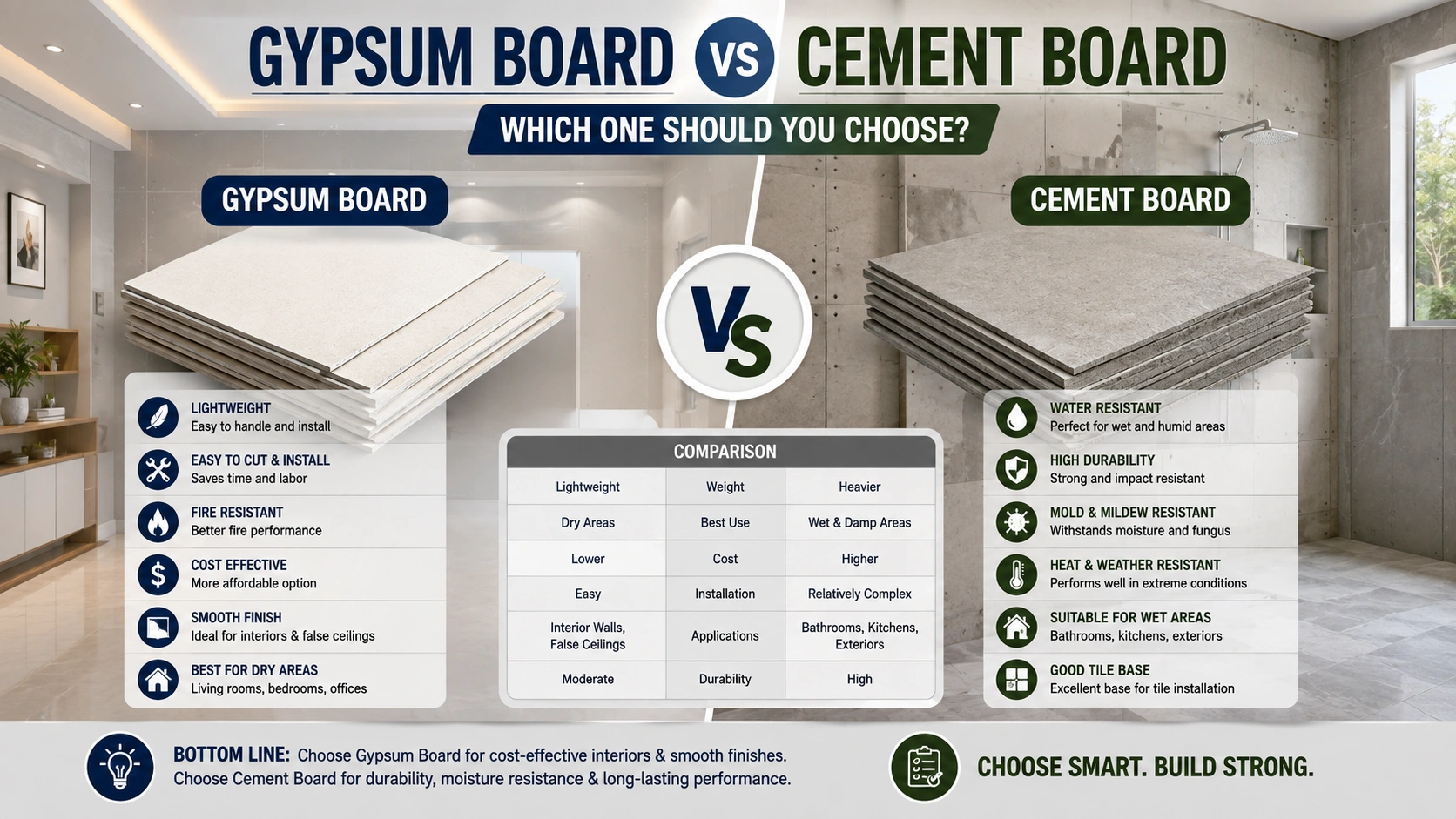
Gypsum Board vs. Cement Board: Detailed Comparison
| Feature | Gypsum Board | Cement Board |
| Material | Gypsum core | Cement-based core |
| Weight | Lightweight | Heavy |
| Installation | Easy and quick | More difficult |
| Cutting | Relatively easy | Requires more effort |
| Surface finish | Smooth | More rigid/rougher |
| Moisture resistance | Depends on product: the standard board is unsuitable for wet exposure | Generally better |
| Impact resistance | Moderate | High |
| Title backing | Limited/specific products only | Commonly used |
| False ceiling | Excellent for many interiors | Usually unnecessary |
| Decorative work | Excellent | Less convenient |
| Cost | Usually lower | Usually higher |
| Labor | Lower |
1. Moisture Resistance
Moisture is one of the biggest factors when deciding between gypsum and cement board. Standard gypsum board is designed primarily for dry interior applications. Continuous exposure to water can cause deterioration, swelling, or loss of strength. Moisture-resistant gypsum products are available, but they should be used only where their manufacturer specifies them as suitable. Cement board generally performs better in wet conditions and is commonly used in bathrooms, shower areas, and behind tiles. However, a cement board should not be considered a complete waterproofing system by itself. Proper waterproofing of joints, corners, penetrations, and surrounding surfaces is still important.
Best choice for wet areas: Cement board
2. Strength and Durability
Cement board is generally denser, harder, and more resistant to impact than standard gypsum board.
This makes it suitable for locations where walls may experience more physical stress.
Gypsum board is durable enough for normal residential and office interiors, but it can be damaged by strong impacts.
Winner: Cement board for demanding applications
3. Weight
Gypsum board is significantly lighter than cement board.
This makes it easier to:
- Transport
- Carry to upper floors.
- Cut
- Handle
- Install
- Use in large ceiling areas.
The lower weight can also be an advantage when designing lightweight interior partitions.
Cement board requires more effort because of its density and weight.
Winner: Gypsum board
4. Installation
Gypsum board is comparatively easy to work with. It can be cut using commonly available drywall tools and installed on suitable metal or timber framing.
The joints can then be treated and finished to create a smooth surface.
Cement board is harder to cut and generally requires more effort during handling and installation. Specialized tools and appropriate fasteners may be required depending on the product. This can increase installation time and labor costs.
Winner: Gypsum board
5. Finishing and Appearance
If your priority is a smooth, clean, and attractive interior finish, gypsum board is usually the preferred option.
It works well for:
- Painting
- Wallpaper
- Decorative finishes
- False ceiling designs
- Cove lighting
- Recessed lighting
- Curved and customized interior features
Cement board is primarily selected for its performance rather than decorative flexibility.
Winner: Gypsum board
6. False Ceiling
Gypsum board is one of the most commonly used materials for interior false ceilings.
It is popular because it allows designers to create:
- Layered ceilings
- Cove lighting
- Recessed lighting
- Geometric patterns
- Border designs
- Minimalist ceilings
- Decorative ceiling features
Cement board can be used in certain ceiling applications, but its additional weight often makes it less attractive for standard indoor decorative ceilings.
Best choice: Gypsum board
7. Bathroom Applications
- Bathrooms require careful material selection because of water vapor, splashing, and possible leakage.
- For areas exposed to regular moisture, cement board is generally a better substrate, particularly where tiles are being installed.
- Gypsum board should not be selected simply because it is cheaper. If the application involves prolonged or direct water exposure, a suitable wet-area substrate should be used according to the manufacturer's instructions.
Best choice for wet bathroom areas: Cement board
8. Kitchen Applications
The choice depends on the exact location.
- For a relatively dry kitchen ceiling or partition, a suitable gypsum board may work well.
- For areas exposed to significant moisture, water, or frequent splashing, a moisture-appropriate cement board or another approved substrate may be preferable.
The important point is that the material should match the exposure conditions.
9. Fire Resistance
Both gypsum and cement-based boards can be used in fire-resistant construction systems.
- Gypsum has a useful fire-performance characteristic because of the chemically bound water within the gypsum core. Special fire-rated gypsum boards are also manufactured for applications requiring higher fire resistance.
- Cement board is cement-based and non-combustible.
However, you should not judge the fire rating of a wall simply by looking at the board. The final fire performance depends on the board type, thickness, number of layers, framing, insulation, joints, and complete tested assembly.
Best approach: Check the tested system rating.
10. Sound Insulation
Gypsum board can provide good acoustic performance when used as part of a properly designed wall system.
For better sound insulation, a partition may include:
- Metal framing
- Mineral wool insulation
- Multiple board layers
- Sealed joints
- Appropriate acoustic detailing
Cement board is denser and can also contribute to sound control, but the performance of the entire wall assembly matters more than the board alone.
Result: Depends on the complete system
11. Cost Comparison
In most standard interior applications, gypsum board is generally more economical than cement board.
The final project cost depends on:
- Board thickness
- Board specification
- Brand
- Framing
- Fasteners
- Joint treatment
- Labor
- Transportation
- Finishing
- Installation complexity
Cement board can have a higher overall installation cost because it is heavier and harder to cut and install.
However, choosing the cheapest board is not necessarily the most economical decision in the long term.
12. Maintenance and Repairs
- Gypsum board is relatively easy to repair when minor damage occurs.
Small holes, cracks, and surface damage can often be repaired using suitable jointing or patching materials.
- Cement board is harder and more rigid, which can make cutting and modification more difficult.
However, its durability can be an advantage in areas where the wall is exposed to moisture or impact.
Which Board Should You Choose for Different Areas?
Living Room
Gypsum board is generally a good choice for partitions, decorative walls, and false ceilings.
Bedroom
Gypsum board is suitable for most dry interior partitions and ceilings.
Office
Gypsum board is generally preferred for lightweight and quickly installed partitions.
Bathroom
Cement board is generally preferable in wet areas, particularly behind tiles.
Shower Area
Use cement board or another manufacturer-approved wet-area substrate, along with appropriate waterproofing.
Kitchen
Use gypsum in suitable dry areas and a moisture-appropriate substrate where regular water exposure is expected.
False Ceiling
Gypsum board is generally the preferred choice for indoor decorative ceilings.
Exterior Application
Do not use ordinary interior gypsum board. Select a product specifically rated for exterior exposure and follow the manufacturer's system requirements.
Gypsum Board: Pros and Cons
Advantages
- Lightweight
- Easy to install
- Faster construction
- Smooth finish
- Excellent for decorative interiors
- Good for false ceilings
- Easy to paint
- Available in specialized fire- and moisture-resistant variants
- Generally economical
Disadvantages
- Standard gypsum is unsuitable for prolonged water exposure.
- Can be damaged by heavy impact
- Requires correct joint treatment
- Water leakage can damage the board.
- Heavy fixtures need proper structural support.
Cement Board: Pros and Cons
Advantages
- Strong and rigid
- Better suited to wet areas
- Good impact resistance
- Suitable for tile backing
- Useful in demanding applications
- Cement-based and non-combustible
Disadvantages
- Heavy
- More difficult to cut
- More labor-intensive
- Installation can take longer.
- Usually more expensive
- Less convenient for detailed decorative work
Gypsum Board vs. Cement Board: Which Is Better?
The answer depends on your application.
Choose gypsum board when:
- The area is dry.
- You need a false ceiling.
- You want decorative interior designs.
- You need lightweight partitions.
- You want quick installation.
- You want a smooth paint-ready finish.
- You are working within a tighter interior budget.
Choose cement board when:
- The area is exposed to significant moisture.
- You need a tile backing substrate.
- You are working around showers or wet bathroom areas.
- Higher impact resistance is important.
- You need a more rigid board.
- The manufacturer's specifications recommend it for the application.
Conclusion
For most dry interior applications, gypsum board is the more practical option because it is lightweight, easy to install, cost-effective, and provides an attractive finish.
- For wet areas and applications requiring greater resistance to moisture and impact, cement board is generally the better choice.
- For a modern home, there is no need to choose only one material. A practical approach is to use gypsum board for bedrooms, living rooms, partitions, and false ceilings, while using cement board in appropriate bathrooms, shower areas, and other moisture-prone locations.
The most important factor is not simply which board is stronger or cheaper. It is whether the board and complete installation system are suitable for the environment in which they will be used.
FAQs
1. Which is better, gypsum board or cement board?
Gypsum is better for dry interiors, while cement board is better for wet and demanding areas.
2. Can gypsum boards be used in bathrooms?
Special moisture-resistant products may be suitable for some areas, but standard gypsum should not be exposed to prolonged water.
3. Is cement board waterproof?
It has strong moisture resistance, but proper waterproofing is still required for wet-area construction.
4. Which is stronger?
Cement board is generally stronger and more impact-resistant than standard gypsum board.
5. Which is cheaper?
Gypsum board is generally more economical for normal interior applications.
6. Which is better for false ceilings?
Gypsum board is generally preferred for indoor false ceilings.
7. Which is better behind bathroom tiles?
Cement board or another approved wet-area substrate is generally preferred.
8. Which is easier to install?
Gypsum board is lighter and easier to cut and install.
9. Can cement boards replace gypsum everywhere?
It can be used in many applications, but its weight and installation requirements make gypsum more practical for many dry interiors.
10. Which should I use for my home?
Use gypsum for most dry interiors and cement board for suitable wet or high-impact areas.