Common Area Usage Rules in Chennai
Common areas in residential apartments, gated communities, and housing societies in Chennai are shared spaces meant for the collective benefit of all residents. Their use is governed by Tamil Nadu Apartment Ownership Act, 1994, building bye-laws, local municipal regulations, and the apartment association’s by-laws.
1. What Are Common Areas?
Common areas include all spaces that are not privately owned by individual flat owners. Examples:
Indoor Common Areas
- Staircases and landings
- Corridors and lobbies
- Lifts and lift shafts
- Common toilets (if any)
- Community halls / party halls
- Gym, yoga rooms, indoor games rooms
Outdoor Common Areas
- Parking areas (open or stilt)
- Gardens and landscaped spaces
- Children’s play areas
- Driveways and internal roads
- Security cabins
- Clubhouse and swimming pool
Important: No individual owner has exclusive ownership over common areas unless specifically allotted in the registered sale deed.
2. Legal Framework Governing Common Areas
a. Tamil Nadu Apartment Ownership Act, 1994
- Declares common areas as undivided and indivisible
- No owner can sell, alter, or encroach upon common areas
- Maintenance responsibility lies with the apartment association
b. CMDA & Local Body Rules
- Chennai Metropolitan Development Authority (CMDA) guidelines
- Greater Chennai Corporation bye-laws
- Fire and safety norms (especially for staircases and corridors)
c. Apartment Association By-laws
- Usage timings
- Booking procedures
- Penalties for misuse
- Visitor and tenant regulations
3. General Rules for Using Common Areas
A. Equal Access
- All residents have equal rights to use common areas
- No discrimination based on ownership size, seniority, or tenure
B. No Permanent Occupation
- Residents cannot:
- Store personal items (cycles, shoe racks, cupboards) in corridors
- Extend balconies into common space
- Enclose stilt parking or terrace areas
C. Safety First
- Fire exits must remain clear at all times
- No obstruction in staircases or lift lobbies
- Hazardous materials are strictly prohibited
4. Parking Rules (Major Issue in Chennai)
Key Parking Guidelines
- Parking only in allotted slots
- Visitor parking must not be occupied permanently
- No parking in:
- Fire driveways
- Entry/exit ramps
- Common roads
Two-Wheeler & EV Rules
- Two-wheelers must park in designated areas
- EV charging points require association approval
- No ad-hoc wiring from common electric supply
5. Use of Amenities (Gym, Hall, Pool, etc.)
Booking & Timings
- Prior booking required for community halls
- Time limits apply (usually 2–4 hours)
- Silence hours generally between 10 PM and 6 AM
Maintenance Charges
- Amenities funded through maintenance fees
- Damage caused by users must be compensated
Guest Usage
- Guests are allowed only when accompanied by residents
- Associations may charge guest usage fees
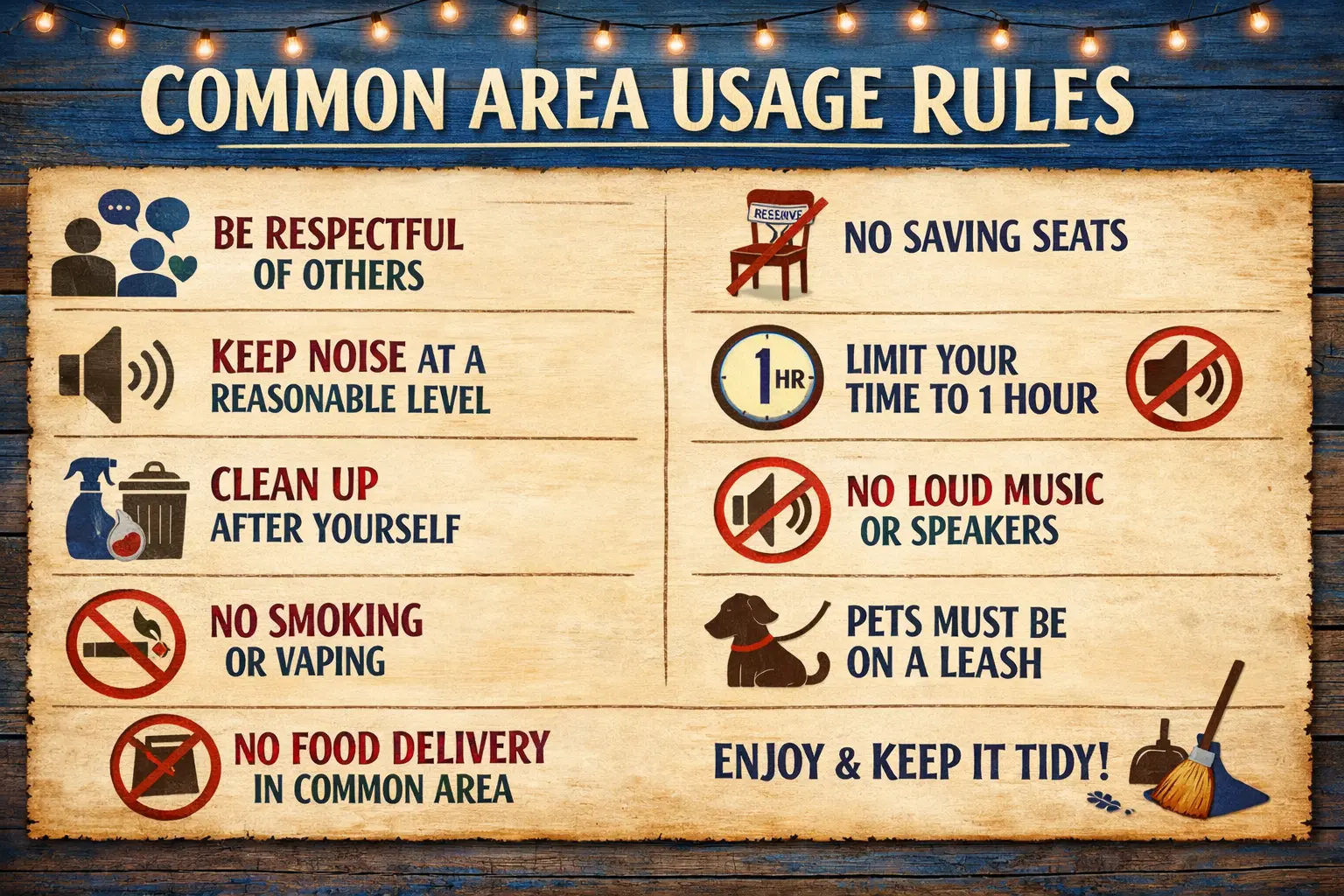
6. Noise, Conduct & Cleanliness Rules
Noise Regulations
- Loud music, parties, and construction restricted after 10 PM
- Religious or cultural events need prior permission
Cleanliness
- No littering in corridors, staircases, or open areas
- Garbage disposal only in designated bins
- Spitting and public urination strictly prohibited
7. Commercial Use of Common Areas
Not Allowed
- Running shops, offices, or tuition classes
- Using parking or lobbies for business activities
- Advertising banners without approval
Allowed Only With Permission
- Temporary stalls during festivals
- Society-approved events
8. Alteration & Structural Changes
- No drilling, breaking, or structural modifications in common areas
- Installation of:
- CCTV
- Mobile towers
- Solar panels
- requires general body approval
9. Penalties for Misuse
Associations may impose:
- Warning notices
- Monetary fines
- Suspension of amenity usage
- Legal action in serious violations
10. Dispute Resolution
Step-by-Step
- Complaint to Association Secretary/Manager
- Discussion in Managing Committee
- General Body Meeting
- Legal remedy (Civil Court / Registrar of Societies)
Frequently Asked Questions (FAQs)
Q1. Can a resident keep shoe racks outside the flat door?
No. Corridors are common areas and must remain obstruction-free, especially for fire safety.
Q2. Is the terrace a common area?
Yes, unless explicitly mentioned as exclusive in the registered sale deed.
Q3. Can association restrict children from playing in common areas?
No blanket ban allowed. Reasonable time and safety restrictions can be imposed.
Q4. Who pays for common area maintenance?
All owners contribute through monthly maintenance, usually based on UDS or flat size.
Q5. Can tenants use common amenities?
Yes, unless restricted by by-laws. Owners are responsible for tenant behavior.
Q6. Can the association disconnect water or power for violations?
No. Essential services cannot be disconnected as a penalty.
Q7. Can one resident occupy visitor parking permanently?
No. Visitor parking is strictly for short-term use.
Q8. Are pets allowed in common areas?
Yes, pets are allowed. Associations can impose hygiene and leash rules but cannot ban pets outright.
Q9. Can CCTV be installed in common areas?
Yes, with association approval and privacy compliance.
Q10. What if the association itself misuses common areas?
Residents can:
- Raise objection in General Body Meeting
- File complaint with Registrar of Societies
- Approach civil court if required