AAC blocks have become a common choice for residential construction because they are lightweight, easy to handle, and can speed up masonry work. But in 2026, simply comparing the price of an AAC block with the price of a red brick does not give the real picture.
AAC Block Construction Cost Per Sq Ft in 2026
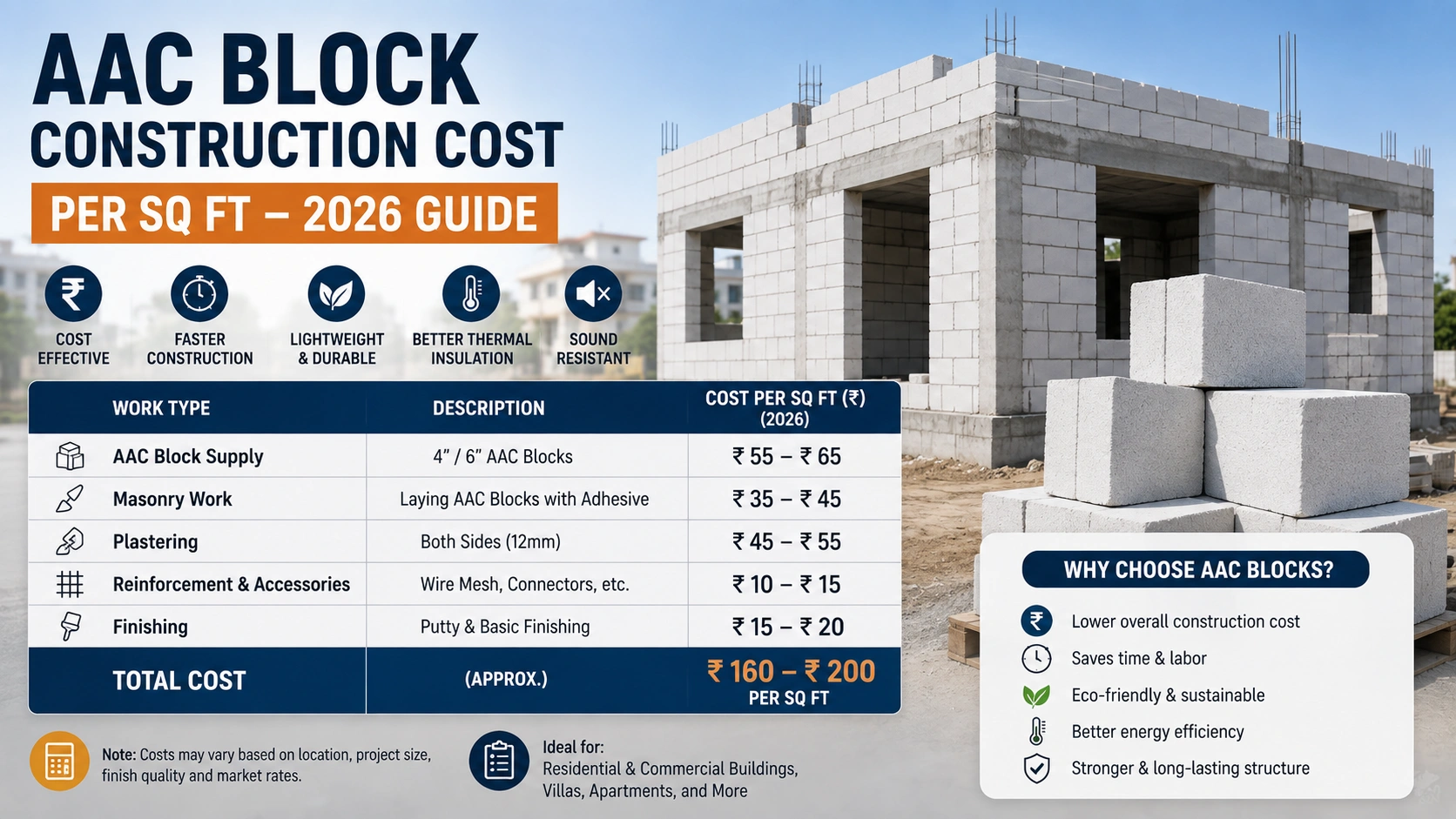
For a residential project, a practical budgeting range can be considered as follows:
| AAC Wal Work | Indicative 2026 cost |
| AAC blocks only | Rs 40-70 sqft |
| Blocks + adhesive | Rs 50-80 sqft |
| Blocks + adhesive + masonry | Rs 65-100 sqft |
| Masonry + basic finishing | Rs 90-150 sqft |
These are indicative planning figures, not fixed market rates. Chennai rates can vary based on supplier, block size, brand, transportation, labor, and project location.
The biggest mistake homeowners make is comparing a material-only rate from one supplier with a labor-inclusive rate from another contractor.
What Is an AAC Block?
AAC stands for Autoclaved Aerated Concrete.
- It is a lightweight building material manufactured using cementitious materials, fine aggregate or fly ash, lime, water, and an aerating agent. The blocks are then cured under controlled conditions in an autoclave.
- The manufacturing process creates a cellular structure containing numerous tiny air pores. This makes AAC blocks much lighter than conventional clay bricks.
AAC blocks are commonly used for:
- External walls
- Internal partition walls
- Apartment construction
- Independent houses
- Commercial buildings
- RCC-framed structures
They are generally used as masonry/infill rather than as a replacement for the structural RCC frame unless a specifically engineered system calls for otherwise.
Why AAC Blocks Are Becoming Popular in 2026
The attraction of AAC is not just its price.
For today's home construction, builders and homeowners are increasingly looking at speed, labor availability, thermal comfort, and overall wall performance.
- Lightweight construction
AAC blocks weigh significantly less than conventional masonry.
This reduces the dead load of the walls and can be beneficial for the overall structural design.
- Faster masonry
A single AAC block covers much more wall area than a conventional brick.
This means fewer units need to be handled and laid.
- Lower mortar consumption
AAC blocks are generally installed using thin-bed adhesive, which can reduce the amount of jointing material compared with conventional thick mortar joints.
- Easier cutting
AAC can be cut relatively easily using suitable tools, making it convenient around:
- Electrical boxes
- Door openings
- Windows
- Plumbing lines
- Service ducts
AAC Block Price in 2026
There isn't one universal AAC block price.
The price depends on:
- Block dimensions
- Density
- Compressive strength
- Brand
- Quantity
- Supplier
- Delivery distance
- GST and other applicable charges
How to Calculate AAC Block Requirement
Suppose your project has 1,000 sq ft of net wall area.
For a 600 × 200 mm block face:
- One block covers about 1.29 sq ft
- 1,000 ÷ 1.29 = approximately 775 blocks
After allowing for cutting and breakage, the purchase quantity may be somewhat higher.
However, don't calculate the requirement from the total built-up area alone.
For example, a 1,500 sq ft house does not mean you need 1,500 sq ft of AAC blocks.
The actual wall area depends on:
- Number of rooms
- Floor height
- External wall length
- Internal partitions
- Door openings
- Window openings
- Staircase walls
- Balcony walls
A proper quantity estimate should be prepared from the architectural drawing.
Also Read: Red Bricks for Building Construction
AAC Block Cost by Wall Thickness
The thickness of the block directly affects the material quantity and overall cost.
100 mm AAC block
Usually considered for suitable internal partition applications.
150 mm AAC block
Can be used for selected internal or external wall applications depending on design requirements.
200 mm AAC block
Commonly considered for external walls where the design calls for greater wall thickness.
The right thickness should be based on the architect's and structural engineer's specifications rather than choosing the cheapest option.
AAC Block Construction Cost: Where Does Your Money Go?
When you receive an AAC masonry quotation, divide it into individual components.
1. Block Cost
This is the basic material cost.
Higher-grade or higher-density blocks may cost more, but selecting a block only because it is cheaper can create quality problems later.
2. Adhesive Cost
AAC blocks normally use a specialized thin-bed adhesive.
The quantity required depends on:
- Block dimensions
- Wall area
- Joint thickness
- Surface accuracy
- Mason's workmanship
Using excessive adhesive can increase the material cost unnecessarily.
3. Masonry Labor
Labor is another major component.
AAC can offer faster installation, but the expected saving depends on whether the workers are experienced with AAC construction.
Poor workmanship can lead to:
- Uneven walls
- Excess adhesive consumption
- Increased cutting waste
- Cracks at junctions
- Additional finishing work
4. Transportation
- AAC blocks are lightweight but occupy considerable volume.
- Therefore, transportation can become important, particularly for projects located far from the supplier.
Always ask for the delivered price, not just the factory/dealer price.
5. Wastage
Some wastage is unavoidable because blocks need to be cut around openings and corners.
A good material plan can keep wastage under control.
Ordering significantly more material than required can unnecessarily increase your construction budget.
6. Plastering and Finishing
Don't assume that the AAC masonry quotation includes plastering.
Ask the contractor specifically:
"Is the rate only for block laying, or does it include finishing?"
This one question can prevent a major difference between two quotations.
AAC Blocks vs. Red Bricks: 2026 Cost Perspective
The comparison should not be based on the price of one unit.
| Factor | AAC Blocks | Red Bricks |
| Unit Size | Larger | Smaller |
| Wall construction | Generally faster | Generally slower |
| Weight | Lower | Higher |
| Jointing material | Thin-bed adhesive commonly used | Conventional mortar |
| Handling | Easier | More labor-intensive |
| Cutting | Easier | Relatively difficult |
| Thermal performance | Generally better | Lower than AAC in comparable applications |
| Transportation | Lightweight but bulky | Heavier |
| Labor | Potentially lower | Potentially higher |
| Overall cost | Depends on the complete wall system | Depends on the complete wall system |
The cheapest material per piece isn't necessarily the cheapest wall.
That is the most important point when comparing AAC and brick.
Does AAC Reduce the Overall House Construction Cost?
It can, but there is no universal percentage saving.
AAC may create savings through:
- Faster wall construction
- Lower mortar consumption
- Lower wall weight
- Easier handling
- Potentially lower labor requirements
- Reduced transportation weight
However, these savings can be offset by:
- Higher block purchase price
- Adhesive cost
- Transportation
- Special finishing requirements
- Poor installation practices
The final result depends on the complete construction system.
AAC Blocks and Structural Cost
One of the major advantages of AAC is its low weight.
A lighter wall means less dead load is transferred to the structural system.
This can potentially influence the design of:
- Columns
- Beams
- Slabs
- Foundations
But homeowners should never assume that using AAC automatically reduces structural costs by a fixed percentage.
The structural engineer must calculate the building based on the actual loads and design requirements.
AAC Blocks for Chennai Homes
For Chennai homeowners, the material rate is only one part of the calculation.
The actual cost can vary between locations, such as
- OMR
- Velachery
- Medavakkam
- Tambaram
- Pallikaranai
- Porur
- Madipakkam
- Perumbakkam
- Sholinganallur
- Avadi
Transportation distance, labor availability, and site accessibility can affect the final quotation.
For example, a supplier offering a lower block price may become more expensive after adding delivery charges.
So compare:
Block + GST + Transport + Unloading
rather than only:
Block price
7 Things to Check Before Buying AAC Blocks
1. Check the block dimensions.
Make sure the delivered blocks match the dimensions specified in your construction plan.
2. Check compressive strength.
Don't select a block only based on its price.
3. Check density.
Density affects weight and performance.
4. Check for damage.
Excessive broken or damaged blocks can increase wastage.
5. Check the adhesive.
Use an adhesive compatible with the block manufacturer's recommendations.
6. Check delivery.
Clarify whether unloading is included in the supplier's rate.
7. Check the invoice.
Make sure the quotation clearly mentions applicable taxes and other charges.
How to Get an Accurate AAC Construction Estimate
Before starting work, prepare the estimate in this order:
- Step 1: Calculate actual wall area.
- Step 2: Deduct doors and windows.
- Step 3: Select the required block thickness.
- Step 4: Calculate block quantity.
- Step 5: Add reasonable wastage.
- Step 6: Calculate adhesive requirement.
- Step 7: Add masonry labor.
- Step 8: Add transportation and unloading.
- Step 9: Add plastering/finishing separately.
- Step 10: Compare the final rate with alternative materials.
This gives you a much more realistic construction budget.
FAQs
1. What is the AAC block construction cost per sq ft in 2026?
A broad planning range is around Rs 65–Rs 100/sq ft for block masonry with adhesive and labor, while complete wall work, including finishing, can be higher.
2. Is AAC cheaper than red brick?
AAC can offer overall savings because it is lightweight, faster to install, and generally uses less jointing material. However, the actual saving depends on local prices and the complete construction scope.
3. How many AAC blocks are needed for 100 sq ft?
For a 600 × 200 mm face-size block, approximately 78 blocks are needed for 100 sq ft before accounting for openings and wastage.
4. Which AAC block thickness is best for a house?
There is no universal answer. 100 mm, 150 mm, and 200 mm blocks have different applications. The architect and structural engineer should specify the appropriate thickness.
5. Does AAC require plastering?
AAC walls generally need a suitable finishing system. The required finish depends on the wall condition, location, and project specification.
6. Is AAC good for Chennai's climate?
AAC's lightweight cellular structure provides useful thermal insulation, making it a practical option for residential construction in warm climates. Proper external finishing and moisture protection are still important.
7. Can AAC blocks reduce foundation costs?
The lower wall weight can potentially reduce structural loads, but any foundation or structural saving must be established through engineering calculations.
8. What is more important: AAC block price or wall cost?
Wall cost is more important. Always consider blocks, adhesive, labor, transport, wastage, and finishing together.
9. How can I reduce AAC construction costs?
Buy based on accurate quantity calculations, compare delivered prices, control wastage, use suitable adhesive, and hire experienced AAC masonry workers.
10. Is AAC suitable for a 2-story house?
AAC blocks are commonly used in multi-story residential construction as masonry/infill walls, but the appropriate block specification and structural system should be determined by qualified design professionals.