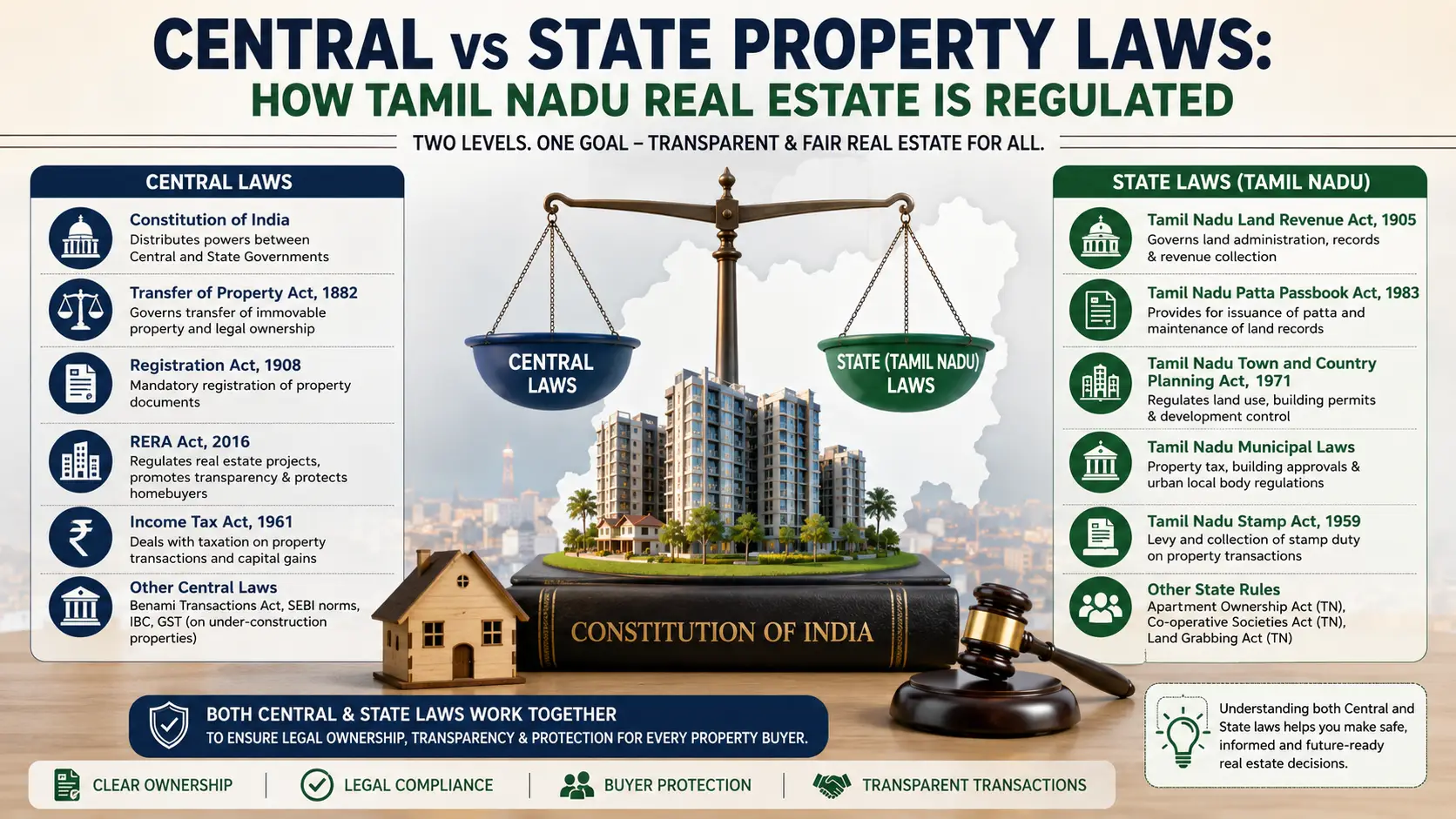
India follows a federal system, where both the Central Government and State Governments have powers to make laws. Property and land laws are a classic example of shared but unequal authority, which directly impacts real estate transactions, ownership, and development.
1. Constitutional Framework: Who Controls Property Laws?
The Indian Constitution (Seventh Schedule) divides law-making powers into three lists:
Union List (Central Government)
- Banking & finance
- Taxation (Income Tax, GST framework)
- Transfer of property in specific cases (companies, trusts, inheritance laws)
State List (State Governments)
- Land
- Land revenue
- Land records
- Agricultural land
- Stamp duty and registration
- Tenancy & land reforms
Concurrent List (Both)
- Transfer of Property (general principles)
- Contracts
- Civil procedures
- Urban planning
- Rent control
Key takeaway:
While ownership principles come from Central laws, actual control over land and real estate is largely with states.
2. Central Property Laws Applicable Across India
These laws apply uniformly across India unless states modify them.
2.1 Transfer of Property Act, 1882
Purpose:
Governs transfer of immovable property such as:
- Sale
- Mortgage
- Lease
- Exchange
- Gift
Impact in Tamil Nadu:
- Defines what is a “sale deed”
- Establishes rights of buyers and sellers
- Still applicable unless overridden by state amendments
2.2 Indian Contract Act, 1872
Purpose:
Ensures property transactions are legally enforceable contracts.
Key role:
- Validity of sale agreements
- Breach and compensation rules
2.3 Registration Act, 1908
Purpose:
- Mandatory registration of property documents
- Provides public notice of ownership
Tamil Nadu adapts:
- Higher stamp duties
- Specific registration rules and timelines
2.4 Real Estate (Regulation and Development) Act, 2016 (RERA)
Purpose:
- Protect homebuyers
- Regulate builders and developers
- Mandatory project registration
Tamil Nadu Implementation:
- Operates through Tamil Nadu RERA (TNRERA)
- Applies to apartments, plots, and large developments
2.5 Inheritance Laws (Personal Laws)
- Hindu Succession Act, 1956
- Muslim Personal Law
- Indian Succession Act, 1925
Relevance:
Determine who inherits property, not land administration.
Also Read: Differences Between Pre RERA and Post RERA Apartment in Chennai
3. State Property Laws: Tamil Nadu’s Authority
Unlike Central laws, Tamil Nadu has wide control over land matters.
4. Tamil Nadu–Specific Real Estate Laws
4.1 Tamil Nadu Stamp Act & Registration Rules
Controls:
- Stamp duty rates
- Registration fees
- Document formats
Current Structure (Indicative):
- Sale deed stamp duty: Higher than many states
- Registration fee: Fixed percentage of property value
- Property cannot be legally transferred without compliance.
4.2 Tamil Nadu Land Reforms Laws
Objectives:
- Prevent land hoarding
- Protect agricultural land
- Enforce land ceiling limits
Impact:
- Limits on how much agricultural land one person can own
- Non-agriculturists face restrictions
4.3 Tamil Nadu Town and Country Planning Act
Controls:
- Land use zoning
- Conversion of agricultural land to residential/commercial
- Building approvals
Authorities Involved:
- CMDA (Chennai)
- DTCP (Other regions)
4.4 Tamil Nadu Apartment Ownership Act
Purpose:
- Legal ownership of individual flats
- Common area rights
- Association formation
Mandatory for:
- Apartment complexes
- Gated communities
4.5 Patta, Chitta & Land Records System
- Patta: Ownership record
- Chitta: Land classification
- Adangal: Usage details
No patta = weak ownership claim
5. How This Affects Buyers & Investors in Tamil Nadu
Advantages
- Strong buyer protection (RERA)
- Clear land records system
- Strict building approval checks
Challenges
- High stamp duty
- Lengthy approvals
- Complex land conversion process
6. Special Focus: Agricultural vs Non-Agricultural Land
Tamil Nadu enforces:
- Strict conversion rules
- Local body approval mandatory
- Violation can lead to demolition or cancellation
7. Legal Hierarchy in Case of Conflict
- Constitution of India
- Central Laws
- State Laws
- Local Body Rules
If Central and State laws conflict:
Central law generally prevails unless land is exclusively a State subject
Conclusion
- Central laws define what property ownership means
- Tamil Nadu laws define how land is owned, transferred, and developed
- Successful real estate transactions in Tamil Nadu require compliance with both
Frequently Asked Questions
1. Can Tamil Nadu override Central property laws?
Partially.
Tamil Nadu can modify laws related to land, stamp duty, and registration but cannot override fundamental ownership rights under Central law.
2. Is RERA compulsory in Tamil Nadu?
Yes.
All eligible projects must register with TNRERA, failing which penalties apply.
3. Is patta mandatory for buying property?
Yes.
A patta establishes legal ownership and is critical for resale, loans, and approvals.
4. Can agricultural land be freely sold?
No.
Restrictions apply, especially for non-agriculturists and land exceeding ceiling limits.
5. Why is stamp duty higher in Tamil Nadu?
Stamp duty is a state revenue source, and Tamil Nadu has chosen higher rates to fund infrastructure and governance.
6. Which law is most important for homebuyers?
- RERA (buyer protection)
- Registration Act (legal validity)
- Stamp Act (financial compliance)
7. What happens if a building violates planning laws?
Penalties
Denial of completion certificate
Demolition in severe cases
8. Are oral property agreements valid?
Legally weak.
Only registered documents provide enforceable ownership rights.