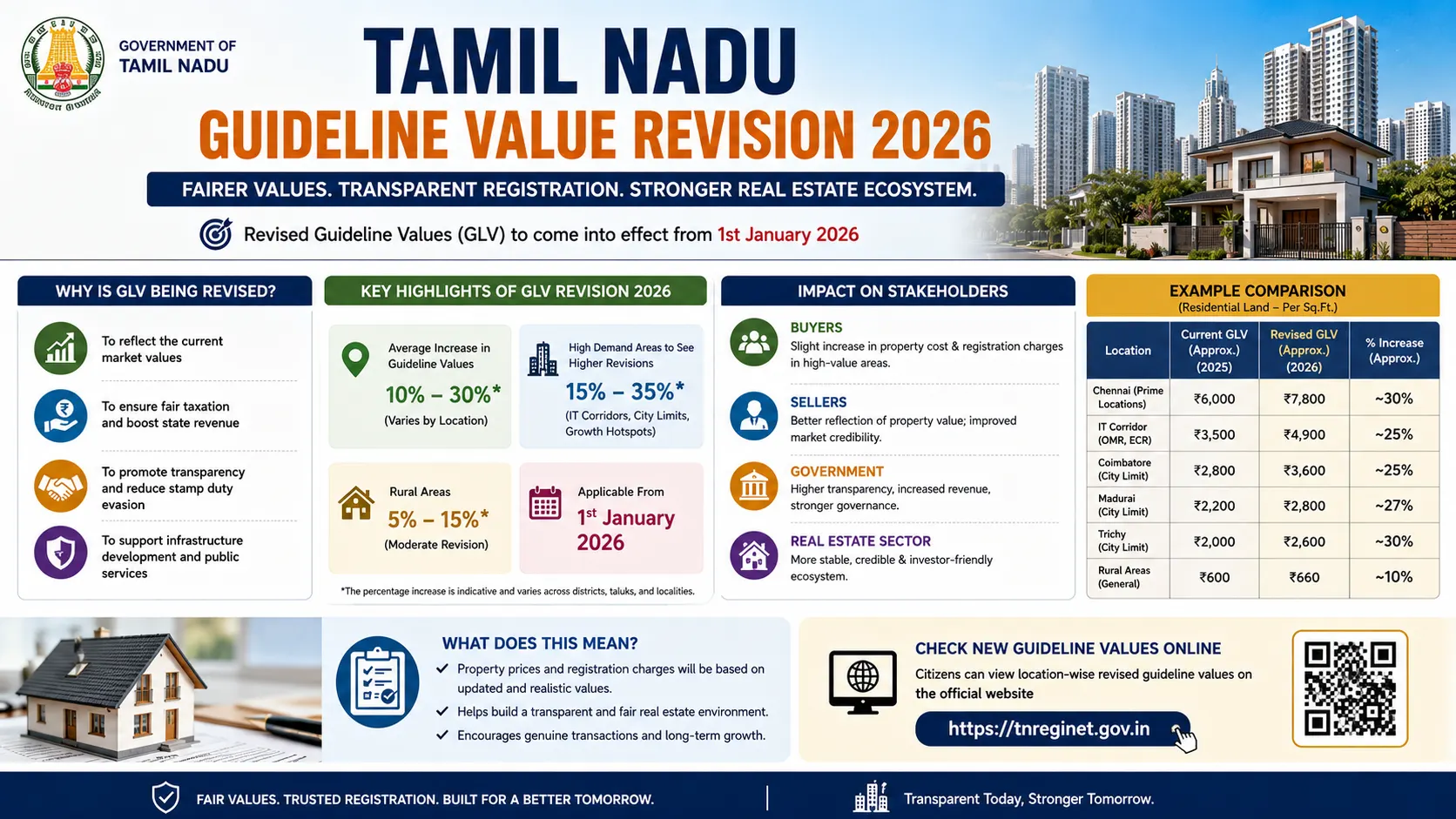
1. What Is Guideline Value in Tamil Nadu?
Guideline value is the minimum government-fixed value for land or buildings in a specific location. Property documents cannot be registered below this value. It is fixed and administered by the Tamil Nadu Registration and Stamps Department.
This value is used mainly for:
- Calculating stamp duty
- Calculating registration charges
- Preventing undervaluation of property
2. What Is the 2026 Guideline Value Revision?
The 2026 revision refers to the state-wide reassessment and update of guideline values carried out by the Government of Tamil Nadu to align property values with current market realities, especially in:
- Rapidly urbanizing areas
- Infrastructure-driven growth corridors
- Expanding municipal and suburban regions
This revision applies to:
- Urban areas (street-wise valuation)
- Rural areas (survey-number-wise valuation)
- Residential, commercial, and industrial properties
3. Why the Guideline Value Was Revised in 2026
The main objectives of the 2026 revision are:
- To reflect actual land price appreciation
- To reduce black-money transactions
- To increase stamp duty revenue
- To bring uniformity and transparency
- To update values after long gaps in certain regions
Many areas saw significant infrastructure growth (roads, metro, IT parks), making earlier guideline values outdated.
4. How Guideline Values Are Fixed
Guideline values are determined based on:
- Location (urban / rural)
- Road width and importance
- Accessibility and transport facilities
- Nearby commercial activity
- Past registered sale data
- Land classification (residential, commercial, industrial)
- Demand trends
Committees at district and state levels review data before approval.
Also Read: Latest Apartment Law Changes in Chennai 2025 and 2026
5. Area-Wise Impact of 2026 Revision
- Metro cities & suburbs: Higher increases due to demand and development
- Developing corridors: Moderate to high increases
- Rural and agricultural zones: Limited or gradual changes
- Prime commercial streets: Higher revisions than residential streets
Not all areas saw the same increase; changes are location-specific.
6. Impact on Property Buyers and Sellers
For Buyers
- Higher stamp duty and registration cost if guideline value increased
- Better clarity on legal property valuation
For Sellers
- Reduced scope for undervaluation
- More transparent transactions
For Investors
- Improved valuation benchmarks
- Better confidence in documentation
7. Stamp Duty and Registration Charges (Based on Guideline Value)
For sale deeds in Tamil Nadu:
- Stamp Duty: 7%
- Registration Fee: 4%
These charges are calculated on the higher of:
- Sale price, or
- Guideline value
8. Guideline Value vs Market Value
Aspect / Guideline Value / Market Value
Fixed by
- Government
- Buyer & seller
Purpose
- Tax calculation
- Actual sale
Nature
- Minimum value
- Fluctuating
Can be lower/higher
- Yes
- Yes
Registration uses the higher value for duty calculation.
9. Where to Check the 2026 Guideline Value
Guideline values can be checked on the official portal of the TNREGINET, maintained by the Registration Department.
Search options include:
- Street name (urban)
- Survey number (rural)
- SRO-wise location details
Frequently Asked Questions (FAQs)
Q1. Is the 2026 guideline value compulsory for property registration?
Yes. Property registration cannot be done below the revised guideline value.
Q2. Can I sell my property below the guideline value?
You can, but stamp duty and registration charges will still be calculated on the guideline value.
Q3. Does the 2026 revision apply to all districts in Tamil Nadu?
Yes. The revision applies statewide, but value changes vary by location.
Q4. Does guideline value affect home loan approval?
Yes. Banks often consider guideline value while assessing property security.
Q5. Are apartments affected by the guideline value revision?
Yes. Apartments follow composite values that include land and building cost.
Q6. How often are guideline values revised in Tamil Nadu?
There is no fixed schedule. Revisions occur periodically based on market conditions.
Q7. What happens if guideline value is higher than market value?
You must still pay stamp duty on the guideline value.
Q8. Who has the authority to revise guideline values?
The Tamil Nadu Government through the Registration and Stamps Department.
Q9. Does agricultural land also have guideline value?
Yes. Agricultural land has survey-number-based guideline values.
Q10. Can guideline value be challenged or appealed?
Generally no, unless there is a documented administrative error.