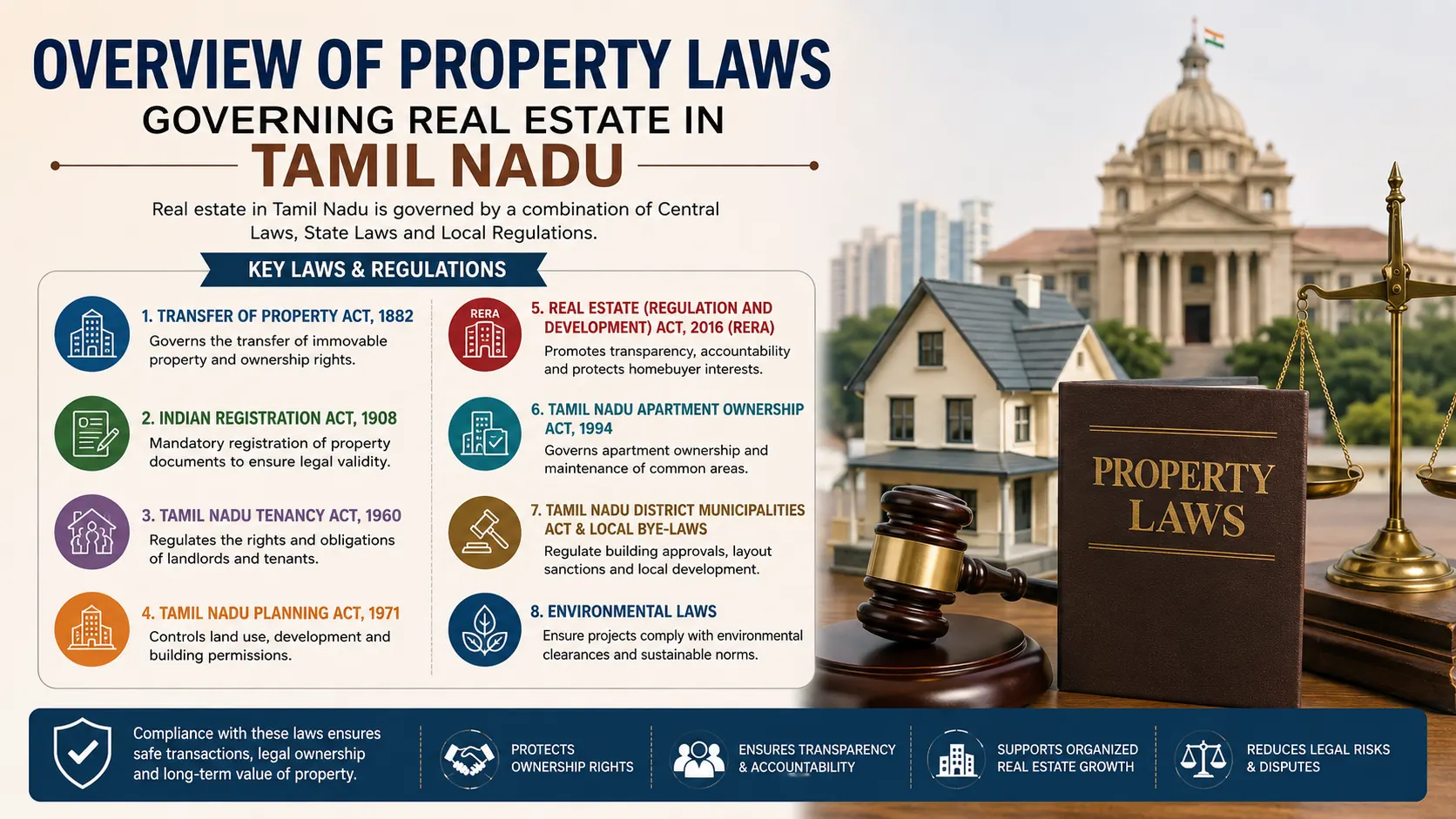
Property and real estate transactions in Tamil Nadu are governed by a combination of central laws and state-specific statutes, along with rules issued by the Tamil Nadu Government and local authorities. These laws regulate ownership, transfer, registration, land classification, construction, tenancy, taxation, and dispute resolution.
1. Ownership and Classification of Property
Types of Property
Property in Tamil Nadu is broadly classified into the following:
- Immovable Property
- Land (agricultural and non-agricultural)
- Residential buildings
- Commercial buildings
- Industrial property
- Movable Property
- Does not include land or buildings (not governed by real estate laws)
Land Classification in Tamil Nadu
Land records classify land as the following:
- Agricultural land (Nanjai / Punjai)
- Residential land
- Commercial land
- Industrial land
- Government poramboke land
- Assigned land
Conversion of agricultural land for residential or commercial use requires approval from competent revenue authorities.
2. Transfer of Property
Modes of Transfer
Property can be transferred through:
- Sale
- Gift
- Lease
- Mortgage
- Exchange
- Inheritance or succession
Legal Requirements
- A valid transfer must involve competent parties, lawful consideration, and clear title.
- Certain transfers (sale, gift of immovable property) must be registered to be legally valid.
3. Registration of Property
Mandatory Registration
Under registration laws:
- Sale deeds
- Gift deeds
- Mortgage deeds
- Lease deeds (exceeding 11 months)
must be registered at the Sub-Registrar Office where the property is located.
Stamp Duty and Registration Charges (Indicative)
- Sale deed: Approx. 7% stamp duty + 4% registration fee
- Gift deed (family members): Lower concessional rates
- Rates may vary depending on government notifications
Guideline Value
- The government fixes a guideline value for every area
- Stamp duty is calculated on the higher of guideline value or sale consideration
4. Title Verification and Due Diligence
Before purchasing property, buyers must verify:
- Parent documents (minimum 30 years)
- Encumbrance Certificate (EC)
- Patta / Chitta / Adangal
- Approved layout and building plan
- Tax receipts
- Completion certificate (for apartments)
Failure to conduct due diligence can result in title disputes or loss of ownership.
5. Revenue Records and Patta System
Patta
- A Patta is a revenue record showing ownership of land
- It contains details such as survey number, land type, and owner name
Importance of Patta
- Proof of possession
- Required for sale, mortgage, or construction
- Needed for availing loans
Types of Patta
- Individual Patta
- Joint Patta
- Sub-division Patta
6. Real Estate Development and Construction Laws
Planning and Development Control
Construction is regulated by:
- Local planning authorities
- Municipal corporations
- Town and country planning departments
Key Requirements
- Approved layout
- Building plan approval
- Adherence to Floor Space Index (FSI)
- Fire safety clearance
- Environmental clearance (for large projects)
Unauthorized constructions are subject to penalties, sealing, or demolition.
7. Apartment Ownership and Housing Societies
Apartment Ownership
- Buyers own individual flats and share common areas proportionately
- The builder must execute a sale deed and undivided share (UDS) of land
Association of Owners
- Apartment owners form a registered association
- Responsible for maintenance, common expenses, and management
8. Tenancy and Lease Laws
Residential and Commercial Leasing
- Lease agreements must be stamped and registered (if above 11 months)
- Tenants are protected from arbitrary eviction
- Rent revision and eviction follow legal procedure
Rights and Duties
- Tenant: timely rent, proper usage
- Landlord: maintenance, peaceful possession
9. Real Estate Regulation (RERA)
Applicability
- Mandatory registration for real estate projects exceeding prescribed size
- Applies to builders, promoters, and real estate agents
Key Protections
- Transparency in project details
- Timely delivery
- Defect liability
- Refund and compensation rights
Also Read: Differences Between Pre RERA and Post RERA Apartment in Chennai
10. Property Tax and Local Levies
Types of Taxes
- Property tax (municipality/corporation)
- Water and sewerage tax
- Vacant land tax (where applicable)
Consequences of Non-Payment
- Penalties
- Interest
- Attachment of property in extreme cases
11. Inheritance and Succession
Applicable Laws
- Hindu succession law
- Muslim personal law
- Indian Succession Act (for Christians and others)
Modes of Inheritance
- Through a Will
- Intestate succession (no will)
- Legal heirs must apply for legal heir certificate or succession certificate.
12. Dispute Resolution in Property Matters
Common Disputes
- Title disputes
- Boundary disputes
- Builder-buyer disputes
- Tenancy disputes
Forums
- Civil courts
- Revenue authorities
- RERA authority
- Consumer courts (in certain cases)
13. Special Considerations in Tamil Nadu
- Assignment lands have transfer restrictions
- Coastal Regulation Zone (CRZ) rules apply in coastal areas
- Temple and wakf properties have special legal protection
- Government lands cannot be sold or encroached upon
Frequently Asked Questions
1. Is registration mandatory for property purchase in Tamil Nadu?
Yes. Sale deeds, gift deeds, and long-term leases must be registered to be legally valid.
2. What is a Patta, and is it compulsory?
Patta is a land revenue record showing ownership. While not a title document, it is essential for transactions, loans, and construction approvals.
3. Can agricultural land be purchased by anyone?
Yes, but conversion approval is required if the land is to be used for non-agricultural purposes.
4. How can I check if a property is legally safe?
By verifying title deeds, encumbrance certificates, pattas, approved plans, and tax receipts.
5. What happens if stamp duty is undervalued?
Authorities may impose penalties and demand additional stamp duty with interest.
6. Are unregistered sale agreements valid?
No. They do not confer ownership rights, though they may have limited contractual value.
7. What is the role of RERA in Tamil Nadu?
RERA ensures transparency and timely delivery and protects buyers from unfair practices by builders.
8. Can a tenant be evicted easily?
No. Eviction must follow legal procedure and valid grounds under tenancy laws.
9. Is oral partition of property valid?
In some family arrangements, oral partition may be recognized, but written and registered documents are strongly recommended.
10. What is the undivided share (UDS) in apartments?
UDS represents the buyer’s proportional ownership in the land on which the apartment is built.