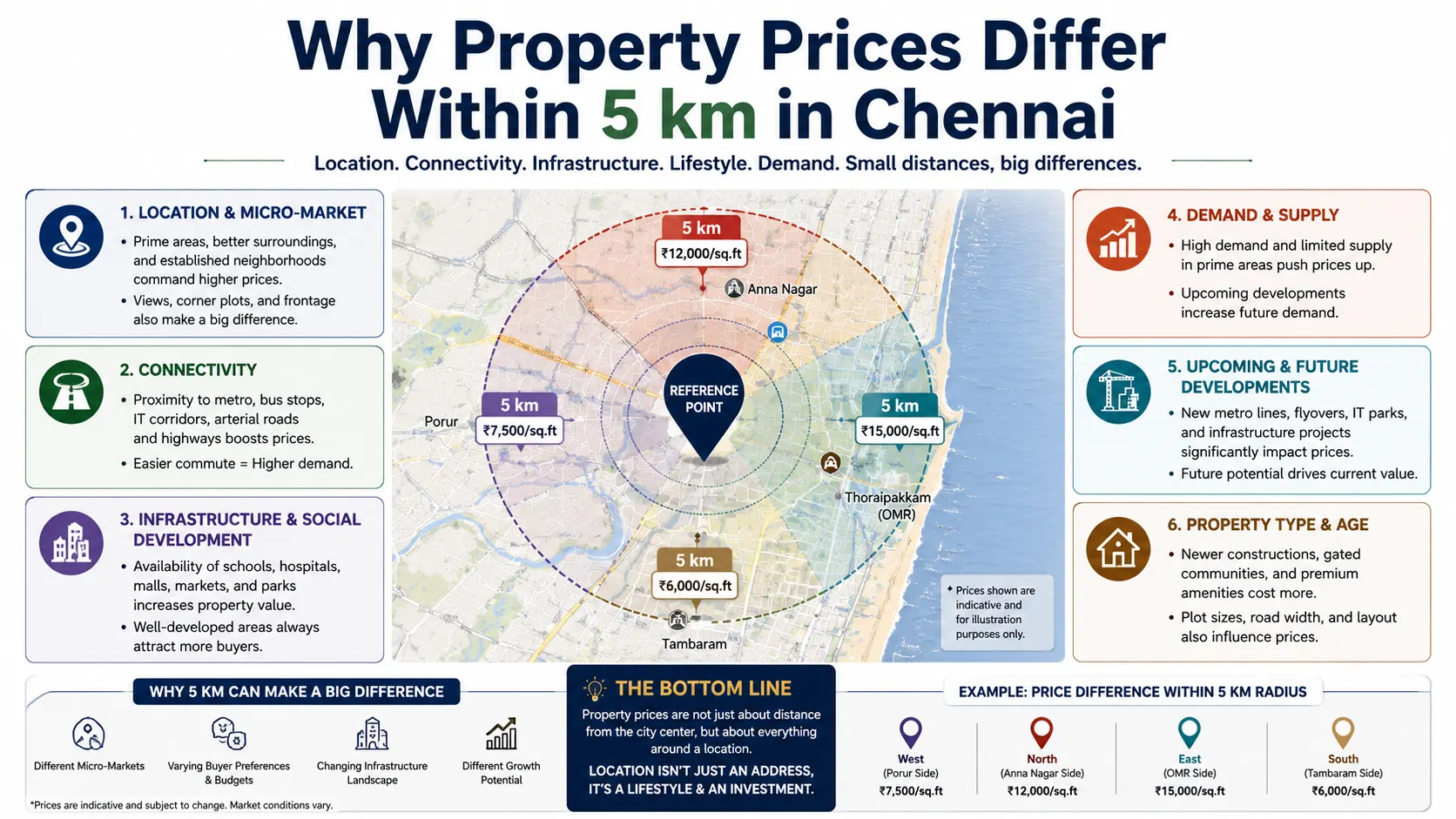
Property prices in Chennai can change dramatically within just 5 km because real estate value is not driven by distance alone—it is driven by micro-market economics, livability, social perception, and infrastructure maturity.
1. Infrastructure Maturity Matters More Than Distance
Two localities 3–5 km apart may look similar on a map, but on the ground,
- One area may have underground drainage, stormwater drains, wide roads, metro access
- The other may still rely on water tankers, narrow roads, flooding-prone streets,
In Chennai, infrastructure has grown unevenly, not uniformly. Older, well-planned zones command a premium because livability is already proven, not promised.
2. Land History & Ownership Patterns
This is a huge but invisible factor.
Within 5 km, land could be
- Old city freehold land (clear title, generations old)
- Former agricultural land converted recently
- Government-allotted or rehousing board areas
- Mixed patta / disputed-title zones
Even if buildings look similar, developers price higher where land acquisition risk was lower.
3. Social Reputation & Buyer Psychology
Property value is deeply tied to perception.
Examples:
- “Good residential area”
- “Flood-prone zone”
- “Labour belt”
- “Upcoming IT belt”
- “Old money locality”
These reputations:
- It takes decades to build
- Change very slowly
- Strongly influence end-user demand
Two areas 4 km apart can attract completely different buyer classes, which immediately reflects in pricing.
Also Read: Chennai Real Estate Market 2026 Property Prices, Emerging Hotspots, Buyer Demand & Future Growth
4. Zoning & Development Control Rules
Localities fall under different categories:
- Floor Space Index (FSI)
- Building height restrictions
- Commercial vs residential zoning
Higher FSI areas allow the following:
- Taller buildings
- More units per land parcel
- Better project economics
Lower FSI areas:
- Have fewer apartments
- More independent houses
- Limited new supply
- Scarcity + demand = higher price.
5. Employment Catchment vs Transit Distance
People don’t measure distance in kilometers.
They measure it in:
- Commute time
- Signal density
- Traffic stress
- First/last-mile ease
An area farther but better connected can be more valuable than a closer but congested one.
Being:
- On a metro line
- Near arterial roads
- Close to job clusters
creates price premiums even if another area is physically nearby.
6. Type of Demand: End-User vs Investor
Prices rise fastest where end-users dominate, not investors.
End-users value:
- Schools
- Hospitals
- Walkability
- Community stability
Investor-heavy zones:
- Rise fast in booms
- Fall or stagnate in slowdowns
Within 5 km, one area may have stable family demand, while another is driven by speculative buying—creating price gaps.
7. Supply Density & Apartment Saturation
Some pockets have:
- Limited land
- Fewer new approvals
- Older independent houses
- Others have:
- High-rise clusters
- Hundreds of new units every year
- Aggressive developer pricing competition
More supply = price pressure.
That’s why a quieter, low-density neighborhood can be costlier than a nearby high-rise zone.
8. School, Hospital & Lifestyle Gravity
Certain institutions act like price magnets:
- Reputed schools
- Multi-specialty hospitals
- Retail hubs
- Cultural centers
Families prefer to live within a comfort radius of these—even if it costs more.