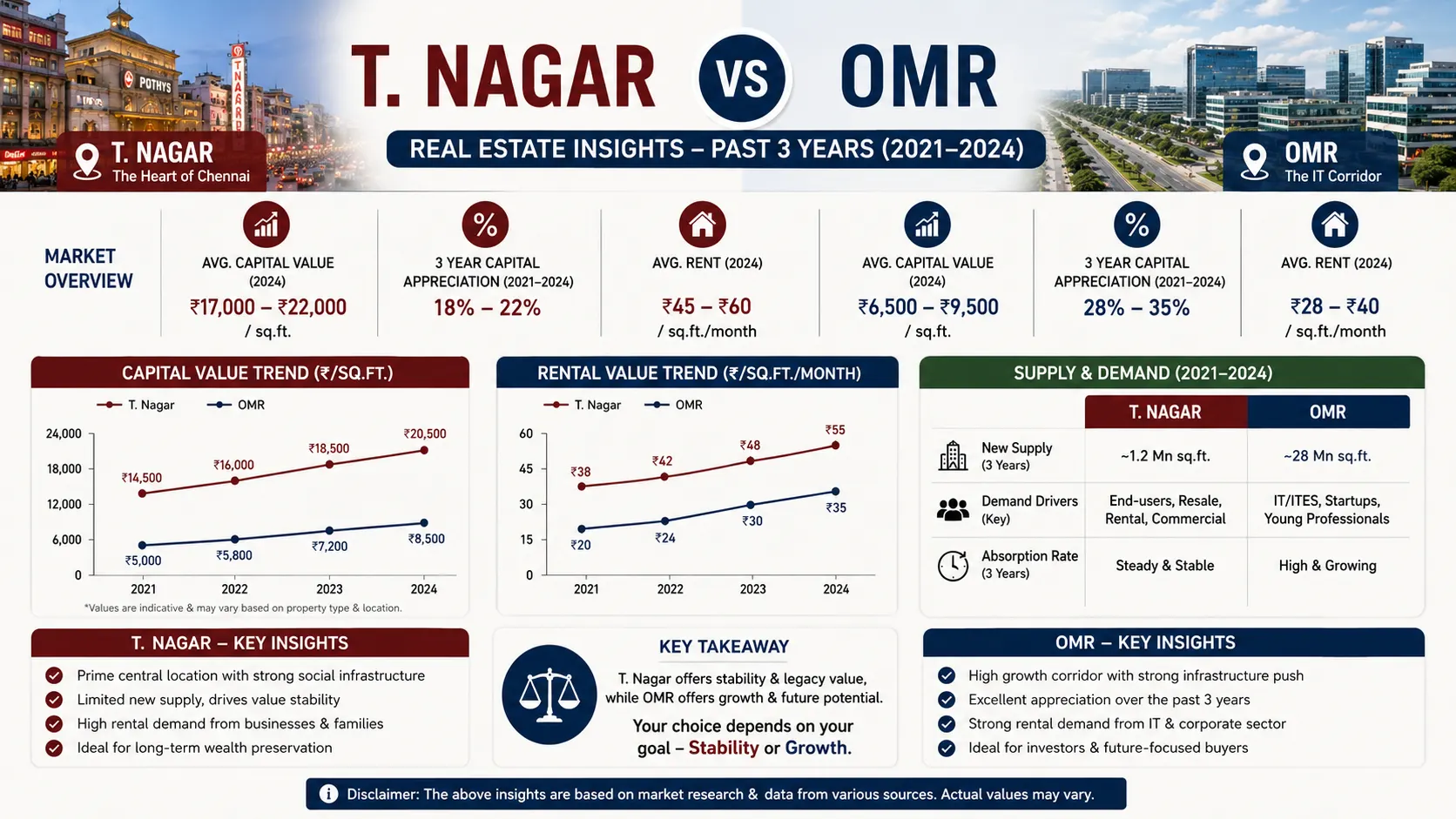
Chennai’s residential real-estate landscape clearly reflects two contrasting market models when comparing T. Nagar and Old Mahabalipuram Road (OMR). While both areas have seen price growth over the last three years, the nature of demand, supply constraints, pricing behavior, and long-term market stability differ substantially.
1. Location & Urban Role
T. Nagar
T. Nagar is a core city locality with a long residential and commercial history. It functions as a dense urban node with strong retail activity, established neighbourhoods, and long-standing social infrastructure. Due to its central positioning, it serves as a preferred residential address for households seeking proximity to major city zones.
OMR
OMR is a linear growth corridor, developed primarily around Chennai’s IT and knowledge economy. Unlike T. Nagar’s compact urban form, OMR stretches across multiple micro-markets, each at a different stage of development. Residential growth on OMR has closely followed employment expansion.
2. Residential Supply Characteristics
T. Nagar
- Extremely limited land availability
- New supply mainly comes through redevelopment of older buildings
- Low volume of large gated communities
- Supply constraints are structural and permanent
This restricted supply has resulted in price rigidity and resistance to downward corrections.
OMR
- Large land parcels available, especially in mid and outer stretches
- Continuous addition of apartments and gated communities
- Supply is elastic and responds to demand cycles
As a result, OMR prices are more sensitive to market conditions and infrastructure timelines.
3. Average Price Trends (Rs per sq. ft.—Residential)
T. Nagar: Past 3 Years
Year / Average Price Range
- 2024
- Rs 14,000 – Rs16,000
- 2025
- Rs 15,500 – Rs18,000
- 2026
- Rs 17,000 – Rs 20,000+
Insights
- Prices remain among the highest in Chennai
- Significant variation between inner streets and peripheral pockets
- Older properties may trade at lower absolute values but still command high per sq.ft rates
Residential Property For Sale in T Nagar
OMR: Past 3 Years
Year / Average Price Range
- 2024
- Rs 6,000 – Rs 7,000
- 2025
- Rs 7,000 – Rs 8,200
- 2026
- Rs 7,800 – Rs 9,000
Micro-Market Spread
- Inner OMR: Rs 9,000 – Rs 15,000+
- Mid OMR: Rs 6,500 – Rs 10,000
- Outer OMR: Rs 4,500 – Rs 8,000
Residential Property For Sale in OMR
4. Price Appreciation Behaviour
T. Nagar
- Appreciation is steady and incremental
- Growth driven by scarcity rather than expansion
- Price increases are gradual but consistent
- Downside risk historically limited due to strong end-user base
3-Year Growth (Approx.): 20–30%
OMR
- Appreciation is cycle-based
- Inner OMR shows stronger appreciation than outer stretches
- Growth influenced by employment absorption and infrastructure delivery
- Prices can stagnate temporarily during high-supply phases
3-Year Growth (Approx.): 30–35%
5. Demand Profile
T. Nagar
- Dominated by end-users
- Strong presence of long-term residents
- Demand driven by lifestyle convenience and centrality
- Lower speculative activity
OMR
- Demand largely from working professionals
- Higher share of investor participation
- Rental-led demand plays a major role
- Demand fluctuates with job market conditions
6. Infrastructure Influence
T. Nagar
- Infrastructure is mature and largely saturated
- Improvements mainly focused on upgrades rather than expansion
- Prices are less dependent on future infrastructure announcements
OMR
- Infrastructure development is a key price driver
- Road expansion, transit connectivity, and social infrastructure directly affect valuation
- Infrastructure delays can temporarily affect demand and pricing
7. Long-Term Market Character
T. Nagar
- High-value, low-supply urban market
- Prices reflect legacy value and central importance
- Growth is slower but more predictable
OMR
- Expanding suburban corridor
- Prices reflect future potential and economic activity
- Growth is faster but uneven across stretches