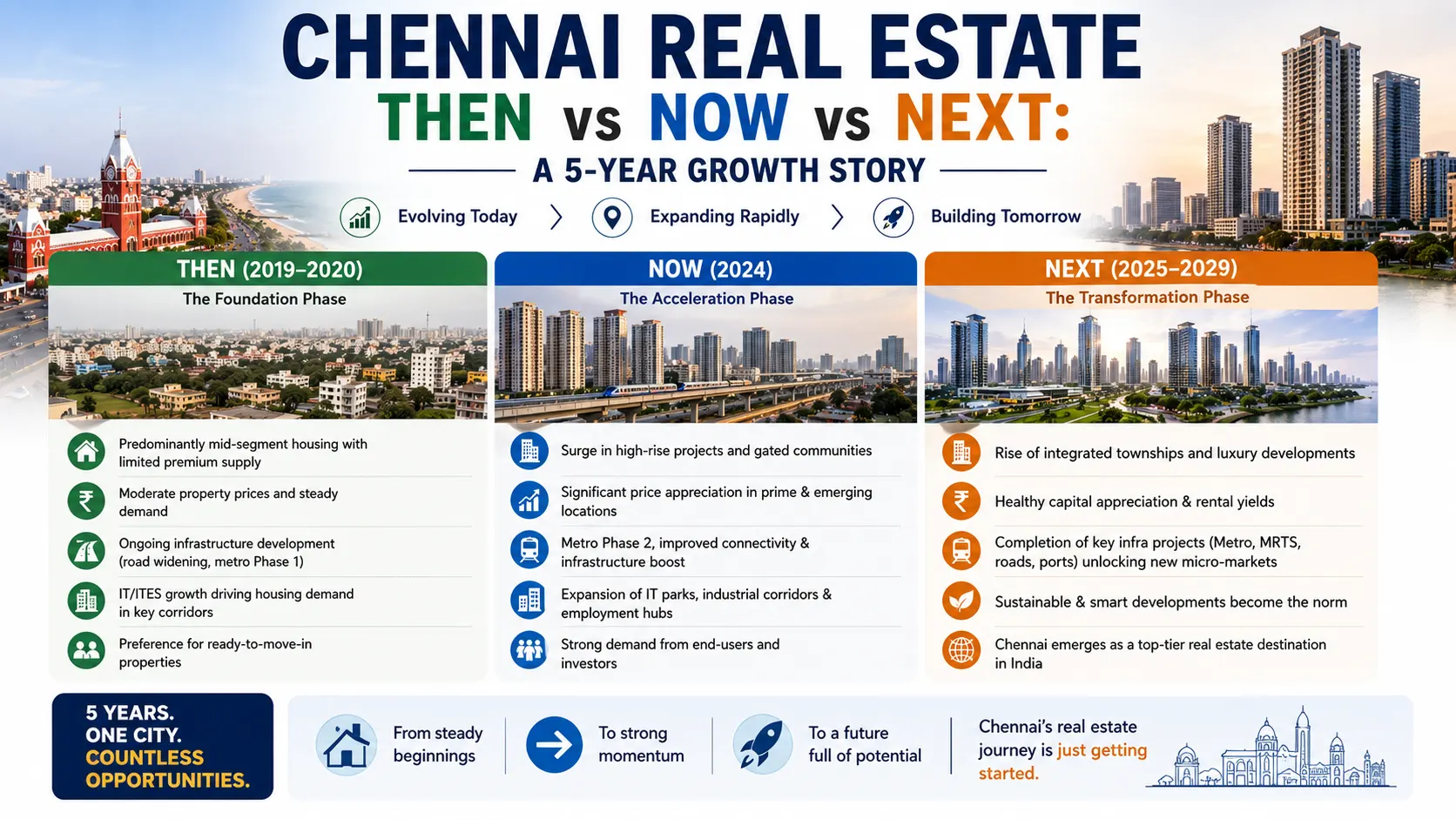
Chennai has historically stood apart from other Indian metros due to its end-user-driven real estate market, controlled supply, and long-term price stability. Unlike cities driven by speculative cycles, Chennai’s property market has evolved gradually, shaped by infrastructure, employment, and livability factors.
THEN: Chennai Real Estate in the Past 5 Years (Approx. 2019–2023)
During this phase, Chennai’s real estate market was defined by consistency rather than volatility.
Market Behaviour
- Residential prices grew at a moderate but steady pace, typically in the range of mid-single-digit annual appreciation.
- The market avoided sharp booms or crashes even during national slowdowns and pandemic-related disruptions.
- Demand was dominated by self-use buyers, with limited speculative investment.
Structural Characteristics
- Supply remained controlled, preventing large unsold inventory.
- Developers focused primarily on mid-segment and affordable housing, with fewer ultra-luxury launches compared to other metros.
- Peripheral areas expanded gradually as infrastructure improved.
Location-Level Growth
- Established residential areas such as Anna Nagar, Adyar, and Besant Nagar saw capital preservation rather than aggressive appreciation.
- IT-linked corridors like OMR and Porur experienced incremental growth due to employment density.
- Suburban belts such as Tambaram, Medavakkam, and Pallikaranai transitioned from fringe markets to mainstream residential zones.
Overall, this period reinforced Chennai’s image as a low-risk, long-term real estate market.
NOW: Chennai Real Estate in the Present Phase (2024–2026)
The current phase represents a structural strengthening of the market rather than a speculative surge.
Current Pricing Environment
- Residential prices vary significantly by micro-market, reflecting connectivity, proximity to employment hubs, and infrastructure readiness.
- Price growth continues to remain measured, with negotiation playing a role in buyer decisions.
Demand Dynamics
- Demand is increasingly skewed toward ready-to-occupy homes, gated communities, and regulated projects.
- Larger unit sizes, lifestyle amenities, and community-oriented developments have gained prominence.
- Rental demand has strengthened in employment-centric locations due to workforce migration and limited new supply in core areas.
Market Sentiment
- Buyers display high price sensitivity and due diligence, indicating a mature market.
- Developers prioritize execution quality and delivery timelines over volume-driven expansion.
- The market remains fundamentally end-user oriented, with investment activity focused on rental yield rather than short-term flips.
At present, Chennai real estate reflects stability with selective growth, supported by genuine housing demand.
Residential Property For Sale In Chennai
NEXT: Chennai Real Estate Outlook for the Next 5 Years (2026–2031)
The upcoming phase is expected to be driven by infrastructure transformation and economic diversification.
Growth Outlook
- City-wide residential values are projected to grow at sustainable annual rates, aligned with income growth and job creation.
- Peripheral and transit-oriented developments are expected to outperform central zones in percentage appreciation.
Infrastructure-Led Expansion
Key drivers shaping the next phase include:
- Metro rail network expansion connecting suburban corridors
- Road and expressway upgrades improving commute efficiency
- Airport and logistics-led commercial development
These factors are expected to redistribute housing demand across newer micro-markets.
Economic & Employment Influence
- Chennai’s diversified economy—spanning IT, automobile manufacturing, electronics, healthcare, and services—reduces dependency on a single sector.
- Expansion of office spaces, industrial parks, and data centers is expected to create localized residential demand clusters.
Market Character Going Forward
- Growth is expected to remain non-speculative and end-user-centric.
- Capital appreciation will be gradual, with rental yield and livability playing a greater role in valuation.
- Markets with integrated infrastructure and employment access will demonstrate stronger long-term performance.
Overall Insight
Chennai’s real estate story is not about rapid spikes, but about durability and long-term value creation. Over the last five years, the city has demonstrated resilience. In the present, it shows maturity. In the next phase, it is positioned for structured, infrastructure-driven expansion rather than speculative escalation.