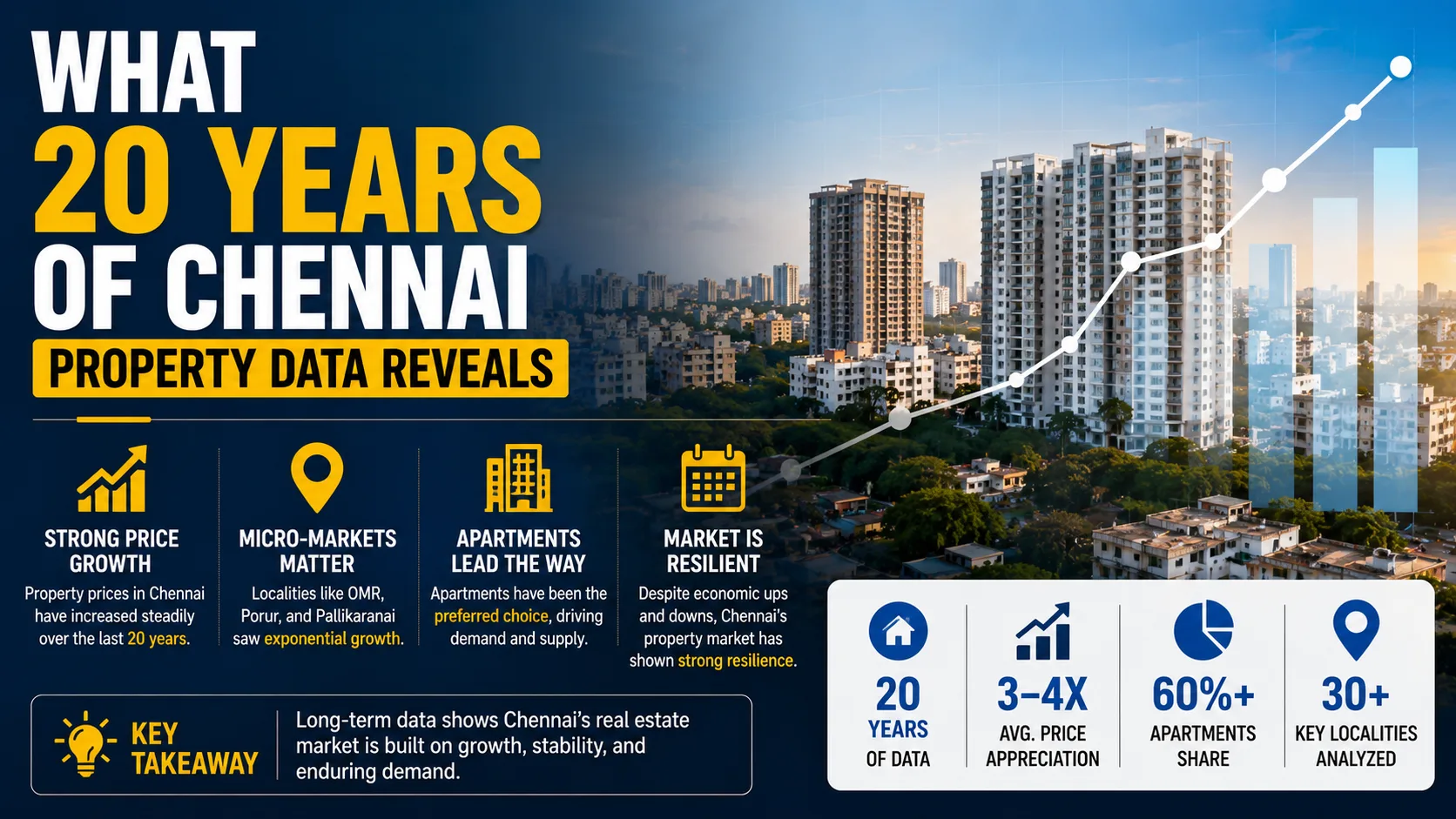
1. Chennai Is a Stability-First Property Market
Over the last two decades, Chennai’s real estate has shown low volatility compared to other Indian metros. Prices have moved in gradual steps rather than sharp spikes or crashes. Even during major disruptions (global financial crisis, demonetization, COVID), prices largely flattened instead of collapsing, indicating a fundamentally demand-driven market.
Insight: Chennai behaves more like a “capital preservation” market than a speculative growth market.
2. End-User Demand Dominates Long-Term Pricing
Across 20 years of data, most residential purchases were driven by people intending to live in the property, not flip it. This has led to:
- Fewer price bubbles
- Slower but steadier appreciation
- Strong resistance to panic selling
Rental demand, job proximity, and liveability consistently mattered more than hype.
Insight: Prices reflect real housing needs rather than investor sentiment.
3. Infrastructure Creates Localized Growth, Not Citywide Booms
Property appreciation in Chennai has been corridor-specific:
- IT corridors, industrial belts, and transit-linked zones saw higher growth
- Interior or poorly connected pockets lagged, even during market upcycles
Major infrastructure announcements initially raised expectations, but actual price appreciation followed only after real usage began, often years later.
Insight: Long-term data shows Chennai rewards infrastructure delivery, not announcements.
Also Read: Chennai Real Estate Past, Present & Future Price Comparison with Other Cities
4. Land Appreciates Faster Than Apartments Over Time
Twenty years of transaction data show a clear pattern:
- Land values compounded strongly due to scarcity
- Apartments appreciated slower due to depreciation, maintenance, and supply
Independent houses in established neighborhoods often outperformed newer high-rise developments over long holding periods.
Insight: In Chennai, scarcity beats scale over long durations.
5. Affordability Acts as a Natural Price Regulator
Unlike markets that overshoot affordability and then correct sharply, Chennai’s price growth repeatedly slows when income-to-price ratios stretch. This self-regulation has:
- Prevented extreme overvaluation
- Kept entry-level and mid-segment demand alive
- Pushed development outward instead of upward in price
Insight: Household income growth has quietly capped excessive price escalation.
6. Rental Yields Stayed Modest but Reliable
Over two decades:
- Rental yields remained moderate
- Vacancy risk stayed low in employment hubs
- Rent growth followed salary growth, not asset price inflation
This reinforced Chennai’s reputation as a utility-focused housing market rather than a yield-chasing one.
Insight: Cash flow stability mattered more than yield maximization.
7. Market Memory Is Long
Historical data shows that Chennai buyers:
- Remember flood-prone zones
- Discount poorly planned layouts
- Penalize builders with past delivery or quality issues
Negative events permanently affected pricing in certain micro-markets, even years later.
Insight: Chennai prices embed long institutional memory, reducing repeated mistakes.
8. Luxury Emerged Late and Grew Selectively
For nearly half the 20-year period, luxury housing demand was limited. Growth in high-end segments accelerated only in the last decade, driven by:
- Higher disposable incomes
- NRI participation
- Lifestyle-oriented buyers
Yet even luxury growth remained measured, not explosive.
Insight: Chennai adopted luxury cautiously, not aggressively.
9. Supply Has Generally Matched Demand
Long-term approvals and completion data show fewer extreme supply gluts compared to other metros. Oversupply occurred in specific corridors, but citywide imbalance was rare.
Insight: Controlled development reduced systemic price risk.
10. Overall 20-Year Pattern
Across cycles, reforms, and economic changes, Chennai property data reveals:
- Slow but dependable appreciation
- Strong downside protection
- Micro-market differentiation
- Buyer rationality over speculation
Insight:
Chennai’s real estate market rewards patience, fundamentals, and long holding periods, not short-term trading or hype-driven decisions.