1. What Is Illegal Apartment Construction?
Illegal apartment construction refers to any residential building or apartment project developed in violation of applicable laws, regulations, or approvals issued by government or local authorities. Such construction is considered unlawful regardless of whether it is partially or fully completed.
Common situations that make an apartment construction illegal include:
- Construction without obtaining mandatory building permits
- Building more floors, units, or area than approved
- Deviations from the sanctioned building plan
- Construction on land not approved for residential use
- Non-compliance with fire safety, structural safety, or environmental norms
- Failure to obtain Completion Certificate (CC) or Occupancy Certificate (OC)
2. Laws Governing Apartment Construction (India – General Framework)
Apartment construction is regulated by multiple layers of law, not a single statute.
a) Municipal & Local Authority Laws
Municipal corporations and development authorities regulate:
- Building plan approvals
- Floor Area Ratio (FAR) / Floor Space Index (FSI)
- Height restrictions
- Setbacks and open spaces
- Zoning and land-use rules
Any violation of these rules makes construction illegal.
b) Town Planning & Development Acts
State-level planning laws control:
- Master plans and development plans
- Land-use classification (residential, commercial, mixed-use, etc.)
- Road access, public utilities, and infrastructure planning
Unauthorized construction that contradicts these plans is illegal.
c) Real Estate Regulatory Authority (RERA)
Under RERA:
- Apartment projects must be registered before sale or advertisement
- Builders must follow sanctioned plans and disclose approvals
- Structural changes without buyer consent are prohibited
Non-registration or deviation is a legal offence with serious penalties.
d) Environmental & Safety Laws
Large apartment projects must comply with:
- Environmental clearance regulations
- Fire safety approvals
- Structural stability certifications
Non-compliance can result in immediate stoppage or demolition orders.
Also Read: Understanding RERA Registration and its Importance Before Buying Property
3. Types of Illegal Apartment Construction
Illegal apartment construction commonly falls into the following categories:
- No Approval Construction – Entire building constructed without any permission
- Excess Construction – Extra floors, flats, or built-up area beyond approval
- Plan Deviations – Change in layout, staircases, parking, or flat sizes
- Zoning Violations – Residential apartments built in non-residential zones
- Encroachment – Construction on public land, roads, or open spaces
- Unsafe Construction – Violating fire, seismic, or structural safety norms
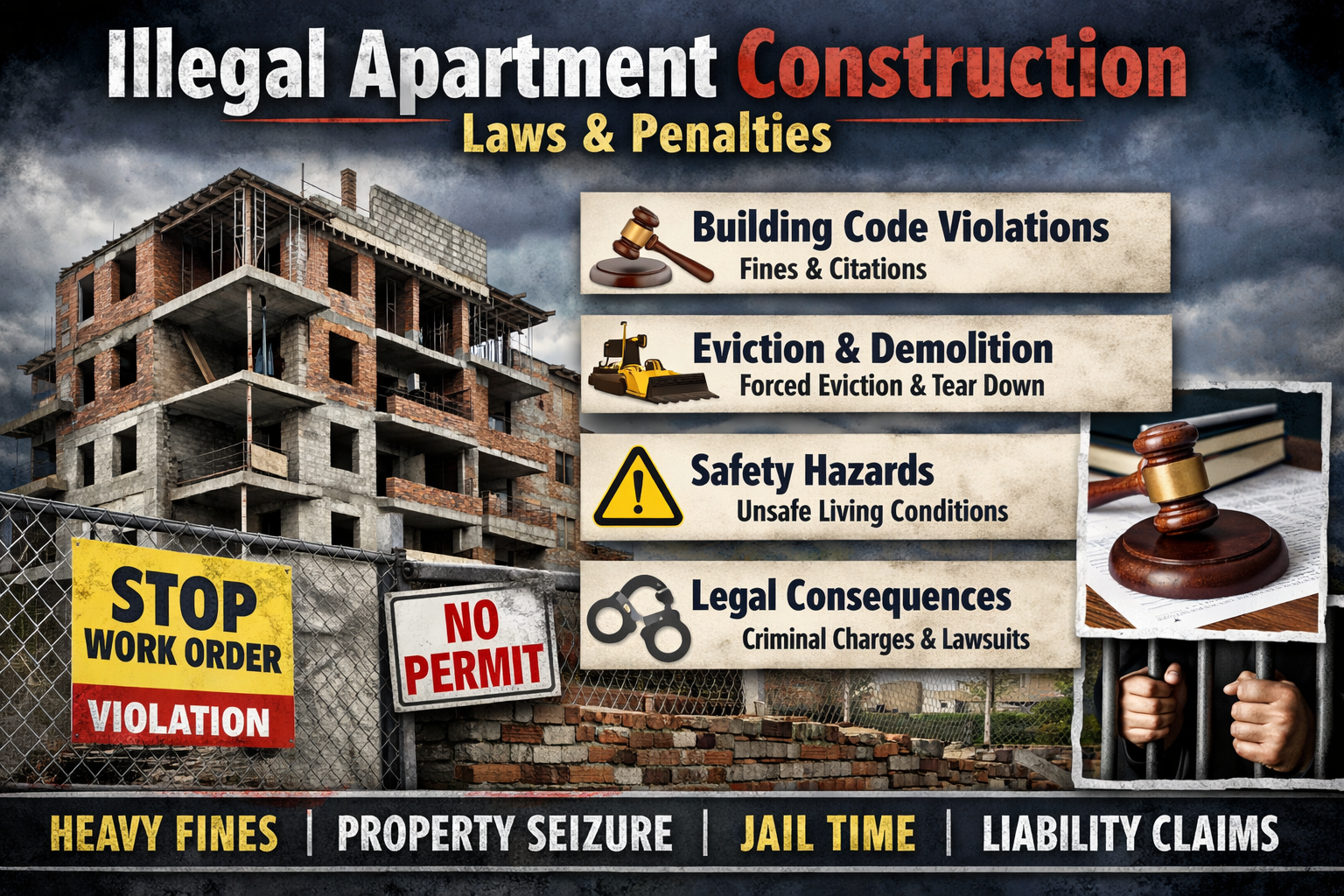
4. Penalties for Illegal Apartment Construction
Penalties vary by state and city but usually include multiple consequences applied together.
a) Monetary Fines
- Heavy fines imposed by municipal authorities
- Fines may increase daily until compliance
- Higher penalties for willful or repeated violations
b) Stop-Work Notices
Authorities may issue:
- Immediate stop-work orders
- Sealing of construction site
- Cancellation of permits
Continuing work after such notice is a serious offence.
c) Demolition Orders
- Illegal portions or entire buildings may be demolished
- Demolition costs are recovered from the owner/developer
- Courts generally do not protect unauthorized structures
d) Criminal Liability
Depending on severity:
- Prosecution under municipal or planning laws
- Imprisonment provisions for defying lawful orders
- FIRs against developers, owners, or responsible officials
e) Loss of Legal Status
- No Occupancy Certificate (OC)
- Utilities like water, electricity, and sewage may be denied
- Apartments become difficult or impossible to sell or mortgage
f) Civil Liability
- Buyers may sue builders for fraud or misrepresentation
- Compensation, refunds, or cancellation of agreements may be ordered
5. Impact on Apartment Buyers & Residents
Residents of illegal apartments may face:
- Risk of eviction or demolition
- Lack of basic civic services
- Inability to obtain home loans
- Reduced property value
- Long legal disputes with uncertain outcomes
Even innocent buyers can be affected, as legality depends on the building — not intent.
6. Government Enforcement Process (Typical)
- Inspection by authorities
- Show-cause notice to owner/builder
- Opportunity for explanation or compliance
- Penalty or rejection of explanation
- Stop-work/sealing/demolition order
- Legal action or prosecution if orders are ignored