Overview
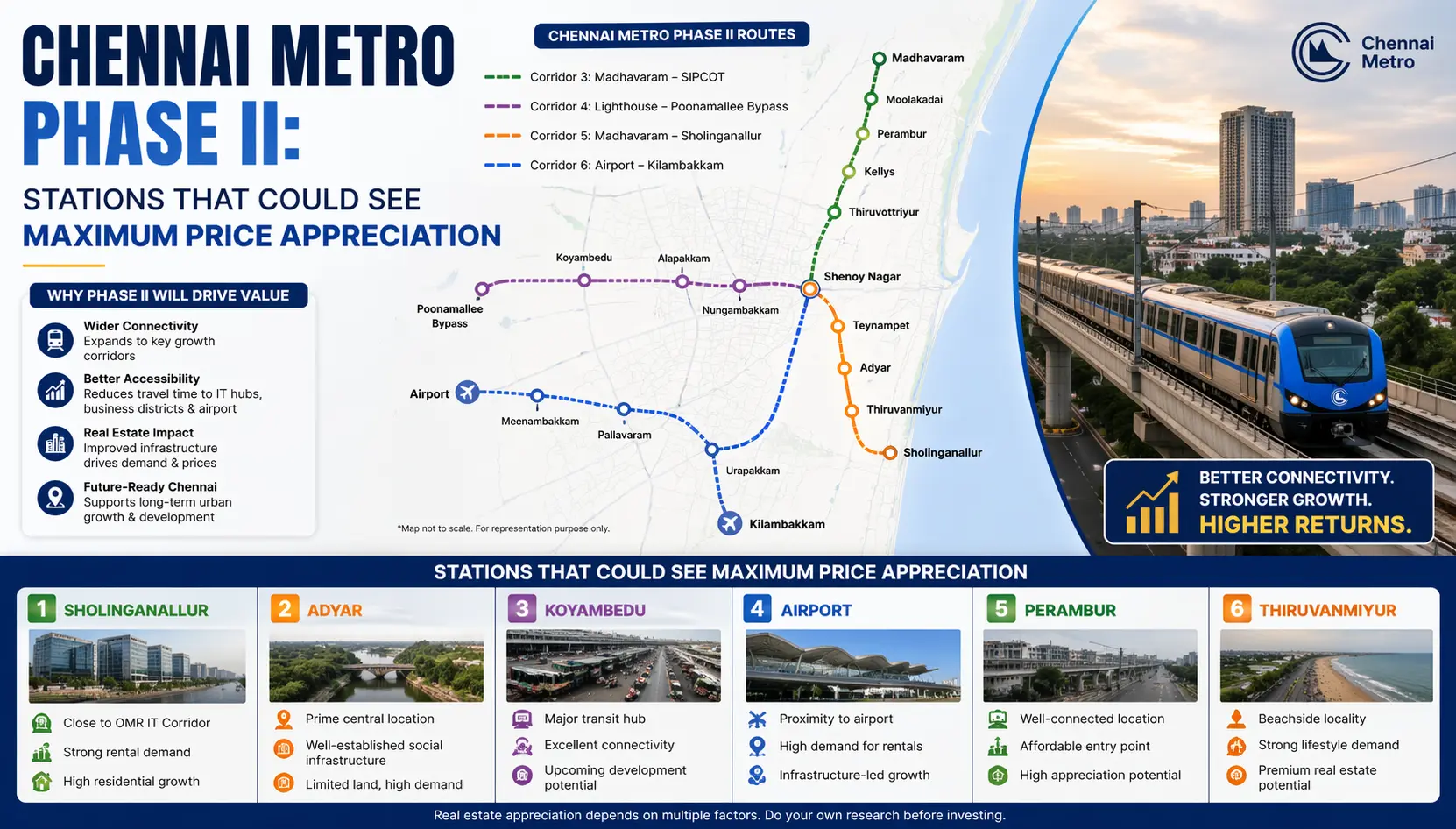
Chennai Metro Phase II is a large-scale urban transit expansion adding ~118 km of metro lines and 100+ stations across North, Central, West, and South Chennai. The project fundamentally alters accessibility patterns, which historically leads to land value uplift, rental growth, and redevelopment activity around stations.
Price appreciation is driven primarily by:
- Reduction in travel time
- Direct metro access to employment hubs
- Increased residential and commercial density
- Transit-oriented development (TOD)
Corridor-wise Impact on Property Prices
Corridor 5: Madhavaram – Sholinganallur
This corridor links North Chennai directly with the OMR IT corridor, making it one of the strongest appreciation drivers.
Sholinganallur
- Major IT employment hub
- High existing rental demand
- Metro reduces dependence on road-based commuting
Impact: Sustained price growth due to end-user and investor demand
Perambur
- Already a multi-modal transport zone (rail + road)
- Metro adds faster access to central and south Chennai
Chennai Metro Rail Limited Phase II Price Appreciation Insights: Appreciation from improved livability and rental demand
Madhavaram
- Historically under-priced compared to city average
- Becomes a major interchange node
Impact: Long-term capital appreciation from infrastructure-led transformation
Corridor 4: Lighthouse – Poonamallee Bypass
This corridor improves east-west connectivity and unlocks western suburban growth.
Koyambedu
- Existing transport hub (bus terminus)
- Metro strengthens commercial and residential density
Impact: Stable appreciation driven by constant demand
Poonamallee
- Peripheral area with lower historical land prices
- Metro significantly shortens commute to city core
Impact: Higher percentage appreciation due to low base values
Residentail Property For Sale in Poonamallee
Corridor 3: Madhavaram – SIPCOT
This corridor connects industrial, residential, and employment zones.
Adyar
- Premium, supply-constrained residential market
- Metro improves accessibility without changing neighborhood density
Impact: Price appreciation through scarcity and improved connectivity
Thiruvanmiyur
- Coastal residential area near OMR
- Strong lifestyle and rental appeal
Impact: Premium value growth rather than volume growth
Residentail Property For Sale in Madhavaram
Why These Stations See Higher Appreciation
Employment Connectivity
- Direct access to IT corridors, industrial zones, and business districts increases housing demand.
Rental Yield Expansion
- Metro proximity attracts working professionals, increasing rental absorption and resale value.
Transit-Oriented Development (TOD)
- Higher Floor Space Index (FSI) and mixed-use zoning near stations raise land efficiency and prices.
Reduced Travel Risk
- Predictable commute times increase buyer willingness to pay a premium.
Early-Stage Pricing Effect
- Areas with lower current prices experience sharper appreciation once metro operations begin.
Appreciation Pattern (Observed Trend)
- Within 500 m of a station: Highest price uplift
- 500 m – 1 km: Moderate but steady appreciation
- Beyond 1 km: Indirect impact, dependent on road access and amenities
The strongest gains typically occur between late construction and 2–3 years after operations begin.
Conclusion
Chennai Metro Phase II reshapes the city’s real estate geography. Stations along OMR-linked corridors, western suburban extensions, and major interchange nodes are positioned for the highest price appreciation due to improved accessibility, demand concentration, and infrastructure-led urban growth.