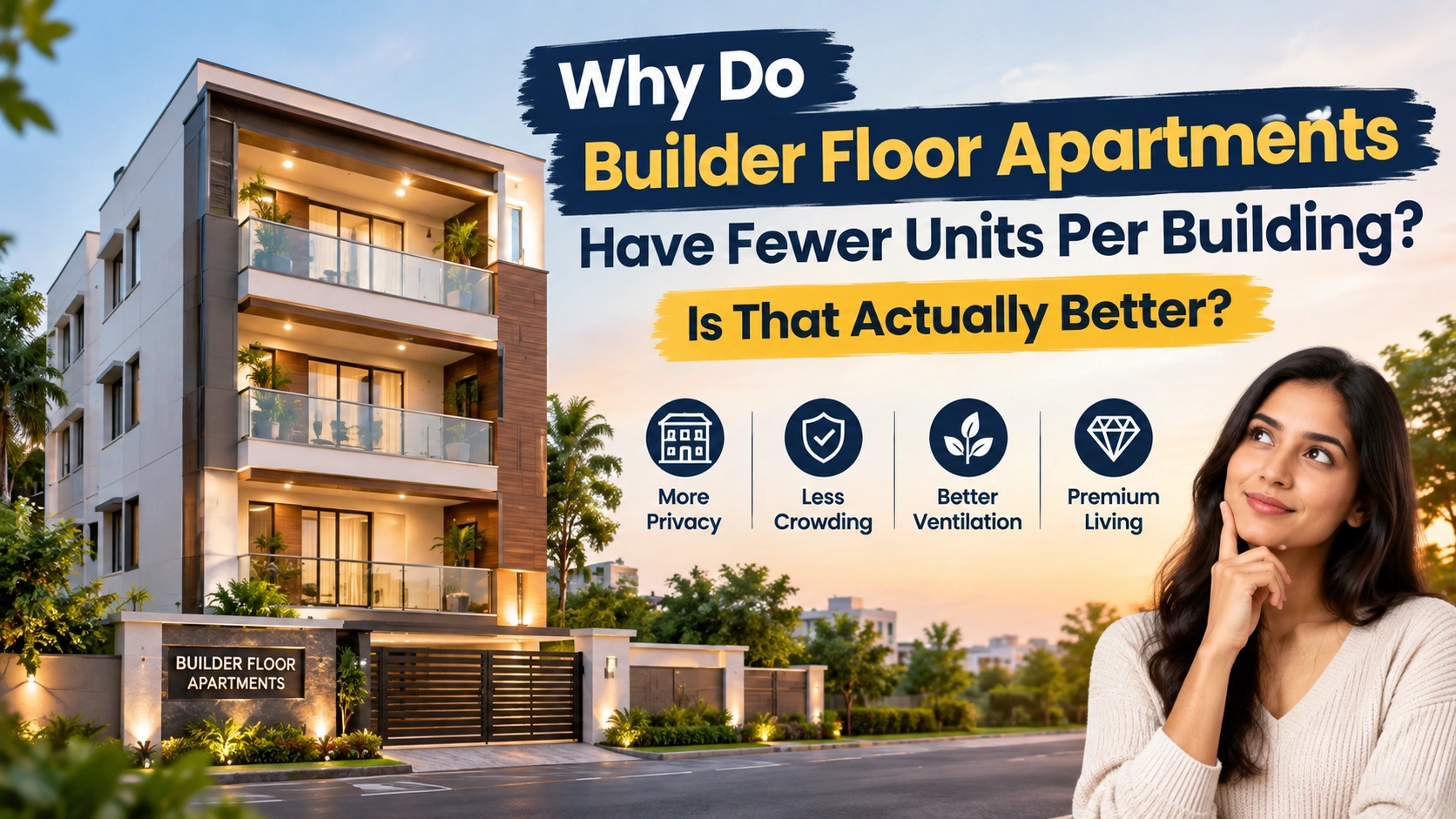
When people search for a builder floor apartment in Chennai, one feature immediately stands out: these buildings usually have far fewer homes than large apartment complexes. A typical builder-floor development may have only a small number of residential units distributed across a few floors, while a large apartment project can contain hundreds of homes. Fewer units can mean greater privacy, lower-density living, less movement in common areas, and potentially more spacious floor plans. At the same time, a smaller building may have fewer amenities, less formal maintenance infrastructure, and fewer residents sharing common expenses.
What Is a Builder Floor Apartment?
A builder floor apartment is generally a residential unit within a low-rise building where a limited number of homes share the structure.
For example, a project may have:
- Ground floor – 1 or 2 homes
- First floor – 1 or 2 homes
- Second floor – 1 or 2 homes
- Third floor – 1 or 2 homes
The exact number of units depends on the plot, approved building plan, development regulations, and project design. This is different from a large apartment community where multiple towers may contain hundreds of residential units. Tamil Nadu's building regulations distinguish different categories of residential development based on parameters such as height, number of dwelling units, road width, setbacks, and FSI. For certain non-high-rise developments, the regulations specifically provide parameters for small developments with up to 16 dwelling units.
Why Do Builder Floor Apartments Have Fewer Units?
There are several reasons.
1. The Building Is Designed for Low-Density Living
Builder floors are generally designed as smaller residential developments rather than large communities. The objective is often to provide individual homes within a compact building while retaining some characteristics of independent-house living.
Instead of having:
100+ families → multiple towers → large common areas
A builder-floor project may have:
4–8 families → one smaller building → limited common areas
The exact number can vary considerably. This creates a fundamentally different residential experience.
2. Plot Size Limits the Number of Homes
One of the biggest reasons for fewer units is the size and configuration of the land. A builder-floor project is often developed on a relatively small residential plot.
The developer has to work within requirements relating to:
- Setbacks
- Building height
- FSI
- Road width
- Parking
- Access
- Open spaces
- Staircases
- Lift requirements where applicable
- Building safety
- Planning permissions
Tamil Nadu's development rules specify planning parameters for non-high-rise buildings, including road width, height, setbacks, FSI, and maximum dwelling units for certain categories of small developments. Therefore, a developer cannot simply keep adding apartments to a building because demand exists.
3. Larger Homes Can Be Created With Fewer Units
Another reason is the demand for larger residential layouts. Suppose a building has six homes. The developer may be able to design each home as a relatively spacious 2 BHK or 3 BHK, depending on the plot and permissible development. If the same building were divided into many smaller units, the average home size could reduce.
This is one reason builder floors can appeal to buyers who prioritize:
- Larger bedrooms
- Spacious living rooms
- Bigger kitchens
- Utility areas
- Balconies
- Home-office space
- Storage
- Larger dining areas
However, fewer units do not automatically guarantee a larger home. The actual floor plan and approved built-up area must always be checked.
4. Fewer Units Create More Privacy
Privacy is one of the biggest reasons buyers consider builder floor apartments.
Imagine two buildings:
Building A
- 100+ apartments
- Multiple units on each floor
- Heavy movement in common areas
- Large resident population
Building B
- 4–8 apartments
- Limited residents
- Less movement
- Smaller common areas
The second arrangement naturally creates a lower-density environment.
Residents may experience:
- Less foot traffic
- Fewer people using common spaces
- Less crowding near entrances
- Greater privacy
- A quieter atmosphere
This is particularly attractive to families who prefer a residential environment with fewer neighbors.
5. Less Crowding in Common Areas
In a large apartment community, common areas may experience considerable daily movement.
Residents may share:
- Lifts
- Corridors
- Parking areas
- Clubhouses
- Play areas
- Security gates
- Swimming pools
- Walking spaces
In a smaller builder-floor building, the number of people using these spaces is significantly lower. This can make daily movement feel more convenient. For example, if only a few families use one staircase or lift, the amount of daily traffic can be considerably lower than in a large residential tower.
6. Builder Floors Can Offer an Independent-House Feel
This is one of the biggest differences between a builder floor and a conventional apartment.
An independent house provides:
Privacy + land ownership + fewer neighbors + greater control
A high-rise apartment provides:
Apartment ownership + amenities + community living + managed common facilities
A builder floor sits somewhere between the two.
It can provide:
Apartment ownership + low-density living + fewer neighbors + a larger individual home
This makes builder floors attractive to people who like the idea of an independent house but do not want to purchase an entire plot and construct a house themselves.
7. Better Natural Light and Ventilation Can Be Possible
A low-density building can sometimes allow better planning for:
- Windows
- Balconies
- Open spaces
- Cross ventilation
- Natural light
However, this is an important distinction: Fewer units do not automatically mean better ventilation. Ventilation depends on the actual building design, orientation, setbacks, window placement, and surrounding structures. Tamil Nadu's development regulations require adequate natural ventilation and lighting for applicable building spaces. Therefore, buyers should physically inspect the property rather than assuming that every builder floor has excellent ventilation.
8. Fewer Residents Can Mean Lower Common-Area Usage
A smaller building usually has fewer residents using it.
- Staircases
- Lift
- Parking
- Water systems
- Common lighting
- Terrace areas
- Security facilities
This can reduce the intensity of common-area usage. But this does not necessarily mean maintenance will always be cheaper. A lift, generator, security service, or water pump still has to be maintained regardless of whether four families or ten families live in the building. The cost is simply divided among the residents according to the project's maintenance arrangement.
9. Maintenance Can Be Simpler
Large apartment communities can have extensive shared facilities.
For example:
- Swimming pool
- Clubhouse
- Gym
- Children's play area
- Multiple lifts
- Large landscaped areas
- Security teams
- Internal roads
- Community halls
These facilities require ongoing maintenance.
A builder floor may focus more on essential facilities such as
- Lift
- Parking
- Water supply
- CCTV
- Security
- Power backup
- Common lighting
- Staircase
- Terrace
With fewer amenities, there may be fewer maintenance responsibilities. However, buyers should compare the actual monthly maintenance amount rather than assuming that a builder floor will always be cheaper.
10. Parking Can Be Easier to Manage
Parking is one of the most important considerations when buying a home in Chennai. A smaller development can have fewer vehicles compared with a large apartment community. This can make parking movement and access simpler. However, buyers should never assume that parking is automatically sufficient.
Before purchasing, confirm:
- Number of car parks
- Two-wheeler parking
- Visitor parking
- Parking allocation
- Whether parking is covered
- Parking dimensions
- Ease of vehicle entry and exit
Tamil Nadu's building rules contain specific parking requirements for residential developments, based on factors including dwelling-unit size.
11. Fewer Units Can Improve the Sense of Ownership
When there are only a few families in a building, residents may have greater visibility over common-property decisions.
For example, residents may collectively discuss:
- Lift maintenance
- Water systems
- Painting
- CCTV
- Security
- Terrace usage
- Common electricity
- Repairs
In a very large apartment community, such decisions may involve a much larger residents' association. A small building can therefore have a more direct and personal management structure.
12. But Fewer Units Also Have Disadvantages
This is where buyers need to look beyond the marketing benefits. Fewer units are not automatically better. There are situations where a large apartment community may be more suitable.
For example, large communities may offer:
- Better security infrastructure
- More amenities
- Professional facility management
- Larger open spaces
- Clubhouse facilities
- Swimming pools
- Gyms
- Children's play areas
- Multiple maintenance staff
- Stronger community interaction
Builder Floor vs Large Apartment: Key Difference
| Features | Builder Floor Apartment | Large Apartment |
| Number of Units | Usually fewer | Usually many |
| Privacy | Often higher | Depends on design |
| Density | Lower | Higher |
| Amenities | Usually limited | Often extensive |
| Common areas | Smaller | Larger |
| Community size | Small | Large |
| Maintenance structure | Smaller-scale | More organized in many projects |
| Floor plans | Can be spacious | Varies |
| Security | Project dependent | Often structured |
| Lifestyle | Quieter, private | Community-oriented |
| Parking | Project dependent | Usually planned at the project level |
| Best suited for | Privacy-focused buyers | Amenities/community-focused buyers |
Is a Builder Floor Better Than a Regular Apartment?
The better choice depends on the buyer.
Builder Floor May Suit You If You Want:
- More privacy
- Fewer neighbors
- Low-density living
- Spacious rooms
- Independent-floor lifestyle
- A quieter environment
- Limited common facilities
- Residential neighborhood living
A Large Apartment May Suit You If You Want:
- Clubhouse
- Swimming pool
- Gym
- Children's play area
- Large landscaped spaces
- Professional security
- Community activities
- Multiple shared facilities
The important point is that property quality matters more than simply the number of units.
Does Fewer Units Mean Higher Land Share?
Land share, or undivided share of land (UDS), depends on the legal structure of the property and how the land is divided among the owners. In a simple example, if the same land parcel is divided among fewer dwelling units, each unit may potentially have a larger land share. But the actual UDS must be checked in the sale deed and relevant property documents. Do not assume higher UDS merely because the building has fewer homes.
Why UDS Matters in a Builder Floor Apartment
UDS represents the buyer's undivided interest in the underlying land.
For example:
A project has:
- Land area: 4,800 sq. ft.
- Total residential units: 4
If the land is divided equally, the theoretical share could be 1,200 sq. ft. per unit. But real projects may have different allocations based on the sale agreement, built-up area, and legal structure. Therefore, the buyer should check the actual registered documents.
UDS can become particularly important when considering:
- Long-term ownership
- Redevelopment
- Resale
- Land value
- Future reconstruction
Does a Smaller Building Mean Lower Electricity Costs?
Not necessarily. Electricity consumption primarily depends on the individual household.
Your monthly electricity bill will depend on appliances such as
- Air conditioners
- Water heaters
- Refrigerators
- Washing machines
- Lighting
- Fans
- Kitchen appliances
A low-rise home may benefit from better natural ventilation or daylight depending on design, but this should not be treated as a guaranteed reduction in electricity costs.
Does Fewer Units Mean Less Noise?
It can, but not always.
A smaller building generally has fewer residents, which can reduce:
- Corridor traffic
- Lift usage
- Common-area activity
- Parking movement
But noise can still come from:
- Neighboring houses
- Main roads
- Commercial establishments
- Construction sites
- Traffic
- Individual occupants
Therefore, inspect the property at different times of the day before purchasing.
What About Security?
Security depends on the project's design and management.
A large apartment may have:
- Security guards
- CCTV
- Controlled entry
- Visitor management
- Security gates
- Intercom systems
A builder floor may have fewer security systems.
Therefore, if security is a major priority, check:
- CCTV coverage
- Main gate
- Intercom
- Security personnel
- Door access
- Lighting
- Parking surveillance
What About Amenities?
This is one area where large apartment communities often have an advantage.
A large project may provide:
- Clubhouse
- Gym
- Swimming pool
- Children's play area
- Indoor games
- Landscaped gardens
- Walking tracks
- Community halls
A builder floor usually concentrates more on the home itself.
Why Are Builder Floors Becoming Relevant in Chennai?
Chennai has many established residential neighborhoods where buyers want newer homes but do not necessarily want a large gated community. Builder-floor development can fit this requirement. In established areas, redevelopment of older houses and plots can create smaller residential buildings offering modern homes within existing neighborhoods.
This is particularly relevant to buyers searching for:
Builder Floor Apartment in Chennai
- Builder Floor Apartments for Sale in Chennai
- 3 BHK Builder Floor Apartment
- 2 BHK Builder Floor Apartment
- Ready-to-Move Builder Floor Apartment
- Flats for Sale in Chennai
The attraction is often the combination of location, privacy, space, and relatively low-density living.
Why Builder Floors Can Work Well in Established Chennai Locations
A major advantage is that buyers may be able to live in an established neighborhood rather than moving far away from the city.
Depending on the locality, residents may already have access to:
- Schools
- Hospitals
- Supermarkets
- Restaurants
- Banks
- Public transportation
- Metro stations
- Employment hubs
- Main roads
The buyer therefore gets a newly constructed home without necessarily sacrificing the convenience of an established locality.
10 Reasons Buyers Consider Fewer Units a Benefit
- Greater privacy
- Lower residential density
- Less common-area traffic
- Potentially larger floor plans
- Quieter living environment
- Fewer neighbors
- More direct resident interaction
- Smaller-scale maintenance
- Independent-floor living experience
- Closer feel to an independent house
Conclusion
The idea behind a builder floor apartment is simple: fewer homes, lower density, and a more individualized residential experience. For many Chennai homebuyers, that can mean more privacy, less crowding, and a closer connection to the independent-house style of living.
Frequently Asked Questions
1. Why do builder floor apartments have fewer units?
Builder floor apartments are generally designed as low-rise, smaller residential developments. Plot size, planning regulations, FSI, setbacks, building height, parking, and approved dwelling-unit limits influence how many homes can be constructed.
2. How many units are usually there in a builder floor building?
There is no universal number. A project may contain only a few homes, but the actual number depends on the plot, approved plan, and applicable development regulations.
3. Are fewer units better in a builder floor apartment?
Fewer units can provide more privacy and lower-density living, but they do not automatically mean better construction, higher UDS, lower maintenance, or better investment performance.
4. Do fewer units mean more privacy?
Generally, fewer residents can mean less movement in shared spaces and greater privacy. However, privacy also depends on the building layout, neighboring properties, and road conditions.
5. Do builder floors have better ventilation?
They can have good ventilation if the building is properly designed with suitable windows, setbacks, and orientation. Buyers should inspect the actual property rather than assuming that every builder floor has superior ventilation.
6. Is UDS higher in builder floor apartments?
It can be, but it is not guaranteed. UDS depends on the property's legal structure and allocation. Buyers should verify the exact UDS in the registered documents.
7. Are builder floors cheaper than large apartments?
Not necessarily. Price depends on location, land value, construction quality, size, amenities, UDS, parking, and demand. A builder floor in a premium Chennai locality can be more expensive than an apartment in another location.
8. Do builder floors have fewer amenities?
Many builder-floor projects have fewer shared amenities than large gated communities. However, some developments can still provide facilities such as lifts, CCTV, power backup, covered parking, and security.
9. Are builder floors suitable for families?
Yes. They can be suitable for families looking for privacy, spacious layouts, and a lower-density residential environment.
10. Are builder floors suitable for senior citizens?
They can be, particularly in low-rise buildings with a reliable lift, convenient parking, and good accessibility. Buyers should check these facilities before purchase.