Stamp duty is one of the most important legal requirements when purchasing any type of property in Chennai. It is a statutory tax collected by the Government of Tamil Nadu on documents that record the transfer of ownership of immovable property. Paying stamp duty and registration charges is compulsory to make the transaction legally valid, enforceable, and recognized by law. Even if the buyer has paid the full sale amount to the seller, ownership does not legally transfer until stamp duty is paid and the sale deed is registered with the government authorities.
Legal Basis of Stamp Duty
Stamp duty in Chennai is governed by:
- The Indian Stamp Act as adapted by Tamil Nadu
- The Registration Act
Under these laws, every property transaction document must be properly stamped and registered. A document that is not adequately stamped is treated as invalid in law and cannot be produced as evidence in any legal proceeding. Stamp duty acts as proof that the government has approved and recorded the transaction.
What Exactly Happens When You Buy a Property
When a property is sold, a legal document known as a sale deed or conveyance deed is executed between the buyer and the seller. This document records:
- Details of buyer and seller
- Description of the property
- Sale consideration
- Mode of payment
- Transfer of ownership rights
Stamp duty is paid on this document to authenticate it. After stamp duty payment, the document is registered, which officially records the transaction in government records.
Stamp Duty Rate in Chennai
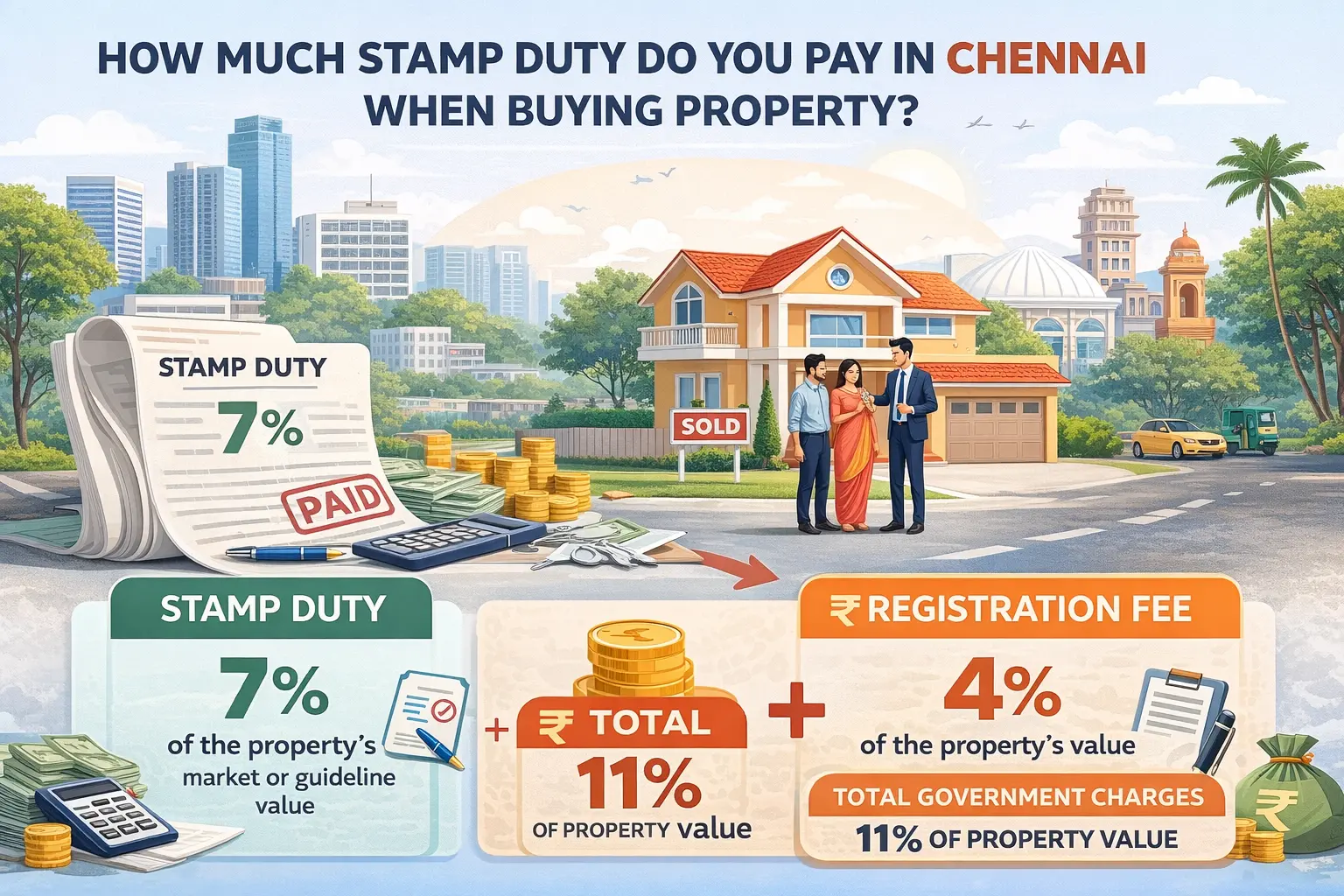
For most property purchases in Chennai, the stamp duty rate is 7 percent of the property value. In addition to stamp duty, registration charges of 4 percent are payable.
This means that a buyer pays a total of 11 percent of the property value as government charges at the time of registration.
These rates apply uniformly across Chennai and are applicable to:
- Residential apartments
- Independent houses
- Villas
- Vacant land or plots
- Commercial buildings
- Resale and second-hand properties
How the Property Value Is Determined for Stamp Duty
Stamp duty is not always calculated on the negotiated sale price. Instead, it is calculated on whichever value is higher between
- The sale consideration mentioned in the sale deed
- The government guideline value fixed for that location
The guideline value is the minimum value set by the government for property transactions in a specific area. It reflects the average market value of properties in that locality. If a property is sold below the guideline value, stamp duty will still be calculated on the higher guideline value, not the lower sale price.
This system exists to:
- Prevent undervaluation of properties
- Reduce black money transactions
- Ensure fair tax collection
Detailed Explanation Using a Practical Scenario
If a buyer purchases a residential property in Chennai for fifty lakh rupees, and the government guideline value for that property is also fifty lakh rupees, stamp duty is charged at seven percent and registration charges at four percent on fifty lakh rupees. If the guideline value is sixty lakh rupees but the sale price is fifty lakh rupees, stamp duty will be calculated on sixty lakh rupees, not on fifty lakh rupees. The buyer must pay charges based on the higher value.
Responsibility for Paying Stamp Duty
By law and common practice, the buyer is responsible for paying stamp duty and registration charges. The seller is not legally obligated to pay these charges unless specifically agreed otherwise in the sale agreement. Stamp duty must be paid before or at the time of registration of the sale deed.
Payment and Registration Process Explained in Detail
Stamp duty and registration charges are paid through government-approved electronic payment systems. After payment, proof of payment is generated.
On the date of registration:
- The buyer and seller appear before the sub-registrar.
- Identity documents are verified
- The sale deed is reviewed
- Biometric and photographic records are captured
- Registration is completed
Once registered, the document becomes part of permanent government land records.
Importance of Registration After Stamp Duty
Stamp duty alone does not transfer ownership. Registration is mandatory. Without registration:
- The buyer has no legal ownership rights
- The document is not enforceable
- Property cannot be legally sold, mortgaged, or gifted
Only a stamped and registered document grants lawful ownership.
Consequences of Non-Payment or Underpayment
If stamp duty is not paid or is underpaid:
- The document may be rejected
- Authorities can impound the document
- Penalties and interest may be imposed
- Legal disputes may arise
- Property ownership can be challenged
In severe cases, the document may be declared invalid.
Stamp Duty on Different Types of Documents
Stamp duty is applicable not only to sale deeds but also to:
- Gift deeds
- Exchange deeds
- Mortgage deeds
- Settlement deeds
- Lease deeds
Each type of document has its own rate structure under Tamil Nadu law, but sale deeds attract the standard 7 percent stamp duty.
Time Limit for Registration
Property documents must be presented for registration within the legally prescribed time after execution. Delayed registration can result in fines, procedural complications, or rejection of the document. Unregistered property documents do not convey ownership, regardless of payment made.
Frequently Asked Questions (FAQs)
Is stamp duty compulsory for every property transaction in Chennai?
Yes. Every transfer of property ownership requires payment of stamp duty and registration charges.
Does stamp duty apply to resale properties?
Yes. There is no difference between new and resale properties. Stamp duty applies equally to both.
Is stamp duty calculated on carpet area or built-up area?
Stamp duty is calculated on the overall property value, not on area measurements.
Are stamp duty rates different for men and women buyers?
No. Tamil Nadu follows a uniform stamp duty structure for all buyers.
Can stamp duty be avoided by making a private agreement?
No. Private agreements without stamp duty and registration have no legal validity.
Is stamp duty required if the property is inherited?
Stamp duty rules differ for inheritance and settlement documents, but ownership transfer still requires legal documentation.
Can stamp duty be refunded?
Stamp duty refunds are allowed only in limited circumstances, such as cancellation of the transaction, and must follow strict legal procedures.
Is stamp duty applicable to land purchases?
Yes. Stamp duty applies to vacant land, agricultural land, and residential plots in Chennai.
Is stamp duty required for joint ownership?
Yes. Stamp duty is charged on the total property value, regardless of the number of owners.