Choosing the right tiles for your home or commercial space is one of the most important decisions during construction or renovation. Among the many options available, ceramic tiles and vitrified tiles are the most widely used. While they may look similar at first glance, they are very different in terms of material, durability, water resistance, cost, and application.
What Are Ceramic Tiles?
Ceramic tiles are one of the oldest and most commonly used tile types. They are manufactured using natural clay, sand, and water, which are shaped into tiles and fired in a kiln at relatively lower temperatures. After firing, the surface is coated with a glaze, which gives the tile its color, pattern, and finish.
Key Features of Ceramic Tiles
- Made from natural clay
- Fired at lower temperatures
- Porous in nature
- Glazed surface for design and shine
- Lightweight and easy to handle
Common Uses of Ceramic Tiles
Ceramic tiles are best suited for:
- Bathroom walls
- Kitchen walls
- Bedroom walls
- Low-traffic floors
- Decorative areas
Because of their affordability and ease of installation, ceramic tiles are a popular choice for wall applications.
What Are Vitrified Tiles?
Vitrified tiles are a more advanced and durable type of tile. They are made from a mixture of refined clay, silica, quartz, and feldspar. These materials are fired at very high temperatures, causing the tile to vitrify (turn glass-like), making it extremely dense and non-porous.
Key Features of Vitrified Tiles
- Very low water absorption
- Extremely strong and durable
- Scratch and stain resistant
- Uniform body (in many types)
- Premium appearance
Common Uses of Vitrified Tiles
Vitrified tiles are ideal for:
- Living rooms
- Bedrooms
- Offices
- Shopping malls
- Commercial buildings
- High-traffic areas
Also Read: Legal Checklist Before Buying a Flat in Chennai
Ceramic Tiles vs Vitrified Tiles: Detailed Comparison
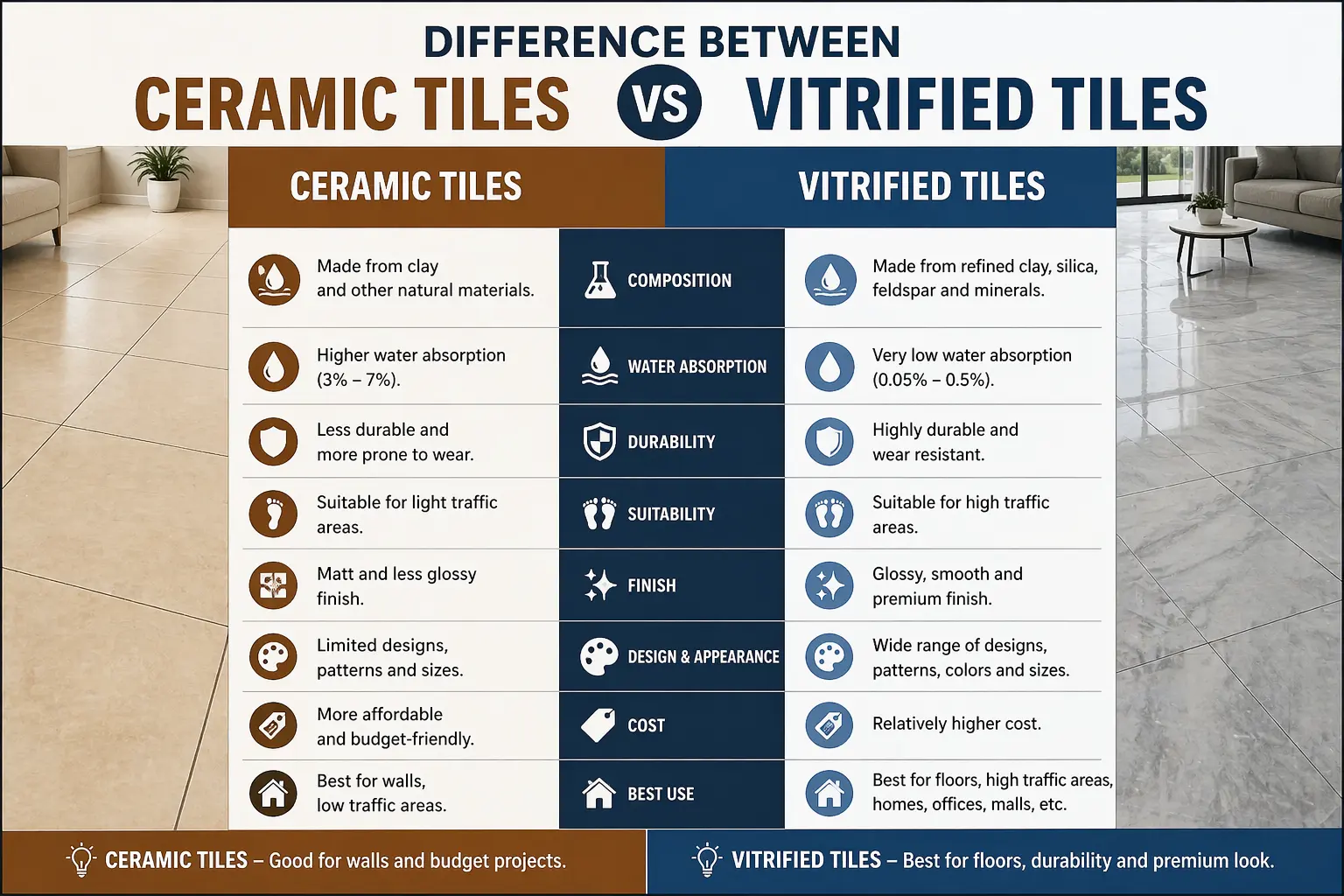
Choosing between ceramic tiles and vitrified tiles is one of the most common dilemmas faced by homeowners and builders. While both are widely used in residential and commercial spaces, they differ significantly in material composition, performance, durability, maintenance, and cost. Understanding these differences helps you select the right tile for the right application.
1. Raw Material & Manufacturing Process
- Ceramic Tiles are manufactured using natural clay, sand, and water. They are fired at relatively lower temperatures. A glaze coating is applied on the surface to add color, texture, and basic water resistance.
- Vitrified Tiles are made using refined clay mixed with silica, quartz, and feldspar. These materials are fired at very high temperatures, resulting in a vitrified (glass-like) structure that is dense and non-porous.
Result: Vitrified tiles are stronger and less porous than ceramic tiles.
2. Water Absorption
Water absorption is a key factor in determining tile durability.
- Ceramic Tiles: Absorb more water (3%–7%), making them unsuitable for high-moisture floors.
- Vitrified Tiles: Extremely low water absorption (0.05%–0.5%), making them almost waterproof.
Result: Vitrified tiles are ideal for flooring and humid areas.
3. Strength & Durability
- Ceramic Tiles: Moderately strong, suitable for walls and light foot traffic. They may crack or chip under heavy loads.
- Vitrified Tiles: Very hard and durable, capable of withstanding heavy foot traffic, furniture, and commercial use.
Result: Vitrified tiles offer superior durability.
4. Porosity & Stain Resistance
- Ceramic Tiles: Porous body; stains can penetrate if the glaze is damaged.
- Vitrified Tiles: Non-porous body; highly resistant to stains and spills.
Result: Vitrified tiles require less maintenance and cleaning.
5. Finish & Appearance
- Ceramic Tiles: Mostly matte or glazed finishes with decorative designs.
- Vitrified Tiles: Available in glossy, matte, polished, wood, stone, and marble finishes.
Result: Vitrified tiles offer a more premium and modern appearance.
6. Maintenance & Cleaning
- Ceramic Tiles: Need frequent cleaning; grout lines may discolor over time.
- Vitrified Tiles: Easy to clean; minimal maintenance; long-lasting shine.
Result: Vitrified tiles are more maintenance-friendly.
7. Installation & Handling
- Ceramic Tiles: Lightweight and easy to cut and install.
- Vitrified Tiles: Heavier, harder, and require skilled labor for installation.
Result: Ceramic tiles are easier and cheaper to install.
Types of Ceramic Tiles
- Glazed Ceramic Tiles – Smooth, shiny surface with decorative designs
- Unglazed Ceramic Tiles – Natural look with more grip
- Digital Ceramic Tiles – Modern printed designs for walls
Types of Vitrified Tiles
Understanding the types of vitrified tiles helps in selecting the right one:
Full Body Vitrified Tiles
- Same color and pattern throughout
- Extremely durable
- Ideal for commercial spaces
Double-Charged Vitrified Tiles
- Two layers pressed together
- Strong surface layer
- Popular for residential flooring
Glazed Vitrified Tiles (GVT)
- Digital designs on vitrified base
- Marble, wood, and stone finishes
Polished Vitrified Tiles
- High-gloss, mirror-like finish
- Luxurious appearance
Water Resistance and Moisture Behavior
- Ceramic tiles have higher water absorption, which makes them less suitable for wet floors. Over time, moisture can penetrate through grout lines.
- Vitrified tiles, on the other hand, are almost waterproof, making them perfect for humid environments and flooring applications.
Durability and Strength
- Ceramic tiles may crack under heavy furniture or high traffic.
- Vitrified tiles can withstand heavy loads, making them suitable for long-term use.
Maintenance and Cleaning
Ceramic Tiles
- Require frequent cleaning
- Grout stains easily
- The surface glaze may wear off
Vitrified Tiles
- Easy to clean
- Highly stain-resistant
- Retain shine for years
Advantages and Disadvantages
Ceramic Tiles – Pros
- Budget-friendly
- Easy to install
- Ideal for walls
- Good variety of designs
Ceramic Tiles – Cons
- Less durable
- Higher water absorption
- Not ideal for heavy traffic
Vitrified Tiles – Pros
- Highly durable
- Water-resistant
- Premium appearance
- Low maintenance
Vitrified Tiles – Cons
- Higher cost
- Glossy finish can be slippery
- Requires skilled installation
Frequently Asked Questions
1. Which tiles are better for flooring?
Vitrified tiles are better for flooring due to strength and durability.
2. Are ceramic tiles outdated?
No, ceramic tiles are still widely used for wall applications.
3. Are vitrified tiles waterproof?
Yes, they have extremely low water absorption.
4. Which tiles are best for bathrooms?
Ceramic tiles for walls and matte vitrified tiles for floors.
5. Which tiles last longer?
Vitrified tiles last significantly longer.