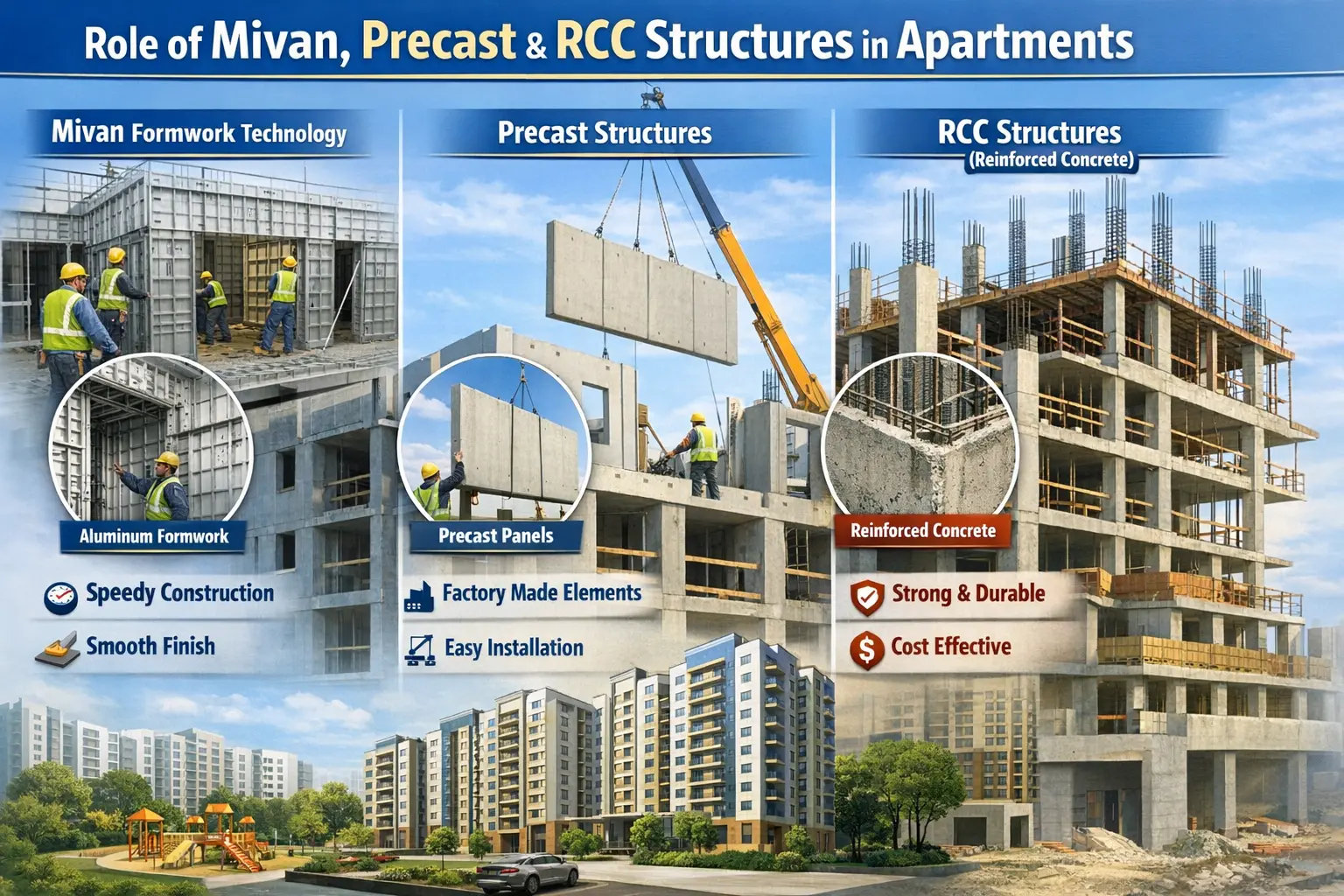
Modern apartment construction uses different structural systems depending on speed, cost, design flexibility, quality, and project scale. The three most commonly used systems are RCC (Reinforced Cement Concrete), Mivan (Aluminium Formwork), and Precast Concrete Structures.
1. INTRODUCTION
With rapid urbanization and shortage of land, multi-storey apartment buildings have become the dominant form of residential construction. The structural system selected for apartments directly affects:
- Structural safety
- Speed of construction
- Cost efficiency
- Quality and durability
- Seismic performance
- Long-term maintenance
The most commonly adopted systems in apartment construction are:
- RCC (Reinforced Cement Concrete) Structures
- Mivan (Aluminium Formwork Shear Wall Construction
- Precast Concrete Structures
Each system plays a specific role depending on project scale, design requirements, and construction timeline.
2. RCC STRUCTURES IN APARTMENTS
2.1 Definition of RCC
Reinforced Cement Concrete (RCC) is a composite structural system in which concrete resists compressive forces and steel reinforcement resists tensile forces.
2.2 Structural System of RCC Apartments
Typical RCC apartment buildings consist of:
- Foundation System
- Isolated footing
- Combined footing
- Raft foundation
- Pile foundation (for high-rise buildings)
- Superstructure
- Columns (vertical load-carrying members
- Beams (horizontal load-transferring members)
- Slabs (floor and roof elements)
- Staircases
- Lift cores
- Shear walls (in high-rise RCC buildings)
2.3 Load Transfer Mechanism in RCC Apartments
- Live loads & dead loads act on slabs
- Loads transfer from slabs → beams
- Beams transfer loads → columns
- Columns transfer loads → foundation
- Foundation transfers loads → soil
This is known as the beam-column load path system.
2.4 Construction Process
- Layout marking
- Shuttering using timber/steel
- Reinforcement fixing
- Concreting (slabs, beams, columns separately)
- Curing (7–28 days)
- De-shuttering
- Masonry infill walls
- Plastering & finishing
2.5 Role of RCC in Apartments
- Forms the primary load-bearing structure
- Suitable for custom architectural designs
- Used widely for low-rise to high-rise apartments
- Allows easy modifications during construction
- Works well with brick/block masonry walls
2.6 Advantages of RCC Apartments
- High structural strength
- Flexible planning & layout
- Low initial cost
- Easy availability of materials
- Simple repair and retrofitting
- Good fire resistance
2.7 Limitations of RCC Apartments
- Slow construction speed
- Heavy dependence on site labor quality
- High material wastage
- More plastering required
- Poor quality control compared to industrialized systems
2.8 Suitability
- Individual apartment buildings
- Medium-scale projects
- Irregular building shapes
- Projects where design changes are frequent
3. MIVAN STRUCTURES IN APARTMENTS
3.1 Definition of Mivan
Mivan is an aluminium formwork construction technology used to cast monolithic RCC structures, where walls, slabs, beams, and columns are poured together. Mivan is not a material, it is a construction method.
3.2 Structural Concept of Mivan Apartments
- Load-bearing RCC shear walls replace brick walls
- Columns and beams are minimized
- Walls and slabs are cast in one continuous operation
- Structure behaves as a single monolithic unit
3.3 Components of Mivan System
- Aluminium wall panels
- Aluminium slab panels
- Deck beams & props
- Pins and wedges
- RCC shear walls
- RCC slabs
- Staircase units
3.4 Load Transfer Mechanism
- Loads act on slabs
- Slabs transfer loads directly to shear walls
- Shear walls transfer loads to foundation
This eliminates beam-column dependency and increases lateral stiffness.
3.5 Construction Sequence
- Erection of aluminium formwork
- Reinforcement placement
- Electrical & plumbing conduits placed inside walls
- Single-stage concreting of walls and slabs
- De-shuttering within 12–24 hours
- Reuse of formwork for next floor
3.6 Role of Mivan in Apartments
- Enables mass housing
- Suitable for high-rise residential towers
- Improves earthquake resistance
- Ensures uniform quality
- Reduces overall project duration drastically
3.7 Advantages of Mivan Apartments
- Very fast construction (4–7 days per floor)
- Excellent surface finish (plaster often not required)
- Strong monolithic structure
- High seismic performance
- Reduced material wastage
- High durability and low maintenance
3.8 Limitations of Mivan Apartments
- Very high initial investment
- Design changes are difficult
- Future alterations (breaking walls) are risky
- Requires skilled supervision
- Economically viable only for repetitive designs
3.9 Suitability
- Large apartment complexes
- Affordable housing schemes
- Repetitive floor plans
- High seismic zones
4. PRECAST STRUCTURES IN APARTMENTS
4.1 Definition of Precast Construction
Precast construction involves casting structural components in a factory and assembling them at site using cranes.
4.2 Precast Components Used
- Precast columns
- Precast beams
- Precast wall panels
- Hollow-core slabs
- Solid slabs
- Precast staircases
- Balcony units
4.3 Structural System
- Frame system
- Wall-panel system
- Hybrid system (precast + RCC)
4.4 Load Transfer Mechanism
- Loads transfer through connected precast elements
- Joints are grouted or post-tensioned
- Structure behaves as a semi-monolithic system
4.5 Construction Process
- Casting in factory with controlled quality
- Curing & strength testing
- Transportation to site
- Erection using cranes
- Joint grouting & connections
- Structural integration
4.6 Role of Precast in Apartments
- Rapid construction of apartment floors
- Factory-controlled quality
- Reduced on-site congestion
- Ideal for urban environments
4.7 Advantages of Precast Apartments
- Very high quality control
- Fastest construction method
- Minimal labor on site
- Less dependency on weather
- Environmentally sustainable
- Cleaner construction sites
4.8 Limitations of Precast Apartments
- High transportation cost
- Crane dependency
- Complex joint detailing
- Requires skilled erection team
- Limited design flexibility
4.9 Suitability
- Large housing projects
- High-rise apartments
- Projects near precast plants
- Fast-track construction projects
5. COMPARATIVE ANALYSIS
| Parameter | RCC | Mivan | Precast |
| Construction Speed | Slow | Very Fast | Very Fast |
| Initial Cost | Low | High | High |
| Design Flexibity | High | Low | Medium |
| Quality Control | Medium | High | Very High |
| Seismic Resistance | Good | Excellent | Excellent |
| Labour Requuriment | High | MEDIUM | Low |
| Maintenance | Moderate | Low | Low |
6. ROLE IN MODERN APARTMENT DEVELOPMENT
RCC is traditional and flexible
- Mivan enables mass housing and vertical growth
- Precast supports industrialized construction
- Choice depends on:
- Project size
- Budget
- Construction time
- Location
- Seismic zone
7. CONCLUSION
- RCC is economical and adaptable
- Mivan is ideal for speed and uniformity
- Precast offers superior quality and sustainability
Modern apartments increasingly use hybrid systems combining RCC foundations with Mivan or Precast superstructures.
https://www.livehomes.in/blogs